Have you ever spent hours highlighting a textbook, only to realize during the exam that you focused on all the wrong things? It’s a gut-wrenching feeling. You put in the work, but the results didn't follow.
This usually happens because of a disconnect between what you actually know and what you think you know. It’s a blind spot. Today, identifying learning gaps with AI is changing the script. Instead of guessing what to study, students are using technology to pinpoint their weaknesses with surgical accuracy. It’s about studying smarter, not just longer.
In this guide, we’ll look at the tech making this possible and how you can use it to flip your academic performance on its head.
The Hidden Barrier: What Are Learning Gaps?
A learning gap is simply the space between what you were taught and what actually stuck. Think of your knowledge like a brick wall; if you miss a foundational concept in Algebra, you’ve got a hole in the bottom of that wall. When you try to stack Calculus on top of it, the whole thing starts to wobble.
The biggest hurdle to fixing these holes is the "illusion of competence."
When you re-read your notes, the words look familiar, and you think, "Yeah, I get this." But you don't actually know it; you just recognize it. Passive studying creates a false sense of security.
Unaddressed student knowledge gaps are more than a minor annoyance. They’re the primary reason students feel overwhelmed or eventually give up on subjects they are totally capable of mastering. When the "missing pieces" pile up, the mental load just becomes too heavy to carry.
The Mechanics of Detection: How AI Sees Your Weaknesses
How does a machine know what’s going on inside your head? It isn’t magic. It’s a mix of smart data and pattern recognition.
AI Performance Analysis
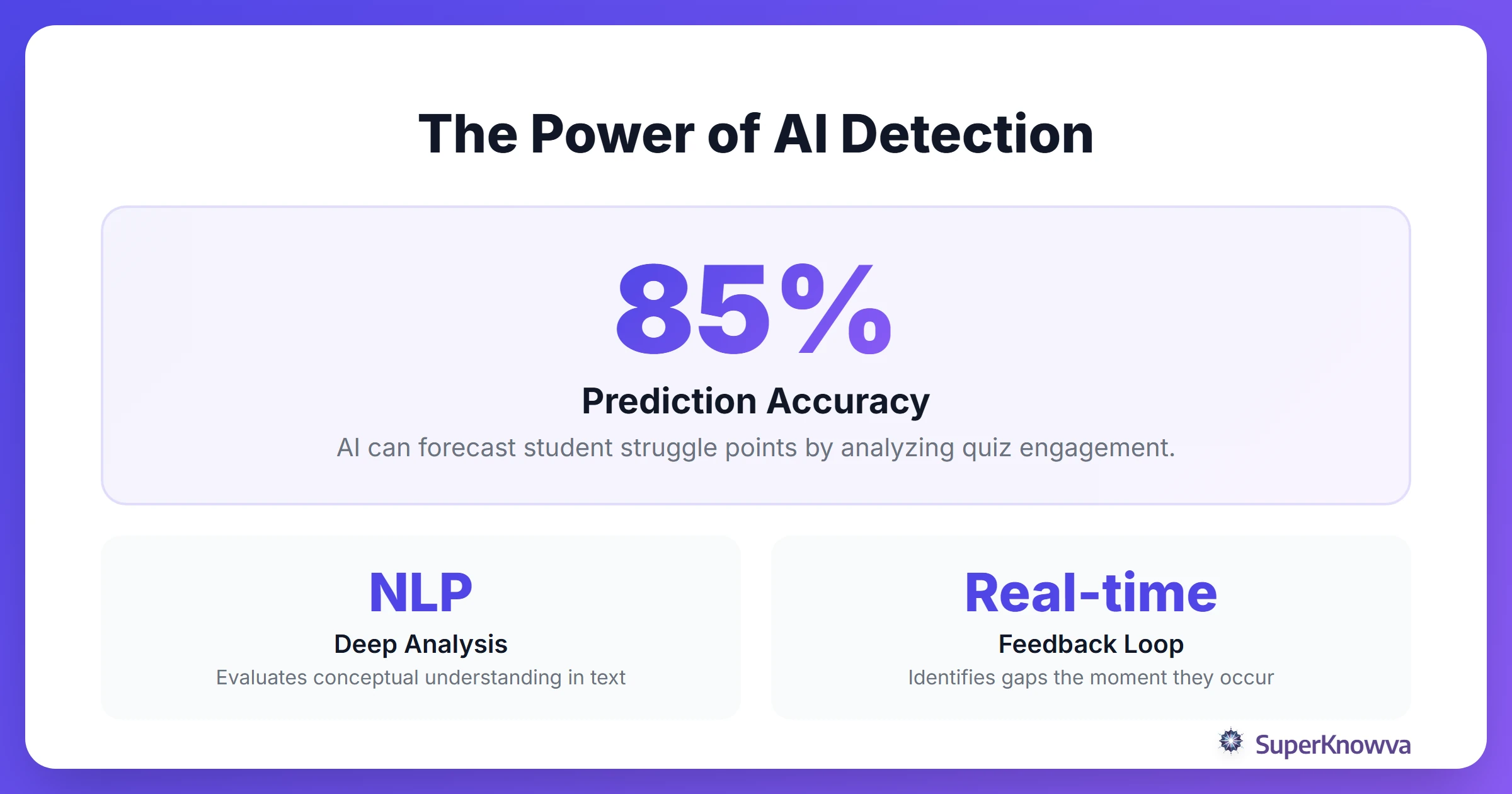
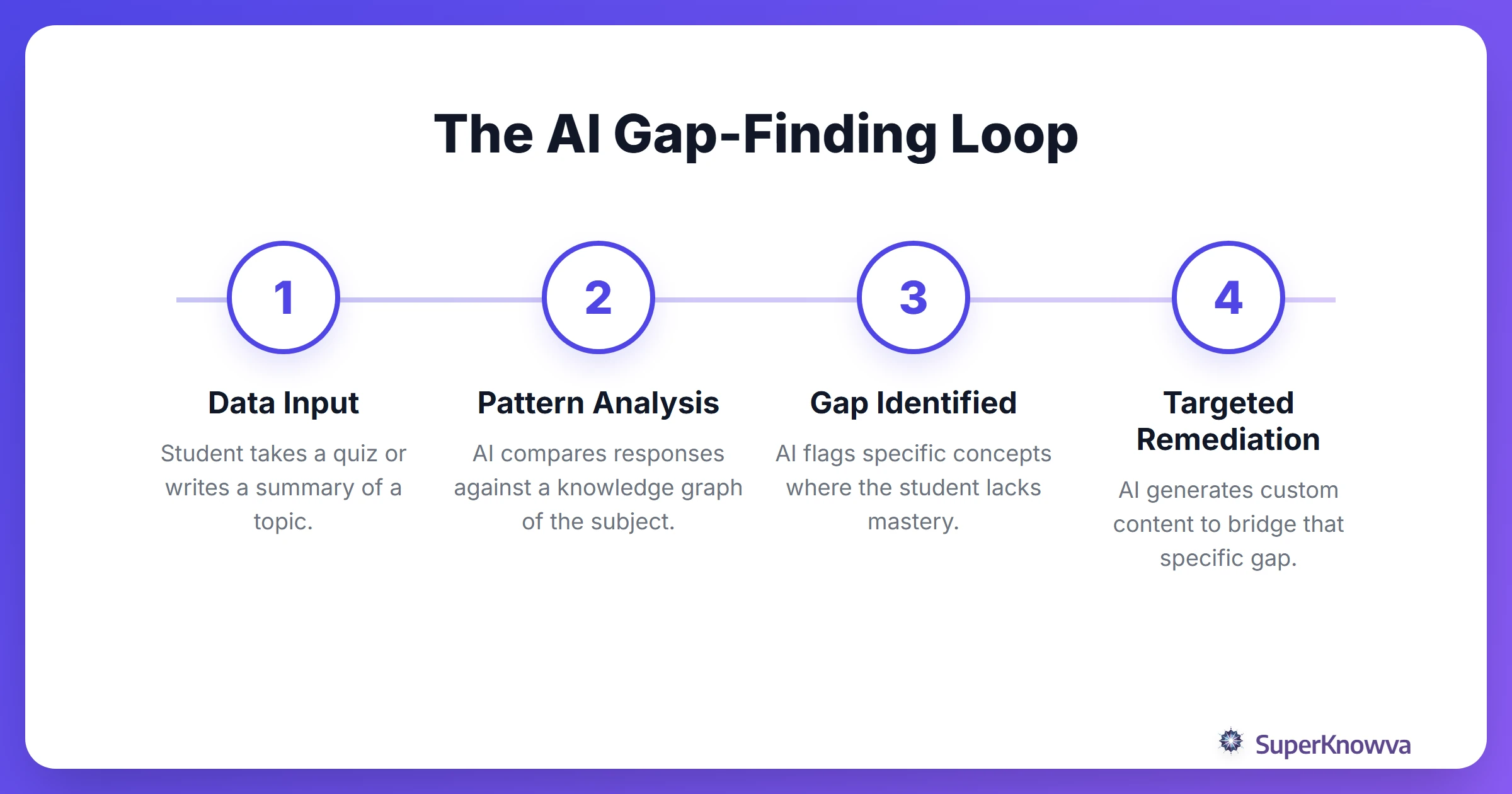
AI doesn't just look at whether you got an answer right or wrong; it looks at how you answered. Did you hesitate for thirty seconds on an organic chemistry question but breeze through biology? The AI notices that delay. It flags the specific sub-topic that caused the friction. Research shows that AI tools can predict student outcomes with 85% accuracy just by analyzing these subtle engagement patterns.
NLP in Education
Natural Language Processing (NLP) allows AI to read between the lines. It can analyze your practice essays or open-ended summaries to find conceptual misunderstandings. If you use a technical term slightly out of context, the NLP engine catches it. It recognizes that you might have memorized a definition without actually grasping the underlying concept.
Predictive Modeling: Forecasting Your Struggles
Traditional studying is reactive. You usually find out you don’t know something when you see a failing grade on a red-inked paper. AI shifts that timeline.
By tracking your academic history, AI identifies long-term trends in how you retain information. It looks at metadata, such as how long it’s been since you last reviewed a topic and your past accuracy rates, to predict where you’re likely to stumble next. This gives you the chance to fix a "weak" area a week before the exam, rather than an hour after it's over.
Adaptive Learning vs. Static Study Methods
Most curricula are a straight line. You start at Chapter 1 and end at Chapter 10, regardless of whether you already know half the material. AI-driven adaptive study plans throw that old model out the window.
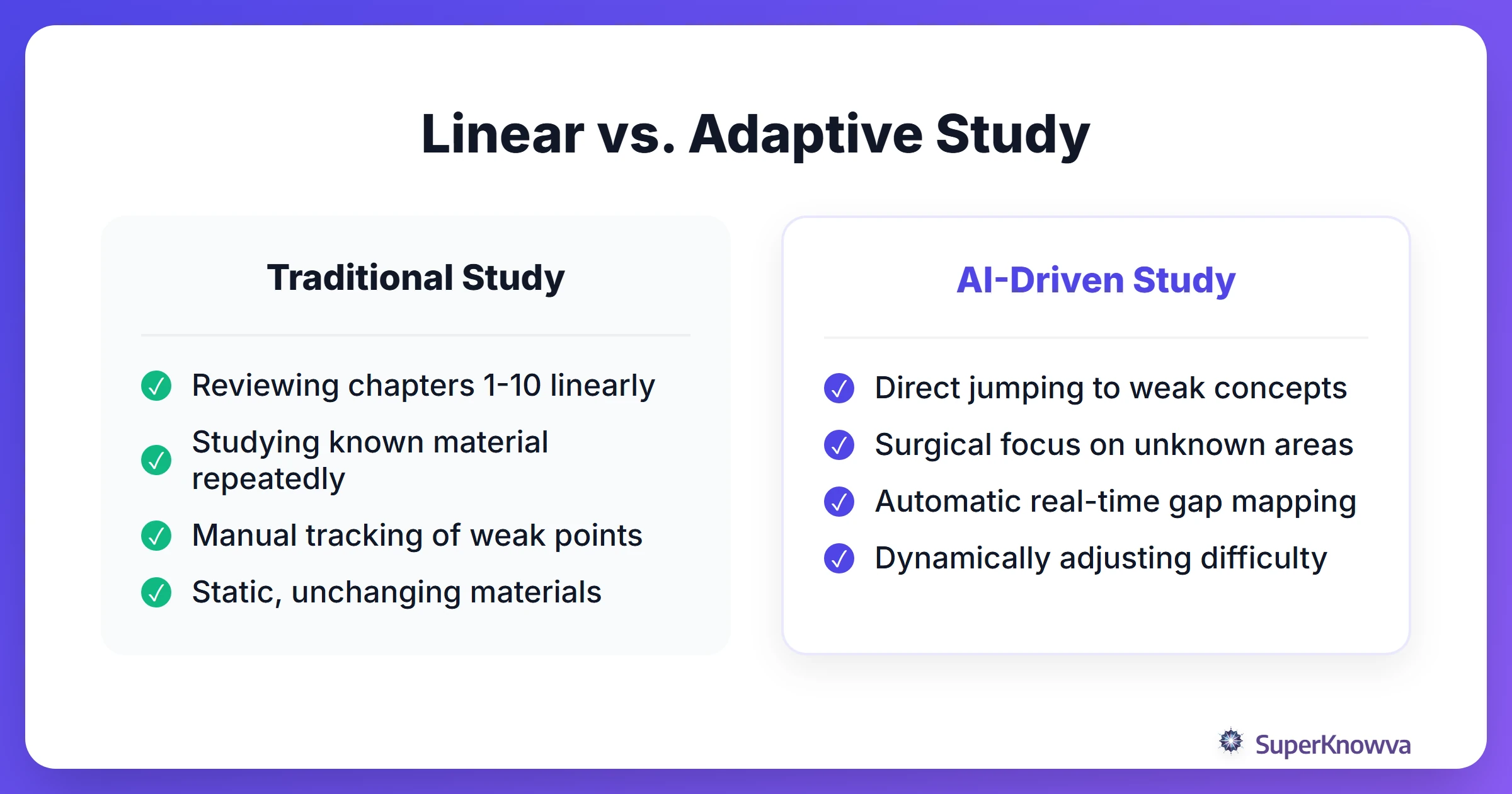
Instead of a one-size-fits-all approach, AI encourages "surgical" review. It’s the Pareto Principle in action: focusing on the 20% of the material you haven't mastered yet usually accounts for 80% of your grade improvement. While textbooks stay the same for everyone, the debate over AI Tutors vs. Human Tutors: Which is Best for Your Learning Style? shows just how much students value real-time, dynamic feedback that bridges gaps instantly.
Practical Tools for Gap Identification
You don’t need to be a tech genius to start using this. Here’s how to bring AI into your daily study routine:
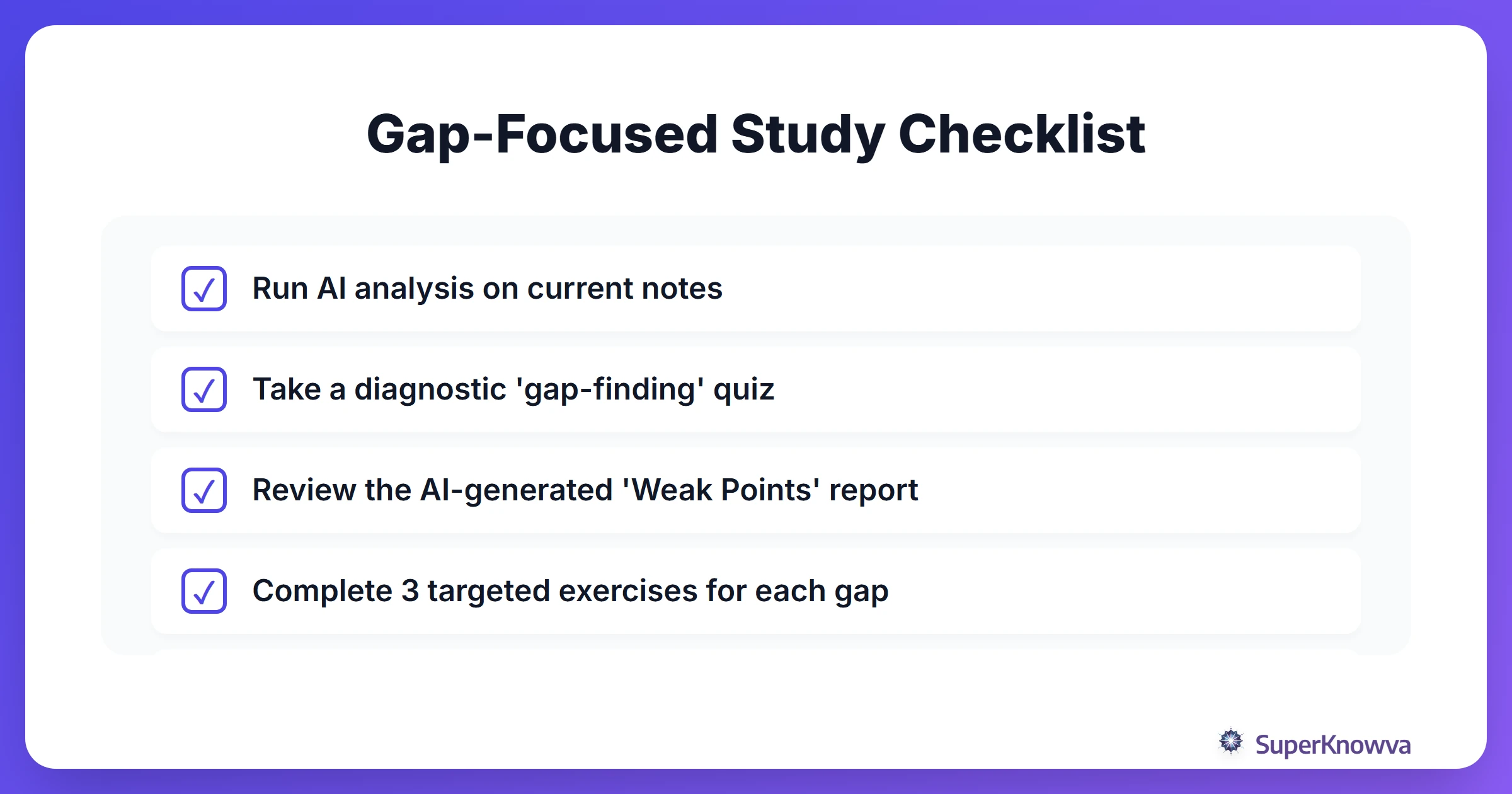
- AI-Powered Note-Taking: Use tools that scan your notes to generate "gap-finding" quizzes automatically. For a deeper look, check out our guide on AI-Powered Note Taking: A Comprehensive Guide.
- Continuous Knowledge Mapping: Stop thinking in terms of "cramming sessions." Use AI platforms to keep a living map of what you know and what you've forgotten.
- Personalized Pathways: Trust the data. If the AI recommends a specific topic, study that next, even if it isn't the next page in your textbook.
Reducing Test Anxiety Through Targeted Mastery
A huge part of test anxiety is the "fear of the unknown." When you aren't sure what you don't know, every question feels like a trap.
By identifying learning gaps with AI, you get a "completion map." Seeing a visual breakdown of your strengths and growth areas builds real confidence. You can even use AI to simulate high-pressure scenarios focused specifically on your weakest spots, which is a core strategy in our look at AI for Test Anxiety Reduction: Strategies and Tools.
For the visual learners out there, combining these insights with AI for Visual Learners: Tools and Techniques can make the process of "filling the gaps" feel much more intuitive. As noted in a scoping study in the Journal of Artificial Intelligence Research, these capabilities are becoming essential for modern learning.
Conclusion
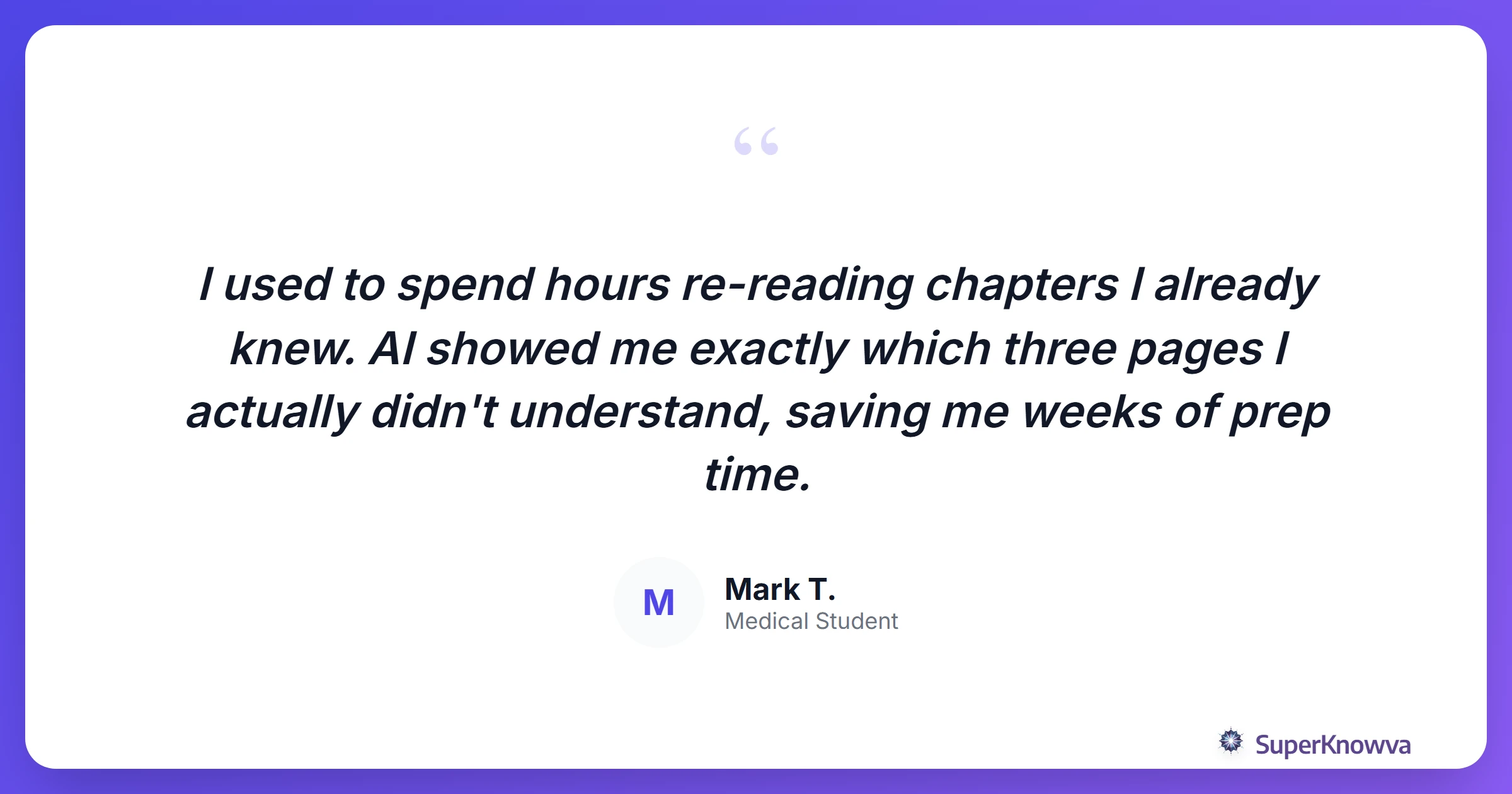
The future of education isn't about grinding out more hours; it's about making every minute of study count. When you use AI to find and fix your learning gaps, you stop wasting time on what you already know and start focusing on what actually moves the needle.
Ready to see where your gaps are hiding? Start using SuperKnowva today and turn your academic weaknesses into your greatest strengths.