We’ve all been there: three tabs open, a half-empty energy drink on the desk, and a mounting sense of panic as the finals countdown hits single digits. The pressure of May exams is a universal student rite of passage. But when the volume of information feels like a tidal wave, most students make the same mistake. They try to work longer hours, sacrificing sleep for frantic multitasking and late-night cramming sessions that rarely stick.
Here is the truth: acing your hardest subjects isn't about the quantity of hours you spend staring at a book. It’s about the intensity of those hours. By applying deep work for exam preparation, you can master complex concepts in half the time and stop the cognitive drain that leads straight to burnout.
Let’s break down how to shift your study habits from "busy" to "high-impact."
What is Deep Work and Why Does it Matter for Exams?
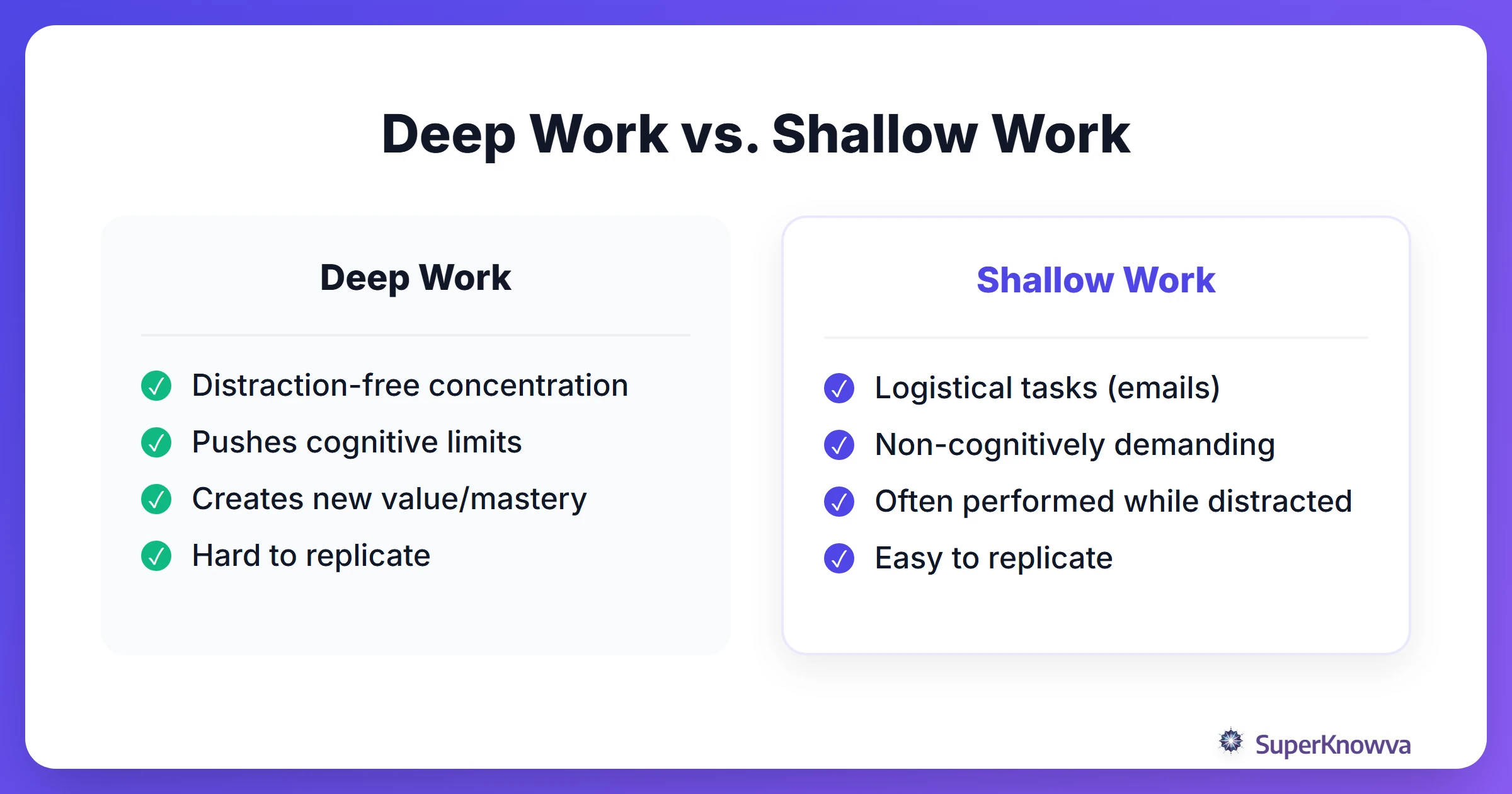
"Deep Work" is a term coined by Cal Newport, a computer science professor who noticed that the most successful people don't just work harder; they work deeper. It refers to distraction-free concentration that challenges your cognitive capacity.
For you, this means ditching "shallow work." Shallow work is the easy stuff: organizing your highlighters, color-coding a calendar you won't follow, or passively re-reading a textbook while your mind wanders. Deep work is the heavy lifting. It’s solving the hard problems and synthesizing new information.
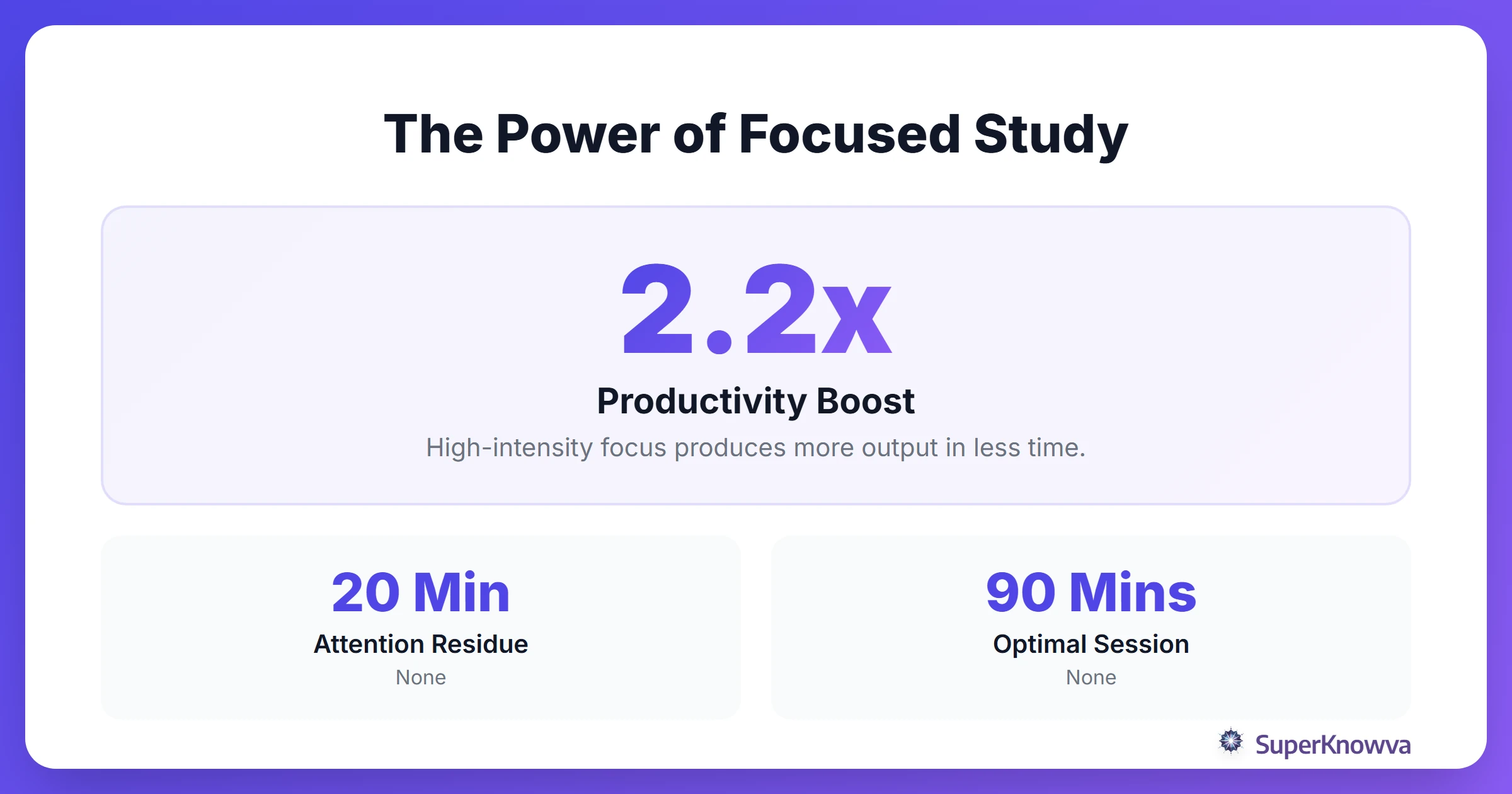
The science is simple but brutal. Every time you pause a difficult study session to check a "quick" notification, you suffer from Attention Residue. Your brain doesn't just snap back to the math problem; a part of your focus stays stuck on that text or DM for up to 20 minutes. In a high-stakes exam, you can't afford that leak. To perform at your peak, you have to eliminate the "switch cost" of multitasking.
Want to see how this fits into your wider academic life? Check out our guide on Deep Work for Students.
Choosing Your Deep Work Philosophy for Finals Season
Your life doesn't look like everyone else's, so your study schedule shouldn't either. Newport suggests different "philosophies" for finding focus. Picking the right one is the best way to start overcoming procrastination.
- The Rhythmic Philosophy: Perfect if you crave routine. You pick a consistent time every day, such as 6 AM to 9 AM before the world wakes up, and make it your dedicated study window.
- The Monastic Philosophy: This is "hermit mode." You head to the silent floor of the library, turn off your phone, and focus on your notes for an entire weekend. No distractions, no social media, just the syllabus.
- The Bimodal Philosophy: Best for those with unbalanced schedules. You might spend two days a week in "deep" immersion and use the other three for "shallow" tasks like emails, admin, and light review.
If you’re juggling five different subjects right now, the Rhythmic approach is usually your best bet for staying sane.
Engineering Your Environment for Peak Concentration
Your desk is either a cockpit or a crash site. To reach a flow state, you have to remove every tiny bit of friction that might distract you.
Ever heard of the "Grand Gesture"? It’s a psychological trick where you change your physical environment to signal to your brain that it’s time to work. Maybe you book a private study room or commute to a specific library you’ve never visited before. That physical shift acts as a mental "on" switch.
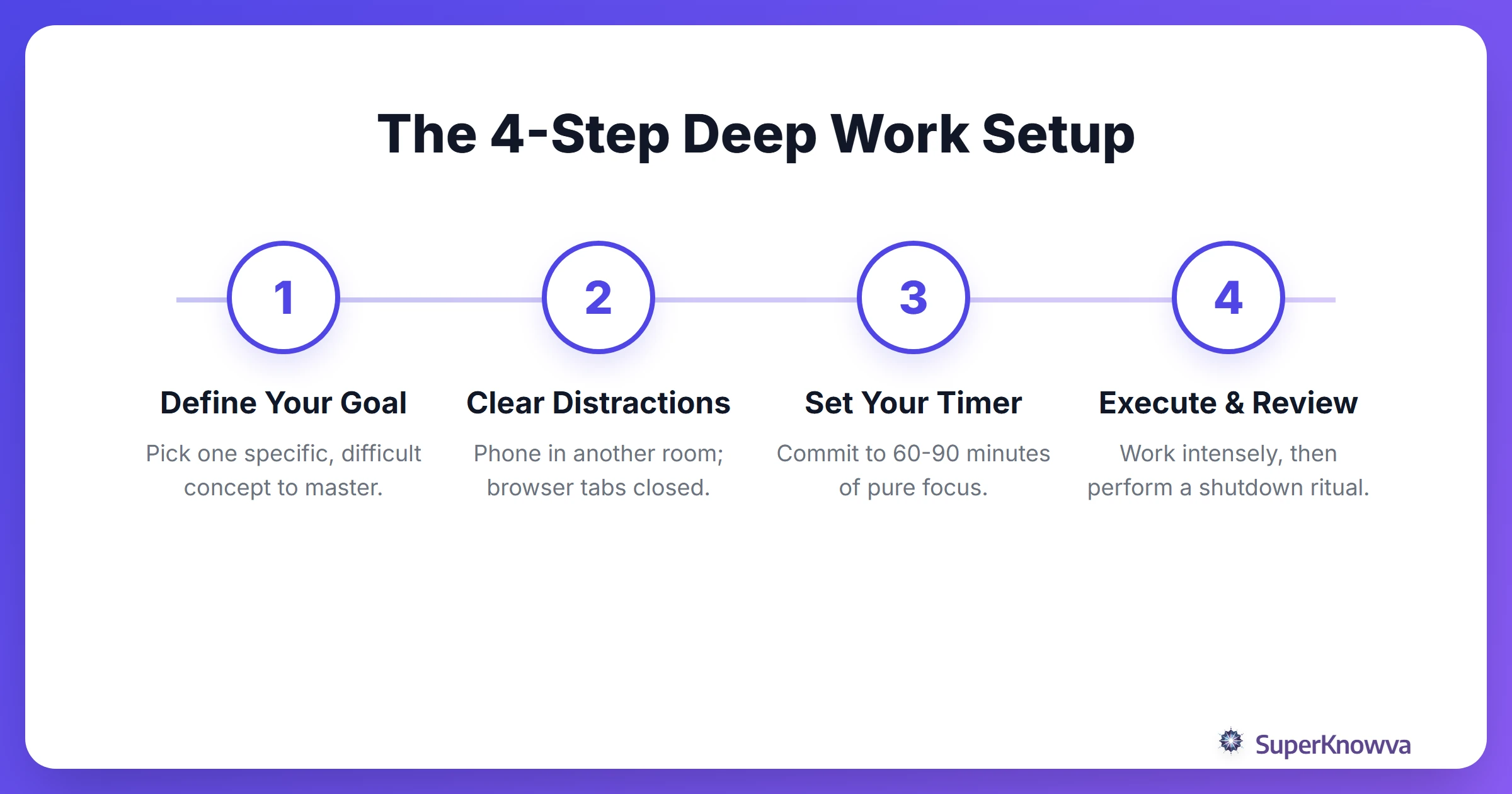
Practice Digital Minimalism for Students. Put your phone in another room. It should be out of sight, not just face down on the desk. Use browser extensions to block the sites you usually scroll through when you are bored. If the silence is too loud, try LoFi beats or white noise. Avoid anything with lyrics; your brain does not need to process a songwriter’s story while you are trying to memorize organic chemistry.
The Anatomy of a High-Intensity Study Session
Think of a deep work session like a workout. You wouldn't try to bench press your max weight without a warm-up, and you shouldn't dive into complex physics without a plan.
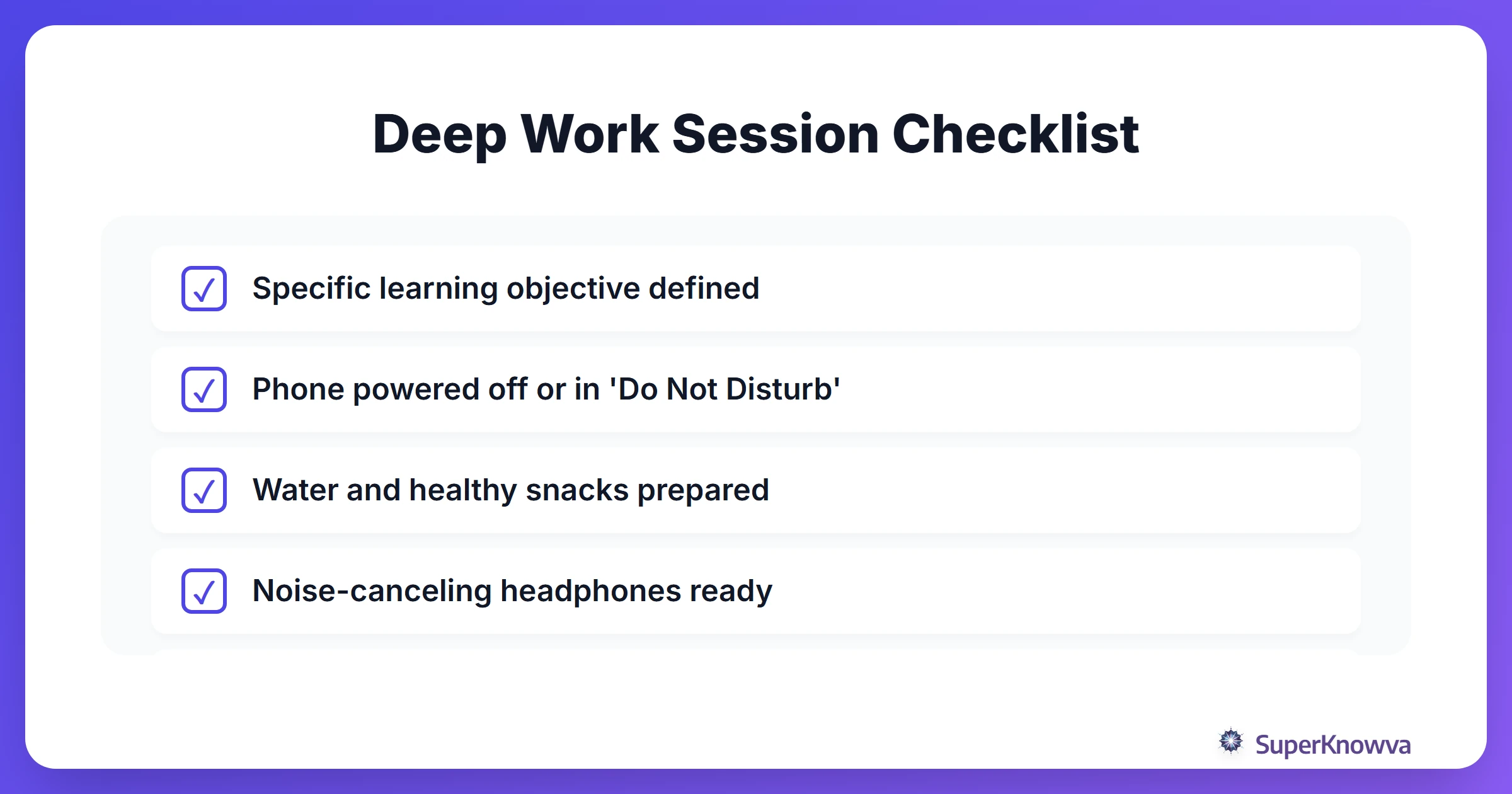
- Pre-session Rituals: Get your water, snacks, and chargers ready before the clock starts. Nothing kills a flow state faster than having to hunt for a pen ten minutes in.
- The Debate: Pomodoro vs. Flowtime: The Pomodoro technique (25 minutes on, 5 minutes off) is great for clearing your inbox, but it can actually interrupt deep thought. Consider Pomodoro vs. Flowtime. Flowtime lets you work for 60–90 minutes, allowing you to actually sink into the material before taking a longer, well-earned break.
- The Shutdown Ritual: When you’re done, be done. Close the laptop, tidy your desk, and write down exactly what you need to do tomorrow. This closes the "open loops" in your brain, so you can actually relax without feeling guilty.
As Cal Newport explains, deep work is a skill that gets better with practice. Keep a simple log of your "Deep Hours" to track your progress.
The Depth Trap: Balancing Mastery with Syllabus Coverage
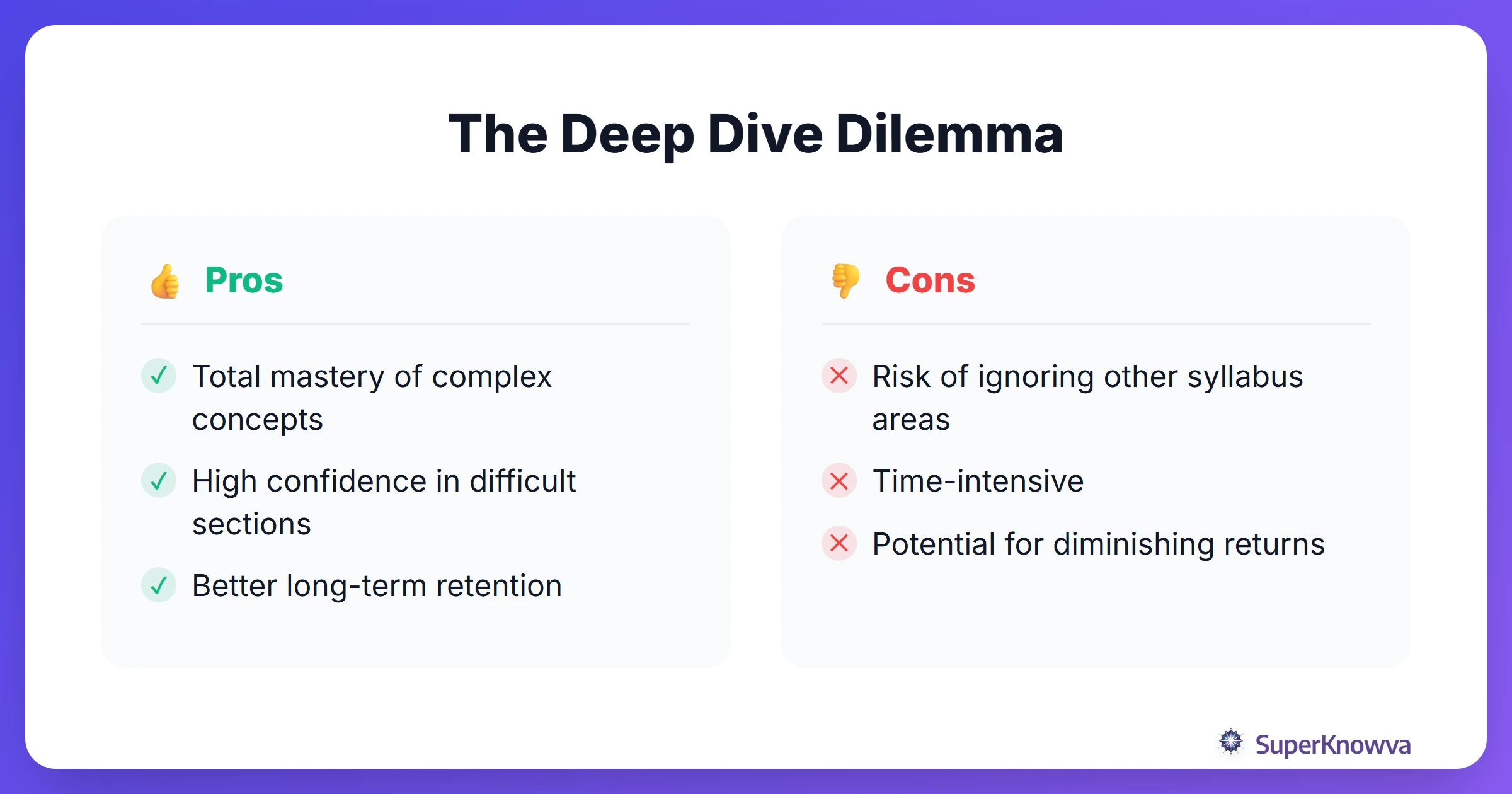
There is one danger to watch out for: the "Depth Trap." This is when you get so obsessed with perfectly understanding one niche topic that you realize you’ve ignored the other 80% of the syllabus.
To avoid this, use the 80/20 rule. Identify the 20% of the material that is most likely to show up on the exam and prioritize that for your deep sessions. Use time-boxing to set a hard limit. If your two-hour window for "Cell Biology" is up, move on. You need a balance between deep understanding and broad coverage.
Integrating Active Recall and Deep Work
Deep work is the perfect environment for high-level study techniques like The Blurting Method. During your session, try the Feynman Technique: explain a concept out loud as if you were teaching it to a ten-year-old. Because you are focused, you’ll immediately spot the "gaps" in your logic that need more work.
This isn't just theory. It works. For instance, one student passed the massive AWS Solutions Architect exam in just 7 days by using these exact principles of intense, undistracted focus.
When you combine SuperKnowva with the discipline of deep work, you are doing more than just studying. You are preparing for success. Start your next session by defining one clear goal, clearing your desk, and focusing. Your hard work will show when it matters most.