Staring at complex diagrams, vocabulary lists, or engineering formulas for hours is frustrating when the information vanishes the moment you close the book. For centuries, elite memory athletes have used a technique called the Method of Loci, or the Memory Palace, to store vast amounts of data.
The catch? Building these mental structures is exhausting. It takes a lot of creative juice that most students just don't have after an eight-hour day of classes. That’s where things are getting interesting. By pairing memory palaces and AI aids, you can build high-performance mental archives in a fraction of the time.
At SuperKnowva, we’re obsessed with combining cognitive science with tech that actually works to help you crush your exams.
Ancient Mnemonics and Modern AI
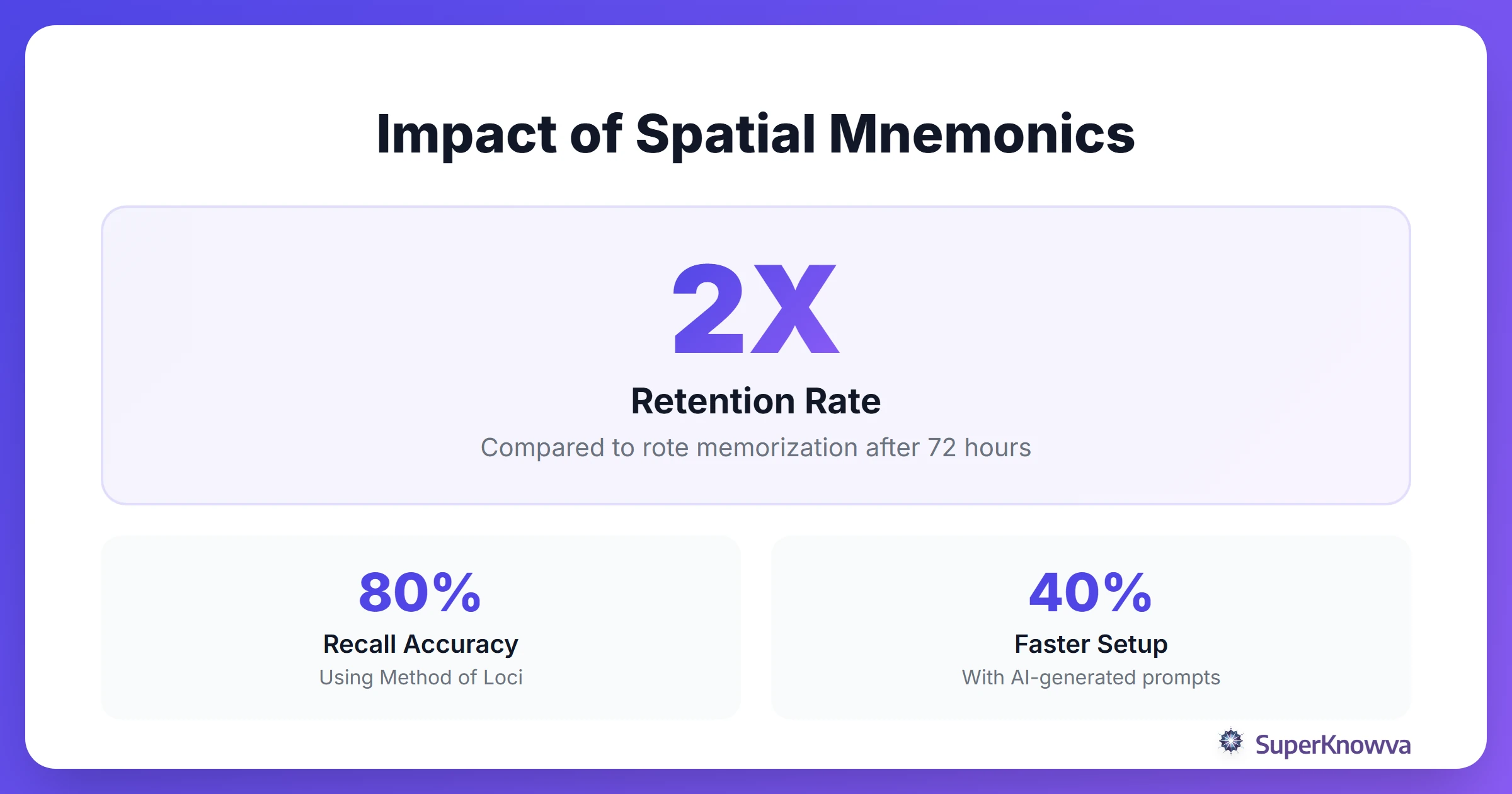
The Method of Loci dates back to Ancient Greece. The logic is simple: your brain remembers physical spaces better than abstract facts. You place information in familiar spots within your mind, such as your childhood bedroom or your favorite coffee shop. When you need to recall that information, you take a mental walk through the building and see the items you left there.
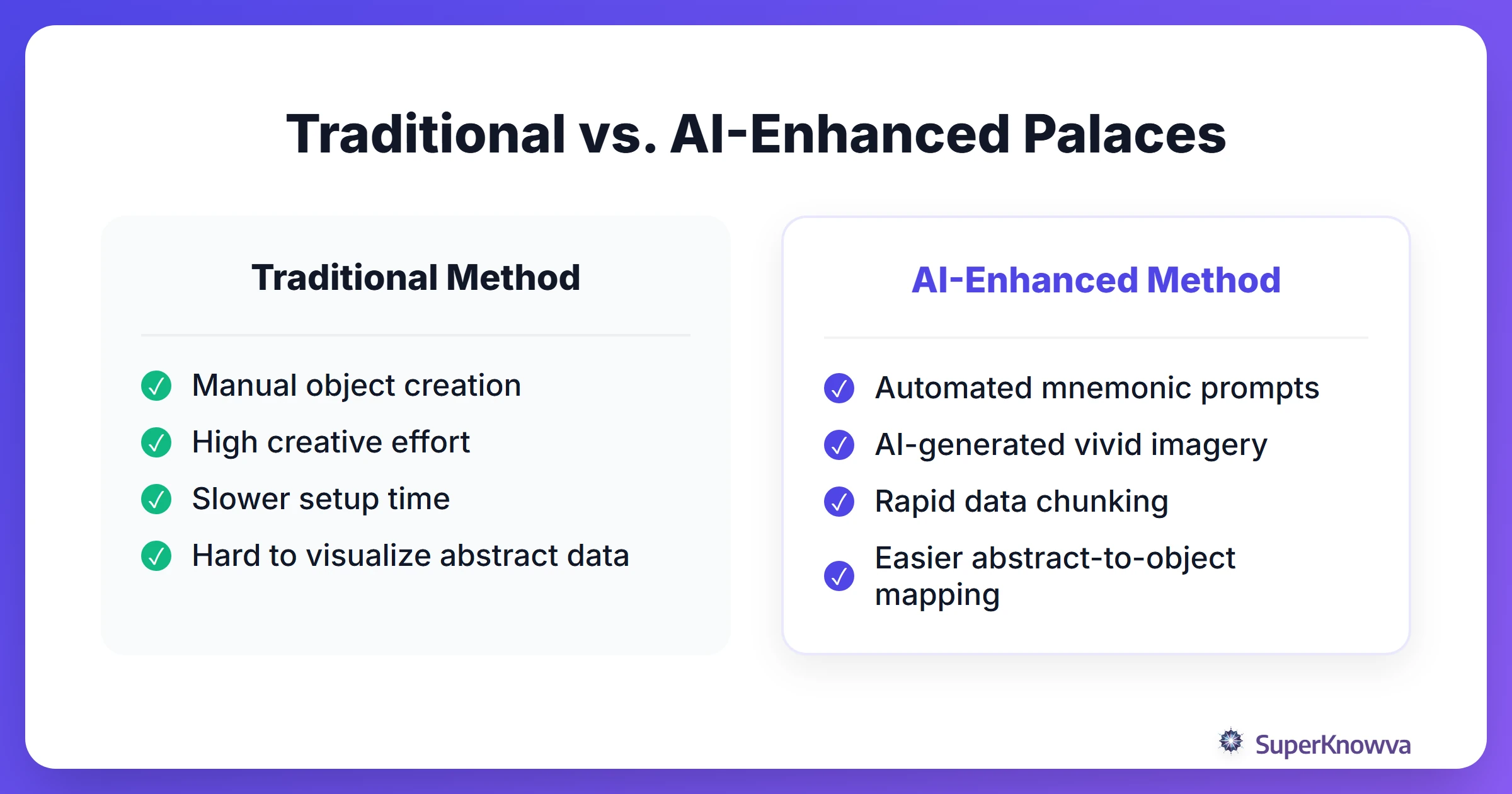
Creating these palaces manually is demanding. Many students quit because transforming dry data into vivid, spatial images is hard work. AI simplifies the process by categorizing notes and suggesting imagery. This shifts learning from passive reading to active, spatial encoding. This is similar to the Blurting Method for active recall, but with the advantage of long-term spatial storage.
Using AI to Solve the 'Creativity Block'
The biggest hurdle in building a memory palace is the "blank page" problem. How do you turn a naval engineering formula or a list of obscure medical terms into something your brain won't immediately delete? If an object isn't bizarre, funny, or multisensory, your brain will discard it as "boring."
AI tools are surprisingly good at being weird. Instead of racking your brain for a rhyme or a metaphor, you can just prompt an AI: "Give me a bizarre, multisensory visual object to represent the Bernoulli equation for my memory palace."
Case Study: The Naval Engineer’s Palace Take a student struggling with the formula for "Buoyancy Frequency." By prompting ChatGPT, they can turn a dry mathematical string into a scene: A neon-pink submarine (the variable) is bouncing on a giant trampoline made of seaweed in the middle of their kitchen. Because the AI suggests these "bizarre" elements, the student’s brain "hooks" onto the image instantly. This partnership lets you focus on the recall rather than the invention, much like using The Feynman Technique to simplify a concept before you try to memorize it.
AI-Driven Chunking: Organizing Data for Palace Placement
Avoid cramming too much into one "room" of your palace. To keep things stable, memory experts recommend the "Rule of Three" to group data into small, manageable chunks.
AI is the perfect architect for this. If you’re staring at a list of twenty chemical reactions, you can ask an AI to: "Group these twenty reactions into three logical categories and give me a 'header' object for each."
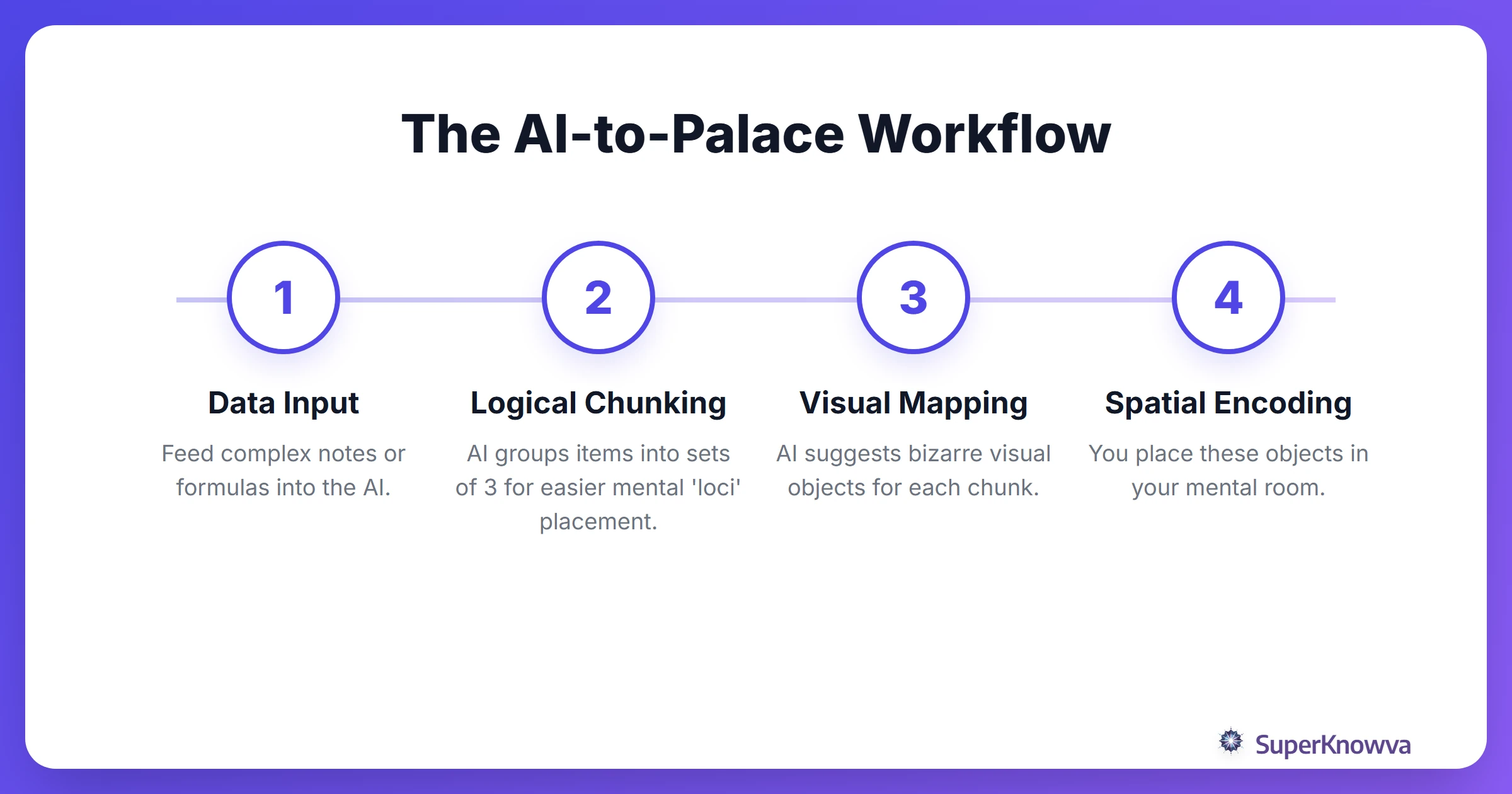
By mapping these hierarchies to specific 'loci' (locations) in your mind, you ensure you remember things in the right order. This is a lifesaver for step-by-step processes like surgical procedures or legal precedents. For those who already use mind mapping techniques, think of the memory palace as the 3D version of your map, with AI acting as the lead designer.
The AI Memory Guide: Interactive Palace Walkthroughs
The coolest part about memory palaces and AI aids is that you can use an AI model as a "stateful" host. You can actually describe your palace to the AI as you build it.
Try telling the AI: "I am building a palace in my local library. In the lobby, I have a giant golden eagle representing the Roman Empire."
Once the AI "knows" your palace, it can:
- Place objects for you: "Where should I put the French Revolution?" The AI might suggest the library's cafe, with a guillotine slicing a baguette.
- Conduct Active Recall sessions: You can ask the AI to quiz you: "I'm walking into the second-floor study room. What am I supposed to see there?"
This turns a boring study session into a dynamic conversation. According to this discussion on using ChatGPT as a Memory Palace Guide, this method reinforces spatial connections way better than looking at a static piece of paper.
Integrating AI Palaces with Your Digital Study Workflow
Your mental palace shouldn't exist in a vacuum. To really master your material, you need to connect your internal mnemonics to your digital tools.
- Spaced Repetition Systems (SRS): Use AI to generate Anki cards that specifically reference your palace imagery. The front of the card asks for a concept, and the back reminds you: "Look at the grandfather clock in your hallway." (Check out this Anki Learning Strategy Discussion for more on optimizing your deck).
- The Second Brain: Think of memory palaces as the "fast-access RAM" of your mind, while your digital notes are the "hard drive." Integrating the two is a core part of building a second brain, ensuring everything you memorize is backed up and organized.
Practical Workflow: Building Your First AI-Enhanced Palace
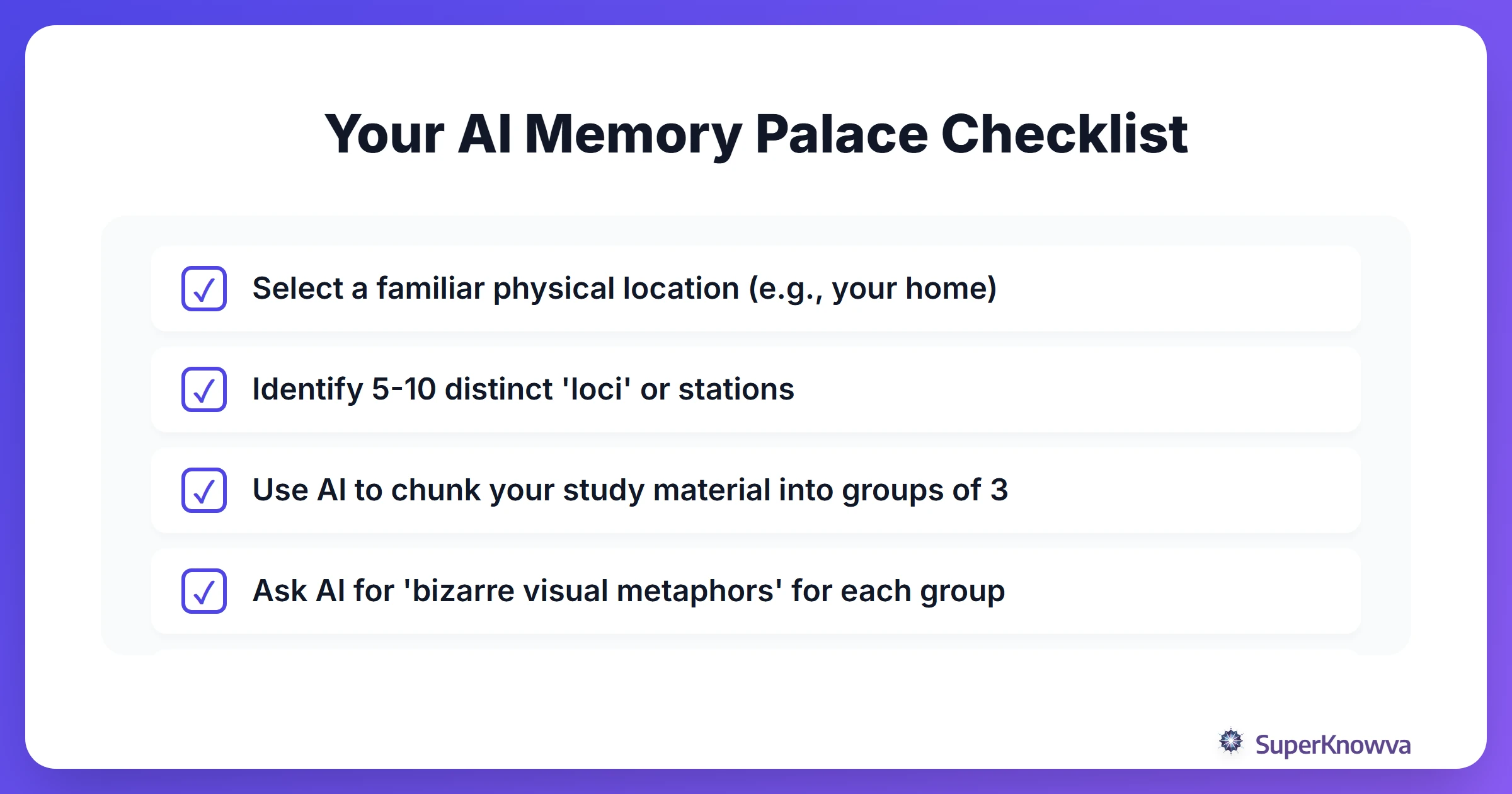
Ready to try it? Follow this four-step workflow for your next study session:
- Step 1: Input & Chunking. Paste your notes into an AI tool. Ask it to summarize the key points and group them into sets of three.
- Step 2: Object Association. For each chunk, ask the AI for a "vivid, strange, and memorable visual metaphor."
- Step 3: Spatial Placement. Mentally walk through a building you know well and "place" these AI-generated metaphors at specific stations (the front door, the sofa, the fridge).
- Step 4: Interactive Testing. Tell the AI where you placed the objects and ask it to quiz you on their meanings.
Conclusion
High-performance learning combines ancient techniques with modern technology. By pairing memory palaces and AI aids, you organize information into a structured system. Stop forgetting your exam material. Build an AI-enhanced palace today to see how much you can remember.