You know the feeling. It’s 2:00 AM, your third cup of coffee is cold, and you’ve been staring at the same paragraph for twenty minutes. Finals week usually feels like a desperate sprint through a haze of stress and sleep deprivation. But here’s the thing: while you’re probably obsessing over what you’re studying, you’re likely ignoring the where.
Optimizing your study environment for finals isn't just about making your desk look good for an Instagram story. It’s about cognitive science. It’s about removing the friction that makes your brain want to quit.
At SuperKnowva, we’ve seen that even the most powerful AI study tools work better when your brain isn't fighting its surroundings. Let's look at how to turn your room from a distraction zone into a high-performance "deep work" sanctuary.
The Science of Lighting: Natural vs. Artificial
Ever wonder why you feel like a zombie after six hours in a windowless library basement? It’s because your brain is essentially a giant light sensor. Your circadian rhythm dictates your energy, and it’s incredibly picky about light temperature.
During your heaviest study blocks, go for blue-enriched cool light. It sounds clinical, but the science is clear: this spectrum keeps you alert and sharp. If you can, drag your desk over to a window. Natural light is the ultimate weapon against the mid-afternoon slump. It keeps your mood up and your eyes from glazing over.
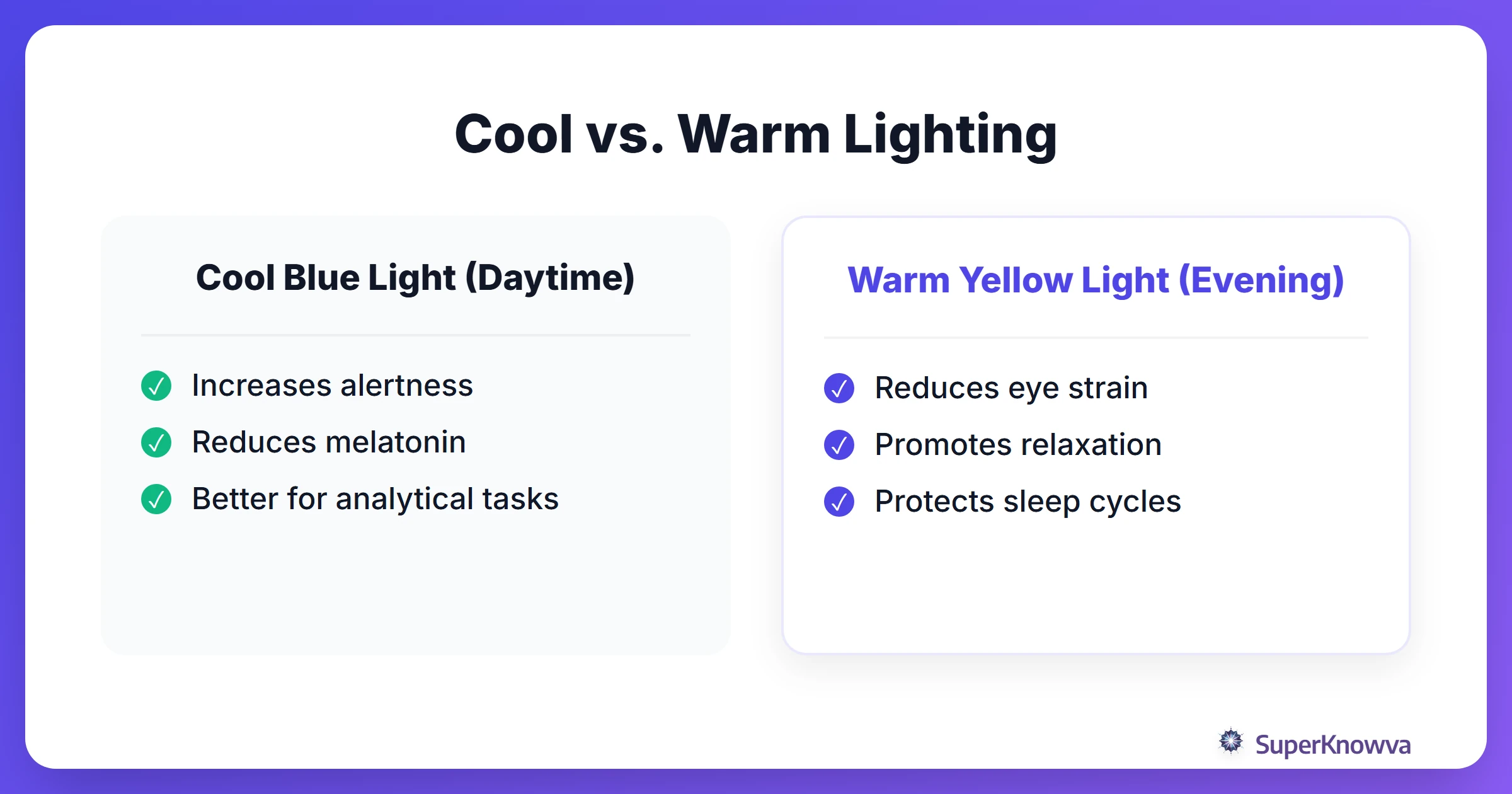
But here’s the trick: you have to switch it up as the sun goes down. When you’re pulling an evening session, move toward warmer, amber-toned lighting. This shift helps your brain transition into the impact of sleep on memory, making sure you actually retain what you just read instead of just staying awake. Pro tip: position your desk perpendicular to the window. You want the light, but you definitely don't want the screen glare that leads to a tension headache by 4:00 PM.
Ergonomics: Designing for Endurance
Studying for finals is an endurance sport. If your lower back is screaming and your neck is stiff, you aren't thinking about organic chemistry; you’re thinking about your pain. Study space ergonomics are the difference between a productive four-hour block and a miserable one.
Try the 90-90-90 rule: Keep your elbows, hips, and knees bent at 90 degrees, with your feet flat on the floor. It feels a bit formal at first, but it saves your spine.
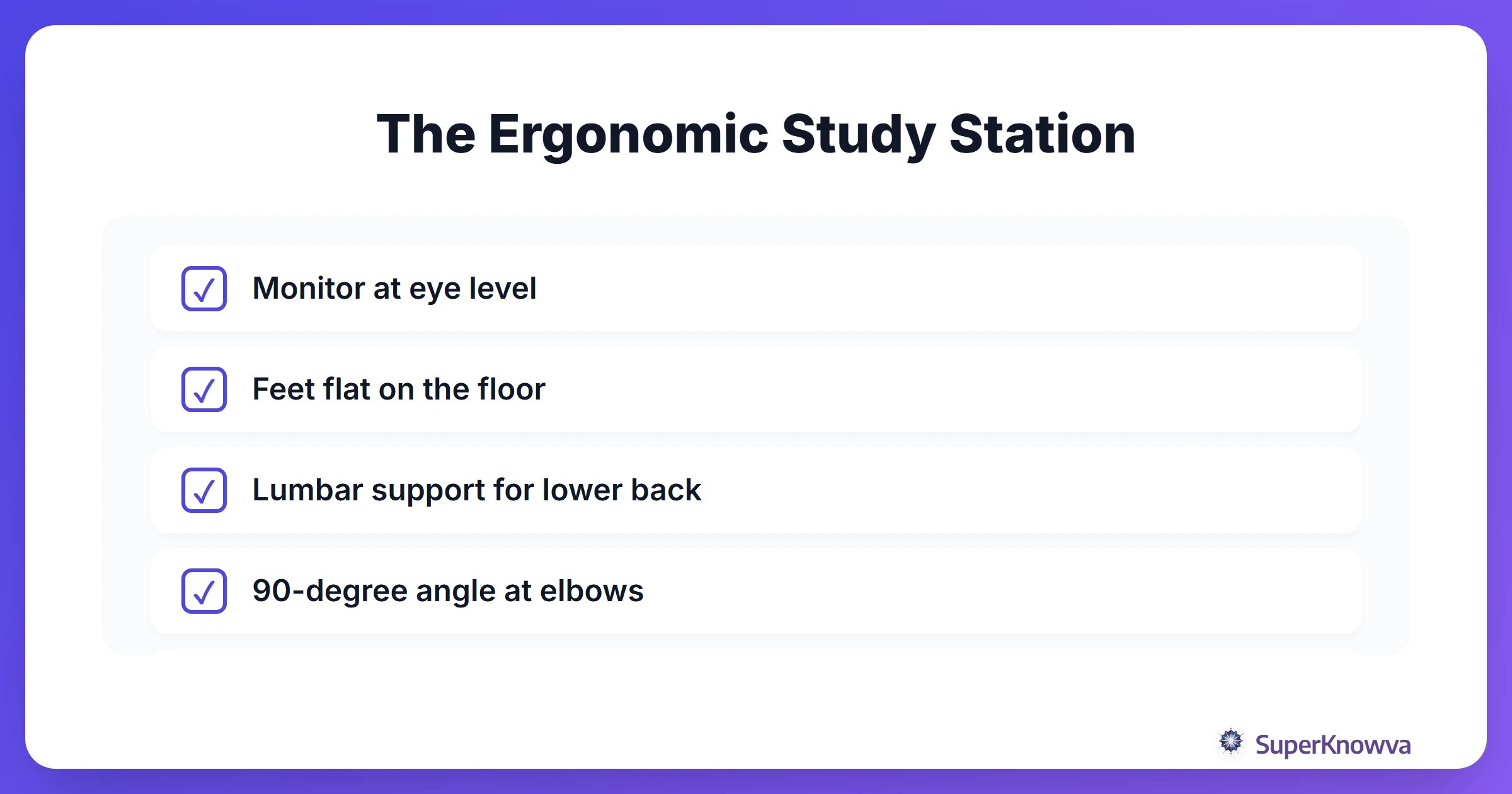
Stop hunching over your laptop. If your screen isn't at eye level, you’re asking for "tech neck." Use a laptop stand or even a stack of textbooks to get that monitor up. Also, remember that movement is fuel for your brain. Whether it's a quick walk or just a few stretches, getting your blood moving every hour is a massive cognitive booster. As noted in these UC Berkeley Focus Strategies, movement helps manage the physical toll of finals. Pair these breaks with different productivity methods to keep your momentum high.
Auditory Optimization: Silence vs. Soundscapes
What is the biggest enemy of focus? It is not necessarily a loud room; it is an unpredictable one. A door slamming or a roommate’s sudden laughter forces your brain to switch tasks, interrupting your concentration.
This is why noise-canceling headphones are basically mandatory for mastering deep work. They let you build a "focus bubble" anywhere, even in a crowded dining hall.
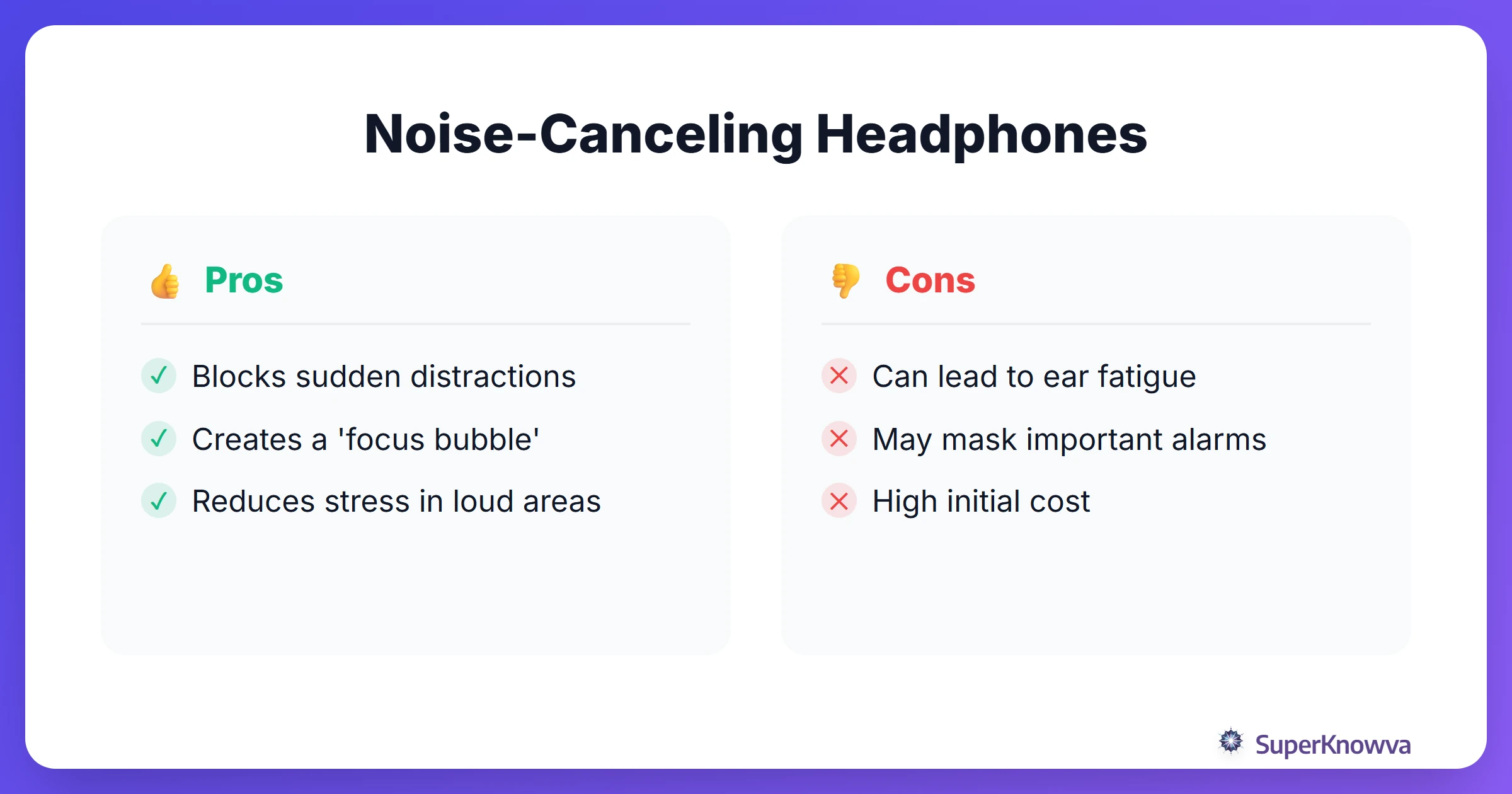
If total silence feels eerie, try auditory masking. There’s a reason Lo-Fi beats and classical music are so popular: they provide a steady background that doesn't distract your language processing centers. If you’re in a loud house, try white, pink, or brown noise. It sounds like static, but it’s incredibly effective at "flattening" the soundscape so your brain can stay locked in.
Visual Minimalism and Decluttering
A messy desk is a loud desk. It’s hard to focus on a complex problem when your peripheral vision is full of old snack wrappers and unrelated notes. It’s like the "broken windows" theory: if your space looks chaotic, your brain feels like it’s okay to be undisciplined.
- Be Ruthless with Space: Only keep the materials for the current subject on your desk. Everything else goes on the floor or in a drawer.
- The "Study Only" Rule: If you use your desk for gaming, eating, and scrolling TikTok, your brain won't know it's time to work when you sit down. Try to make your desk a dedicated zone for academics.
- The Reset: Before you go to bed, clear your desk. There is nothing better than waking up to a clean slate instead of yesterday's mess.
According to Sustainable Study Tips from UAlberta, minimalism is one of the most underrated ways to keep your stress levels under control when things get intense.
Context-Dependent Memory and Location Rotation
Have you ever studied for hours, felt like you knew the material, and then completely blanked the second you sat down for the exam? It might be because your brain tied that information too closely to your bedroom.
This is called the encoding specificity principle. Basically, your brain uses environmental cues to help store information.
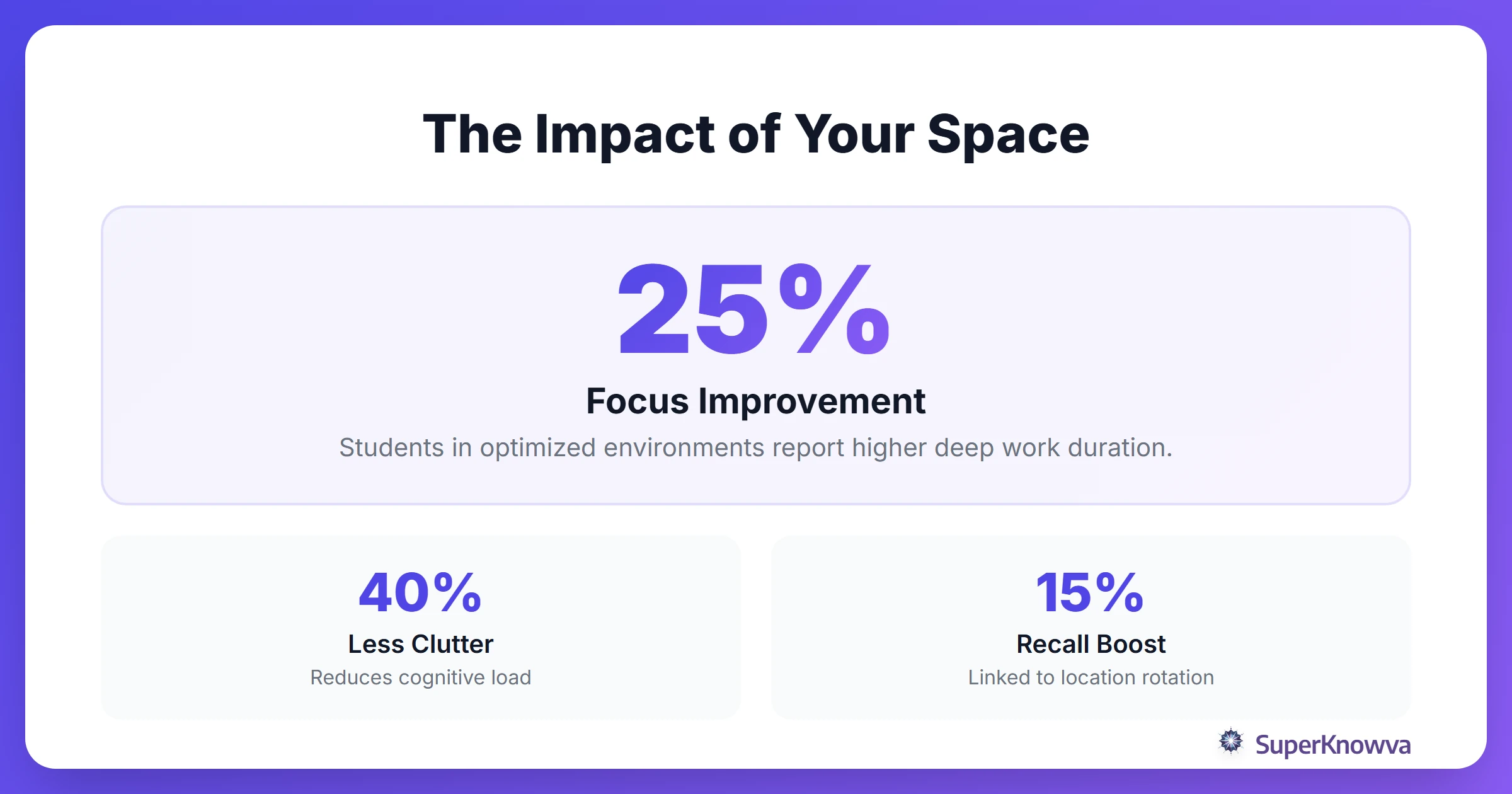
The fix? Location rotation. Don't just sit in the same cubicle for fourteen hours. Study your biology notes at your desk, but review them again in a quiet cafe or a different floor of the library. By changing your exam preparation environment, you force your brain to build stronger, more flexible neural pathways. You’ll find it much easier to recall that info in the exam hall because your memory isn't "stuck" to your bedroom wall.
The Digital Environment: Clearing the Path
Since you're likely using AI and digital tools to learn, your computer screen is just as much a "space" as your physical desk. Digital minimalism is about cutting out the noise before it starts.
Do a "Tab Purge." If you have 47 tabs open, your brain is constantly being tempted to multitask. Close everything that isn't essential. Multitasking is a myth; it actually tanks your productivity by up to 40%.
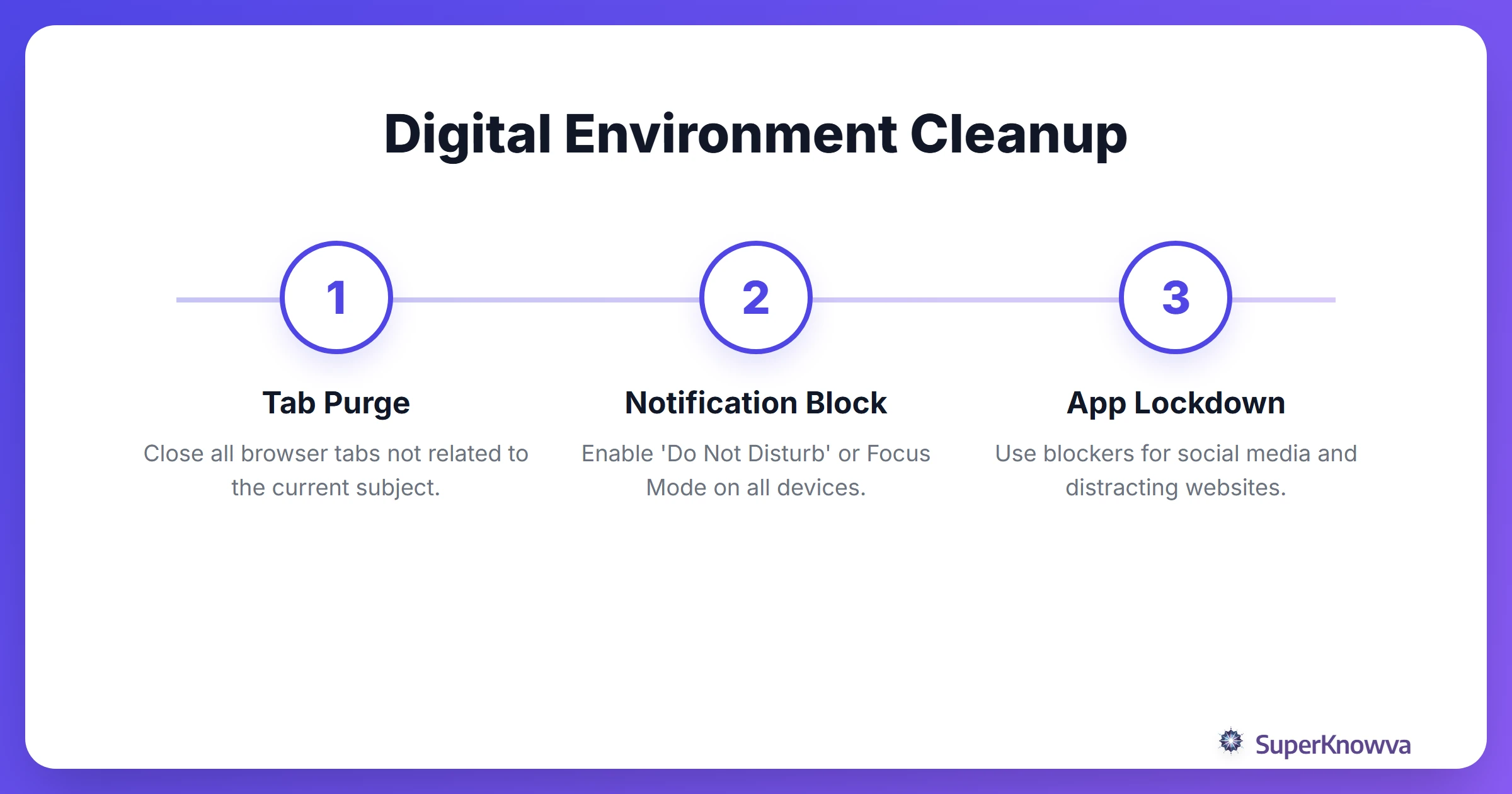
Use technology to protect yourself from technology. Turn on Focus Modes to kill social media notifications. If your willpower is failing, use apps like Freedom or Cold Turkey to literally lock yourself out of distracting sites. By practicing digital minimalism for students, you turn your laptop back into a tool rather than a distraction machine.
Conclusion
Optimizing your study environment isn't about being "perfect" or having a Pinterest-worthy office. It’s about building a system that works with your brain instead of against it. By taking control of your lighting, ergonomics, and digital space, you’re giving yourself a massive competitive edge.
Fix your space today. Your future, post-finals self will thank you.