Give each topic that appears on both exams two practice tasks. In a lab block, identify the structure on a model or an image your instructor allows. In a lecture block, explain what the structure does or how it connects to the parts around it. Put both tasks on your calendar, then leave time to redo whichever one gives you trouble.
Make one topic serve both exams
Start with your syllabus, lab guide, and any sample questions. Check what you’ll see in the practical, what you’ll have to write in the lecture exam, and whether either format has timing or material restrictions. If the instructions leave something unclear, ask your instructor before planning a mock exam.
Suppose both assessments cover blood flow through the heart. For the practical, open a heart model to a view that exposes the chambers and cover the labels. Point to the valve between the right atrium and the right ventricle, name it, and say how you found it. Check your answer with the model key or the OpenStax heart anatomy reference.
For written practice, put the model away and trace blood flow from the right atrium to the pulmonary trunk. A complete answer for this prompt goes from the right atrium through the tricuspid valve into the right ventricle, then through the pulmonary valve into the pulmonary trunk. If you pointed to the pulmonary valve on the model when asked for the tricuspid valve, start at the right ventricle and find both openings. Follow the one leading back to the right atrium to locate the tricuspid valve. Follow the one leading out to the pulmonary trunk to locate the pulmonary valve. Try finding both from another view.
Build the four-week schedule
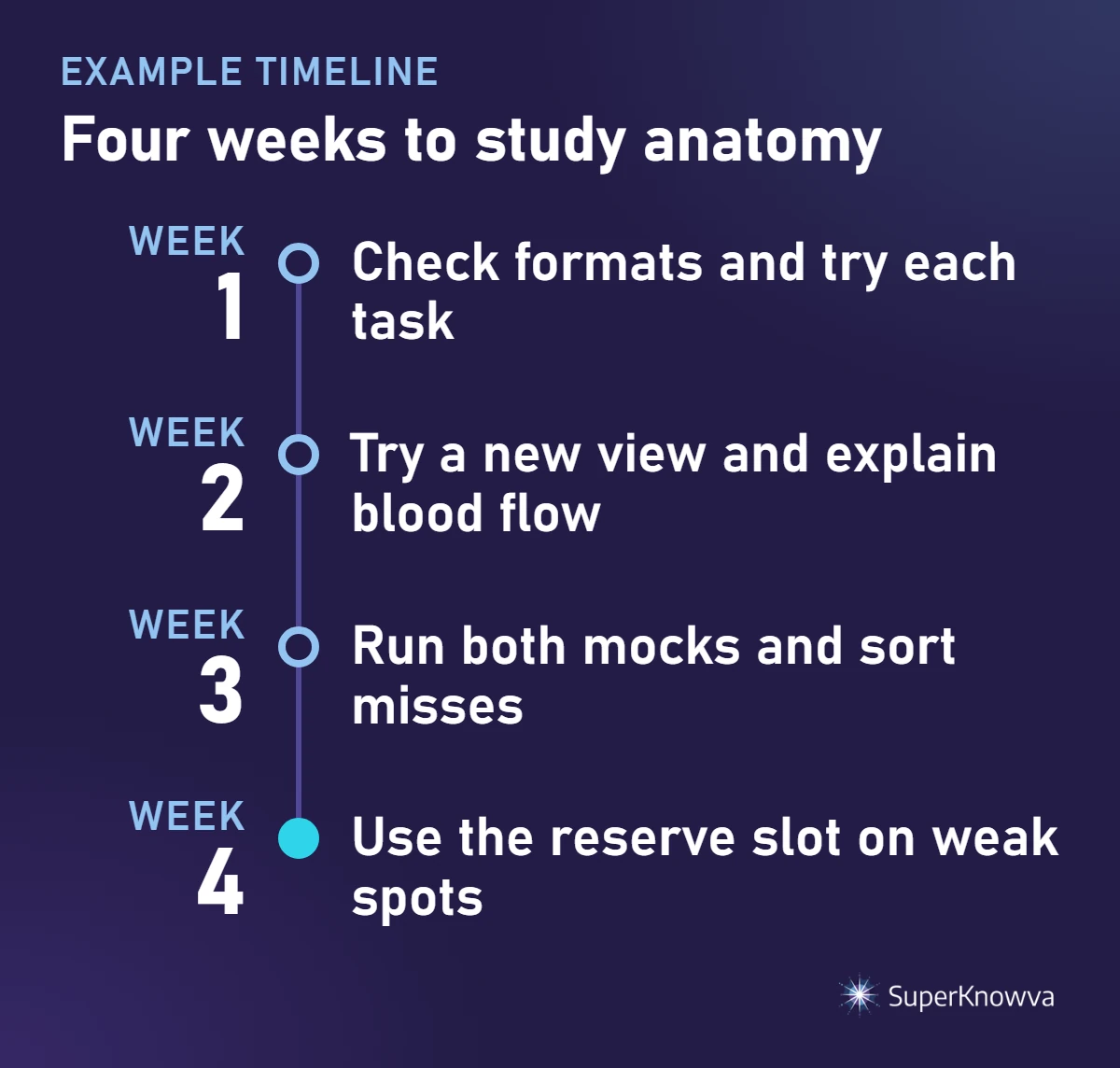
Example schedule for two anatomy exams in week four. Use your course dates and available lab time.
In this example, Monday is the available lab block, Wednesday is a written practice block, and Saturday is a reserve slot. Put your lab block wherever you can use the required materials. Move the reserve slot earlier if it falls after either assessment.
- Week 1. Check formats and try each task. On Monday, use a course model to identify a few structures with the labels covered. On Wednesday, write a short explanation from the same topic and check it against your notes. Record what you missed in each format.
- Week 2. Try a new view and explain blood flow. On Monday, find the two valves on a different view of the heart. On Wednesday, write the pathway without the model in front of you. Check the order of the chambers and valves.
- Week 3. Run both mocks and sort misses. On Monday, rotate through a short set of the identification prompts your course uses. On Wednesday, answer a short set of written prompts with the materials and timing your instructor specifies, if applicable. Sort each miss by task so you know what to redo.
- Week 4. Use the reserve slot on weak spots. Return to the model for any structure you still misidentify from a new angle. Rewrite a response that dropped a connection. If both checks go well, use the slot for a brief pass through the remaining shared topics.
Repair the error you actually made
You recognized the picture and lost your bearings when it changed. Find the neighboring chambers first, then name the valve between them. For a course-approved image, use this biology diagram recall exercise to practice with the labels covered.
Your written answer skipped a connection. Compare it with the course reference and locate the first missing step. If your pathway jumped from the right ventricle to the pulmonary trunk, write the segment again with the pulmonary valve included. Then retry the full prompt without looking.
You missed the lab block. Use a course-approved image from a different view or move the block to another available lab session. Keep your written block on the calendar. When you next have access to the model, start with the structure you couldn’t check in the image.
Put the first two blocks on your calendar
Pick one item that appears in the instructions for both exams. Add a lab block that ends with an identification you can check and a written block that ends with a short answer you can check against your course material.
