It’s 2:00 AM. You are three coffees deep, staring at a 400-page textbook, and your first exam is in six days. That sinking realization that "winging it" will not work this time is unavoidable. While most students rely on panic and luck, successful students use a system.
Mastering time blocking for exams isn't just about filling in a calendar; it’s about reclaiming your sanity. It’s the difference between a chaotic finals week and a structured, manageable path to an A.
In this guide, we’re going beyond the basics. We’re looking at advanced strategies to prioritize the subjects that actually matter, use AI to do the heavy lifting, and keep your brain from melting before Friday.
Why Your To-Do List is Sabotaging You
Most students start their morning with a massive list of tasks. The problem? A list tells you what to do, but it doesn't give you a deadline to do it. This leads to "decision fatigue," the mental burnout you feel before you’ve even opened a book because you’re constantly wondering what to study next.
Time blocking fixes this by "pre-deciding" your day. When you assign Organic Chemistry to 2:00 PM, you stop negotiating with yourself. It’s the cornerstone of Deep Work for Students because it protects your focus from the constant itch to check your phone.
If you’re a chronic procrastinator, time blocking creates a much-needed sense of artificial urgency. When you know you only have 90 minutes for Calculus before you must move on, you’re a lot less likely to spend forty minutes scrolling through TikTok.
'Eat the Frog' (Even if it's Gross)
The "Eat the Frog" rule is simple: do the thing you’re dreading most, first. During finals week, your "frog" is that one high-stakes, terrifyingly difficult exam that’s keeping you up at night.
Your first block of the day should always be your hardest material. Why? Because your brain is fresh. Trying to solve complex physics equations at 10:00 PM when your cognitive energy is spent is a recipe for frustration.
If you find yourself staring at the page and unable to start, understanding the science of overcoming procrastination can help you push through that initial "ugh" feeling and get to work.
Buffer Blocks: Expect the Unexpected
A rigid schedule is a fragile schedule. If you plan every minute from 8:00 AM to 8:00 PM, one difficult chapter can ruin your entire week. This is where buffer blocks save your life.
Build in 30-60 minute "margin of error" periods. These are unassigned slots used to catch up on overflow or tackle a concept that turned out to be harder than expected. Harvard Summer School's Time Management Tips emphasize that a calendar shouldn't be a cage; it should be a safety net that prevents overlapping deadlines from crushing you.
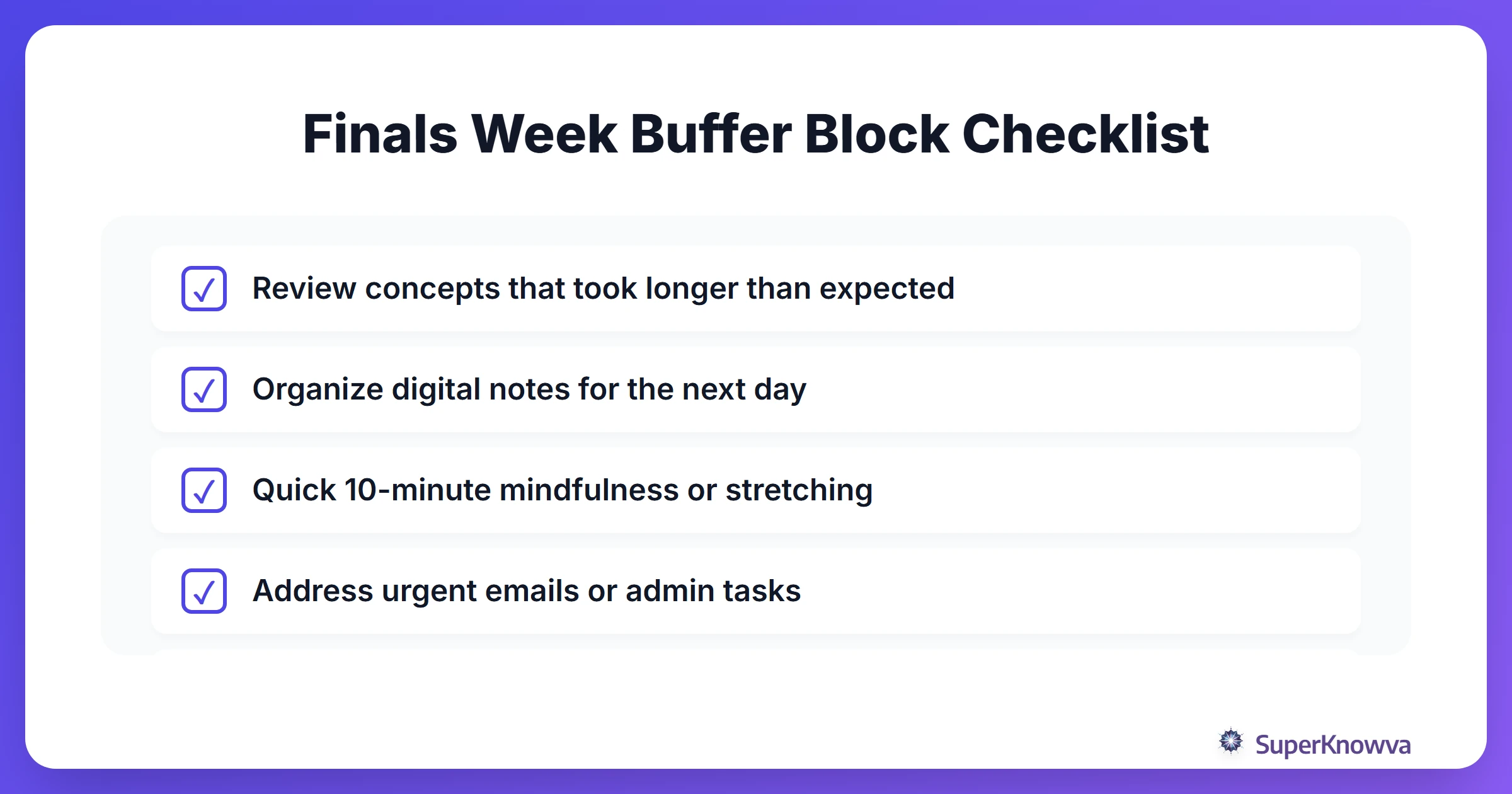
Don’t forget recovery blocks. Studying for 12 hours straight is ineffective. Eventually, you stop learning and just start staring. A 30-minute walk isn't "wasted time." It is a necessary reset.
Stop Reading, Start Doing: Active Recall Blocks
Time blocking is just a container. What you put inside it is what actually gets you the grade. Passive reading is the enemy. If your block says "Read History Chapter 5," you're probably wasting your time.
Instead, define your blocks by output. Use techniques like The Blurting Method. Your block shouldn't be "Study Biology"; it should be "Complete three Blurting sessions for Chapter 4."
Try interleaving too. Instead of studying one subject for six hours, mix related topics into shorter, alternating blocks. It feels harder because your brain has to work to "switch gears," but that’s exactly what builds long-term retention.
Pomodoro vs. Flowtime: Pick Your Weapon
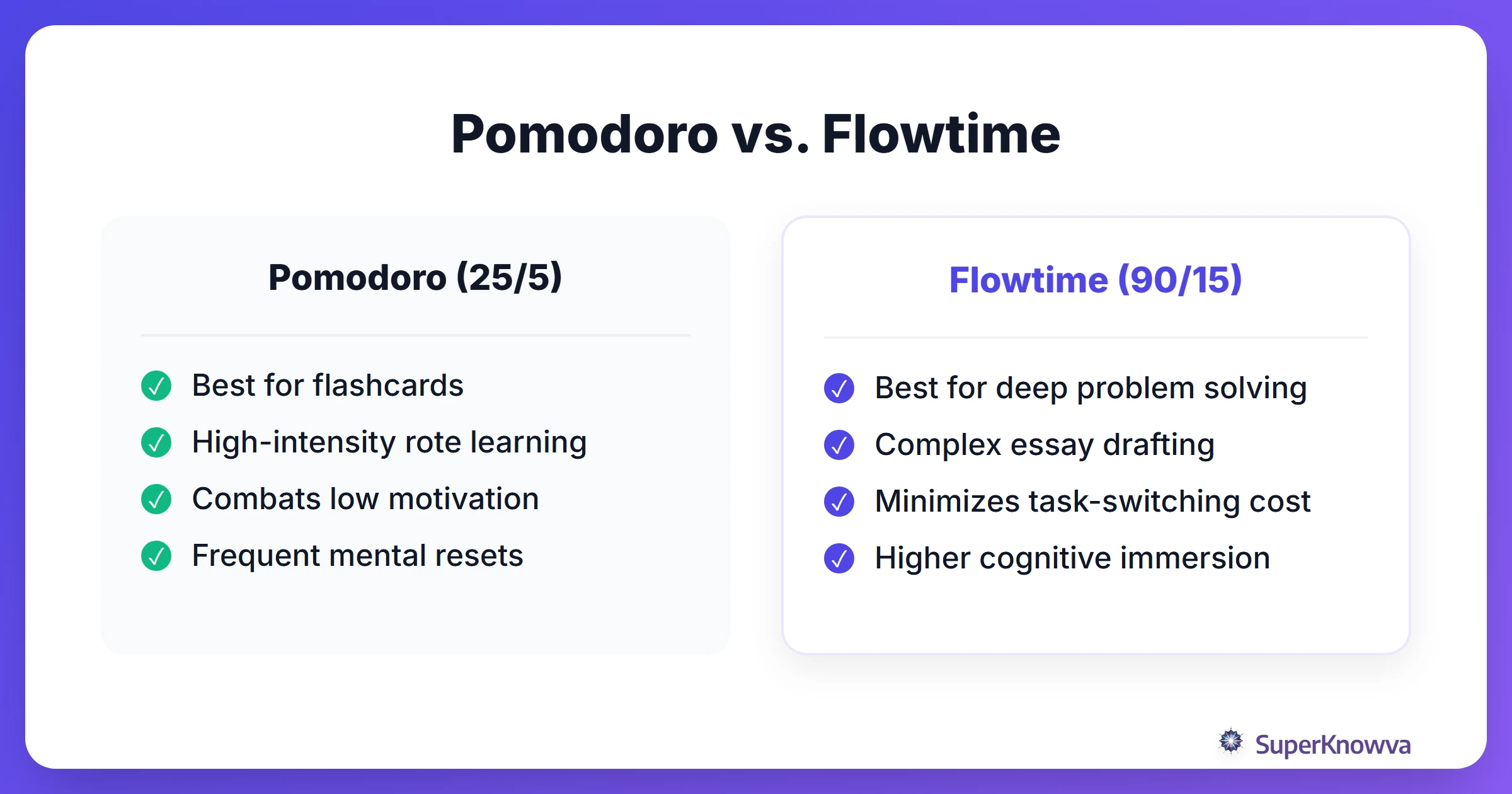
Not all study sessions are created equal. You need to match your timing to the task at hand. The debate between Pomodoro vs. Flowtime usually comes down to the type of work you’re doing:
- Pomodoro (25/5): Best for high-intensity rote work like flashcards or vocab. The short breaks keep you from burning out on boring tasks.
- Flowtime (90/15): Essential for deep work like essay drafting or complex problem sets. These tasks require a "warm-up" period; a 25-minute timer usually cuts your focus just as you're getting into the zone.
Pro tip: Put your phone in another room. During these blocks, the outside world doesn't exist.
Let AI Handle the Logistics
The era of the static paper planner is over. Modern exam time management is dynamic. Why spend an hour planning your week when you could be studying?
Tools like SuperKnowva can scan your syllabus and suggest the best block lengths based on how hard the material is. Instead of guessing where you're weak, the AI identifies your gaps through practice quizzes and automatically shifts your schedule to focus on those areas.
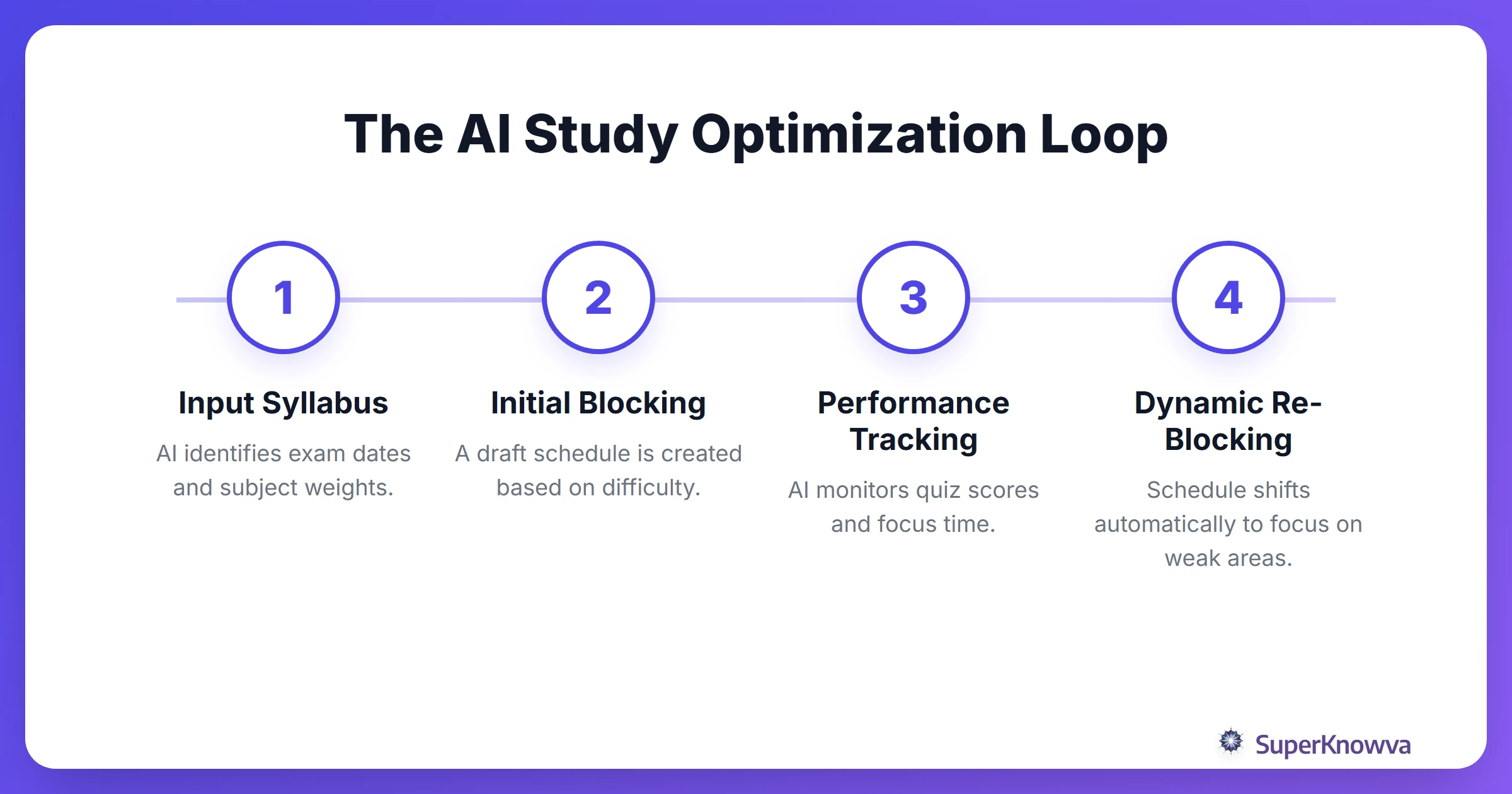
This is predictive scheduling. By tracking "forgetting curves," AI ensures you revisit the hardest topics right before you are likely to forget them, maximizing your memory before the exam.
The 'Exam Day' Strategy
Time blocking shouldn't stop at the door of the testing center. You need a plan for the exam itself.
Have you heard of the 75-second rule? If you haven't made progress on a question in 75 seconds, mark it and move on. Many students on Reddit Exam Time Management Advice suggest this "mindset-first" approach to avoid the "time sink" trap where one hard question ruins your pace for the rest of the test.
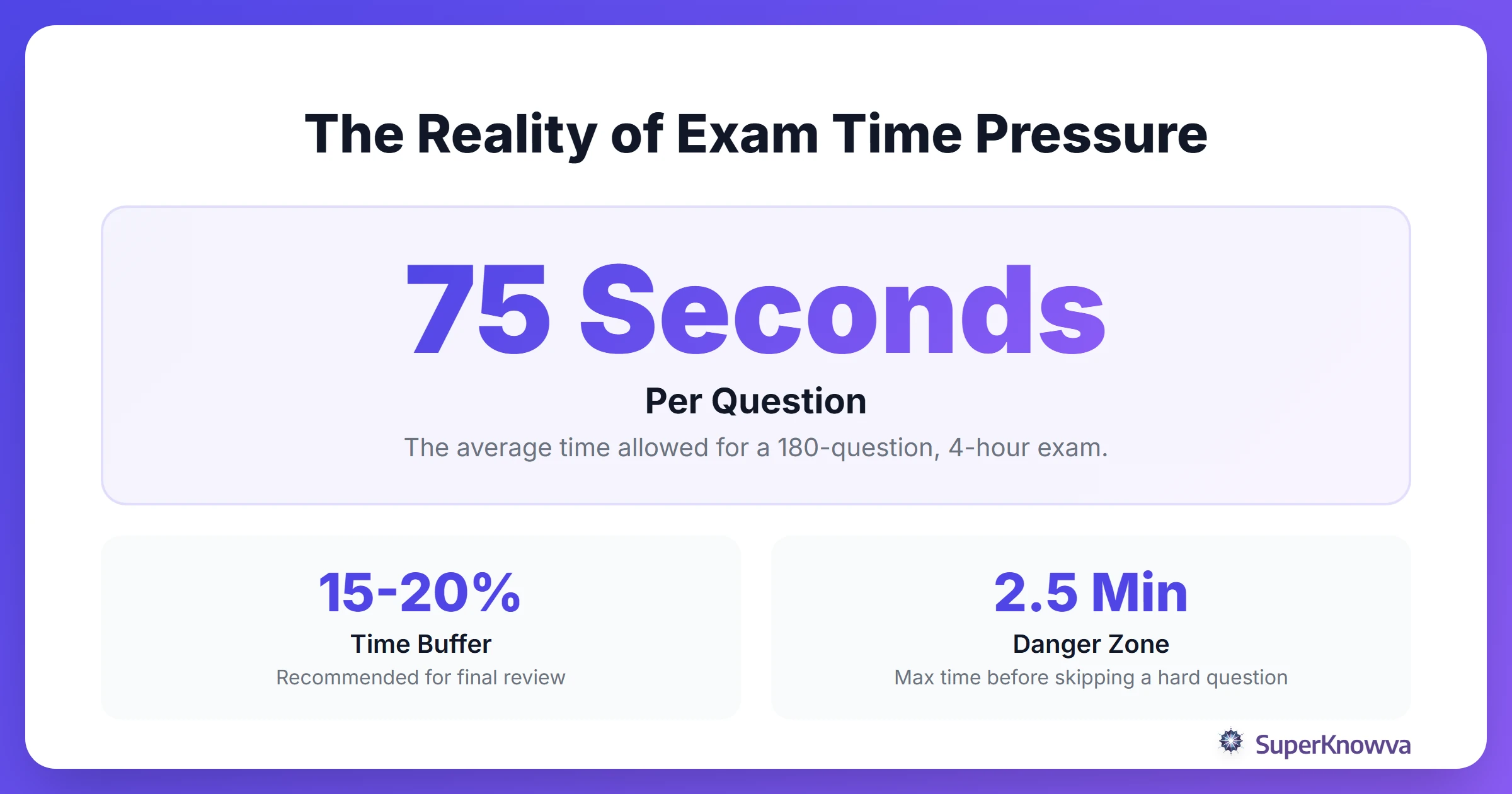
Always leave 10–15 minutes at the end of your exam block for a "silly mistake" check. Ensure you didn't skip a bubble on the Scantron and take one last look at those flagged questions.
Finals week is manageable. By using AI, respecting your energy levels, and building a schedule that accounts for human error, you can do more than just get by. Work toward that A.