
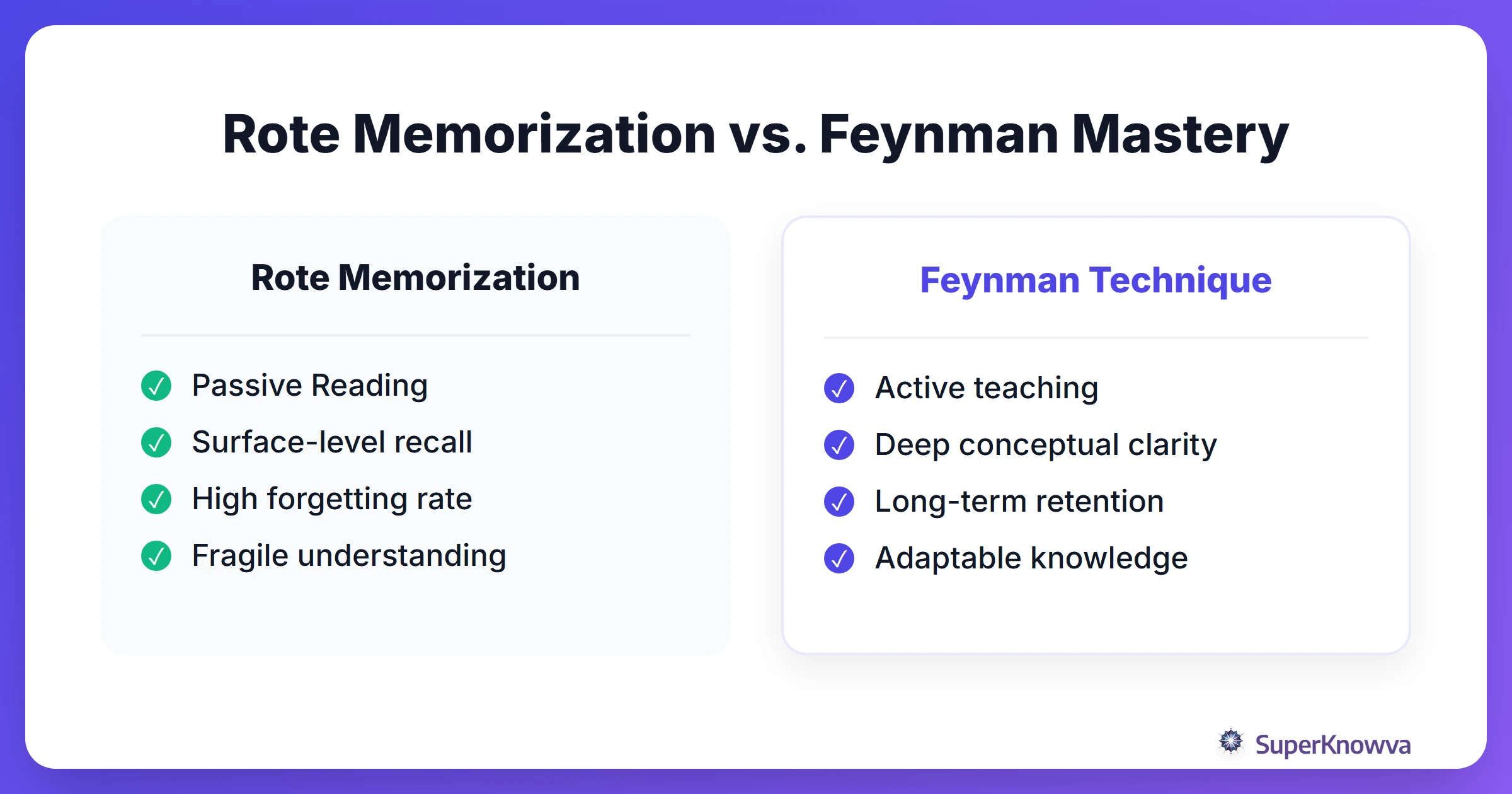
You know that feeling? You’re staring at a 400-page biology textbook or a tangled mess of organic chemistry mechanisms, and it might as well be written in ancient Greek. Most students panic and hit the highlighter, coloring every page neon yellow and hoping for the best. But highlighting isn't learning; it's just coloring.
If you want to actually master the material, you need a strategy built for depth. Using the feynman technique science exam prep method helps you move past surface-level recognition and reach the kind of deep understanding required for those brutal science finals.
Let's break down how to use this Nobel Prize-winning strategy to make even the most intimidating theories feel simple.
What is the Feynman Technique and Why Science Students Need It
The Feynman Technique is a simple four-step process: to learn something, explain it as if you were talking to someone else. It’s named after Richard Feynman, a Nobel Prize-winning physicist known as the "Great Explainer." He believed that if you couldn't explain something simply, you didn't really understand it.
Science finals require application rather than just definitions. Can you apply the concept of "entropy" to a multi-step thermodynamics problem? Many students fall into the "Illusion of Competence", a trap where you think you know a topic because the words look familiar on the page. Teaching the material is the best way to find gaps in your knowledge before the exam.

Step 1: Choose Your Concept and Teach it to a Toddler
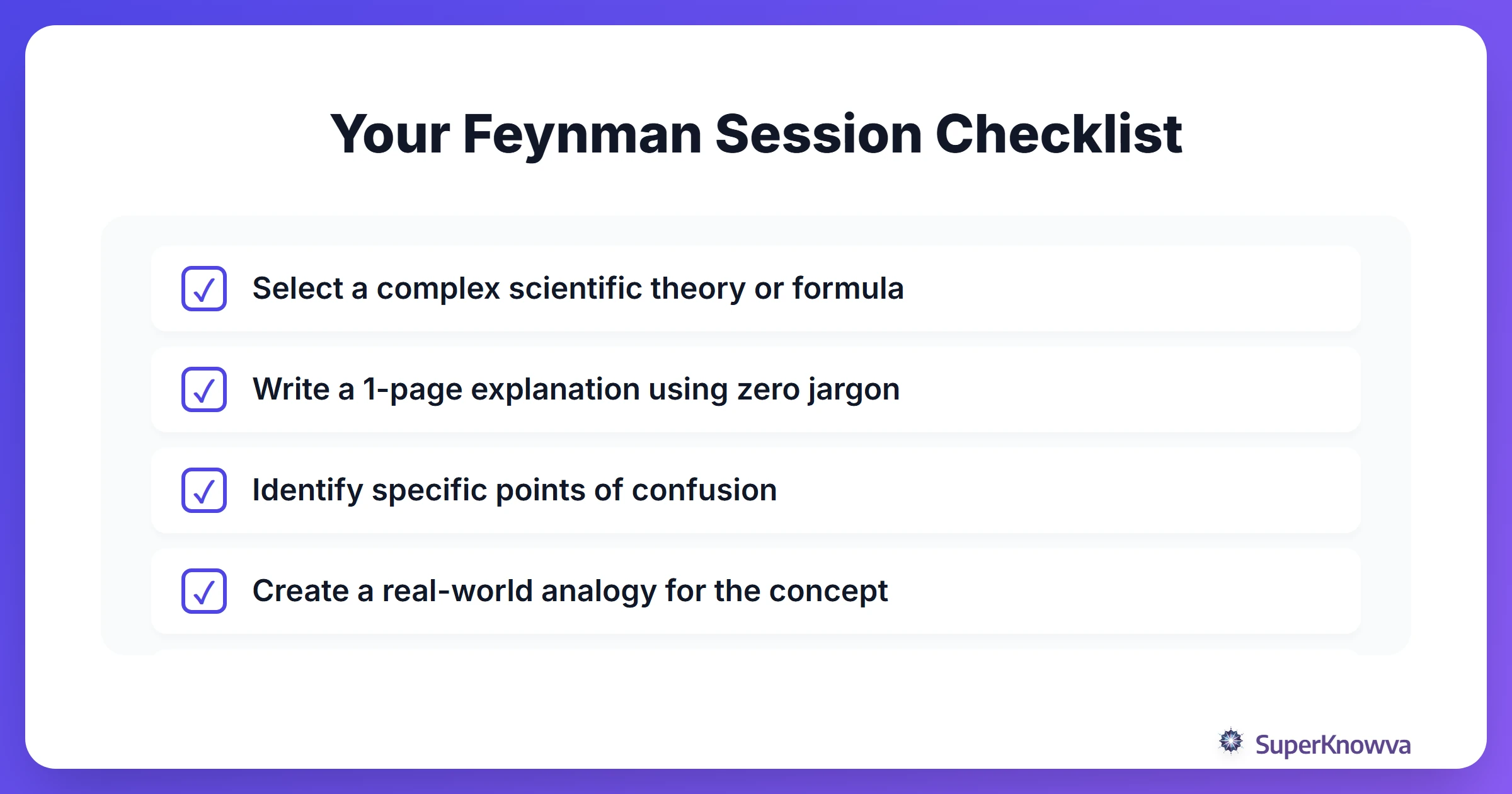
First things first: be specific. Don't try to "learn biology" in one afternoon. Instead, pick a single mechanism, like Action Potentials or the Laws of Thermodynamics.
Once you’ve got your topic, try the "Toddler Test." Imagine you’re explaining this to a 10-year-old. Grab a blank sheet of paper and write out the explanation using zero jargon. If you find yourself reaching for big words like "depolarization" or "enthalpy," stop. Force yourself to use plain English. While we’re talking about science here, you can apply the core principles of The Feynman Technique: How to Learn Anything Faster to just about any subject.
Simple language is the ultimate proof of mastery. If you can’t explain it without the technical fluff, you don't own the knowledge yet.
Step 2: Identify Your Knowledge Gaps
As you’re writing your explanation, you’ll eventually hit a wall. You might understand how a process starts and how it ends, but the middle feels like a "black box." This is actually the best part of the feynman technique science exam prep process.
That moment of "wait, how does that work again?" is your "Aha!" moment. Don't ignore it. Document those gaps specifically. Are you shaky on how the sodium-potassium pump resets? Do you lose the logic when the Krebs cycle transitions to the electron transport chain? By pinpointing exactly where you're lost, you stop wasting time re-studying the stuff you already know.

Step 3: Go Back to the Source Material
Now that you have a "missing persons" list for your knowledge, it’s time for a targeted deep dive. Head back to your textbooks or lecture notes, but do it with a mission. You aren't just reading anymore; you’re hunting for the "Why" behind the gaps you found in Step 2.
If the sheer volume of your science finals is making you want to hide under the covers, understanding the science of overcoming procrastination can help you actually get started. Use this phase to refine your explanation until the logic flows perfectly. You’re weaving new info into what you already know, which is exactly how long-term memory is built.
Step 4: Simplify and Use Analogies
The final step is to make it stick using analogies. Science is often abstract and hard to visualize. Analogies provide the "hooks" your brain needs. For example, think of a cell like a tiny factory: the nucleus is the boss’s office, and the mitochondria are the generators keeping the lights on.

Read your simplified explanation out loud. If it sounds clunky or confusing, simplify it again. By the time you’re done, you should have a "cheat sheet" of concepts stripped down to their core. Visualizing these simplified concepts through mind mapping can also help you see how different scientific laws connect, giving you a bird’s-eye view of the whole subject.
Combining Feynman with Other High-Performance Strategies
The Feynman Technique is a powerhouse, but it’s even better when you pair it with other active learning habits.
- Active Recall & Spaced Repetition: Take your simplified "Why" and turn it into flashcards.
- The Blurting Method: Need a quick logic check? Many students combine Feynman with The Blurting Method for a high-intensity review session.
- Teach-Back Sessions: Grab a study group. Assign everyone a chapter to "Feynman" to the rest of the class.
Even the University of York recommends this technique for high-stakes revision because it builds real confidence. It’s no wonder it’s consistently ranked among the top study methods for science students across the globe.
When you force yourself to teach what you’re learning, you aren't just memorizing facts for a test. You’re building mastery that lasts long after the final exam is over.