For many students, the leap from high school algebra to university-level thermodynamics or multi-variable calculus doesn't feel like a step. It feels like a freefall.
The abstract nature of these subjects creates a massive barrier to entry. Textbooks try their best, but static pages often fail to explain the "why" behind a complex formula. This is where AI in STEM education changes the game. By turning rigid equations into dynamic, interactive experiences, generative AI is helping students move past rote memorization and toward actual intuition.
At SuperKnowva, we believe mastering STEM shouldn't feel like decoding an ancient, forgotten language. In this post, we’ll look at how generative AI is reshaping the way we learn, from the behavior of subatomic particles to the mechanics of the cosmos.
Visualizing the Invisible: AI in Organic Chemistry and Calculus
Spatial reasoning is the silent killer of many STEM dreams. In organic chemistry, for example, your success depends on your ability to visualize how a molecule rotates in 3D space to predict a reaction. For decades, students have relied on plastic ball-and-stick models or flat 2D drawings that barely tell the whole story.
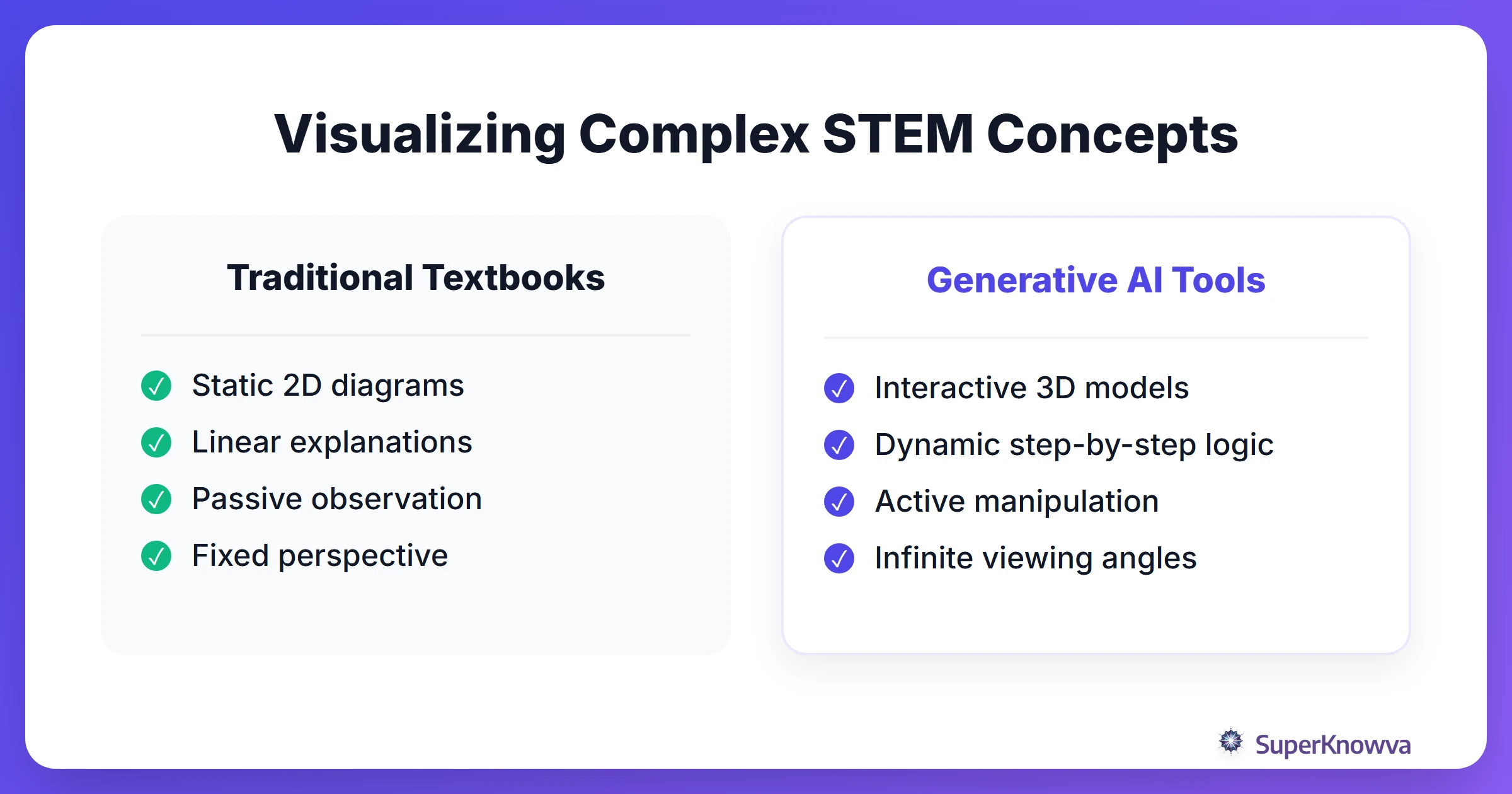
Now, organic chemistry AI visualization tools allow you to convert a simple chemical formula into an interactive 3D model instantly. You can twist it, turn it, and watch it react in real-time.
This shift is just as powerful in math. Generative AI can take a complex calculus derivative and break it down into visual steps, showing exactly how a tangent line moves along a curve. For AI for visual learners, this makes abstract concepts feel tangible. Recent case studies show that students using AI-augmented visualization see a significant jump in success rates, especially in subjects where "seeing" the problem is half the battle.
Personalized STEM Pathways: The Rise of AI Tutors
The "one-size-fits-all" lecture is where students get lost. If you blink during a crucial concept in week three of physics, every week after that becomes a struggle. This is where having an AI calculus tutor or a physics-specific model becomes a lifesaver.
Unlike a human tutor who might be available for one hour on a Tuesday, AI provides a 24/7 feedback loop.
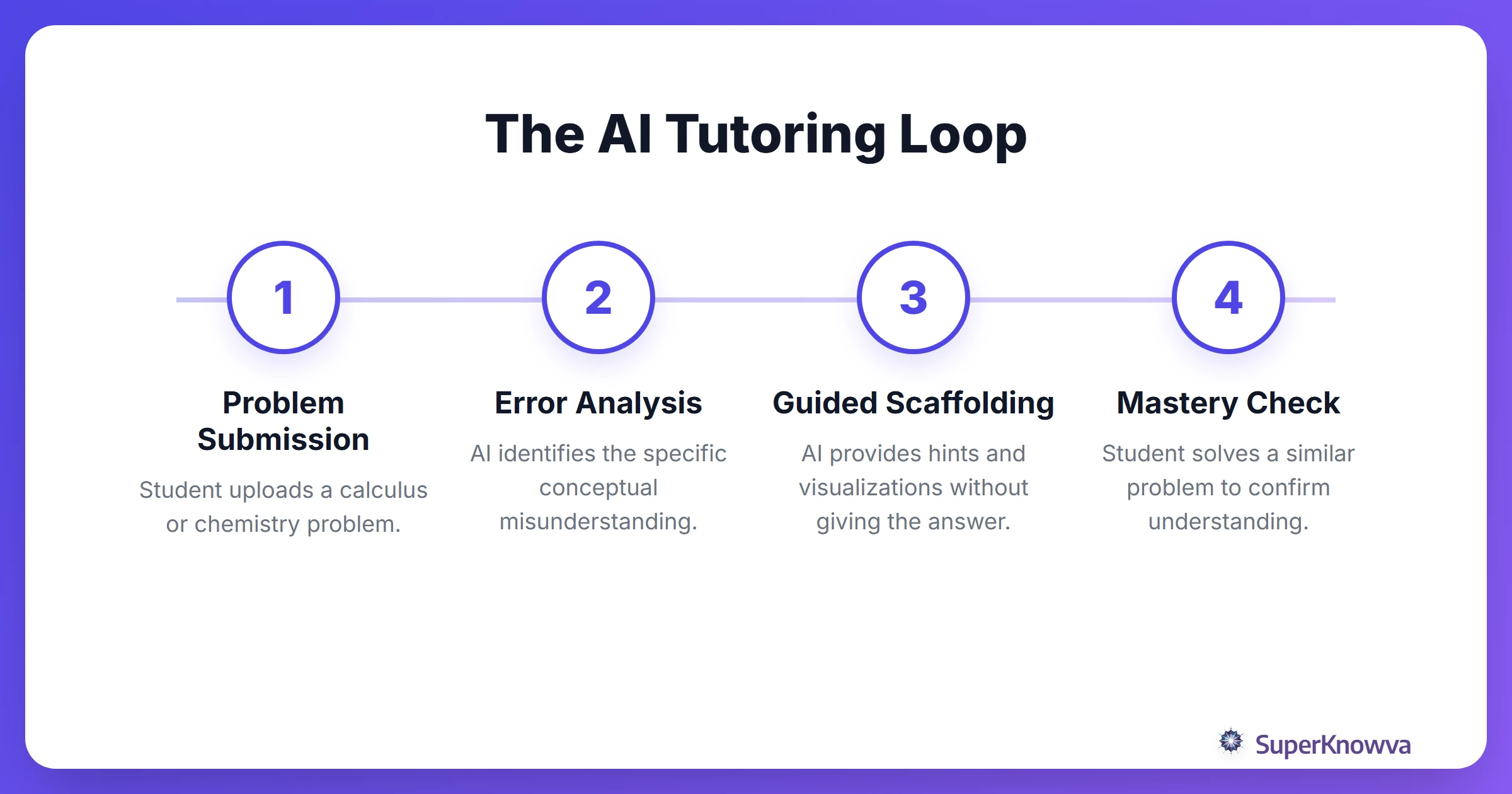
These tutors are excellent at spotting exactly where you went off the rails. If you’re struggling with an integral, the AI doesn’t just hand you the answer. It uses scaffolding to guide you through the algebra steps you might have forgotten. It’s a low-stakes environment. You can fail, iterate, and ask "stupid" questions without judgment, building the confidence needed to master advanced STEM learning tools.
Bridging the Gap with AI-Powered Science Simulations
Lab time is the best part of STEM, but it’s also the most expensive and time-consuming. You can't exactly "experiment" with nuclear decay or high-pressure chemical synthesis in a standard classroom.
Generative AI has evolved basic virtual labs into high-fidelity AI science simulations. These are digital sandboxes where you can break things without the consequences.
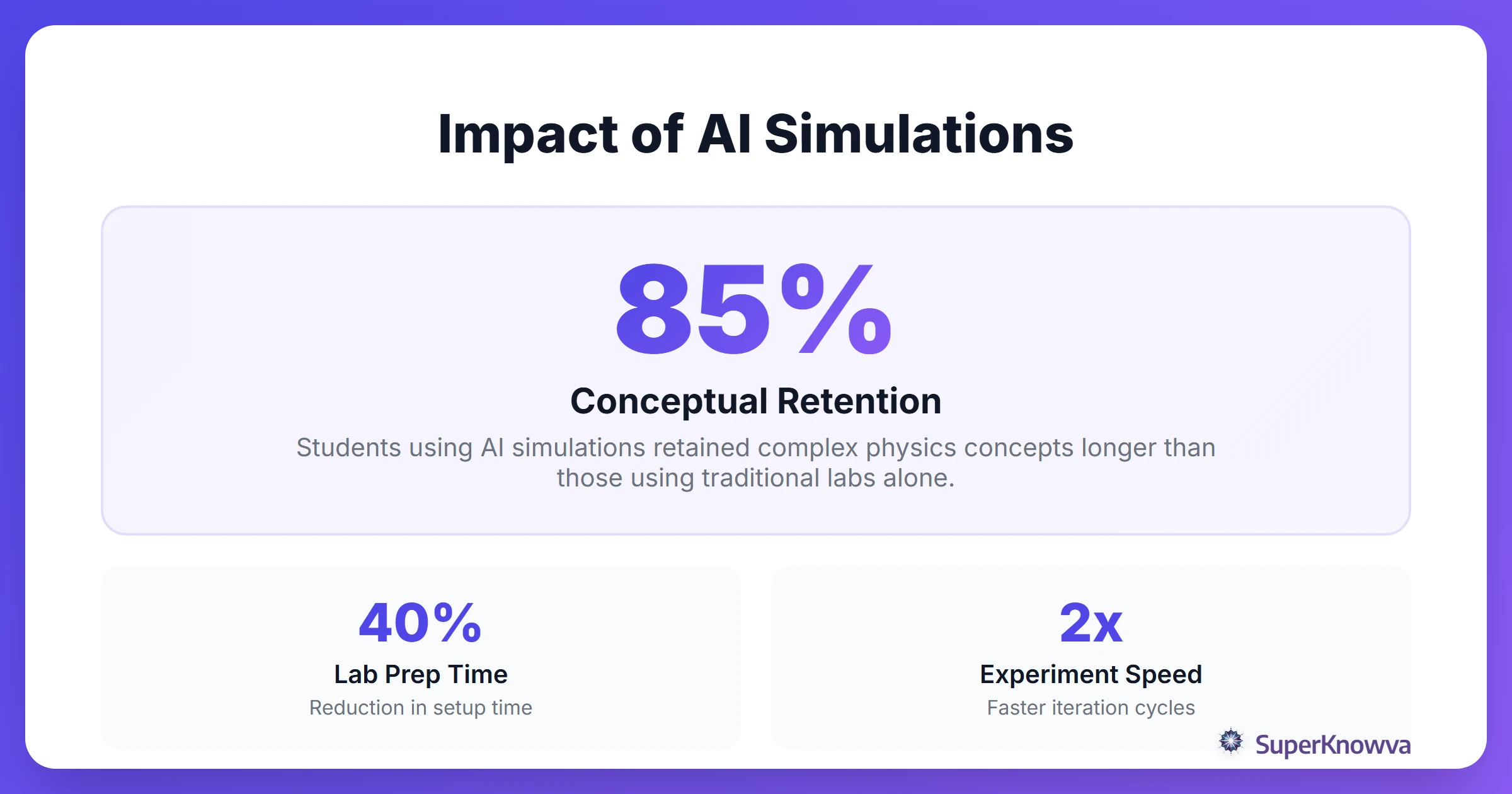
What happens if you crank the friction coefficient to the max in a mechanics simulation? The AI recalculates the outcome instantly. This "what-if" approach is at the heart of AI for science simulations. It builds a deep, gut-level intuition for scientific principles so that when you finally step into a physical lab, you already know how the world works.
AI in Higher Education: From Admissions to Research
Beyond the classroom, generative AI for science is overhauling the backend of higher education. STEM departments are using AI to handle the paperwork mountain, freeing up faculty to actually mentor their students.
In undergraduate research, AI accelerates the research process. It analyzes large datasets and identifies patterns in seconds, completing tasks that previously required months of manual labor from graduate students.
According to NORC Research: AI in STEM Higher Education, we are seeing a major shift toward "AI-augmented" degrees. Engineering programs are now using AI-driven advising to help students manage tricky prerequisites and find research opportunities that actually fit their goals. The goal is simple: ensure the next generation of scientists isn't just using AI, but is fluent in it.
Ethics of AI in STEM
Progress requires responsibility. Implementing AI in STEM presents real challenges. These include the risk of algorithmic bias, where an AI might repeat errors found in old scientific data, and the need for strict data privacy.
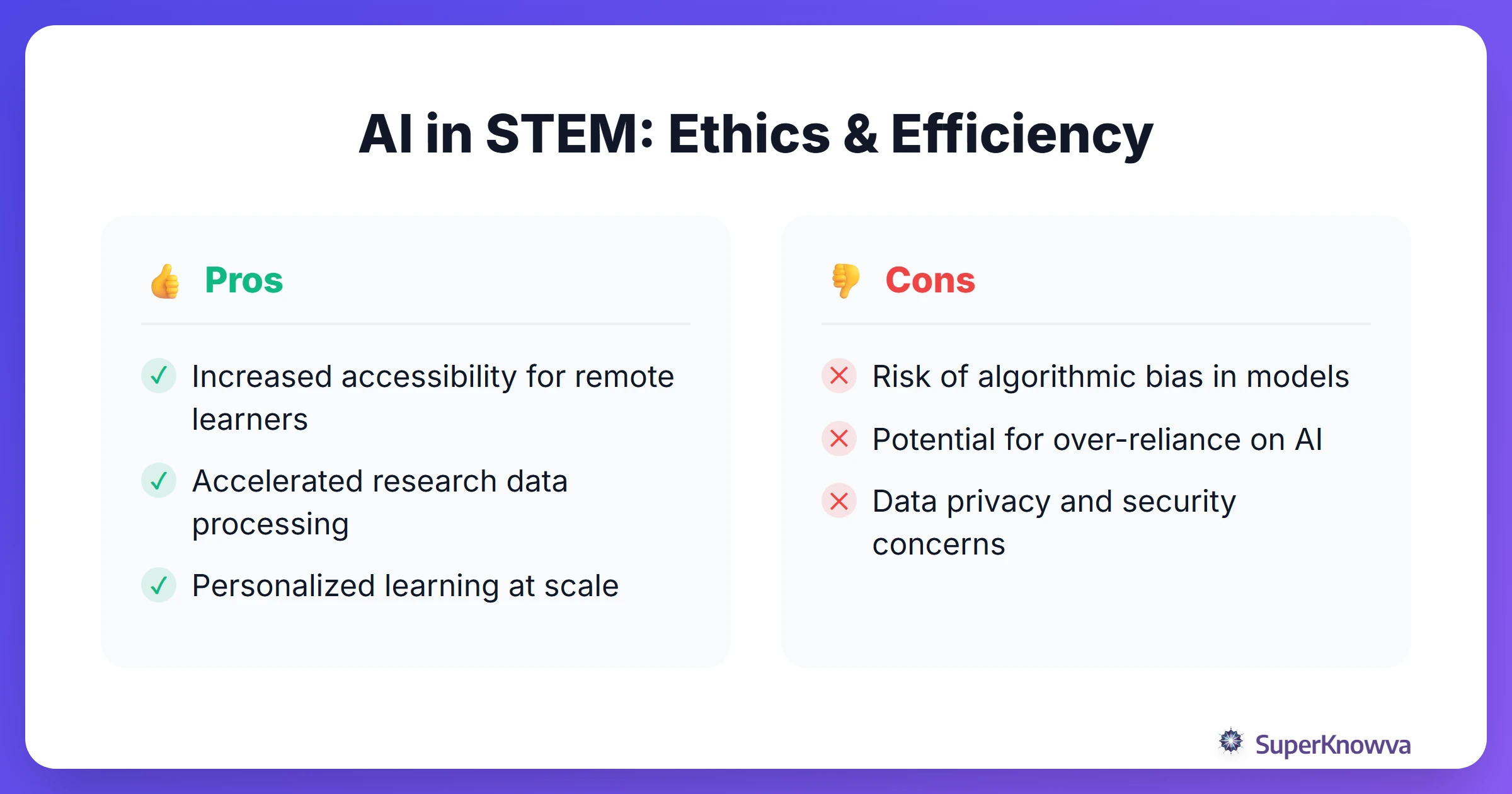
The solution? A "human-in-the-loop" approach. We need educators to oversee AI outputs to ensure accuracy and encourage AI for creative problem solving rather than just letting a tool do the thinking. We also have to ensure that high-end AI tools don't just go to the wealthiest schools. Scientific literacy shouldn't be determined by a zip code.
The Future of the STEM Workforce: NSF and K-12 Initiatives
This transformation is starting earlier than you might think. National initiatives, like the NSF AI Education Funding Opportunities, are pouring resources into "Advancing Artificial Intelligence Education for American Youth."
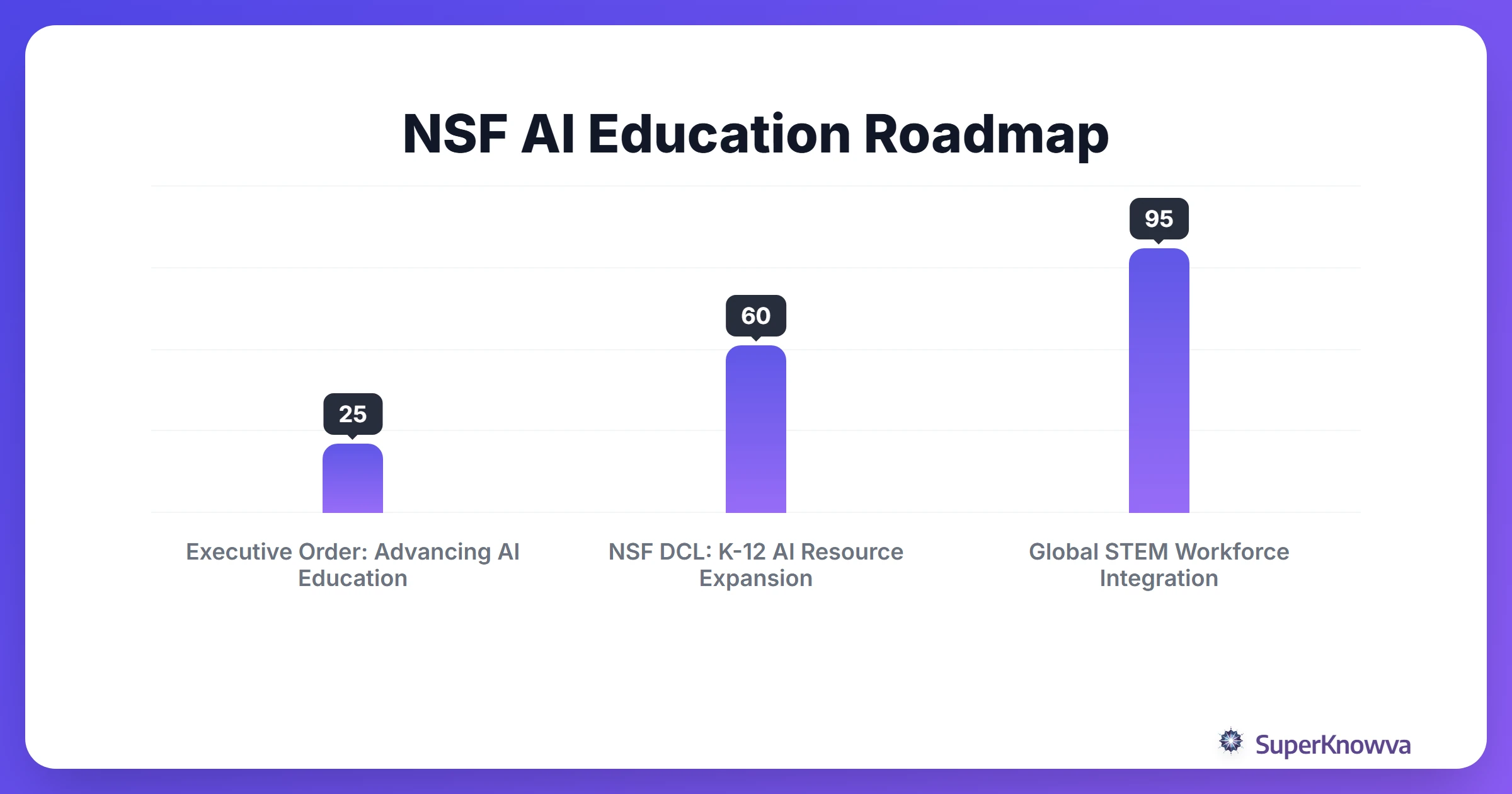
The mission is to prepare K-12 students for an AI-integrated economy before they reach college. By teaching AI literacy early, we ensure graduates are ready to use these tools to address global challenges such as climate change and medicine.
At SuperKnowva, we are proud to be part of this progress. Whether you are balancing your first chemical equation or tackling triple integrals, our AI-powered platform is designed to help you visualize, understand, and master your STEM studies.