Let’s be honest: for most premeds, the CARS section feels like a personal attack. You’ve spent years mastering organic chemistry and physics, only to be tripped up by a 600-word essay on 18th-century French pottery or the nuances of literary deconstruction.
It’s the one part of the exam where your science brain actually works against you. You can’t memorize your way to a 132 here. Instead, you have to change how you think. This is exactly why an mcat cars section ai tutoring strategy is becoming the go-to move for students stuck in a score plateau.
In this guide, we’ll break down how to use AI to decode dense passages, spot logic traps, and finally stop overthinking every single answer choice.
Why the CARS Section is the Ultimate MCAT Gatekeeper
CARS is often the most critical part of a medical school application. It's the only section where outside knowledge is a liability. If you bring your own opinions or facts into a passage, you've already lost. You must rely entirely on what's on the screen, nothing more and nothing less.
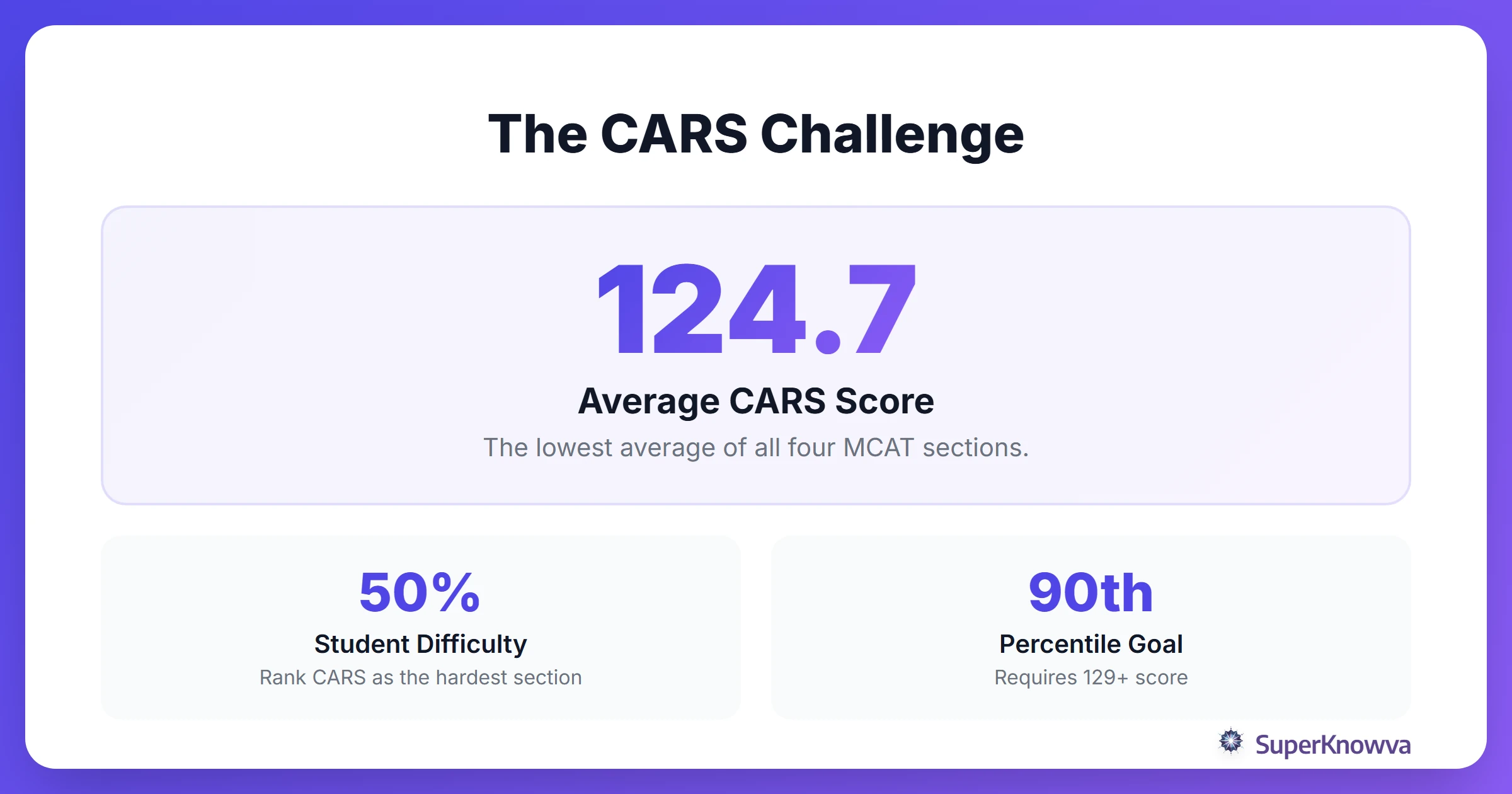
Most students fall into the same three traps:
- The "Outside Info" Trap: Bringing in personal bias or facts the author never mentioned.
- The Clock: Getting paralyzed by a dense paragraph and watching five minutes vanish.
- The Logic Gap: Struggling to see why an author is making a specific claim.
Rote memorization is useless here. That’s why ai mcat prep is so effective. It provides a logic-based framework that helps you strip away the "fluff" and see the skeleton of an argument, much like the MCAT Ethics & Reasoning skills you need for the behavioral science sections.
Active Reasoning: How AI Tutors Transform Your Reading Style
To beat CARS, you can’t just read the text; you have to interrogate it. Most students read a passage and hope for the best. With an AI tutor, you can turn mcat passage analysis into a real-time conversation.
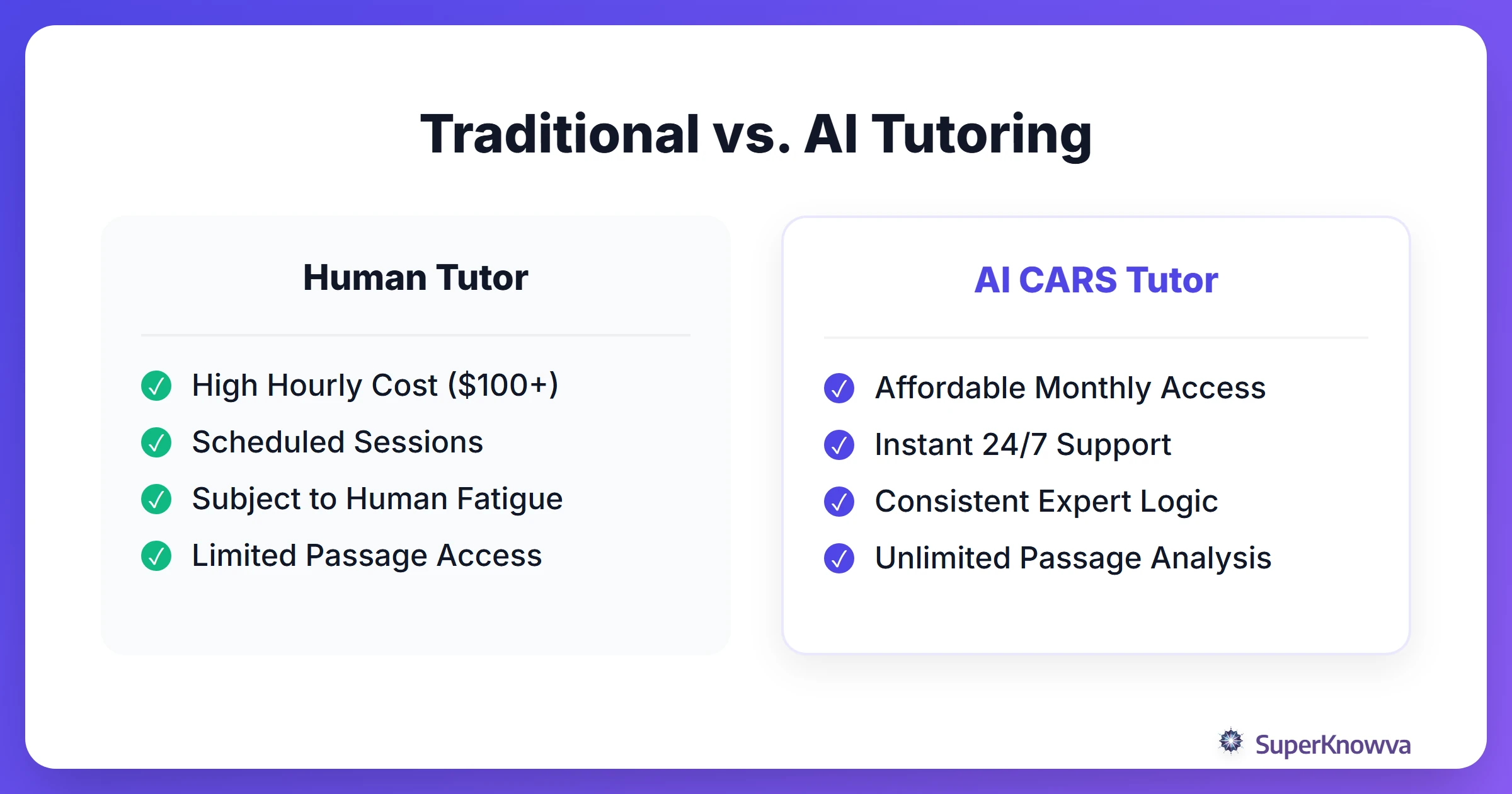
By using tools like Blueprint Prep AI Tools or specialized platforms like CARS Unlimited by IFD, you can train your brain to spot expert-level logic. Instead of just staring at the words, you start asking the right questions: Why this specific word? Where is the "pivot" in this argument? What is the author actually trying to prove?
Using AI to build a "mental map" of a passage creates a visual architecture of claims and evidence. This is the same type of active engagement used in AI for Reading Comprehension for other high-stakes exams.
Deconstructing Complex Passages with AI Dialogue
One of the best ways to use a personalized mcat tutor powered by AI is to treat it as a sounding board. When you hit a passage about "Phenomenology" or "Post-Structuralist Economics," the jargon can feel like a brick wall.
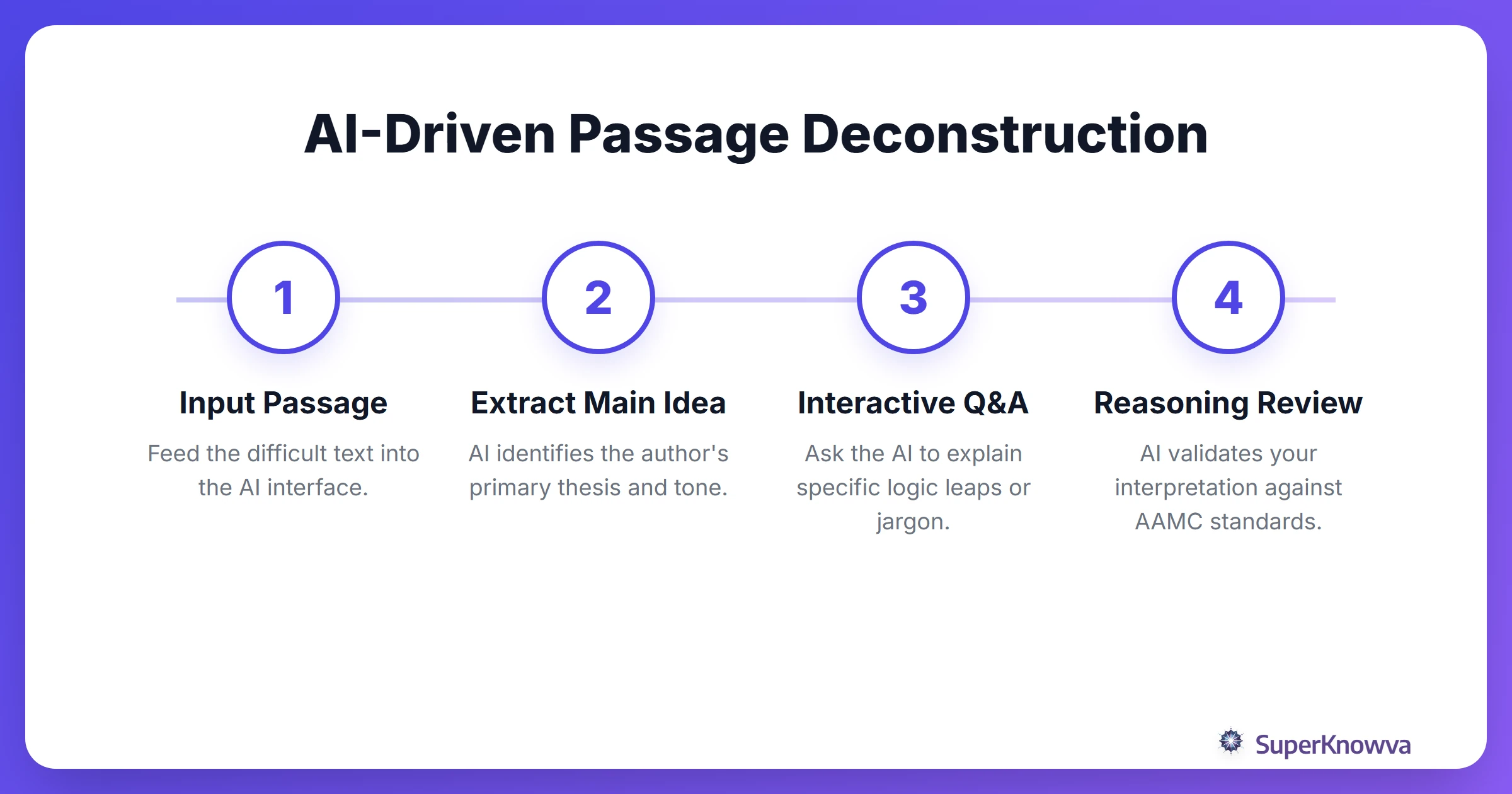
Try this step-by-step strategy to break down the text:
- Paste the Text: Throw a confusing paragraph into the AI.
- Check the Tone: Ask, "Is the author being sarcastic, objective, or critical?"
- Kill the Jargon: Use an "Explain Like I’m Five" (ELI5) prompt to turn dense humanities concepts into plain English.
- Find the Anchor: Ask the AI to summarize the main thesis in a single, simple sentence.
This isn't about taking a shortcut. It’s about learning how to digest core arguments so you can eventually do it on your own during the real deal.
Identifying Logic Patterns and Question Traps
The AAMC doesn't just ask questions; they set traps. They love "distractor" answers: choices that sound perfectly reasonable in the real world but aren't supported by the passage. AI helps you categorize these:
- Foundations of Comprehension: The "what did they actually say?" questions.
- Reasoning Within the Text: How does Paragraph A support Paragraph C?
- Reasoning Beyond the Text: If the author saw a new study, how would they react?
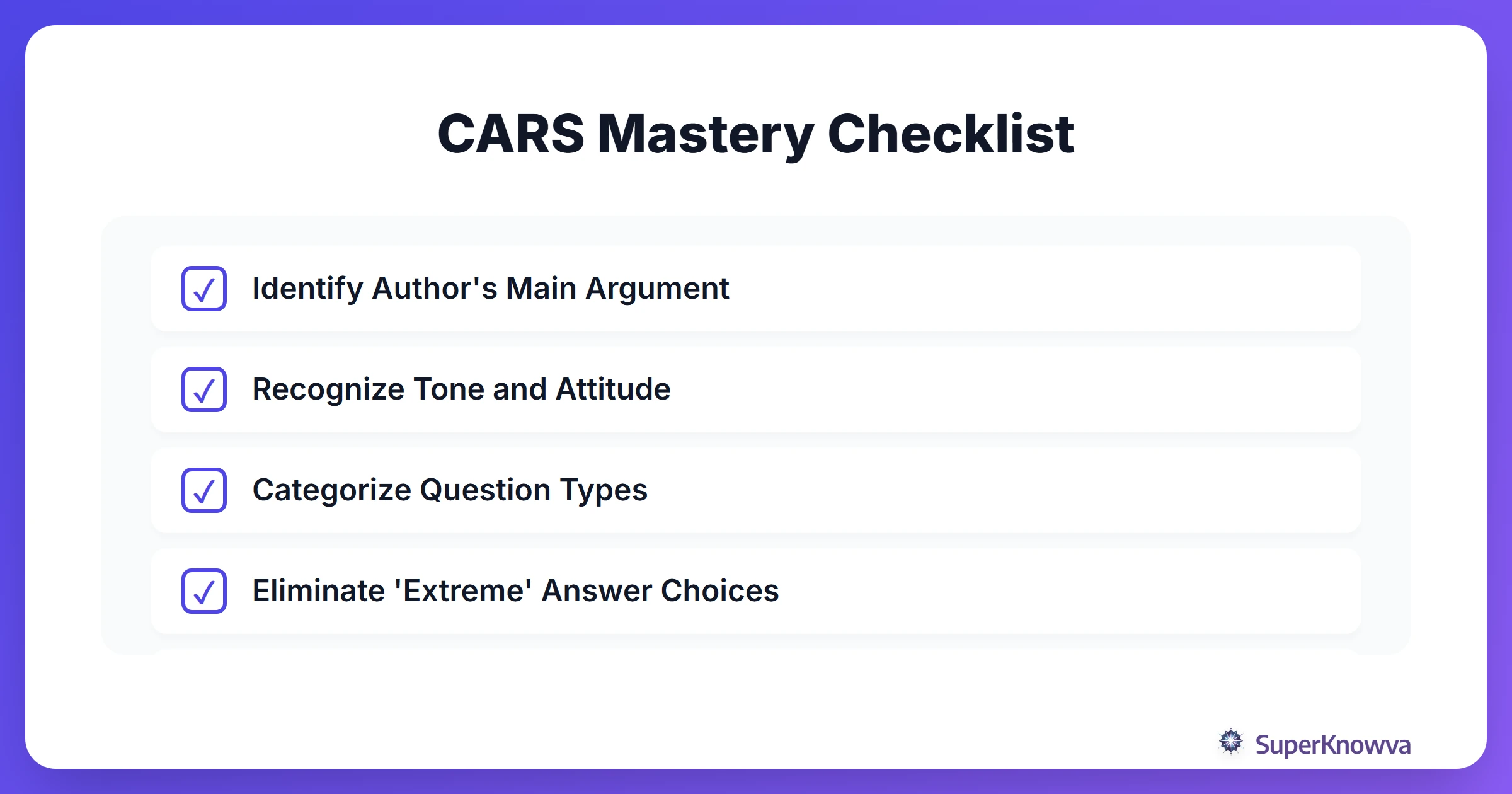
Use AI to perform a "logic autopsy" on your practice exams. If you missed a "least/except" question, ask the AI to point out the specific evidence for the three correct answers. This trains your eyes to look for the literal evidence the AAMC requires.
The 24/7 Feedback Loop: Personalized CARS Coaching
The biggest perk of mcat cars section ai tutoring? It’s always there. A human tutor is great, but they aren't sitting next to you at 11:00 PM when you’re struggling with a philosophy passage.
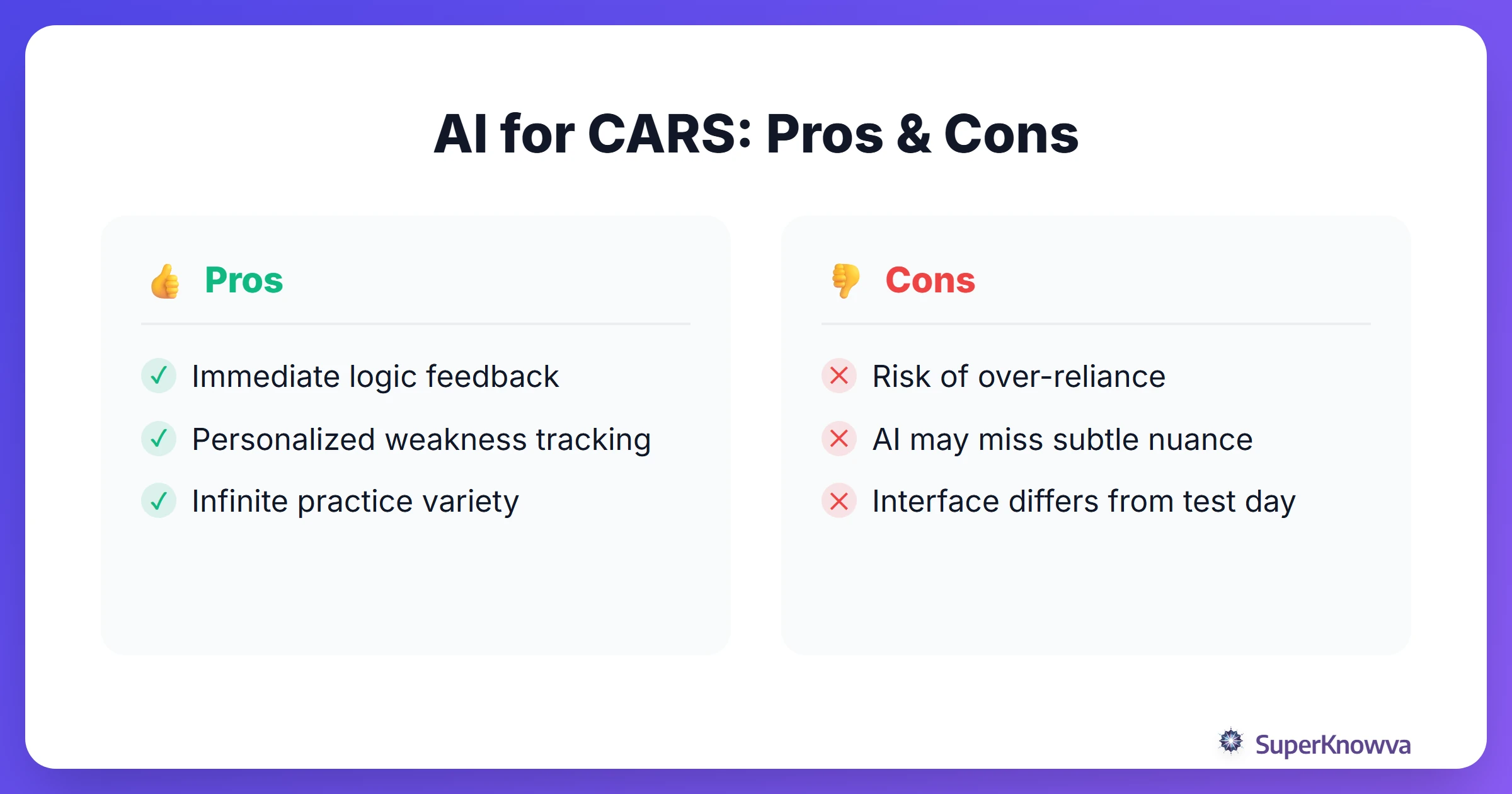
Personalized AI Feedback allows you to:
- Spot Your Weaknesses: Are you a pro at history but failing every philosophy passage? AI tracks the trends you might miss.
- Fix Your "Extreme" Bias: Do you keep picking answers with words like always, never, or only? AI can flag that habit and remind you to look for more moderate language.
- Scale Your Speed: Start with slow, AI-assisted breakdowns and gradually move toward timed, independent practice as your "logic muscles" get stronger.
Integrating AI into Your Study Plan
AI is a powerful supplement, but it doesn't replace official AAMC materials. To see a real jump in your score, try this daily routine:
- The Practice: Do 2-3 passages from official AAMC resources.
- The Review: For every question you missed (or even guessed on), use the AI to walk through the logic of the right answer.
- The Weaning: As test day gets closer, stop using the "ELI5" prompts. You need to be the one doing the heavy lifting under pressure.
Students using AI-driven strategies have seen their CARS scores jump 5+ points just by learning how to consistently find the "Main Idea." Treat the mcat verbal reasoning section like a logic puzzle rather than a reading test, and you’ll turn the MCAT's biggest gatekeeper into your biggest advantage.