Ever had that slightly eerie feeling when your study app knows exactly which concept you’re about to fail before you even take the quiz? It feels like mind-reading, but there’s no crystal ball involved. It’s all down to neural networks and learning models.
These systems are the heavy-duty engines driving modern education technology. They’re the reason platforms like SuperKnowva can ditch the "one-size-fits-all" textbook approach and give you a study plan that actually fits your brain.
In this guide, we’re opening up the hood. We’ll look at how these digital "brains" function and how they’re turning your late-night study sessions into high-speed lanes to mastery.
The Biological Blueprint: From Brains to Bits
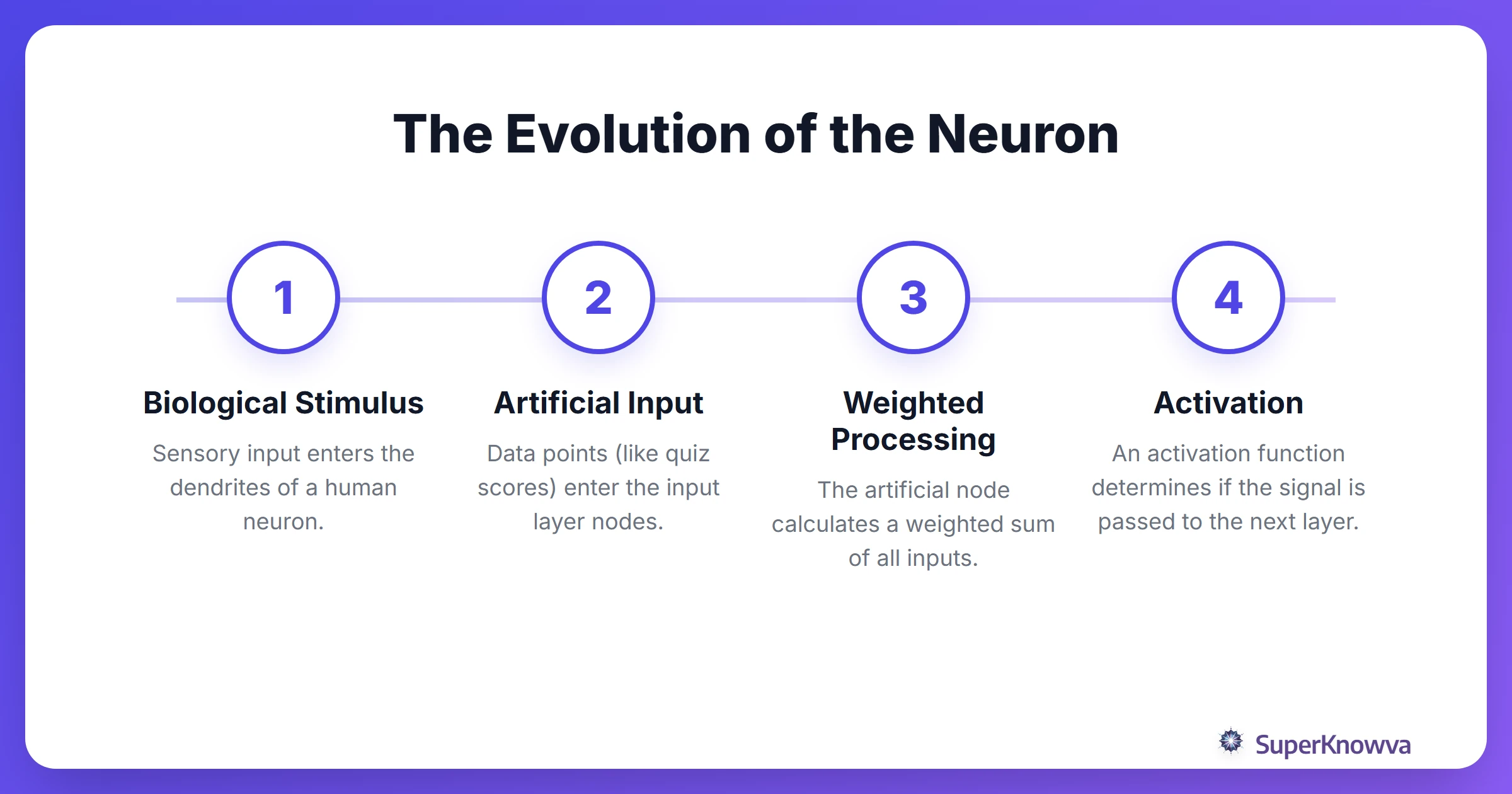
At their simplest, artificial neural networks are just a digital riff on the human brain. Your brain is a massive web of billions of neurons firing signals to one another. An AI model works similarly, built from "nodes" (our version of artificial neurons).
Think of the move from biology to bits in three simple steps:
- Input: An artificial neuron grabs a piece of data.
- Processing: The node crunches some numbers.
- Output: It passes the result down the line to the next layer.
SuperKnowva acts as the translator here. We take these complex mathematical structures and turn them into tangible benefits for you. You don’t need to worry about the calculus or linear algebra happening behind the scenes; our models do that heavy lifting so your study materials are organized exactly how your brain naturally absorbs information.
The Architecture of Learning: Layers, Weights, and Biases
If you want to understand neural networks and learning models, you have to look at the "sandwich" of layers that makes them work:
- Input Layers: This is the entry point. The model takes in your data, including everything from the PDF notes you uploaded to the time spent on a specific practice question.
- Hidden Layers: These layers perform the mathematical calculations to identify patterns that a human would likely miss.
- Output Layers: This is the final result, such as a prediction of exam readiness or a suggestion to study "Photosynthesis" for another ten minutes.
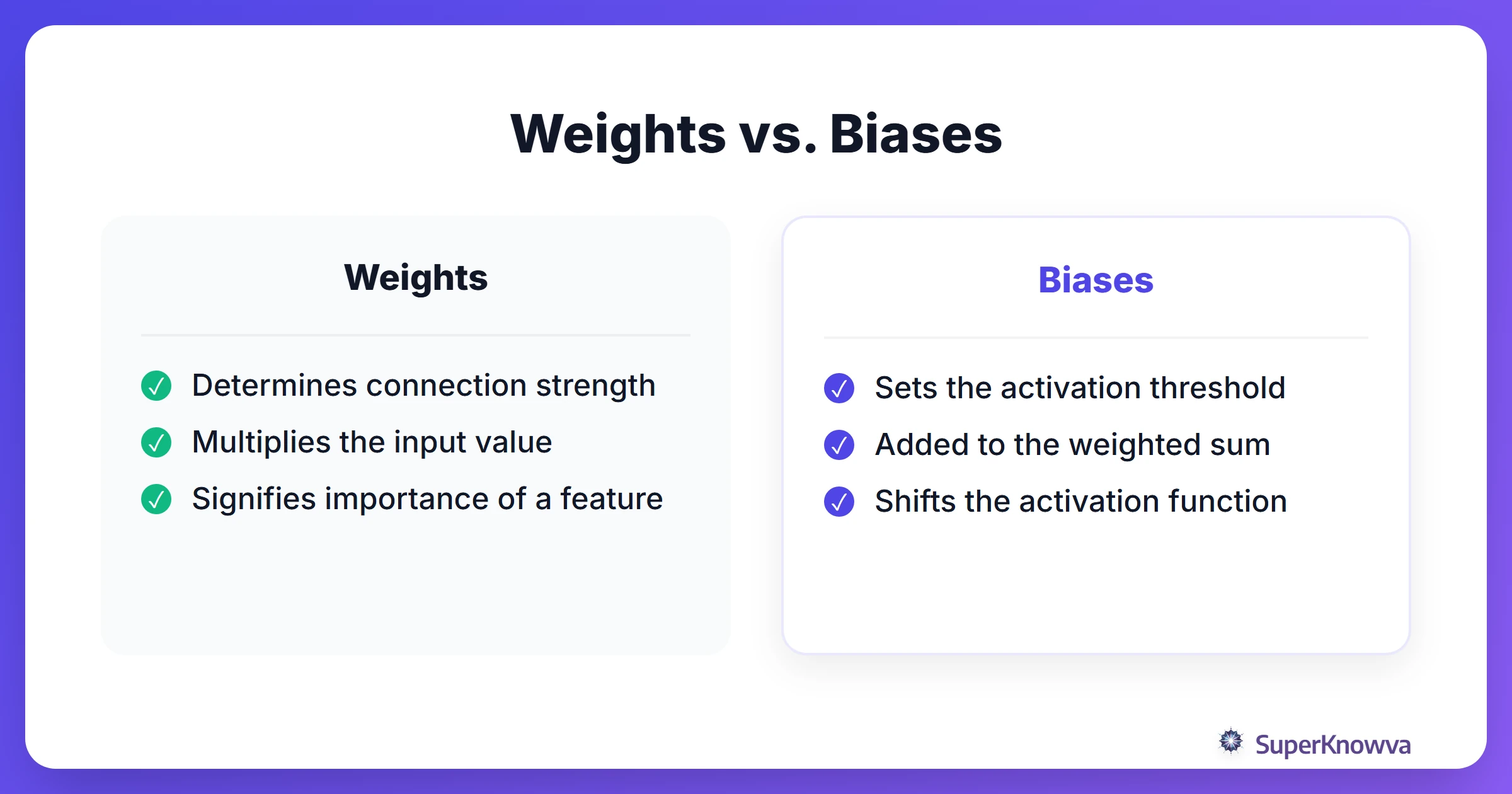
Inside these layers, Weights and Biases are the primary components. A weight acts as a volume knob the model adjusts to determine the importance of information, such as a recurring mistake on a specific topic. A bias functions as a threshold to help the model decide if a signal is strong enough to change your study path.
How Neural Nets Actually 'Learn': The Training Recipe
A neural network isn't born a genius. It starts out knowing nothing and has to be taught. As expert Andrej Karpathy points out in his famous A Recipe for Training Neural Networks, getting this right is an art form.
The "learning" happens in a constant loop:
- Loss Functions: The model makes a guess (e.g., "You’ve mastered Newton’s Laws"). The loss function measures exactly how wrong that guess was based on your actual quiz performance.
- Backpropagation Explained: This is the "aha!" moment. The network sends error signals backward through the layers to find out which "volume knobs" (weights) caused the mistake.
- Gradient Descent: The model nudges those weights just a tiny bit to make sure it doesn't make the same mistake twice.
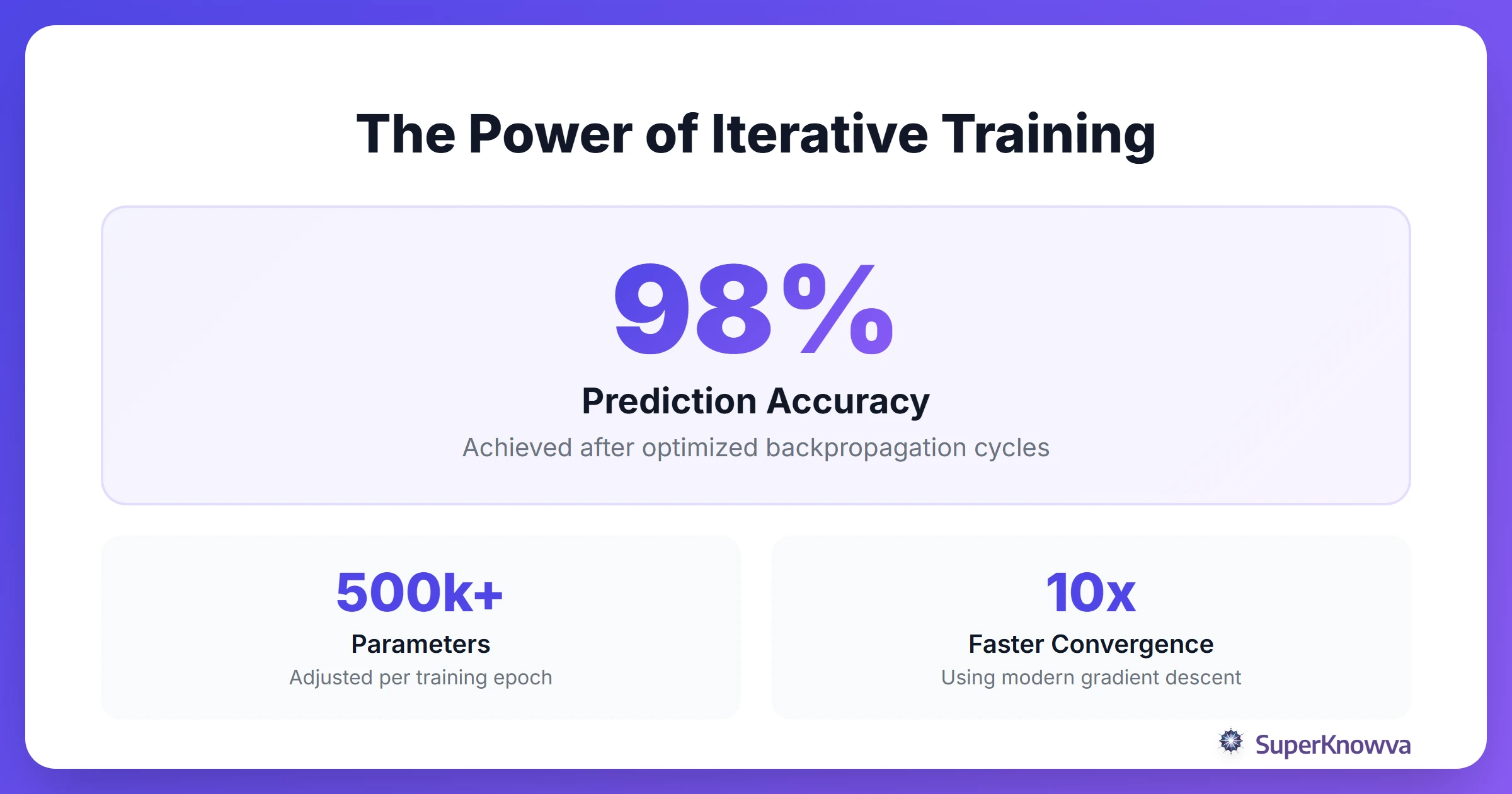
To get "state of the art" accuracy, you need massive datasets. By crunching millions of these data points, SuperKnowva’s models become incredibly precise at mapping out your exact progress.
Deep Learning vs. Traditional Machine Learning
People often use "Machine Learning" and "Deep Learning" as if they are the same. They are not. Traditional ML usually needs a human to do "manual feature engineering," where a person tells the computer what to look for.
Deep learning basics, however, are different. These models are self-sufficient; they discover patterns on their own. This is essential for AI in education because study materials are messy. Whether you’re uploading a textbook PDF, a recording of a lecture, or a photo of your handwritten notes, deep learning allows SuperKnowva to "read" and understand that content without a human having to categorize it first.
As IBM notes, Deep learning is a subset of machine learning driven by multilayered neural networks whose design is inspired by the human brain. The "Deep" just refers to the number of hidden layers. The more layers, the more sophisticated the understanding. This is a huge win for AI tools for visual learners who need complex diagrams broken down into simple, actionable steps.
SuperKnowva’s Secret Sauce: Personalized Study Paths
So, how does all this math actually help you get an A? SuperKnowva uses neural networks and learning models to build personalized study paths that change as you do.
- The Forgetting Curve: Our models map your specific memory decay. We know exactly when you’re about to forget a concept and ping you to review it right before it slips away.
- Predictive Analysis: We can often spot which concepts will trip you up before you’ve even opened the chapter, based on patterns from thousands of similar learners.
- Dynamic Adjustment: Every answer you give is a new data point. The model learns from you in real-time, moving you away from a boring "Chapter 1 to 10" grind and toward a high-efficiency mastery model.
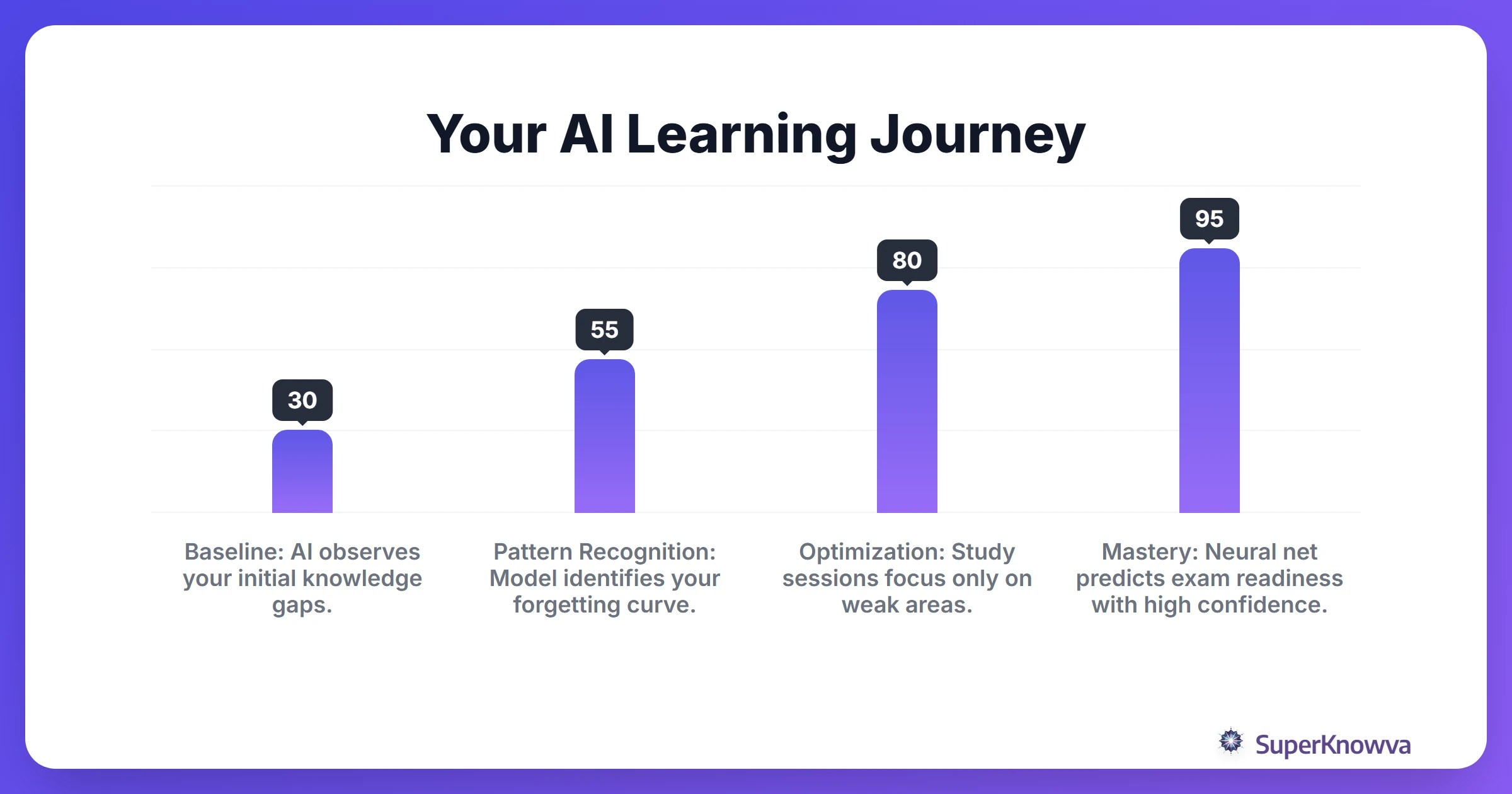
This is why the AI vs. human tutoring styles feel different. A human tutor uses intuition; the AI relies on data. It’s also what makes gamified AI learning platforms feel addictive. Adjusting your study path feels less like a chore and more like leveling up in a game.
Beyond the Basics: Physics-Informed Neural Networks (PINNs)
For science and engineering, we use Physics-Informed Neural Networks (PINNs). While standard neural networks learn from data alone, PINNs are "taught" the laws of physics (like gravity or thermodynamics) right from the start.
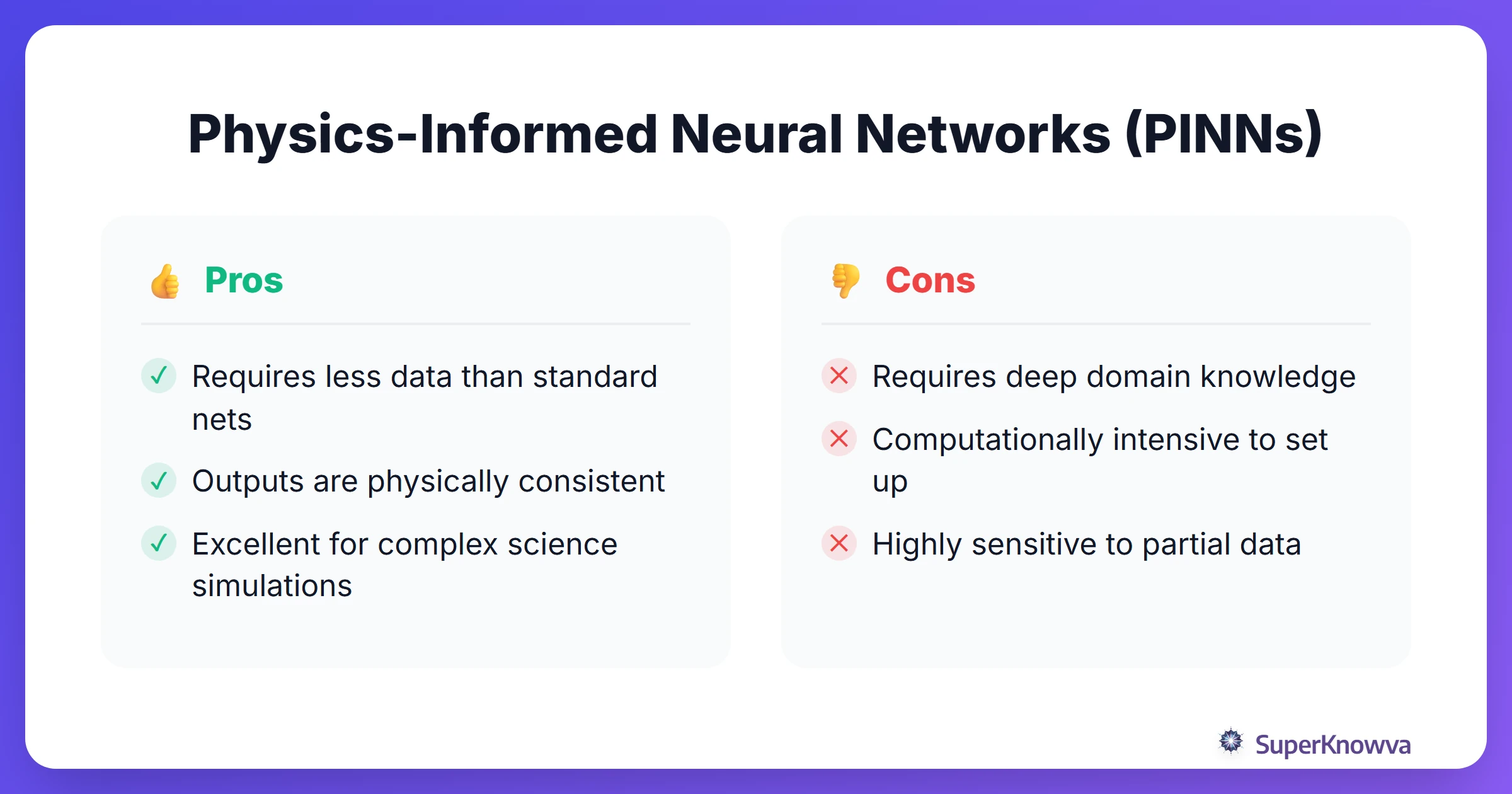
PINNs are effective because they go beyond pattern recognition to ensure answers remain physically possible. This positions SuperKnowva as a leader in AI for science simulations, providing a balance of flexible, data-driven learning and the established rules of the physical world.
By blending biological inspiration with raw computing power, SuperKnowva ensures your study time is never wasted. You aren't just working harder; you’re studying with the most advanced architecture on the planet in your corner.