Engineering coursework is a different beast entirely. We’ve all been there: frantically scribbling as the professor fills a third chalkboard with Greek symbols and vector fields. Between deriving second-order differential equations and sketching heat transfer gradients, the standard "outline method" used by your friends in the humanities simply falls apart.
To survive and actually understand the material, you need a specialized approach to note-taking for engineering students. It’s not about recording every word; it’s about precision, speed, and making sure that what you write today still makes sense during finals week.
The Engineering Challenge: Why Standard Methods Fail
Most of us start university using the same tactics we used in high school: transcription. You try to write down exactly what the professor says. In a Dynamics or Thermodynamics lecture, that is a one-way ticket to burnout.
The problem? Information density. Engineering lectures are a rapid-fire mix of verbal context, complex math, and multi-layered diagrams. If you spend three minutes perfecting the curve of a vector, you’ve already missed the fundamental principle that explains why that vector exists.
Passive transcription also creates a "fluency illusion." You feel like you’ve mastered the material because your notebook looks full, but you lack the deep conceptual grasp required to solve a problem from scratch. This is exactly why so many students are ditching paper for high-efficiency digital note-taking engineering systems.
Choosing Your Stack: The Best Apps for Technical Notes
Your "stack" needs to do two things: respect the tactile nature of drawing and offer the organizational power of a search engine.
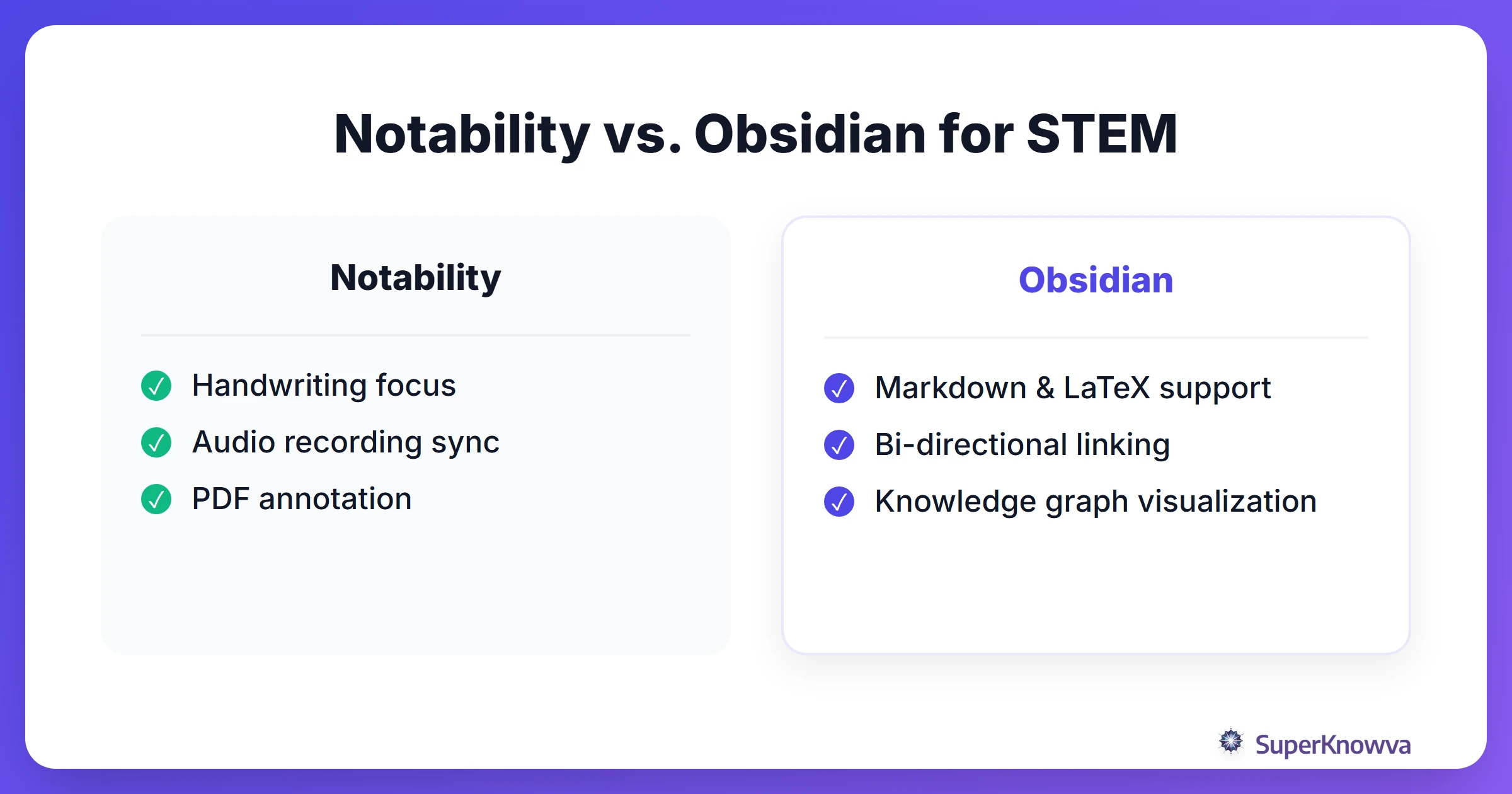
- Notability: Frequently ranked as one of the best note-taking apps for engineers, and for good reason. Its handwriting engine is smooth, but the real winner is the audio-syncing. If you’re reviewing a derivation and can’t figure out how Step A became Step B, you can tap your note to hear exactly what the professor was saying at that moment.
- Obsidian: If you like the idea of a "digital brain," Obsidian is the gold standard. It uses bi-directional links to connect notes, allowing you to build a personal Wikipedia of concepts.
- LaTeX and Markdown: It sounds intimidating, but learning basic LaTeX is a significant advantage. It allows you to type professional-grade formulas, such as the Navier-Stokes equations, into a searchable format that looks like it came straight out of a textbook.
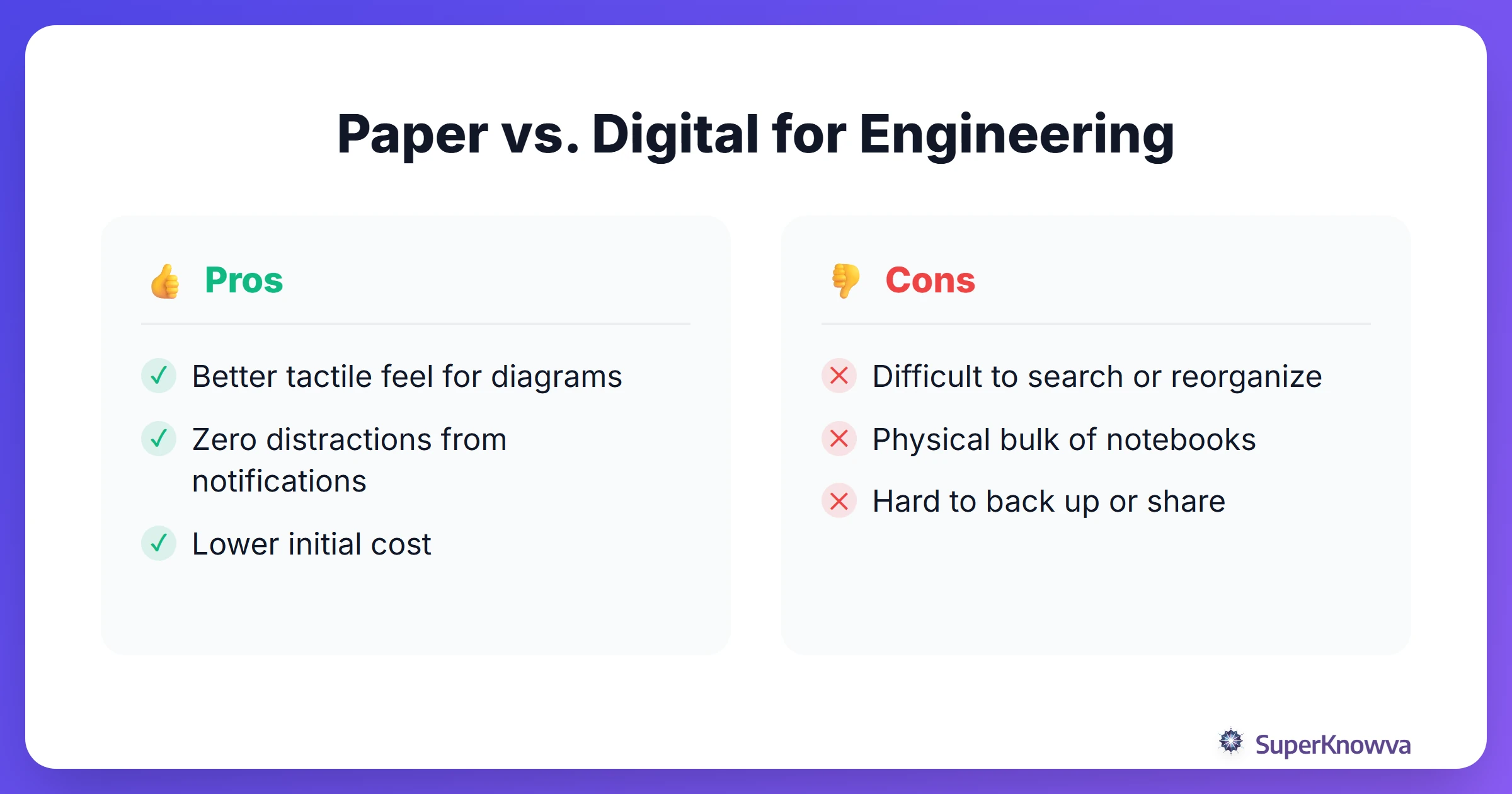
The choice usually comes down to muscle memory vs. searchability. Handwriting helps you internalize formulas, but typing makes those formulas searchable years later. Many top students use a hybrid workflow: handwrite the "messy" version during the lecture, then "clean" and organize it into Markdown later. For a deeper look at this, check out this Notability Blog: Engineering Student Interview.
Building an Engineering Second Brain
Engineering isn't just a collection of random subjects; it’s a web of interconnected laws. To manage this, try Building a Second Brain using the P.A.R.A. method.
Instead of filing notes by course codes (like MECH 201), try organizing them by fundamental principles. A note on "Conservation of Energy" shouldn't live in a silo; it should link to Physics, Fluid Mechanics, and Electrical Circuits. When you link concepts across disciplines, you stop memorizing edge cases and start understanding the "root" logic.
Visualizing Complexity: Diagrams and Mind Mapping
In this field, a picture is worth more than a thousand words. It is the key to the entire solution. You need to get fast at sketching circuit diagrams and free-body diagrams (FBDs).
Don’t start from a blank canvas if you don't have to. Most professors provide PDF slides. Import them into your app and annotate them. By letting the app handle the complex diagram, you can focus your energy on the "why" behind the labels.
If you’re struggling to see the big picture, try mind mapping techniques. A mind map can help you visualize how a Laplace Transform bridges the gap between a time-domain differential equation and a frequency-domain solution. It makes the abstract feel tangible.
Active Recall for Engineers: The "Pretty Note" Trap
Having "fancy notes" is a trap if they don't help you solve problems. Engineering exams don't care if you can read; they care if you can do.
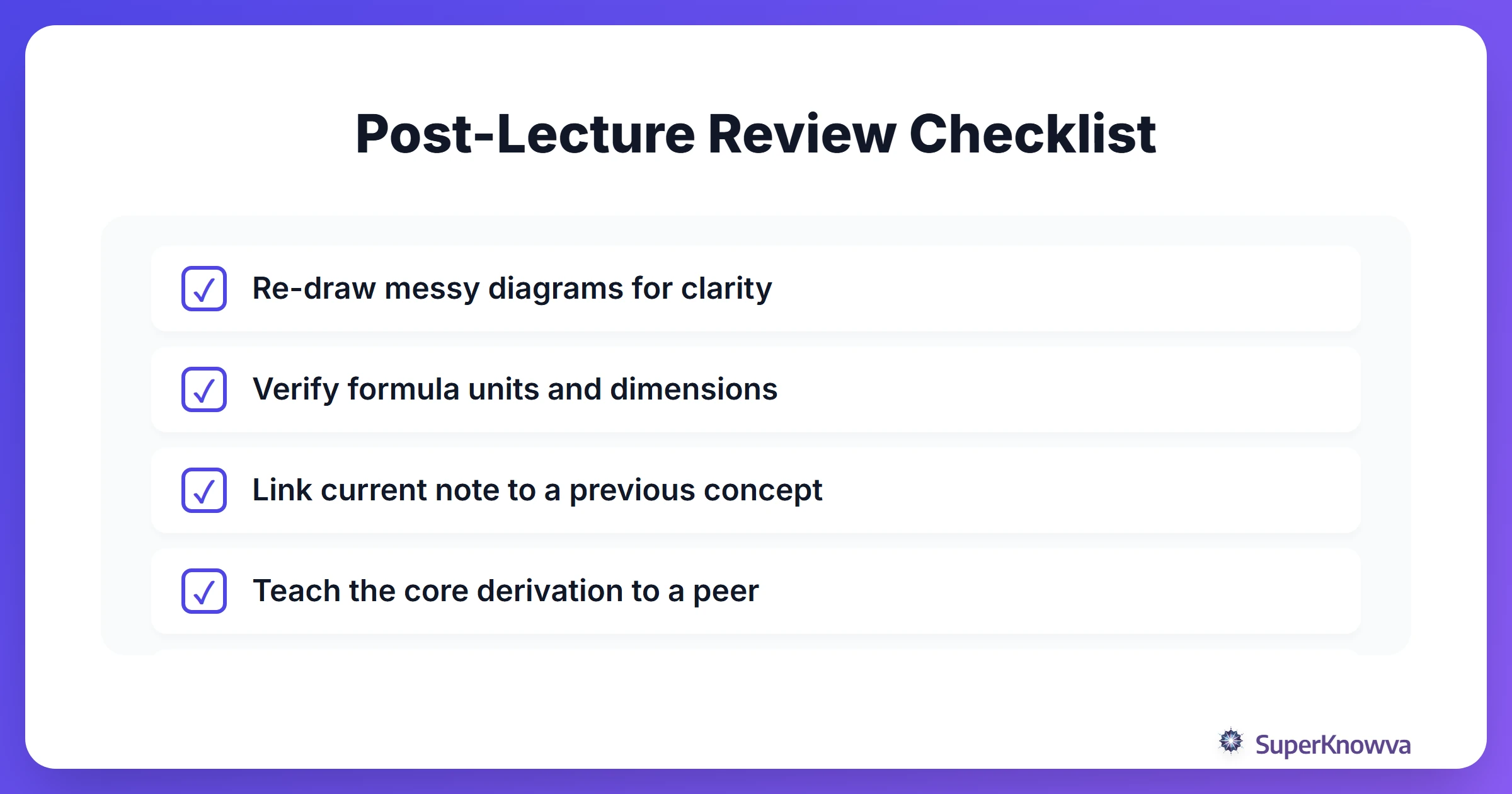
One of the best ways to test if you actually know a derivation is The Blurting Method. After class, close your laptop and "blurt" everything you remember about a specific concept onto a blank page. Then, check your notes to see what you missed. It’s painful, but it works.
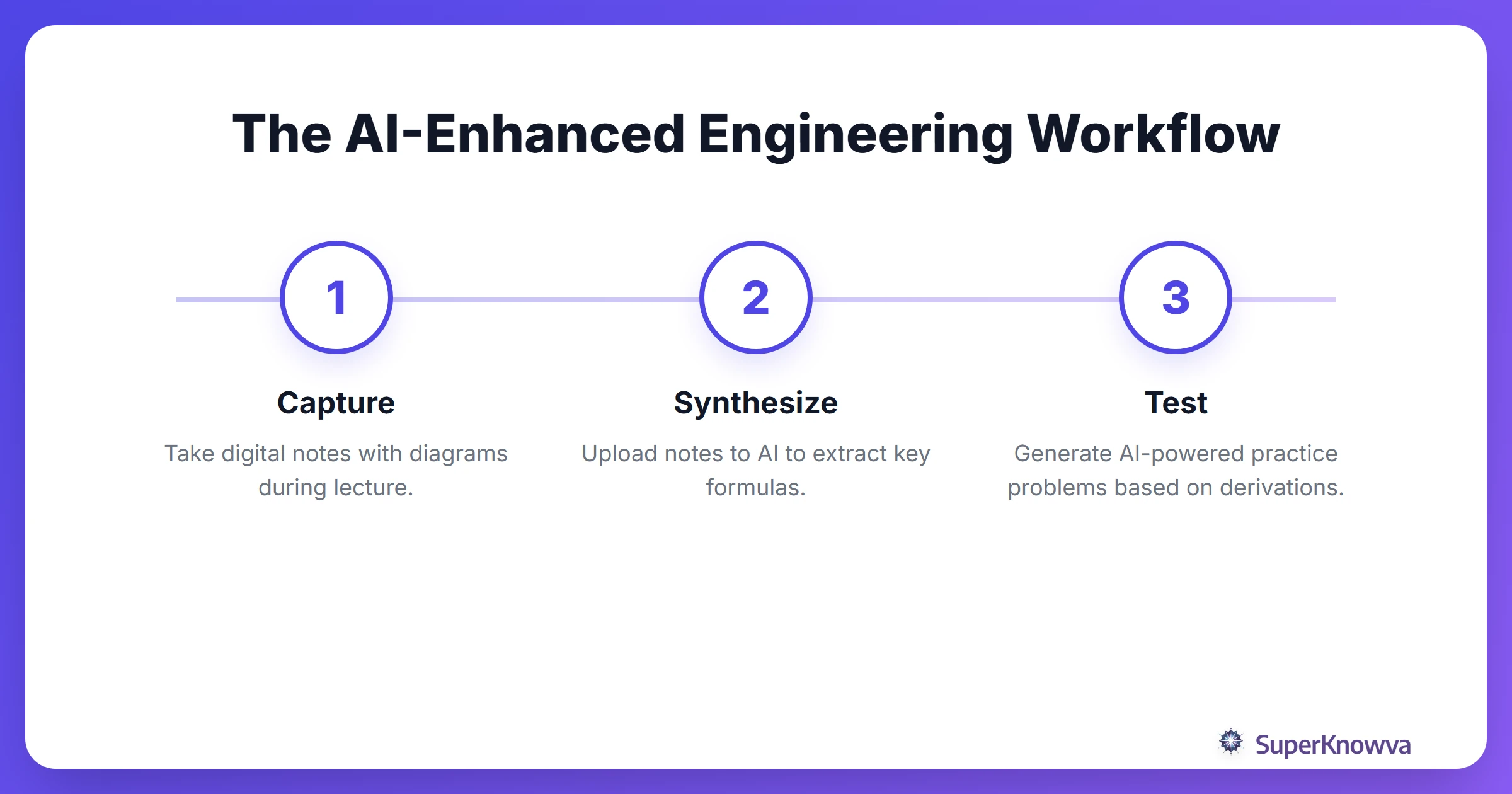
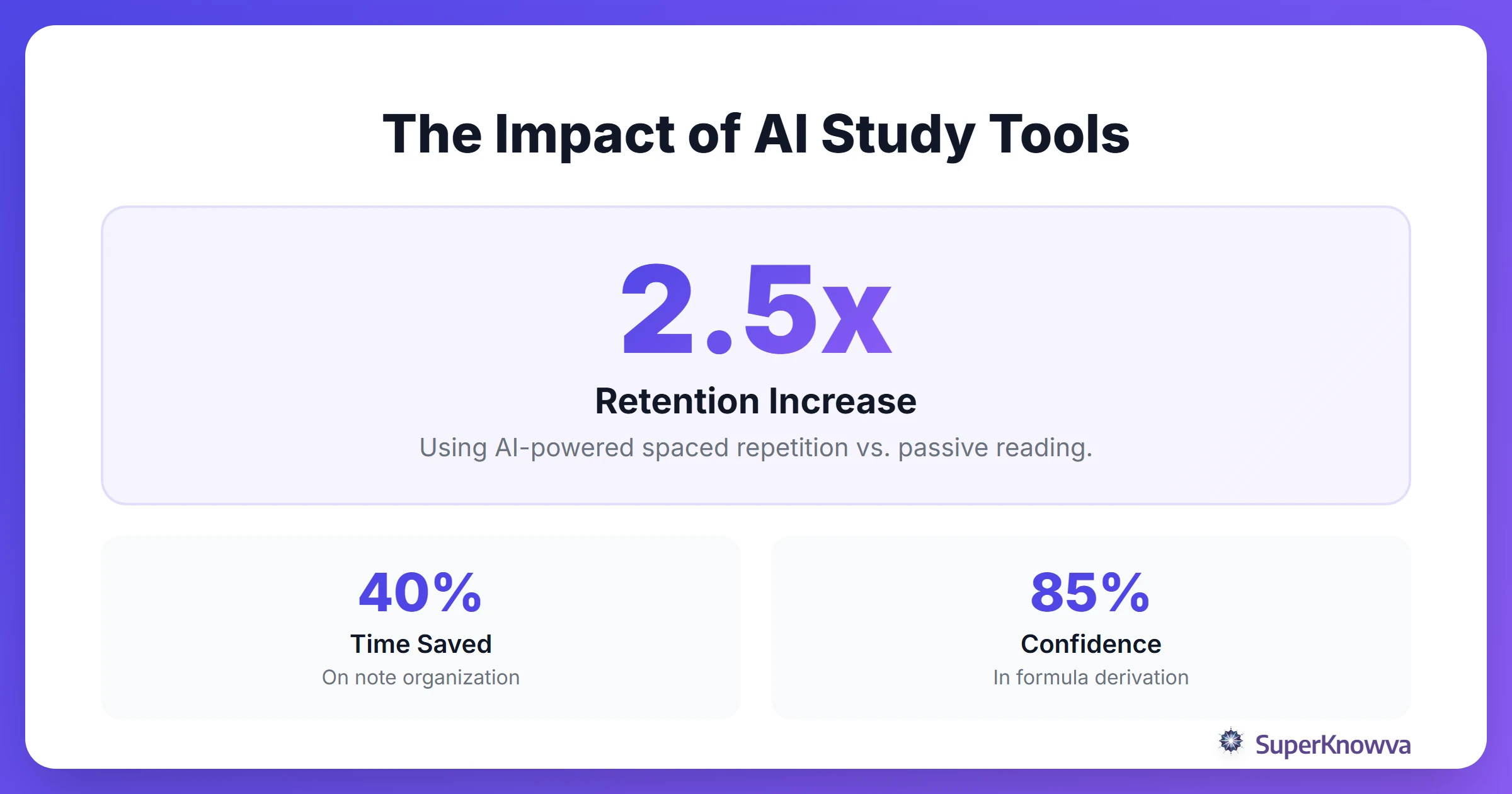
To speed this up, look into AI study tools for engineering like SuperKnowva. You can upload your technical notes, and the AI generates practice problems or conceptual quizzes based on your course material. This forces you to switch between subjects, a technique called interleaving, which is an effective way to learn.
Using AI to Master Formulas
We’ve all been there: you’re looking at a textbook derivation and Step 4 to Step 5 feels like magic. AI is becoming an essential tool for organizing engineering formulas and filling those gaps.
If you’re stuck, ask an AI assistant to break down intermediate algebraic steps. AI can also tag your PDFs and lecture slides by topic so you are not searching through folders while working on a lab report.
The future of engineering is AI-driven spaced repetition. By tracking which formulas you consistently miss, AI can schedule your review sessions at the exact moment you're about to forget them.
The Workflow: From Lecture Hall to Long-Term Memory
Success in engineering is a daily grind, not a weekend sprint. A "one-and-done" approach to lectures is a recipe for a mid-semester crisis. Aim for a 1:5 ratio: for every hour of lecture, spend 12 minutes refining your notes that same day.
During this review, use The Feynman Technique. If you can’t explain a core engineering law in simple terms to a non-engineer, you don't understand it yet.
As exams approach, condense your weekly notes into "Master Sheets," one-page cheat sheets with the most vital formulas and diagrams. Synthesizing the information is how you learn the material.
Conclusion
Mastering note-taking for engineering students isn't about having the neatest handwriting in the room. It’s about building a system that can handle the weight of complex problem-solving. By pairing powerful apps like Notability with AI-driven active recall, you can turn a mountain of daunting coursework into a manageable "Second Brain."
For more advice from people in the trenches, check out the Reddit Engineering Students: Note-Taking FAQ. Ready to level up? Start integrating AI into your workflow today and watch your technical mastery take off.