Preparing for the USMLE Step 1 is often called a marathon, but for most medical students, it feels like a sprint through high-yield facts. Even with the move to pass/fail, the pressure remains. Now, the goal is not just a score; it is achieving foundational mastery without burning out before dedicated study begins.
To survive the volume, students are moving away from brute-force memorization. Instead, they’re using usmle step 1 ai questions and adaptive platforms to cut through the noise.
In this guide, we’ll look at how AI is taking the "Gold Standard" study methods and giving them a much-needed upgrade.
The Evolution of USMLE Prep: From Static to Adaptive
For decades, the "tried and true" Step 1 strategy was simple: buy a massive question bank, start at question one, and pray you hit "100% completed" before your test date. It’s a linear path, but it’s fundamentally flawed. Why? Because it treats every student exactly the same.
Whether you’re a cardiology natural or someone who still breaks into a cold sweat over renal physiology, a static bank serves you the same questions in the same order. It’s inefficient.
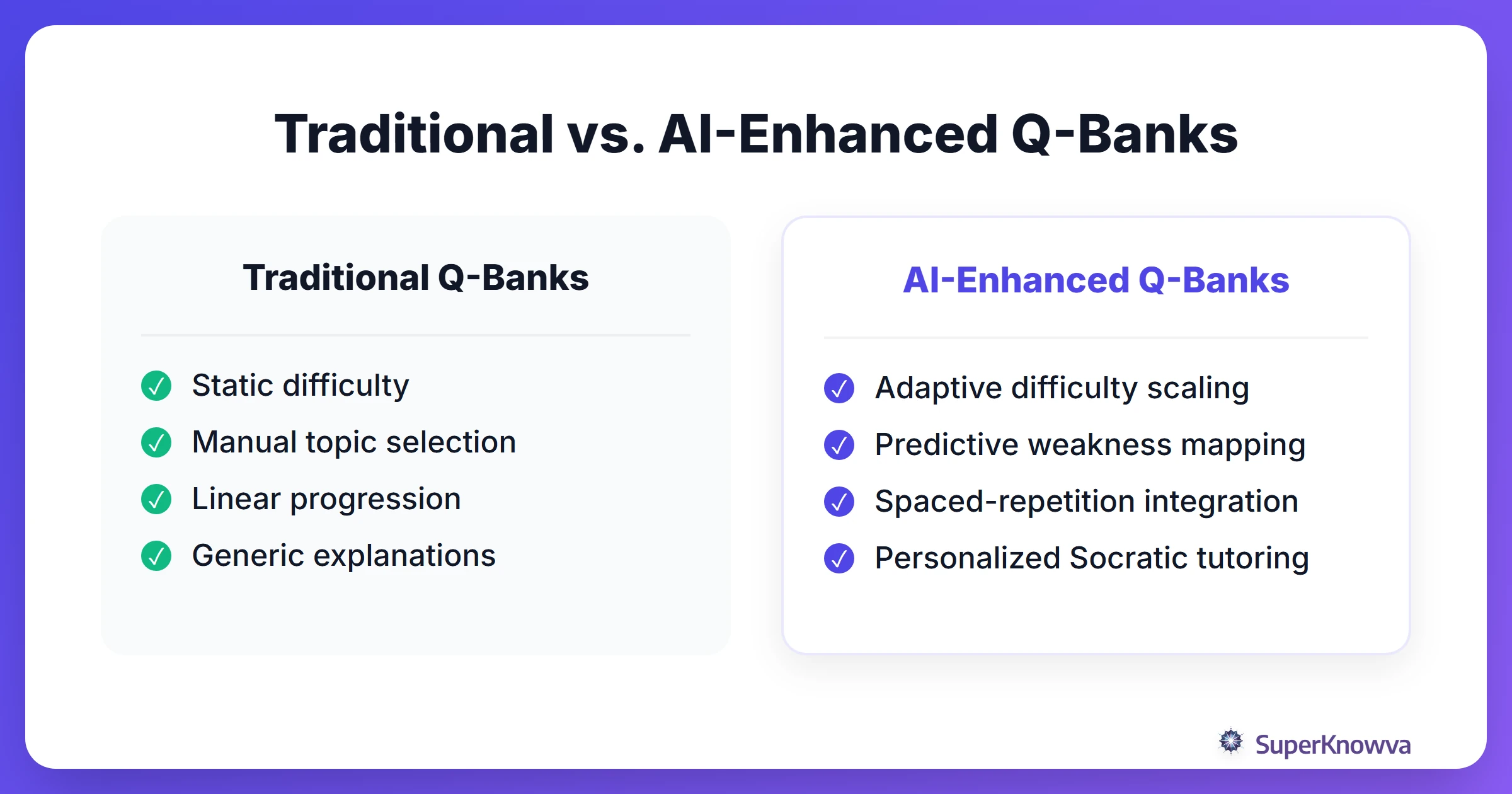
AI changes the game with adaptive difficulty scaling. Instead of a random grab bag, a "Dynamic Q-Bank" watches how you think. If you’re flying through pulmonary questions but stumbling on lysosomal storage diseases, the AI catches the trend in real-time.
The goal shifts from "finishing the bank" to mastering the concepts. You aren't just checking boxes anymore; you’re building a personalized curriculum that evolves alongside you.
Precision Targeting: Finding Your "Hidden" Gaps
We’ve all been there: you think you’ve got heart failure down, but then you hit a block that crosses it with complex pharmacology and your accuracy plummets. Traditional filters usually miss these nuances. They tell you that you’re "weak in Cardio," but that’s too broad to be helpful.
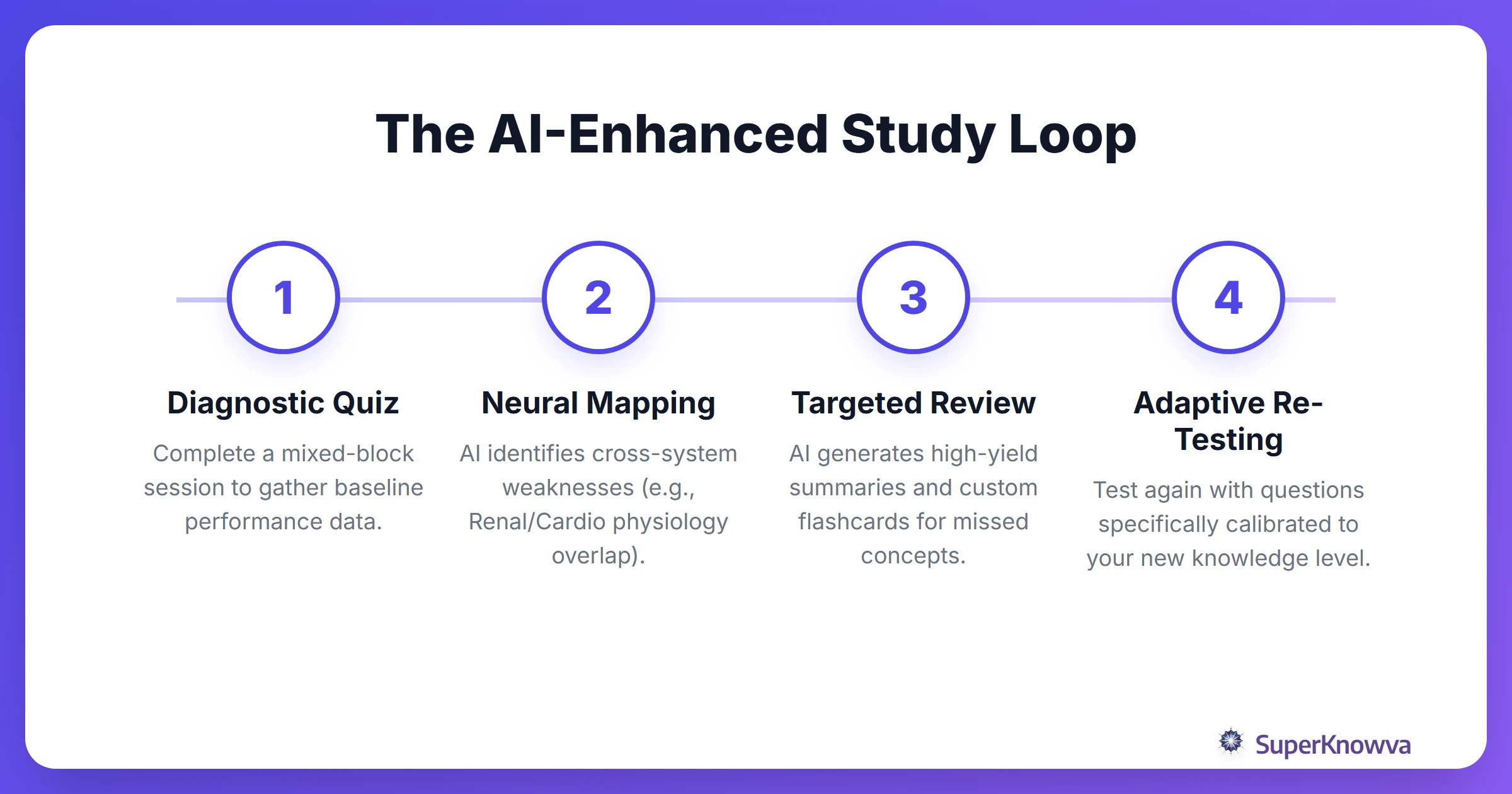
AI uses neural networks to map how medical concepts interconnect. It identifies "latent weaknesses," the subtle threads connecting different organ systems that are often overlooked.
By moving beyond simple "percent correct" stats, AI offers predictive scoring. It doesn’t just recap yesterday’s failures; it predicts how you’ll handle the actual exam based on the specific complexity of the questions you're solving right now.
Furthermore, how AI provides personalized feedback for USMLE success is fundamentally changing the review process. Natural language processing (NLP) can now break down complex pathophysiology in a way that feels like a conversation, helping you grasp the "why" behind an incorrect answer rather than just memorizing the "what."
Maximizing Retention with AI-Driven Spaced Repetition
Review fatigue is real. There is nothing more soul-crushing than waking up to find 500 Anki cards due when you still have two UWorld blocks to finish.
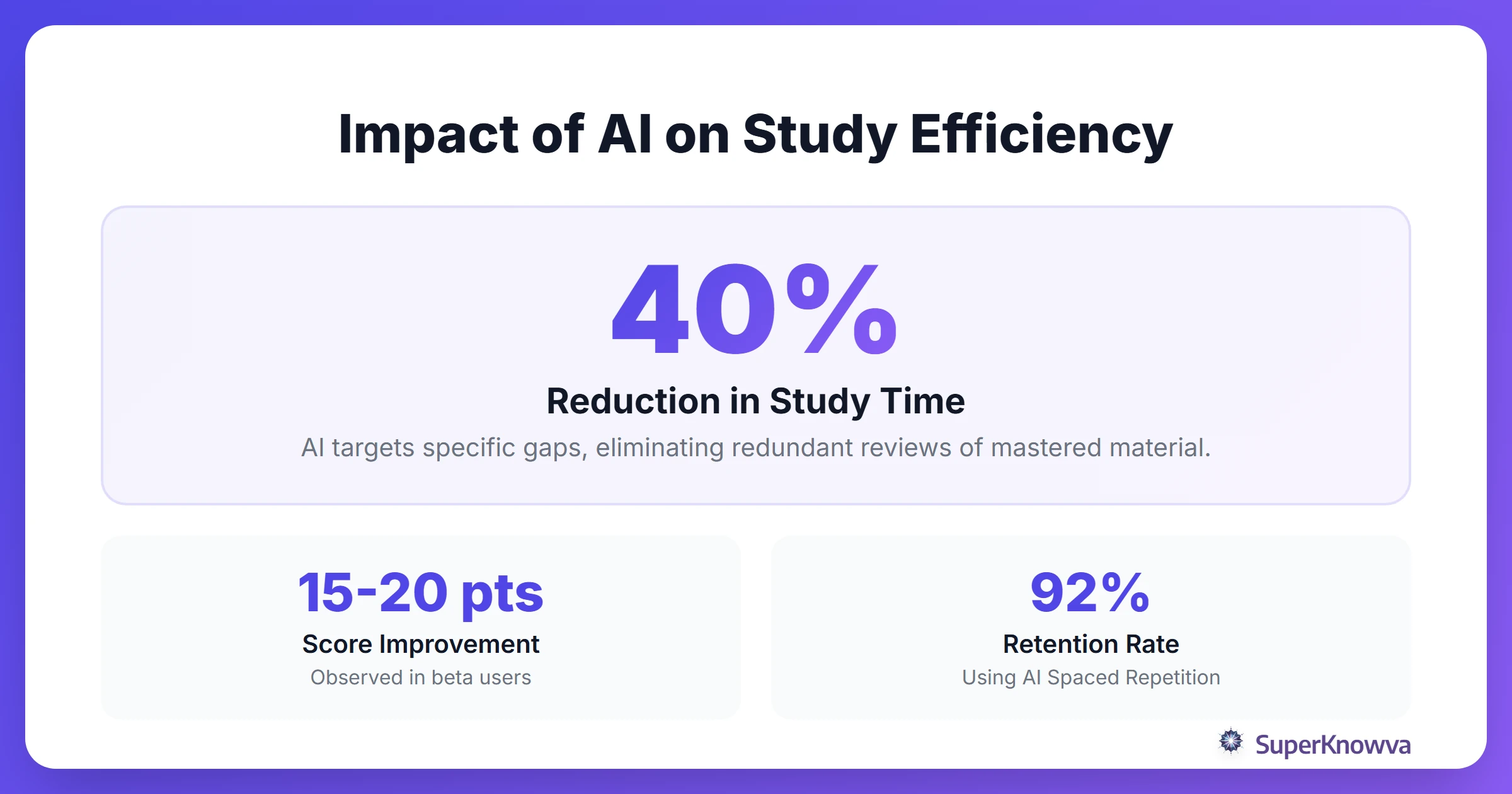
AI solves this by plugging your Q-Bank performance directly into your review schedule. When you miss a high-yield fact in a practice block, the AI doesn't just show you a flashcard; it intelligently resets the review interval for that specific concept.
By prioritizing "vulnerable memory clusters," the algorithm ensures you’re spending your limited energy on the facts you’re actually likely to forget, rather than the ones you’ve already mastered. In the battle against subjects like pharmacology and pathology, this targeted approach consistently produces higher retention with fewer total hours spent staring at a screen.
The Synthetic Mentor: Generative AI as Your Personal Tutor
Sometimes, even the best UWorld or NBME explanations can feel like they’re written in a different language. This is where generative AI acts as a "Synthetic Mentor."
Think of it as a tutor that never gets tired of your questions. You can use AI to re-contextualize a dense explanation into simpler terms or ask it to generate custom practice questions based on your own lecture notes.
The best tools available now are Socratic AI tutors. Instead of just handing you the answer, they guide you through the clinical reasoning. They might ask, "If this patient has a low pH and high CO2, what would you expect the bicarbonate to do?" This kind of active engagement is what makes the information stick for the long haul.
A word of caution: accuracy is everything. When using smart AI-powered question banks for USMLE prep, always make sure the tool is pulling from reputable medical literature. If you're curious about what other students are using, check out this Community Discussion: AI Programs for UWorld.
Strategy: Integrating AI Without Overwhelming Your Schedule
AI shouldn't replace your primary resources like First Aid; it should be the glue that holds them together.
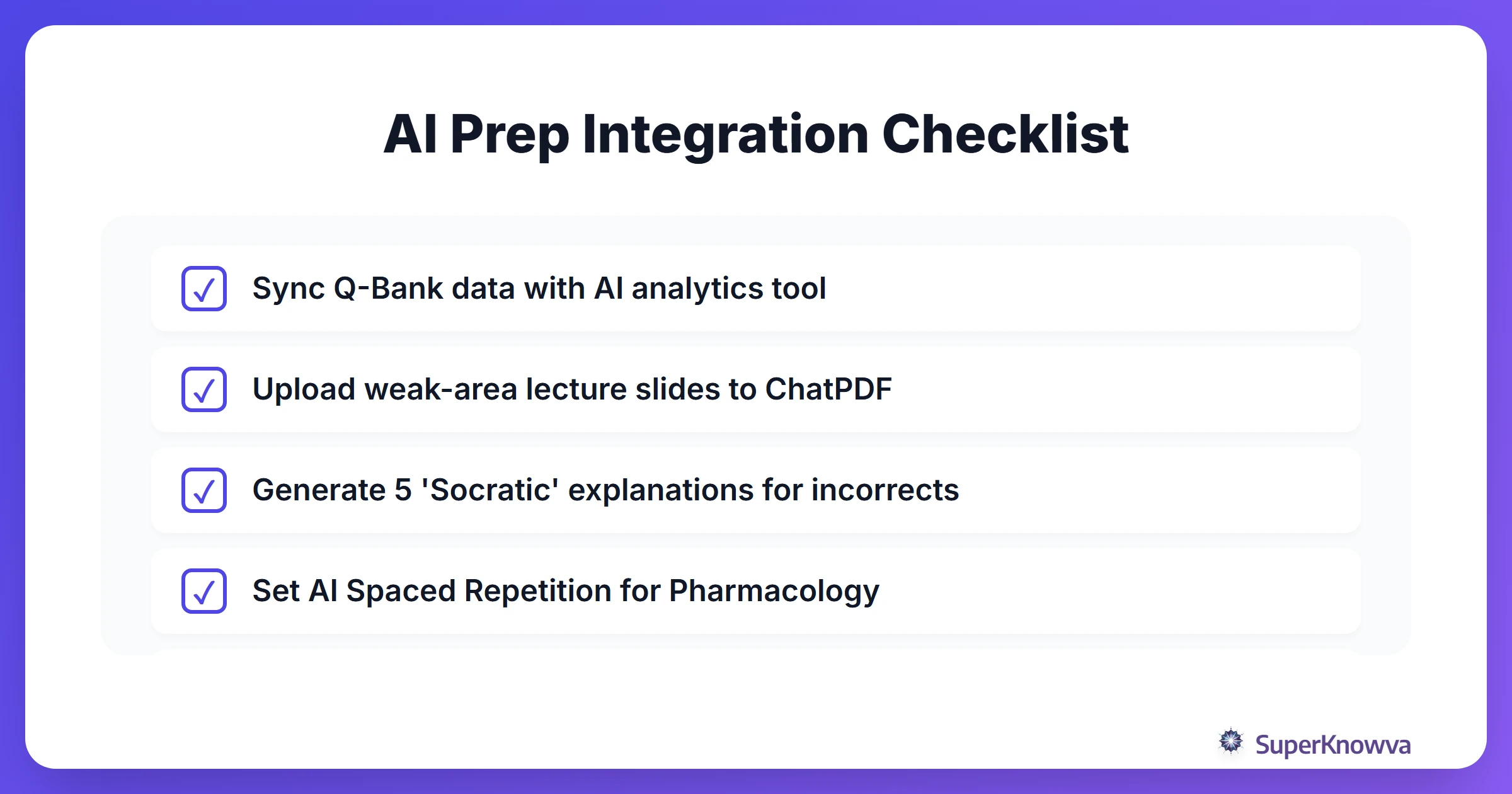
Here’s a simple, AI-Enhanced Study Workflow:
- Summarize the Heavy Stuff: Use ChatPDF to upload dense textbook chapters and extract the high-yield summaries instantly.
- Bridge the Gap: Use SuperKnowva to connect your lecture slides to board-style questions. By uploading your specific curriculum, SuperKnowva can generate questions that mimic the NBME style but stay relevant to what you’re learning in class.
- Let Data Dictate Dedicated: During your dedicated period, let the AI analytics run the show. If the data says your biochemistry is peaking, the AI will automatically pivot your focus to your "danger zones" like ethics or biostatistics.
Data-Driven Confidence: Knowing When You’re Ready
The final weeks before Step 1 are usually a mess of anxiety. Am I ready? Should I push my date back?
While NBME self-assessments are the gold standard, they are only snapshots in time. AI provides a continuous readiness score. By tracking your daily performance and spotting "plateau" patterns, AI can tell you exactly when you’ve hit the threshold to pass.
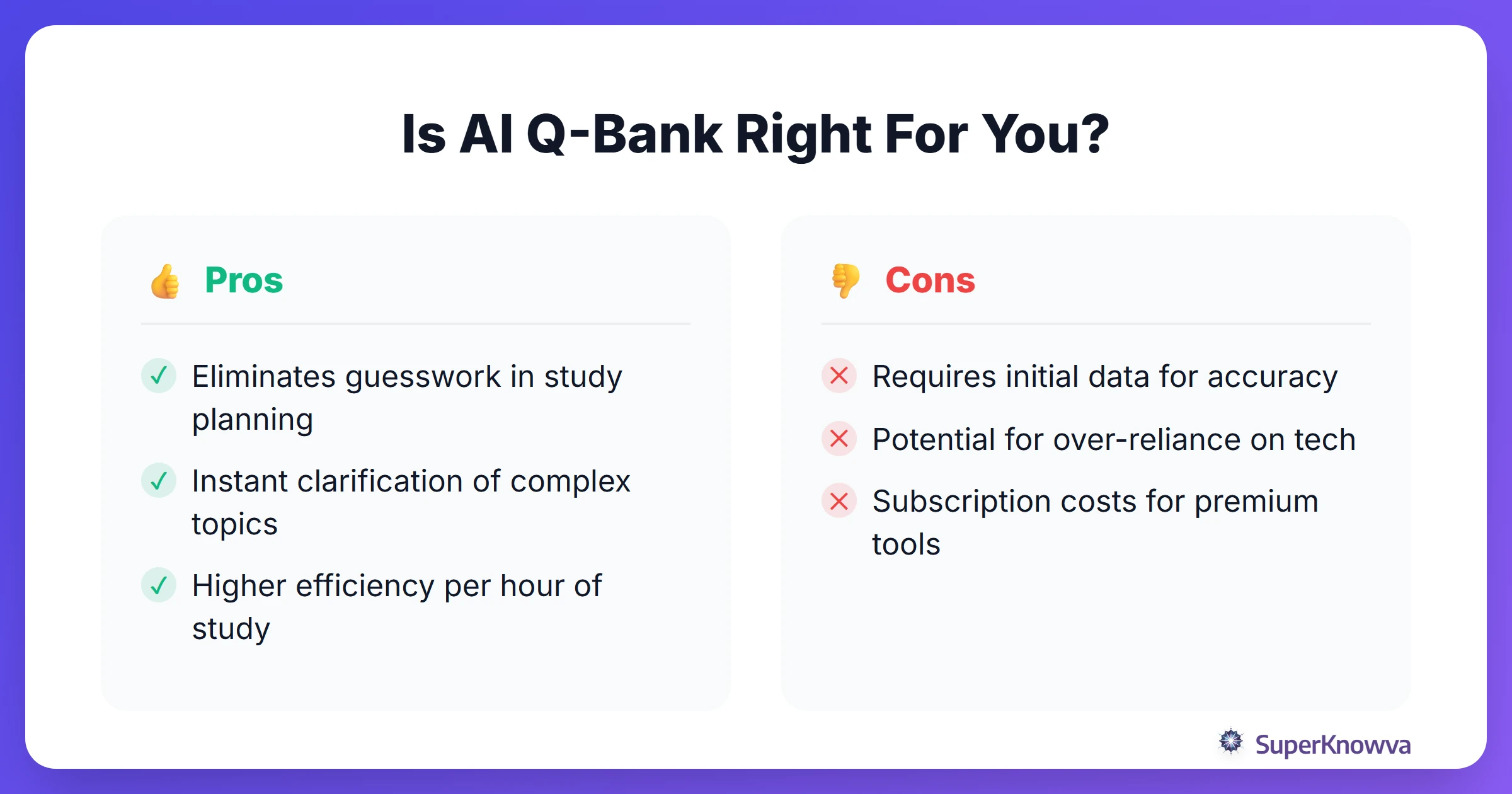
The psychological edge of having data-backed confidence is huge. When you walk into that Prometric center, you won't just hope you're ready; you will have the data to prove it. To learn more about organizing your study schedule, take a look at Ace USMLE Step 1: The Ultimate Guide to AI-Powered Preparation.
One final tip: In your last week, let the AI prune your to-do list. Stop trying to do everything. Focus only on the "vulnerable" topics the algorithm flags. Study smarter, trust the data, and go crush the boards!