Struggling to remember the difference between oxidative phosphorylation and substrate-level phosphorylation? You’re not alone. Let’s be real: AP Biology is a beast. It’s notorious for a massive breadth of content and those "everything-is-connected" themes that can make your head spin. But here’s the truth: the secret to a 5 isn't just reading the textbook until your eyes bleed. It’s about how you practice.
With the rise of ap biology ai practice questions, students are finally moving away from passive highlighting and toward active, adaptive mastery. In this guide, we’ll show you how to use AI to crush the most difficult units and walk into exam day with total confidence.
Ditching the 1,000-Page Paperweight: Why AI Changes Everything
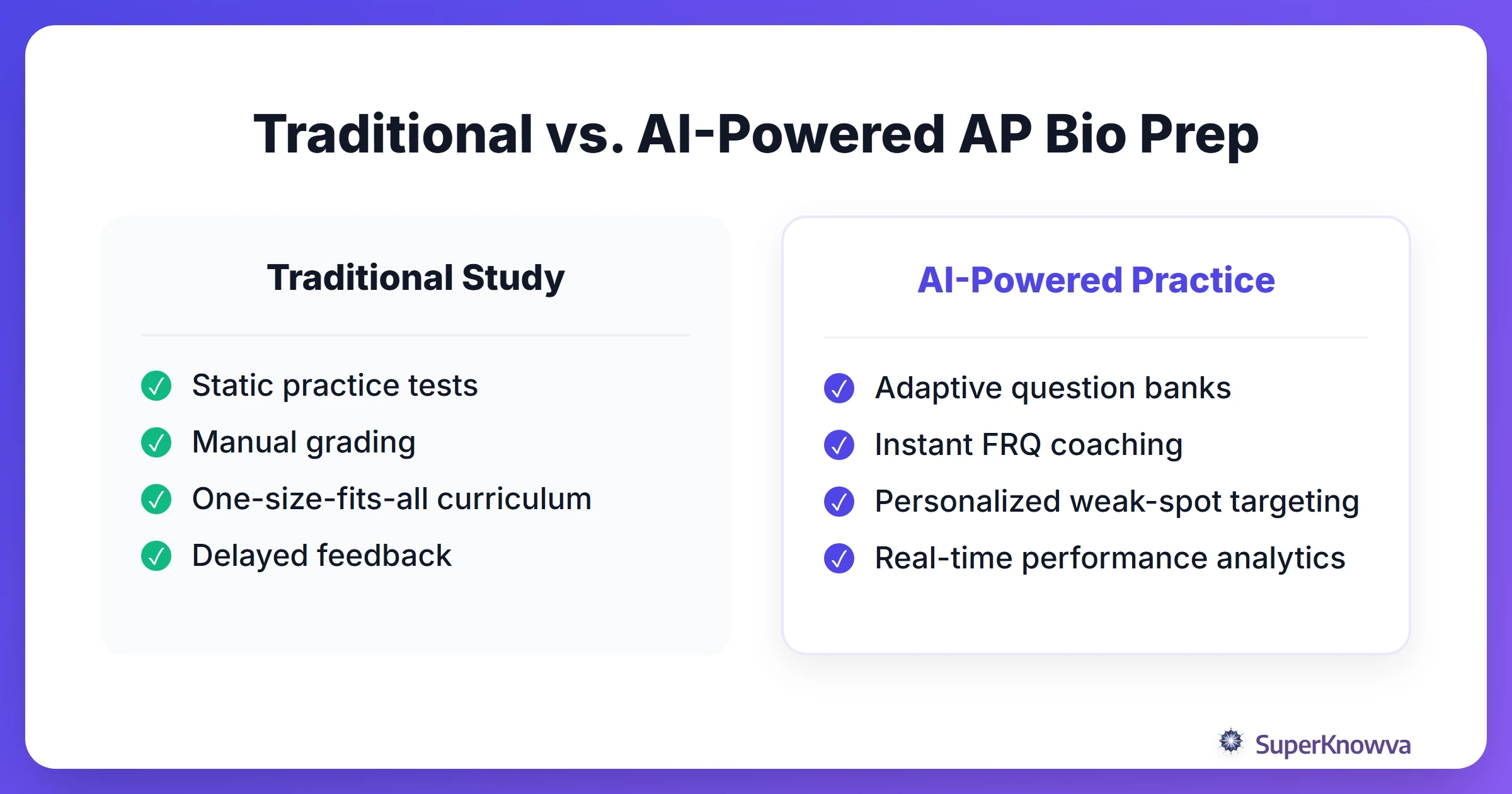
For decades, AP Bio prep meant lugging around a textbook that doubled as a doorstop and taking static practice tests that never changed, no matter how many times you got the same question wrong. It’s a "one-size-fits-all" approach that is, frankly, a waste of time. You end up bored with topics you’ve already mastered and frustrated by the ones that still feel like gibberish.
AI flips the script by creating a learning environment that actually listens to you. Instead of a fixed set of questions, an ai-powered biology tutor pinpoints your specific knowledge gaps in real-time. If you’re a pro at cell organelles but keep tripping over signal transduction pathways, the AI notices. It shifts the focus. This kind of granular feedback ensures you aren't spinning your wheels, allowing you to boost your reading comprehension with AI techniques and apply them to even the densest scientific texts.
Mastering the "Engine Room": Cellular Processes
Units 2 (Cell Structure) and 3 (Cellular Energetics) are the engine room of the AP Biology curriculum. They’re also usually the most intimidating because they require you to understand complex metabolic pathways, not just memorize parts of a cell.
SuperKnowva provides ap biology cellular processes practice that moves past simple definitions. AI generates custom "what if" scenarios. For example, "What happens to the rate of ATP production if a specific enzyme in the Krebs cycle is inhibited?" This requires you to apply knowledge rather than memorizing a diagram. Visualizing these pathways through interactive drills turns abstract concepts into logical, predictable systems.
Cracking the Genetics Code
Genetics (Unit 5) and Gene Expression (Unit 6) are high-weight areas where small mistakes, such as a calculation error or a misinterpreted pedigree, can cost you significant points.
Traditional workbooks only give you a handful of Punnett squares before they run out of steam. In contrast, AI can generate an infinite variety of ap bio genetics drills. You can start with simple Mendelian inheritance and work your way up to complex linked genes and non-nuclear inheritance patterns. As you get better, the AI turns up the heat, introducing biotechnology applications like CRISPR or gel electrophoresis analysis. It’s the best way to ensure you’re ready for those tricky "grid-in" questions on the exam.
FRQ Coaching: Learn to Write Like an Exam Reader
The Free-Response Questions (FRQs) are often the "make or break" section for a 5. It isn’t enough to just know the science; you have to use the specific "task verbs" (Describe, Explain, Justify) that AP readers are looking for.
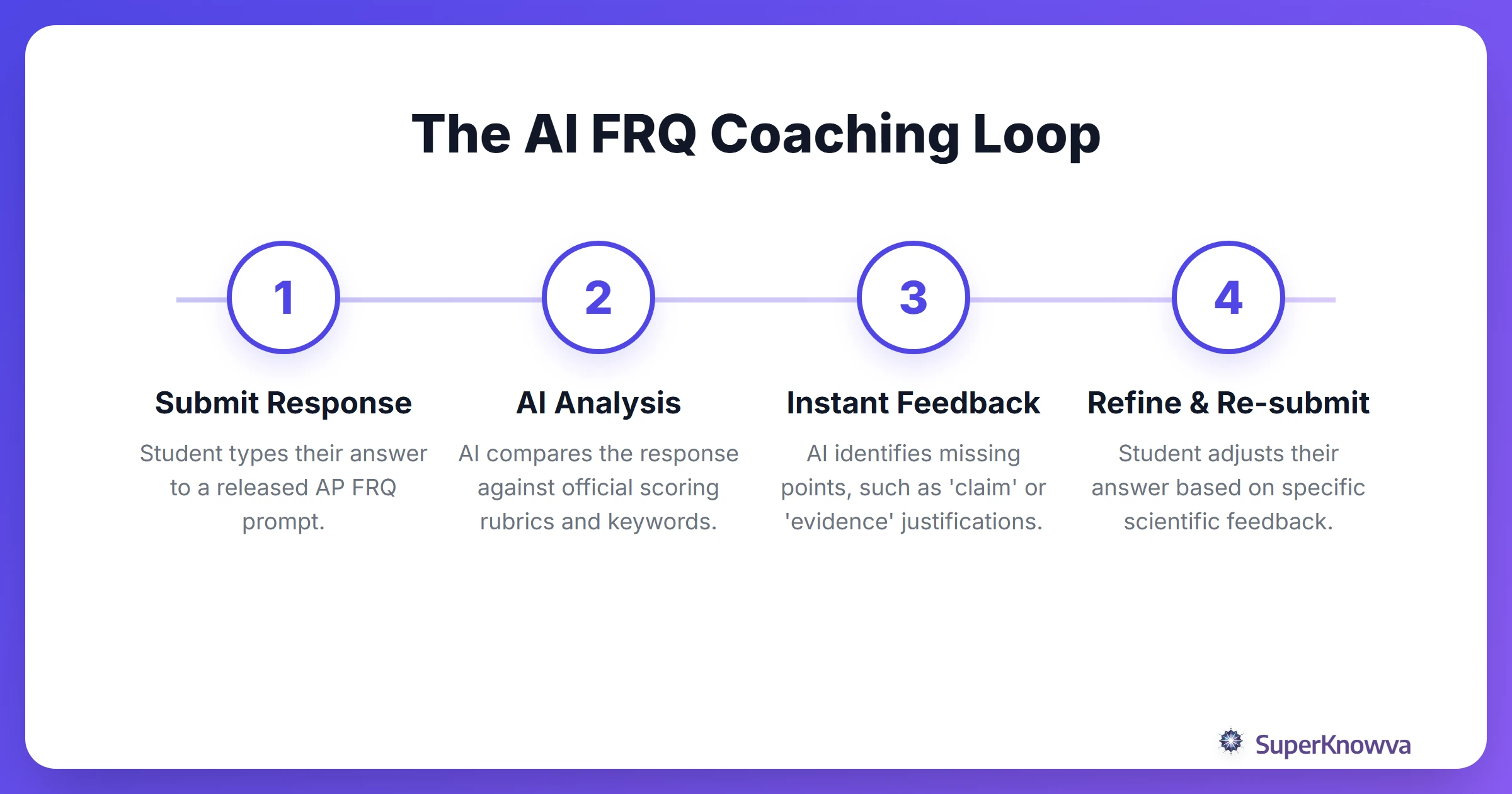
Through ap biology frq coaching, AI tools can grade your written responses instantly. By comparing your answer against official scoring rubrics, the AI can tell you if you missed a "claim" or failed to provide enough "evidence." This iterative process helps you master precise scientific terminology, much like how students are improving scientific reasoning with AI for high-level medical exams.
Your Personalized 8-Week Study Timeline
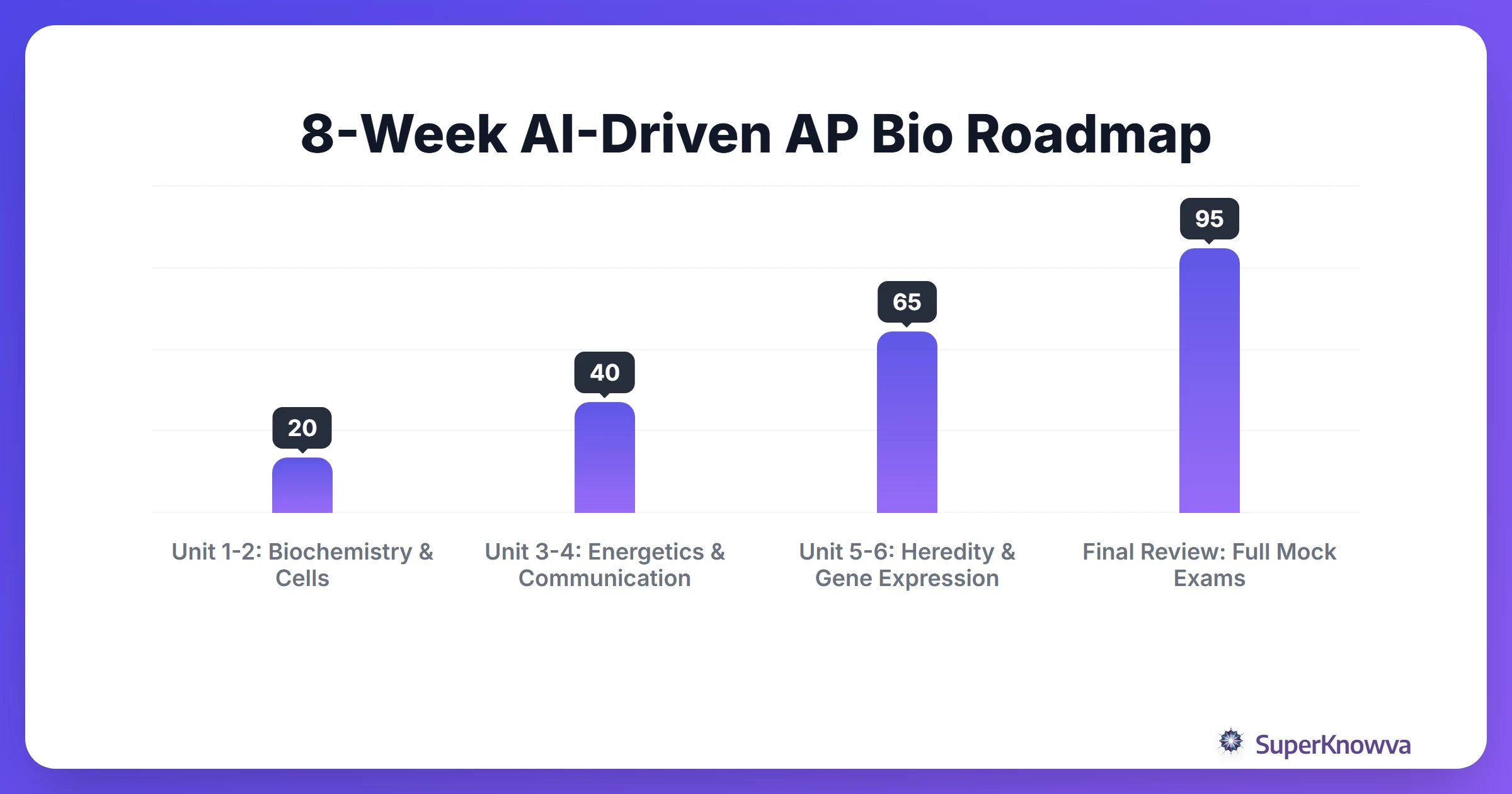
Cramming doesn't work for biology. The concepts are too interconnected for a last-minute marathon. A better strategy involves using smart study tools for ap biology to organize your time based on what you actually need to work on.
An AI-driven roadmap allows you to:
- Allocate Time Wisely: Spend more hours on your weak units (maybe Natural Selection?) and less on the ones you’ve already cleared.
- Use Spaced Repetition: Keep biochemical cycles fresh in your mind so you don't forget Unit 1 by the time you reach Unit 8.
- Balance Your Drills: Mix high-speed MCQ (Multiple Choice Question) sessions with deep-dive FRQ practice.
How to Make SuperKnowva Part of Your Routine
Consistency is everything. To get the most out of SuperKnowva, try these daily habits:
- The 10-Minute Morning Drill: Start your day with a "Question of the Day" focused on your lowest-scoring unit.
- Note Conversion: Upload your class notes to SuperKnowva to instantly turn them into AI-powered flashcards and quizzes.
- Simulate the Pressure: Use the AI to generate a full 90-minute MCQ section to build the mental stamina you’ll need on test day.
If the math-heavy portions of Unit 3 or Unit 7 are giving you trouble, you might also benefit from AI-powered quantitative reasoning strategies to sharpen your data analysis. For extra resources, check out the Knowt AP Biology Practice Test Room or the Biomania AP Bio Prep App.
Data Over Guesswork: Moving from a 3 to a 5
The difference between a 3 and a 5 usually comes down to data. AI tools provide performance metrics that show you exactly where you stand. You don't have to guess if you're ready; you can see your mastery percentage in every sub-topic.
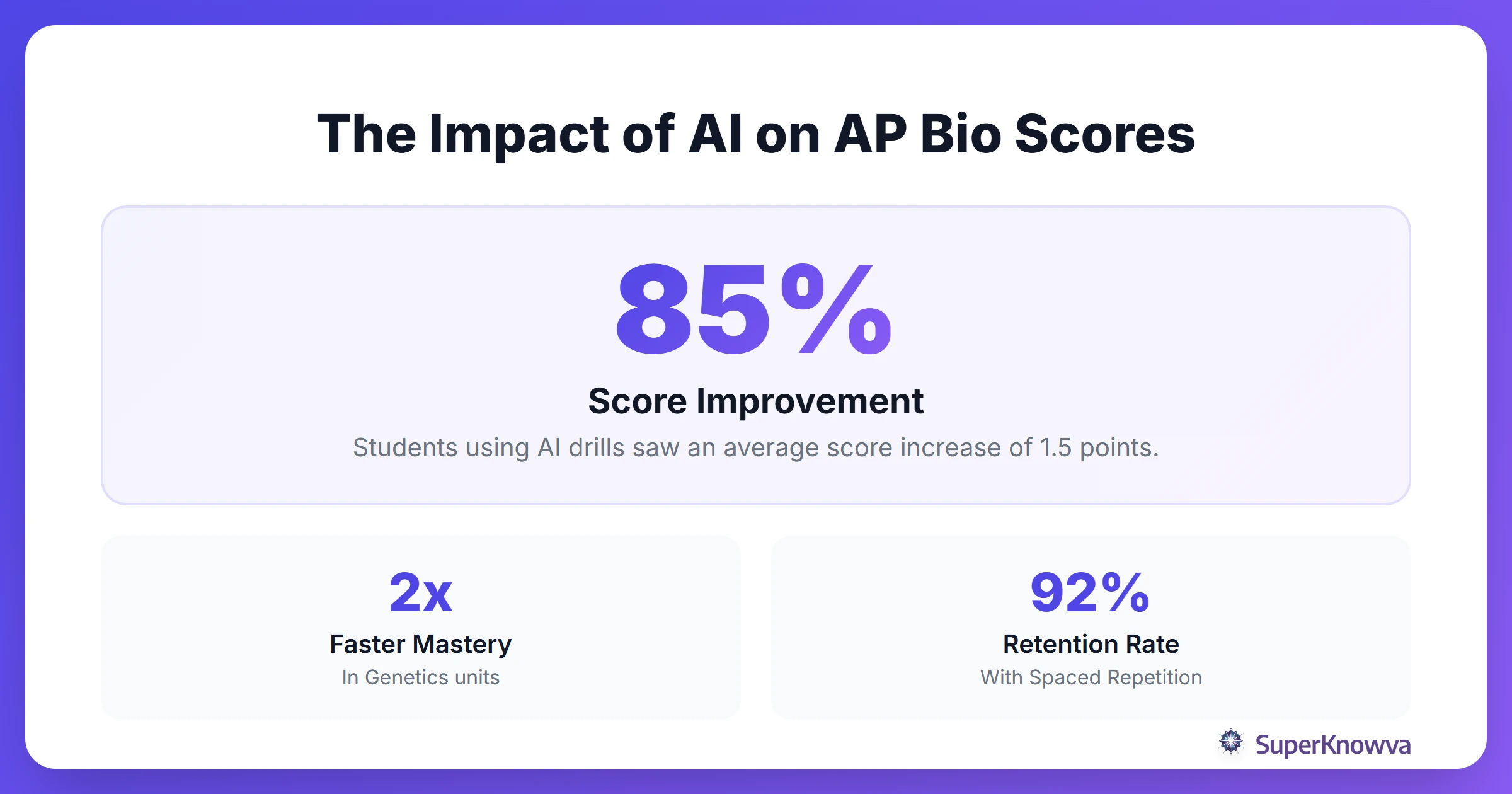
By focusing on high-weight units and using AI to polish those last few weak spots in the final two weeks, you can maximize your score. The data is clear: students who engage with adaptive, AI-driven drills see significant improvements in both retention and test-day performance.
Don't leave your AP score to chance. Stop the passive reading and start practicing with purpose. Embrace AI-driven mastery and earn a 5 today with SuperKnowva.