Ask any high schooler which class keeps them up at night, and nine times out of ten, they’ll say AP Chemistry. It’s a beast. Memorizing the periodic table or mastering electron configurations is one thing, but applying those concepts to messy, real-world data? That’s where things get complicated.
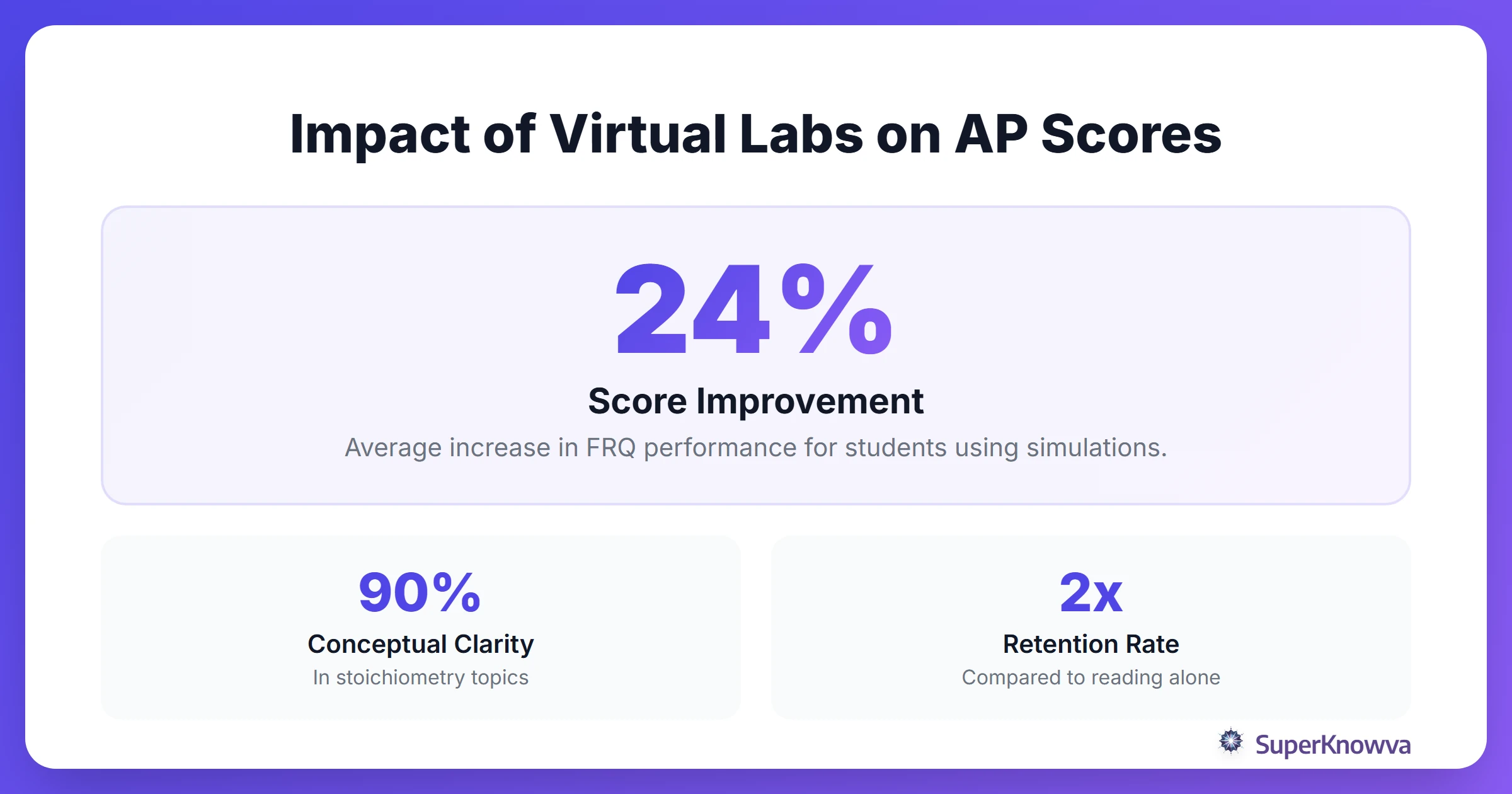
For students staring down the Free-Response Section (FRQ), ap chemistry lab simulation ai tools are becoming the "secret weapon" that turns a potential 3 into a solid 5.
The Hurdle of the AP Chemistry Lab Exam
If you’ve spent any time with AP Chemistry FRQ prep materials, you know the deal: lab-based questions are a massive chunk of your total score. These prompts don't just ask you to plug numbers into an equation. They want you to design an experiment from scratch, sniff out sources of error, and interpret data from a procedure you might have only seen once in a crowded classroom.
Physical lab time is a luxury. Between 50-minute periods, expensive chemicals, and accidental spills, most students enter exams with theoretical knowledge but little practical experience. AI and virtual simulations provide a solution. They turn passive reading into active, hands-on practice.
Why AI-Driven Simulations Outperform Traditional Virtual Labs
Remember those old virtual chemistry labs from middle school? The ones that felt like a clunky 2005 Flash game? You clicked a button, a beaker moved, and if you did anything "wrong," the screen just froze.
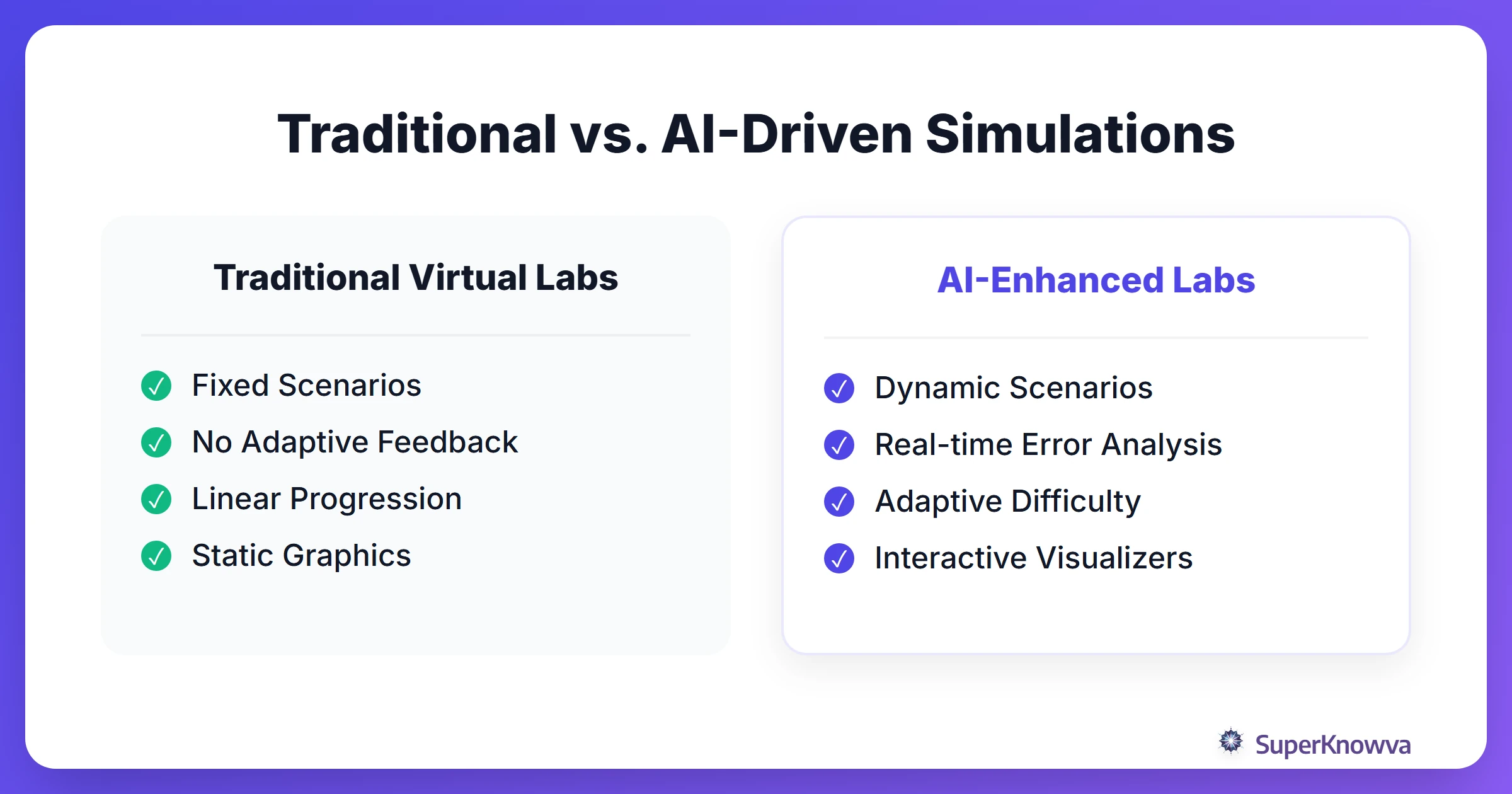
Modern AI-enhanced simulations create dynamic environments through "vibe coding," an intuitive and student-led way of building software. Instead of following a rigid script, an AI science tutor monitors your progress. If your titration curve looks like a mountain range, the AI provides more than a red "X." It analyzes your drop rate and identifies where your technique slipped. This adaptive system increases the challenge as your skills improve.
Mastering Titration and Acid-Base Equilibria
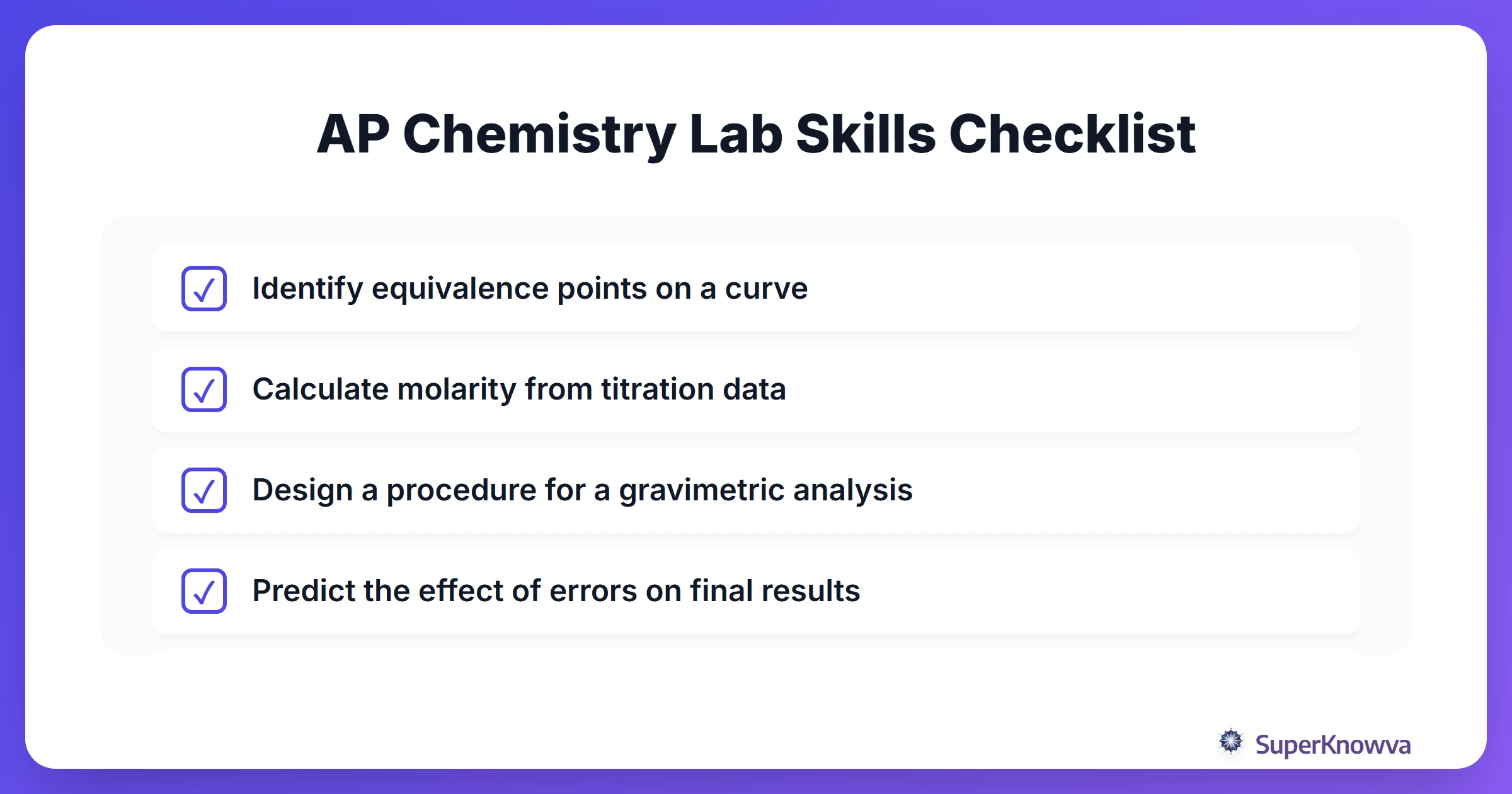
Titration is the bread and butter of AP Chem. You are almost guaranteed to see a titration curve on the exam, and the College Board loves asking you to find the equivalence point, the pKa, or the buffering region.
With a titration simulation, the "oops" factor is gone. In a physical lab, one single extra drop of base can ruin thirty minutes of work. In an AI-driven environment, you can hit "reset" and try a dozen different indicators or concentrations in the time it would take to wash a single beaker.
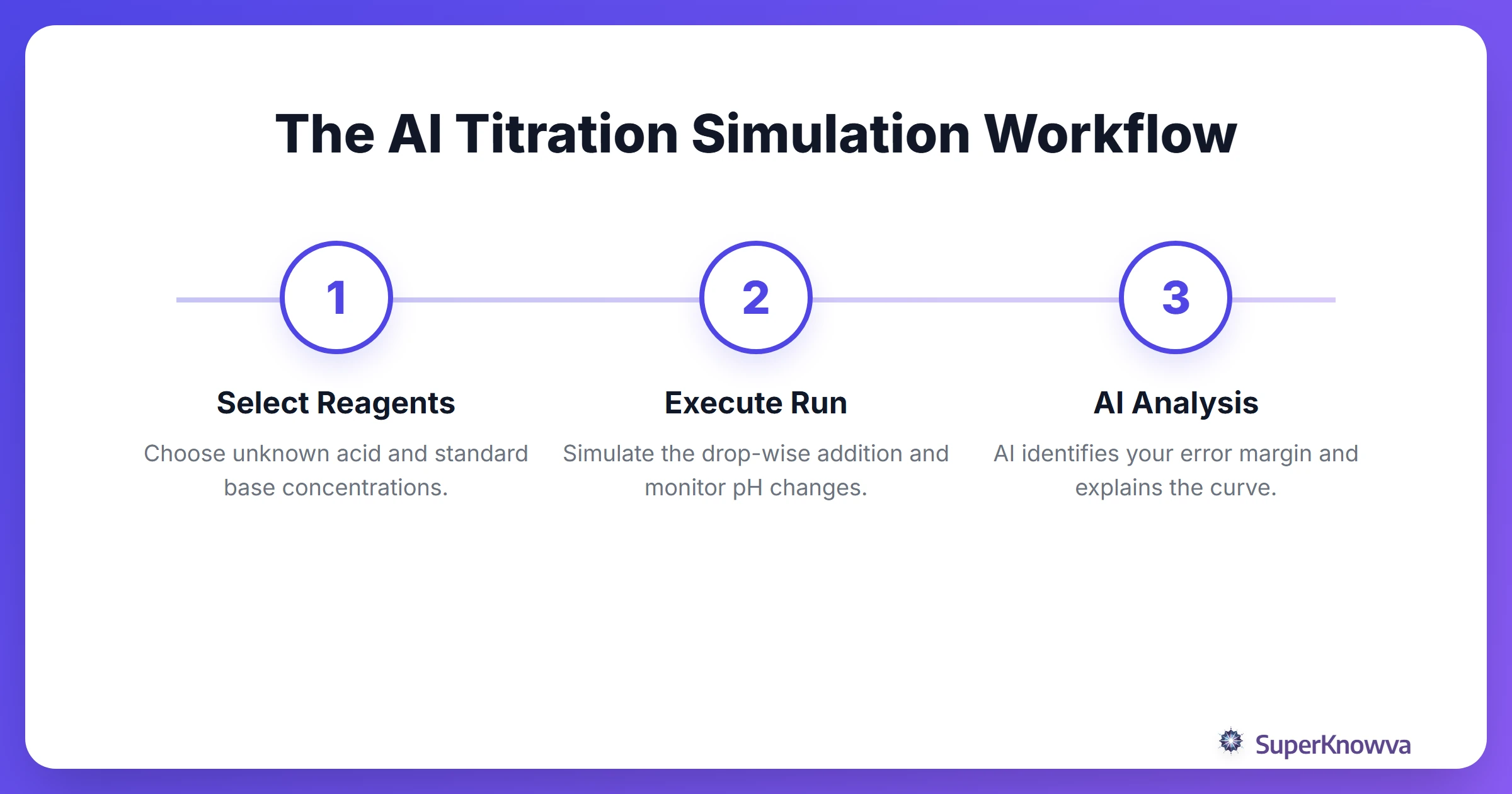
The real magic? AI can generate "mystery" acid-base scenarios that mimic the unpredictability of the FRQ. By practicing with unknown substances in a digital space, you build the intuition needed to handle whatever curveball the College Board throws your way.
Stoichiometry and Solution Preparation Practice
One of the easiest ways to lose points on the FRQ is by messing up a "procedural" question, like forgetting to mention that you should never add water directly to concentrated acid.
Through stoichiometry practice in a virtual setting, you can master:
- Molarity and Dilutions: Actually executing the precise measurements needed for a standard solution.
- Gravimetric Analysis: Simulating the tedious process of filtration and drying to find the mass of a precipitate.
- Error Analysis: Seeing exactly how "spilling" a few milligrams of reactant changes your final theoretical yield.
To nail these calculations, it helps to use an AI-powered quantitative reasoning guide to make sure your math is as solid as your chemistry. Tools like ChemCollective Virtual Labs are also fantastic for connecting these abstract numbers to authentic laboratory work.
Analyzing Spectrophotometry and Kinetics
The Beer-Lambert Law is a frequent guest on the AP exam. But let's face it: spectrophotometers are expensive, and most schools only have one or two for the whole class to share.
AI visualizers let you simulate the use of a spectrophotometer without the wait time. You can:
- Visualize molecular collisions: Watch how temperature and orientation actually change reaction success.
- Plot Absorbance vs. Time: Generate real-time data to figure out if a reaction is zero, first, or second order.
This level of visualization is essential for improving scientific reasoning with AI. It forces you to look past the numbers and understand the molecular behavior that drives the data.
Top Resources for AP Chemistry Simulations
Ready to start experimenting? Here are the best tools to add to your study rotation:
- ChemCollective: This is the gold standard. It offers a "Virtual Lab" where you can mix reagents from a digital stockroom. The ChemCollective Virtual Labs are specifically built to link math with real chemistry.
- LabXchange: A massive library of interactive science. LabXchange Simulations offer free, high-quality experiments across dozens of chemistry modules.
- Custom AI Prompts: Don't overlook ChatGPT or Claude. You can use them as a virtual "Lab Supervisor." Try this prompt: "Act as an AP Chemistry lab supervisor. Give me a scenario involving a gravimetric analysis of an unknown chloride salt and ask me to design a step-by-step procedure to find its purity."
Integrating Simulations into Your Study Schedule
You can't master the lab section in a single weekend. It takes consistent, focused practice. Even if you're already using tech to boost your reading comprehension with AI for other subjects, you need to carve out specific time for chemistry simulations.
A 4-Week AI Lab Plan:
- Week 1: Titration and Buffers. Focus on those equivalence points.
- Week 2: Stoichiometry and Gravimetric Analysis. Master the "procedural" FRQ steps.
- Week 3: Kinetics and Spectrophotometry. Practice Beer-Lambert Law graphs.
- Week 4: Full FRQ Simulation. Use AI to generate a mock lab-based FRQ and solve it under a timer.
Keep a dedicated notebook for your "virtual lab results." You’ll end up with a personalized study guide that covers the exact techniques the AP exam rewards. Transitioning from a simulation to a 5 on the exam is all about building the confidence that comes from doing, not just reading. Grab these AI tools, start experimenting, and turn the lab section into your highest-scoring opportunity.