
Ever spent an hour staring at a biology textbook, only to realize you haven't actually absorbed a single word? We’ve all been there. You’re reading the same sentence for the fifth time, hoping the information will magically stick. But here’s the reality: your brain isn’t a tape recorder. It isn’t built to process endless walls of text in isolation.
If you want to stop the "read and forget" cycle, you need to change how you feed information to your brain. This is where the dual coding study strategy science comes in. By pairing words with visuals, you can move past rote memorization and actually start understanding the material.
In this guide, we’ll break down how dual coding works and how you can use it to crush your next science or history exam.
What is Dual Coding? The Science of Two Channels
At its simplest, dual coding is the practice of combining verbal and visual information to make learning "stick." It isn't just a trendy study tip; it’s a proven cognitive science framework developed by Allan Paivio back in the 1970s.
According to dual coding theory, your brain has two separate "lanes" for processing information: one for verbal stimuli (words you read or hear) and one for visual stimuli (images, charts, and diagrams).
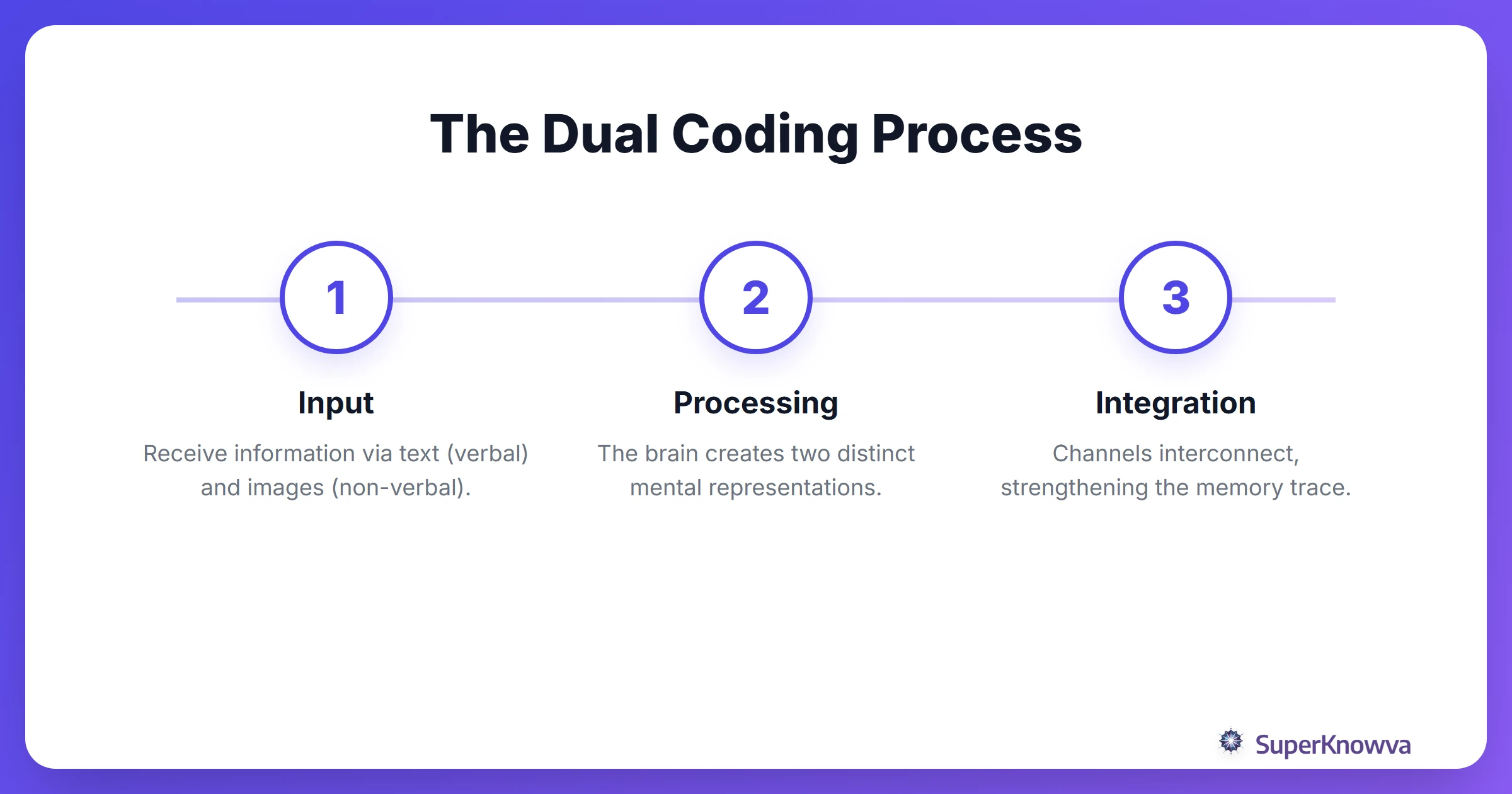
When you only read text, you’re only using one lane. You’re essentially driving in a traffic jam while the other lane is wide open. By using both channels at once, you create two distinct mental footprints for the same concept.
Think of it as a safety net. If you’re in the middle of a high-stakes exam and forget the exact wording of a definition, that mental image you created acts like a hook, pulling the information back to the surface.
Dual Coding vs. Learning Styles: Fact vs. Fiction
You’ve probably heard people say, "I’m a visual learner," or "I only learn by listening." It’s a popular idea, but modern research has largely debunked it. The Myth of Learning Styles explains that pigeonholing yourself into one "style" can actually hold you back.

Unlike learning styles, which are based on what a student prefers, dual coding works for everyone. It’s effective because of how the human brain is wired, not because of a personality trait. This is why learning scientists dual coding experts are pushing students away from "styles" and toward evidence-based strategies that use every part of the brain.
Applying Dual Coding to Complex Science Exams
Science is often abstract and full of invisible processes. This makes it the perfect candidate for the dual coding study strategy science. Instead of just memorizing a paragraph about how a cell works, you need to see it.
- Biology: Don't just read about the Krebs cycle or mitosis. Draw the stages. Use arrows to show the movement of chromosomes. Label everything. The act of placing the label next to the image bridges those two brain channels.
- Physics & Chemistry: Use diagrams for mechanics or molecular structures. Seeing the "shape" of a molecule or the direction of a force vector helps you understand why things happen, which is much more powerful than just knowing that they happen.
- Graphic Organizers: Flowcharts are effective for understanding cause-and-effect in biological pathways or chemical reactions.

Want to take it a step further? Combine dual coding with The Blurting Method for active recall. Study a diagram, hide it, and then try to "blurt" out the drawing and the labels from memory. You’ll quickly see exactly where your knowledge gaps are.
Dual Coding for History: Timelines and Narrative Maps
History isn't just a dry list of dates and dead people; it’s a story. But keeping that story straight is tough when it’s just black ink on a white page. Dual coding helps you build a "big picture" map of historical events.
- Visual Timelines: Instead of a vertical list, go horizontal. Add small sketches for key events, such as a tiny crown for a coronation or a simple scroll for a treaty.
- Cartoon Strips: For complex sequences, like the events leading up to a revolution, draw a comic strip. Each panel represents a step in the narrative, linking the events together logically.
- Geopolitical Maps: Use maps to visualize troop movements or how borders shifted. Spatial context makes history feel real rather than abstract.
- Visual Shorthand: Link symbols to ideologies. Use a balance scale for justice or a factory for the Industrial Revolution to make abstract concepts concrete.
4 Practical Steps to Implement Dual Coding Today
Ready to give it a shot? Use this checklist during your next study session.

- Find the match: Look at your textbook. If the text describes a process, find the diagram that goes with it. Never read the description without looking at the picture.
- Get messy: Draw your own versions. You don’t need to be an artist. Stick figures and boxes are fine. The act of drawing the concept yourself is what builds the neural connection.
- Talk it out: Explain the connection in your own words. Why is that arrow pointing there? What does this symbol represent?
- Test from memory: This is highly effective for science exam preparation. Close the book and try to redraw the diagram and write the explanation from scratch.
Digital Tools vs. Analog Sketching
Should you use a pen and paper or a tablet? Both work, but they offer different benefits for history study tips and science revision.
- Analog Sketching: There’s a powerful "motor-memory" connection when you draw by hand. The physical movement helps lock the info into your long-term memory.
- Digital Tools: If you like a clean look, tools like Canva (for infographics), Miro (for flowcharts), or Notability are great.
You can even store these visuals in a digital "second brain" or use apps like SuperKnowva to keep your visual and verbal notes organized in one place.
Combining Dual Coding with Other Power Strategies
Dual coding is great on its own, but it’s unstoppable when paired with other evidence-based techniques for long term retention.
- Interleaving: Don't just draw five diagrams of the same thing. Use interleaving practice to switch between different topics. This forces your brain to work harder to retrieve the right visual-verbal pair.
- The Feynman Technique: After drawing your diagram, use The Feynman Technique to explain it to a friend (or your cat). If you can't explain the drawing simply, you haven't mastered it yet.
- Spaced Repetition: Review your visuals at increasing intervals. This stops the "forgetting curve" from wiping out your hard work.
- Mind Mapping: Dual coding is a close cousin to mind mapping techniques. Both rely on visual organization to make sense of the chaos.
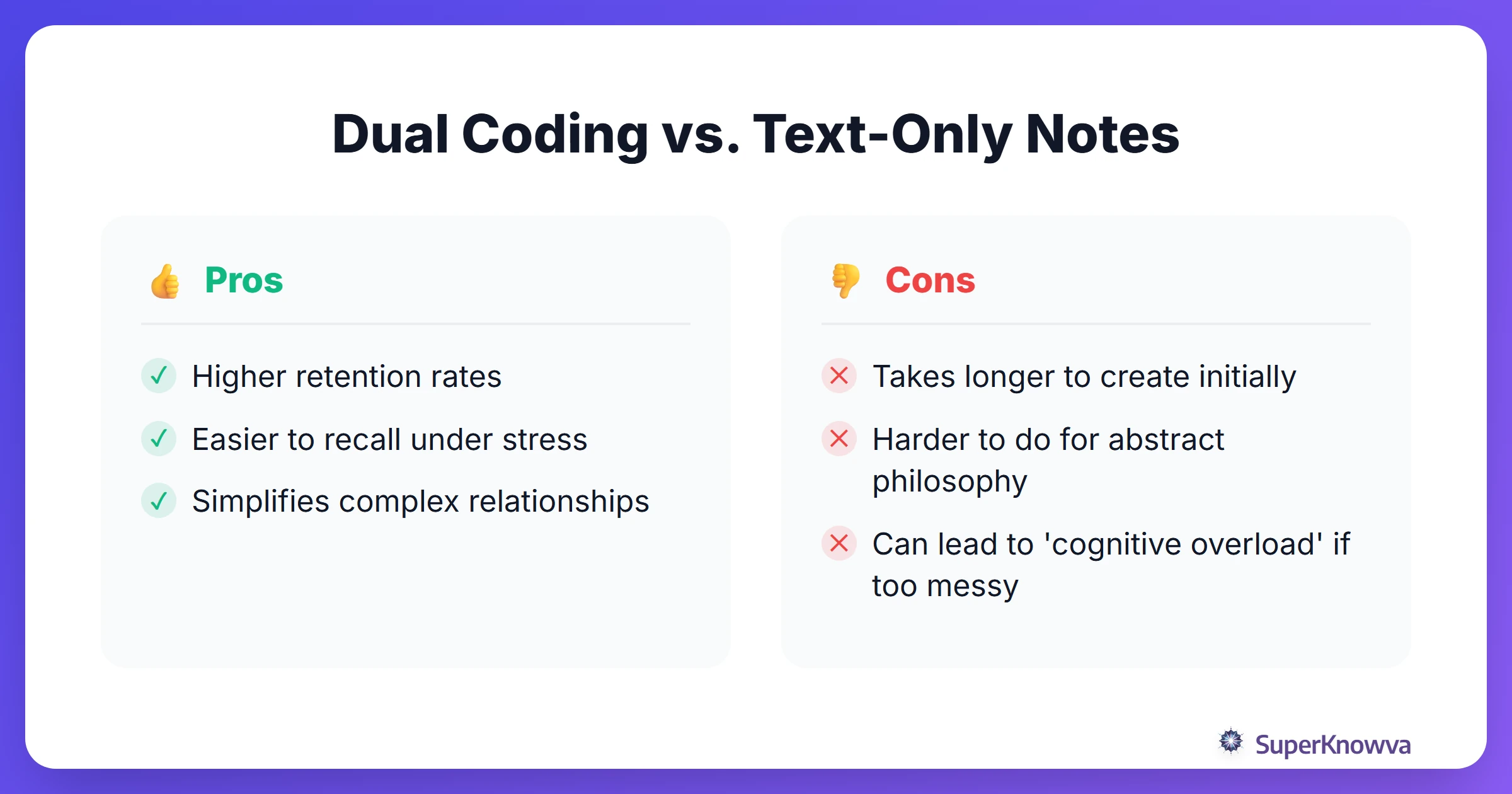
It’s time to move beyond simple note-taking. By embracing the power of visuals, you can transform the way you learn. Start small, draw often, and watch your memory double. For more deep dives into how we learn, check out the Learning Scientists: Dual Coding Guide.