Ever feel like your brain is a browser with 100 tabs open, and half of them are just random science facts you can't quite place? You’re not alone. Science isn't just a list of definitions to be memorized for a Friday quiz; it’s a massive, messy, interconnected web of systems, cycles, and laws.
Whether you are studying cellular respiration or predicting how a molecule behaves in organic chemistry, traditional linear notes often fall short. This is where mind mapping for science students provides a clear advantage. By moving away from standard lists and toward visual networks, you can mirror the way the universe and your brain function.
In this guide, we’ll look at how to use mind mapping to master biology, chemistry, and physics, and how AI-powered tools can help you get from "I'm lost" to "I've got this" much faster.
Why Your Brain Craves Visuals
Writing line after line of text in a notebook is an ineffective way to learn science. Science is rarely linear. A single shift in a biological environment can trigger many different effects. A chemical reaction isn't just A + B = C; it is a transition of energy and changing molecular states.
The science is clear: our brains process images and spatial relationships way faster than plain text. Mind maps work because they let you see the "Big Picture" and the tiny details at the same time. By using non-linear brainstorming, you’re actually encouraging scientific discovery. You start spotting patterns between seemingly unrelated topics that you’d totally miss in a standard notebook.

Mapping Biology: From Cells to the Biosphere
Biology is probably the most visual science out there. From the microscopic machinery of a cell to the global scale of ecology, everything is a system. When you use mind mapping for students, you can transform those dense, dry textbook chapters into diagrams that actually make sense.
- Metabolic Pathways: Map the Krebs Cycle as a circular flow rather than a list. Use branches to show exactly where ATP is generated and where CO2 is released.
- Taxonomy and Classification: Create a family tree for life. Start with Domains and Kingdoms, then branch down into Phyla, Classes, and specific species.
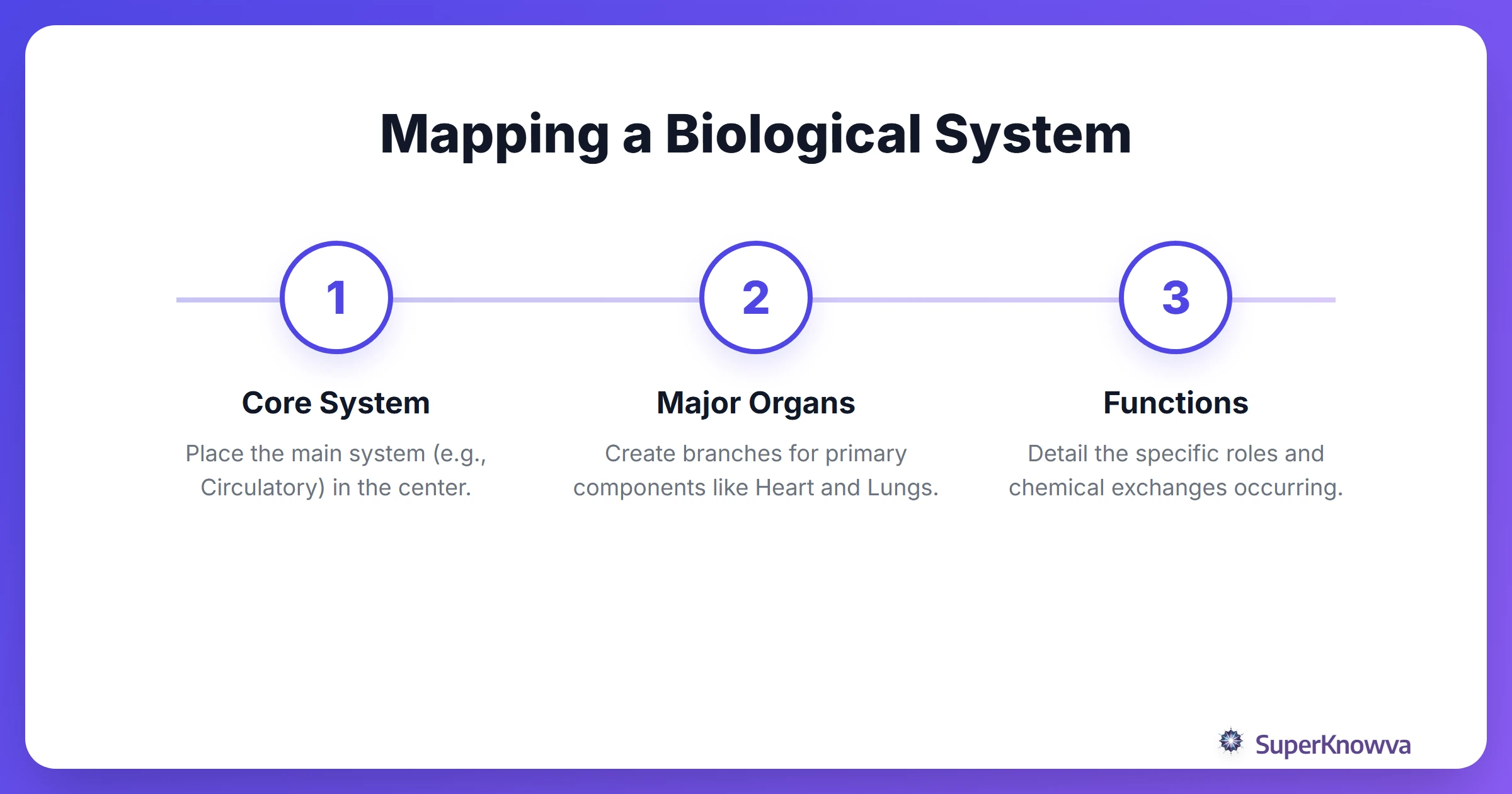
- Interconnected Body Systems: Map the human body by showing interactions between systems, such as the respiratory system providing oxygen to the circulatory system to fuel muscles.
- Integrated Diagrams: Sketch mitochondria or a lipid bilayer directly into your map to reinforce visual recall.
Chemistry: Taming the Chaos of Reactions
Chemistry often feels like a foreign language, but chemistry reaction mapping is the Rosetta Stone you’ve been looking for.
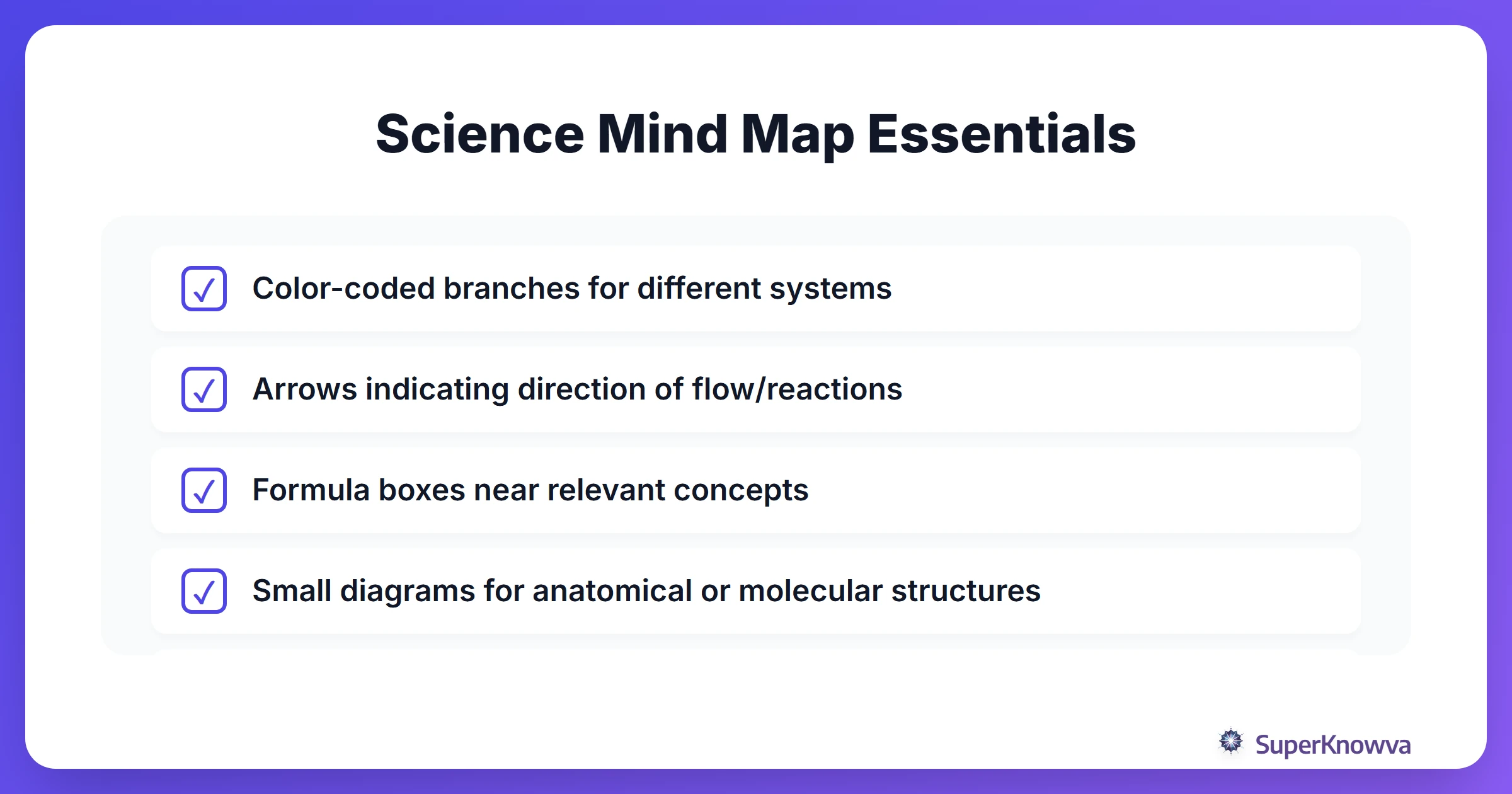
Organic chemistry, the notorious "pre-med killer," is easier to understand through visualization. You can place a specific functional group (like alcohols) in the center and branch out to every reaction that creates or uses it. Use color coding, such as red for reagents, blue for catalysts, and green for products, to clarify the information.
Visualizing periodic trends is another huge win. Instead of just reading about electronegativity, map the periodic table's structure to show how atomic radius and ionization energy shift as you move across the rows. If you need a head start, check out the Biggerplate Science Mind Map Library for some great community-created examples.
Physics: Making the Math Make Sense
Physics is often the "boss level" of science because it forces you to bridge the gap between abstract math and real-world reality. Mind maps help you build that bridge.
Start by mapping the big three: Mechanics, Thermodynamics, and Electromagnetism. From there, connect specific formulas to the physical laws they represent. For example, under "Mechanics," you might have a branch for "Newton’s Second Law," which then links to the formula and a sketch of a force diagram.
Struggling with a concept? Try using the Feynman Technique alongside your map. Explain the concept in plain English, then link that explanation back to the mathematical derivation. If you can't explain it simply, your map will show you exactly where the gap in your knowledge is.
How to Build a Science Mind Map: A Step-by-Step Guide
Ready to get started? Follow this simple workflow:
- The Central Concept: Put the core topic (e.g., "Photosynthesis") right in the middle.
- Primary Branches: Identify the main ideas. For Photosynthesis, these are the "Light-Dependent Reactions" and "The Calvin Cycle."
- Secondary Branches: Dive into the details: formulas, enzymes, reagents, or specific equations.
- The Cross-Links: Draw lines between different branches to show how things connect, such as linking the chemistry of ATP to the biological function of muscle contraction.
The AI Shortcut: Mapping with SuperKnowva
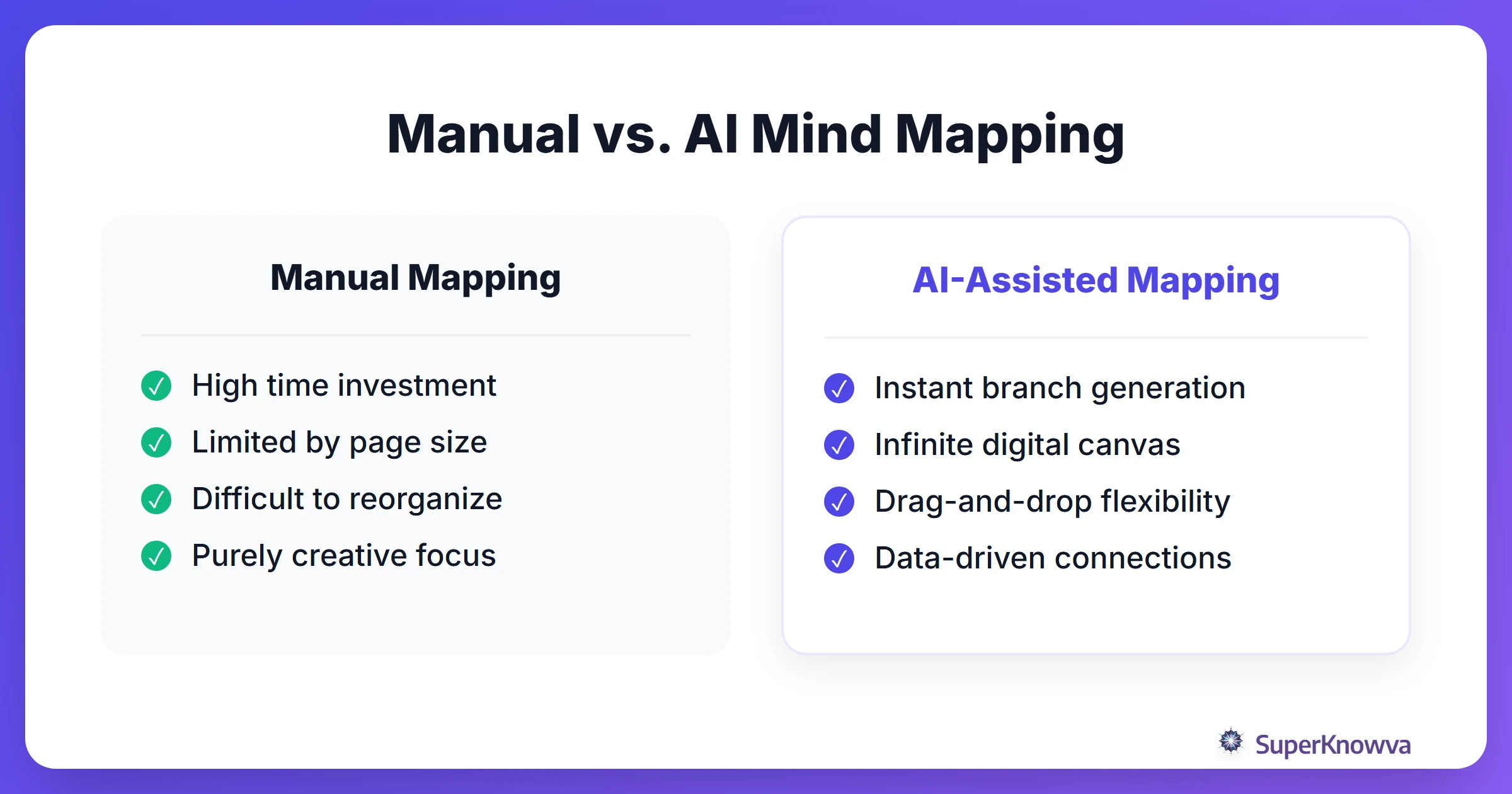
The hardest part of mind mapping? Starting. Staring at a blank page is intimidating. This is where an AI mind map generator like SuperKnowva becomes your best friend.
AI tools scan science textbooks or lecture slides to extract key concepts and create a foundational structure. Instead of starting from scratch, you begin with a logical framework to customize. AI can also identify "missing links." If you have mapped a chemical reaction but forgot the catalyst, the software can prompt you to fill in the blank.
Want to see how other students are doing it? The r/mindmapping community on Reddit is a great place to see how people are moving from old-school paper maps to dynamic, AI-powered study aids.
The Pro Move: Combining Maps with Active Recall
A mind map is a great reference, but it’s a powerhouse study tool when you combine it with active recall.
Try the "Closed Map" strategy: Look at your master map for five minutes, put it away, and try to recreate it from memory on a blank sheet. It’s a visual version of The Blurting Method.
You can also use your maps for interleaving practice. Spend ten minutes on the "Thermodynamics" branch of your physics map, then jump immediately to "Exothermic Reactions" in chemistry. This forces your brain to see the universal principles that govern both, making you much more prepared for those tricky "Big Picture" exam questions.
Conclusion
Mastering science isn't about having a photographic memory; it’s about having a better system for organizing the chaos. By using mind mapping for science students, you turn a mountain of facts into a clear, visual structure. Whether you’re sketching them by hand or using SuperKnowva’s AI to automate the work, start mapping today. Your grades and focus will improve.