Ever spent six hours highlighting a textbook, only to wake up the next morning feeling like your brain hit "factory reset"? Most students struggle with the "leakiness" of human memory every day. The problem is not your intelligence; it is your strategy.
Mastering spaced repetition for students is the closest thing to a "save button" for your brain. It’s the secret to breaking the cycle of forgetting and finally feeling like you actually own the information you’re studying.
In this guide, we’ll look at why our brains are wired to forget and how AI-powered tools like SuperKnowva turn that "science of forgetting" into a system for total mastery.
The Forgetting Curve: Why Your Brain Deletes Information
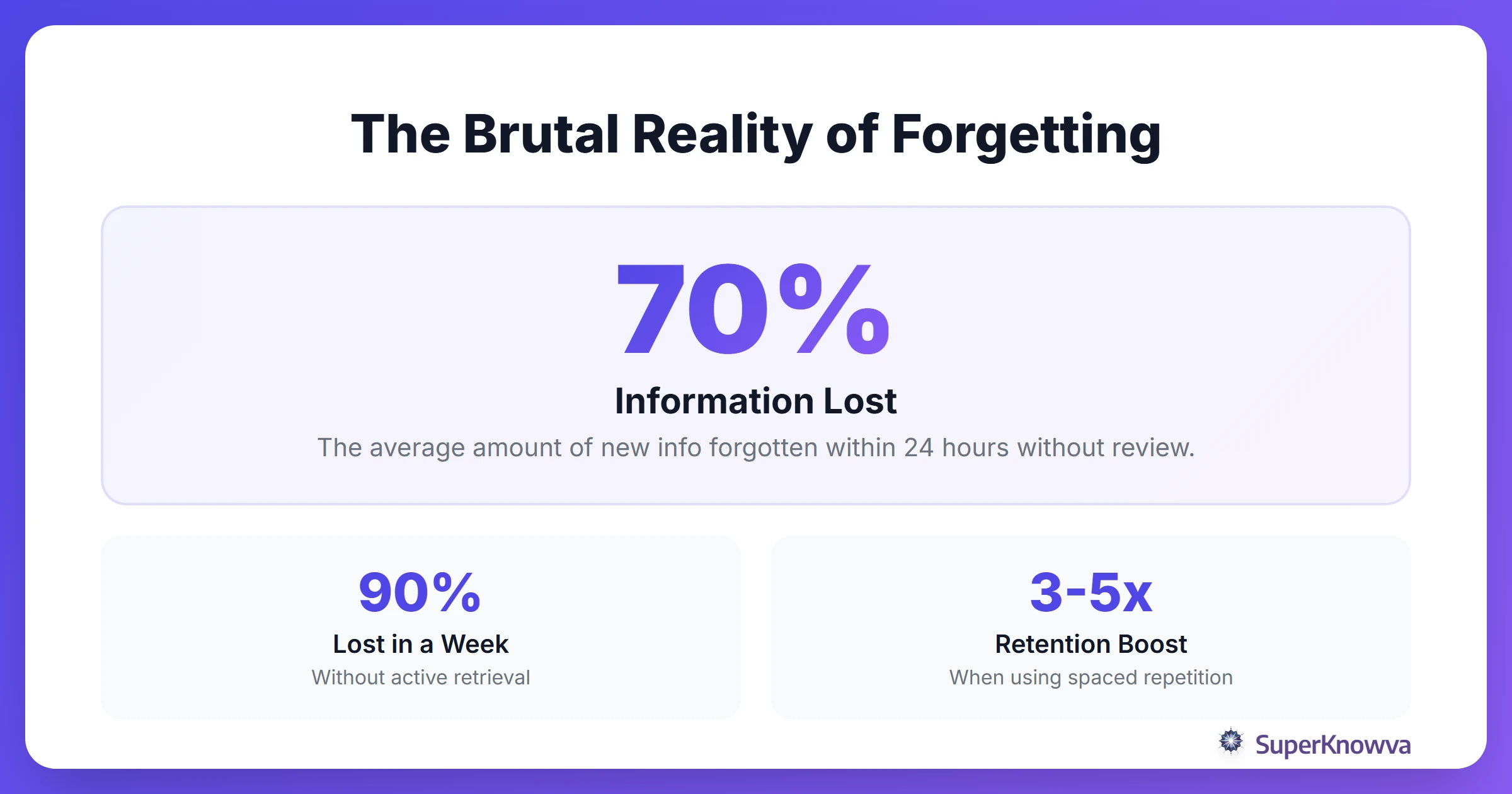
Back in the 1880s, psychologist Hermann Ebbinghaus discovered something brutal: human memory decays at an exponential rate. He called it the forgetting curve. Without a review, we lose about 70% of what we learn within just 24 hours.
Think of your brain as a survival machine, not a hard drive. It’s constantly filtering for "unimportant" data to prevent cognitive overload. If you don’t use a fact or revisit it, your brain assumes it’s garbage and prunes the neural pathway. It's basically digital decluttering, but for your mind.
To fight this, you need desirable difficulty. This is the idea that learning sticks best when your brain has to work a little bit to retrieve a memory. By hitting consistent review cycles, you’re essentially shouting at your brain: "Hey, this is important for survival!" (Or at least for passing your finals). That signal forces the data into your long-term memory.
What is Spaced Repetition? The Solution to Cramming
Spaced repetition is a simple but powerful shift in how you use your time. Instead of looking at a concept ten times in one frantic night, you look at it ten times over several weeks.
It’s the polar opposite of the classic "cram and forget" method. While cramming might get you through a 9:00 AM exam, the information usually vanishes by lunch. Why? Because those neural pathways were never reinforced. Spaced repetition exploits the "spacing effect," where your brain strengthens a connection every time you successfully recall a fact just as you were about to forget it.
The "engine" under the hood here is active recall. Instead of passively reading and re-reading a page (which is mostly a waste of time), you force your brain to produce the answer from scratch. When you combine active recall with perfectly timed gaps, you maximize your study efficiency. You’re building a library of knowledge that lasts years, not hours.
The 2357 Method vs. Modern AI Algorithms
Many students start out with manual systems like The 2357 Method for Revision. This involves a rigid schedule: you review your notes after 2 days, then 3, then 5, and finally 7.
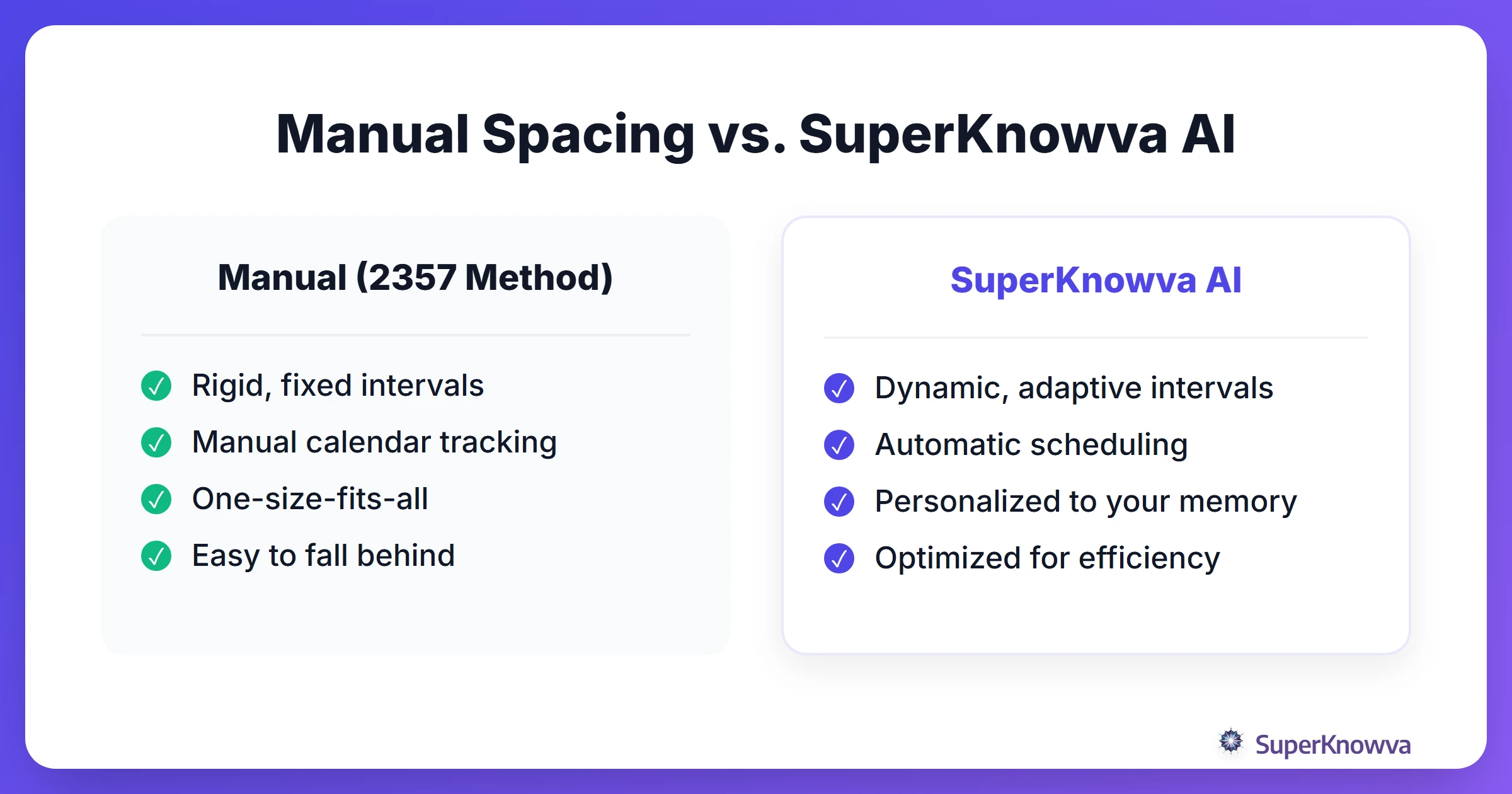
The 2357 method is definitely better than nothing, but it has some major flaws:
- It’s rigid: It treats a complex organic chemistry formula the same way it treats a simple vocab word.
- It’s a logistical mess: Keeping a manual calendar for hundreds of different facts is a full-time job in itself.
- It’s inefficient: You end up wasting time reviewing "easy" stuff too often while the "hard" stuff slips through the cracks.
Modern spaced repetition software like SuperKnowva fixes this. Instead of a paper calendar, AI algorithms adjust in real-time based on how you’re actually doing. It ensures you only study the exact things you’re on the verge of forgetting.
How SuperKnowva’s Algorithm Optimizes Your Study Time
SuperKnowva doesn't just give you a generic schedule; it predicts your personal forgetting curve. Every time you answer a question, the algorithm tracks your speed and accuracy to calculate an "Ease Factor."
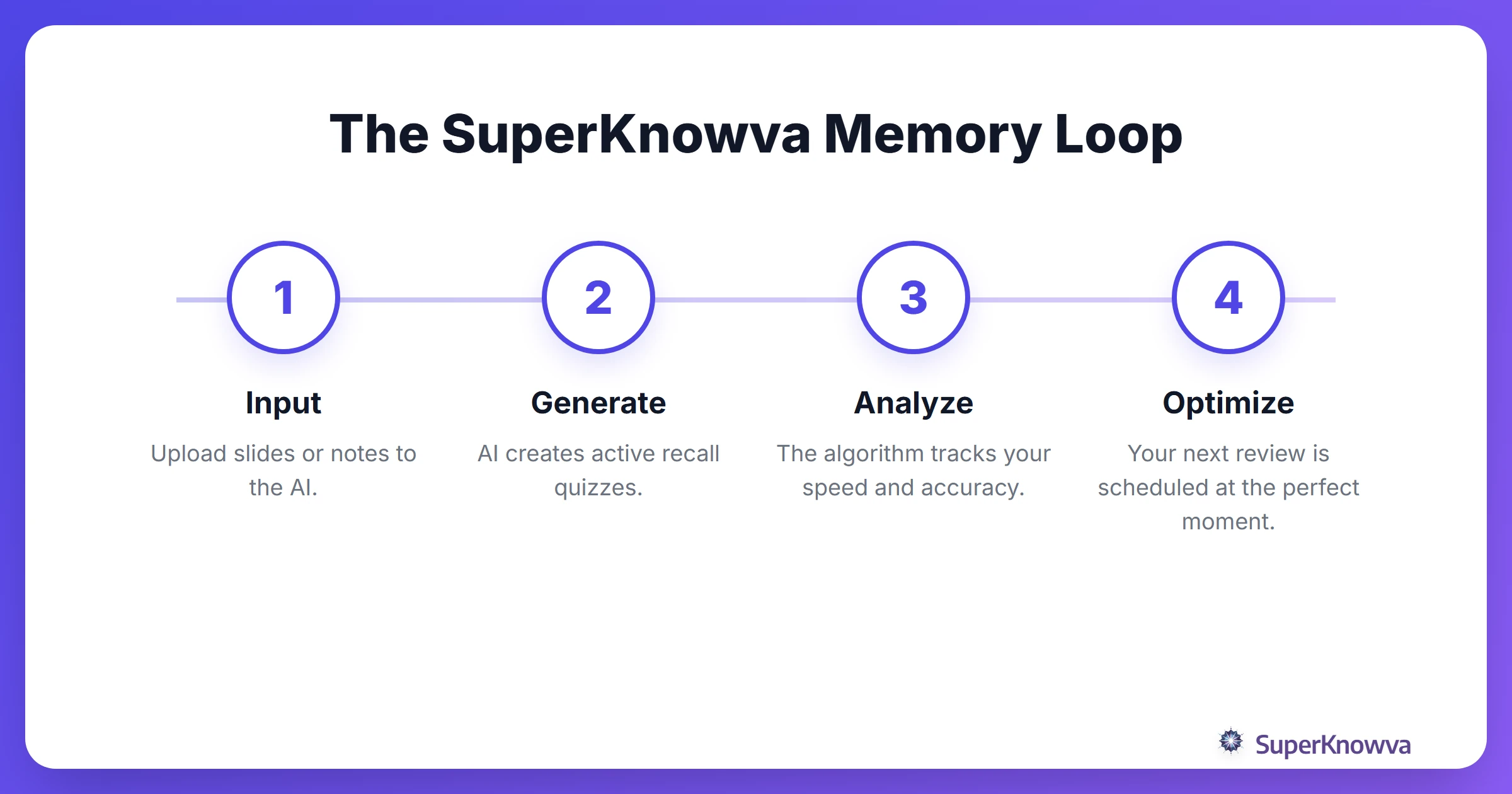
Struggling with a concept? The algorithm shortens the interval, bringing it back for review sooner. Finding a concept easy? The interval expands exponentially. This means your study sessions are 100% optimized. You never waste a second on things you already know, and you never miss a review for the tricky stuff.
Of course, the algorithm works best when you’re taking care of yourself. There’s a massive link between Sleep and Memory Consolidation that helps "lock in" those gains. Plus, SuperKnowva integrates AI-generated quizzes directly into this schedule, so you don't have to spend hours making flashcards by hand.
Active Recall: The Engine Powering the Algorithm
The algorithm depends on the effort you put in. To feed the system correctly, you have to use active recall. Testing yourself is more effective than re-reading because of the "testing effect." The act of reaching into your brain to pull out a memory changes that memory, making it more durable.
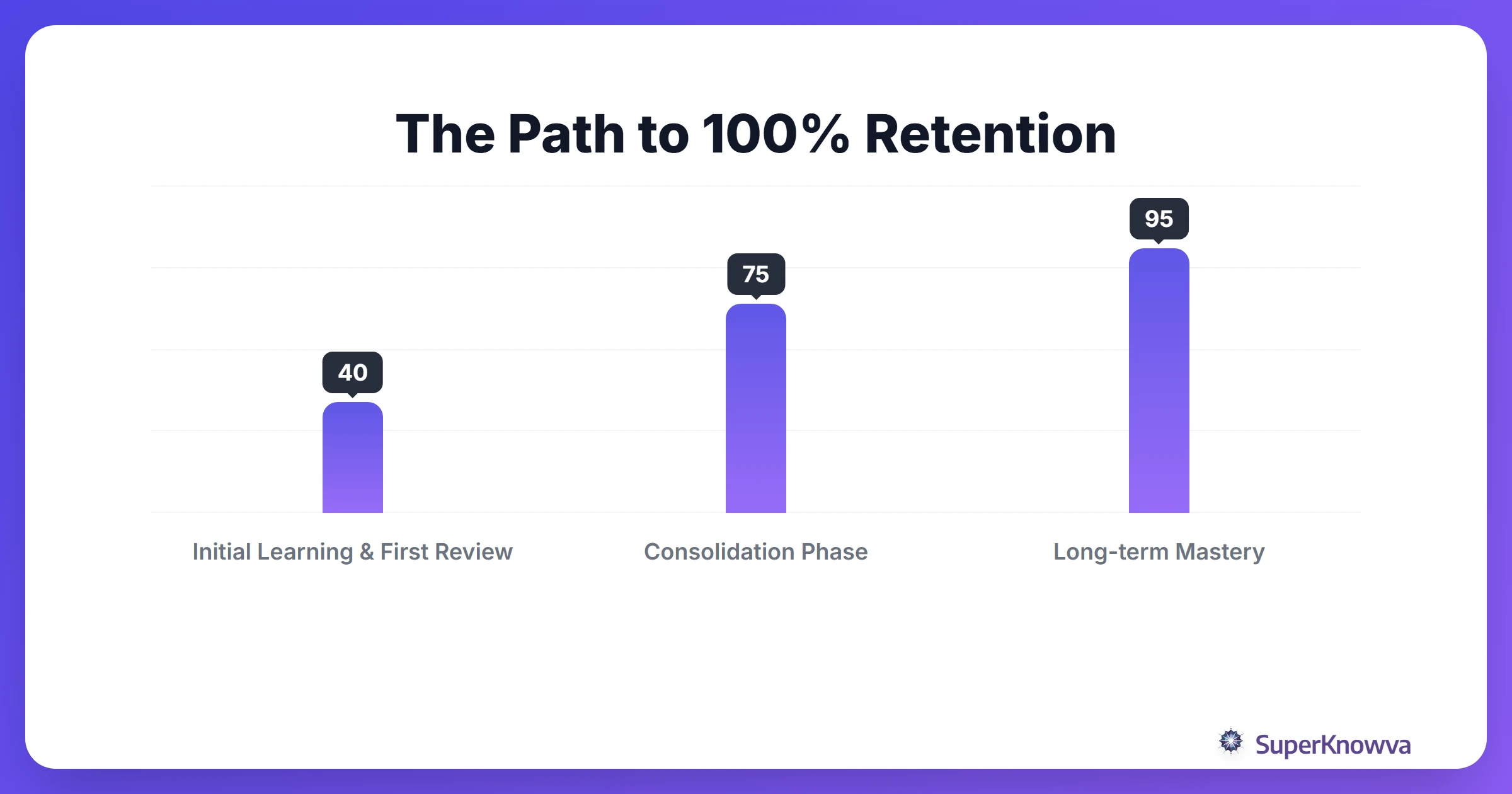
To get the most out of your sessions:
- Keep it atomic: One question should have one clear, simple answer.
- Be brutally honest: If you almost got it right but missed a tiny detail, mark it as "Hard" or "Again." Don't cheat the system.
- Mix your methods: Combining spaced repetition with the Blurting Method can supercharge your sessions.
- Don't stay in one lane: For the best results, mix different subjects together using Interleaving Practice.
The Real-World Impact: From Failing to Top of the Class
Switching from passive reading to algorithmic review is often a turning point for students. Spaced Repetition in the Classroom case studies show that these algorithms improve grades and increase engagement.
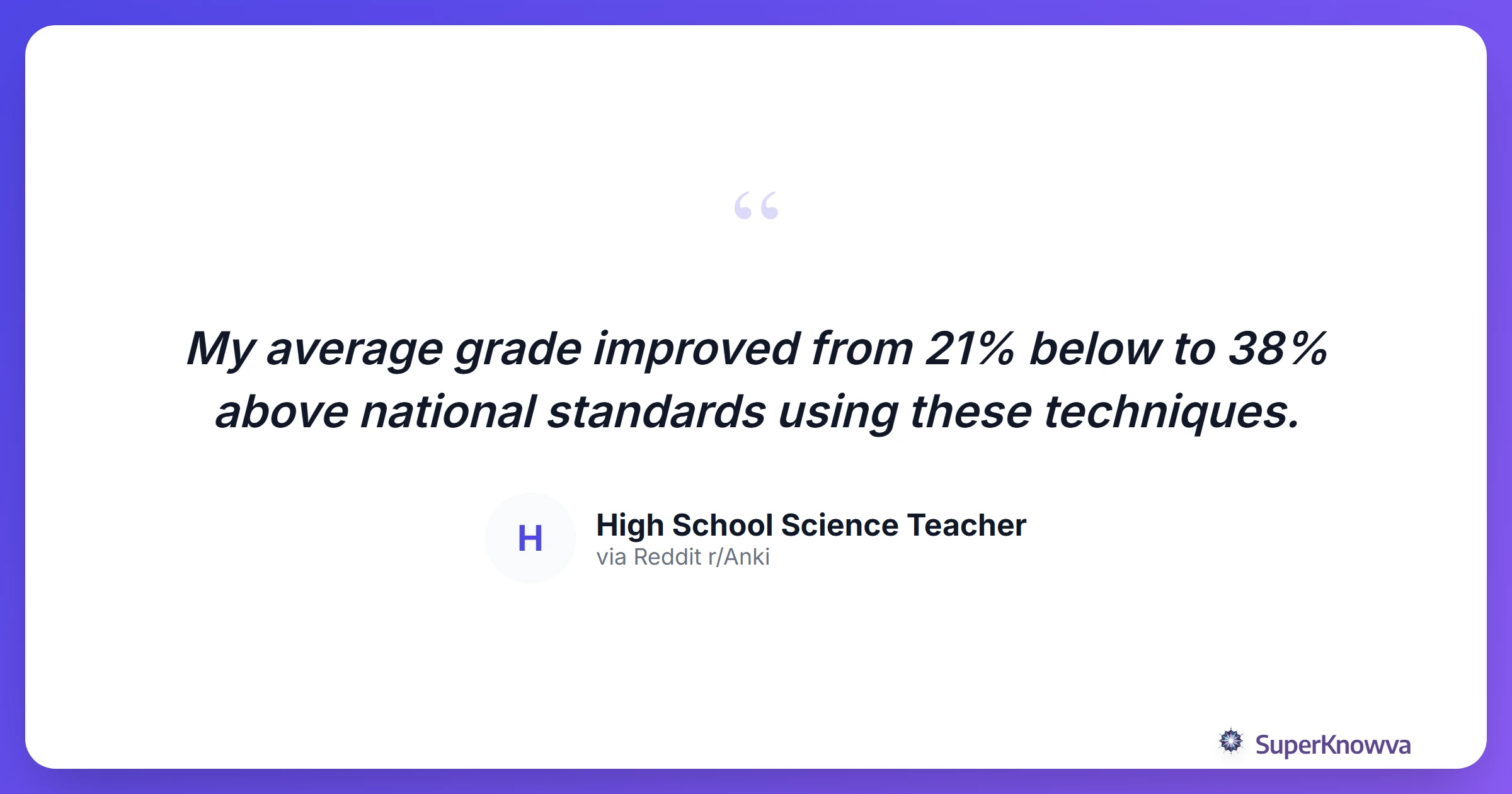
Beyond the GPA boost, using a system like SuperKnowva kills study anxiety. When you know the algorithm has your back, you stop worrying about "losing" what you've learned. This is essential for students in high-stakes fields like medicine or law, where the sheer volume of info is impossible to manage the old-fashioned way.
How to Start Your Spaced Repetition Practice Today
Ready to stop the brain-drain? Moving to an AI-driven workflow is easier than you might think.
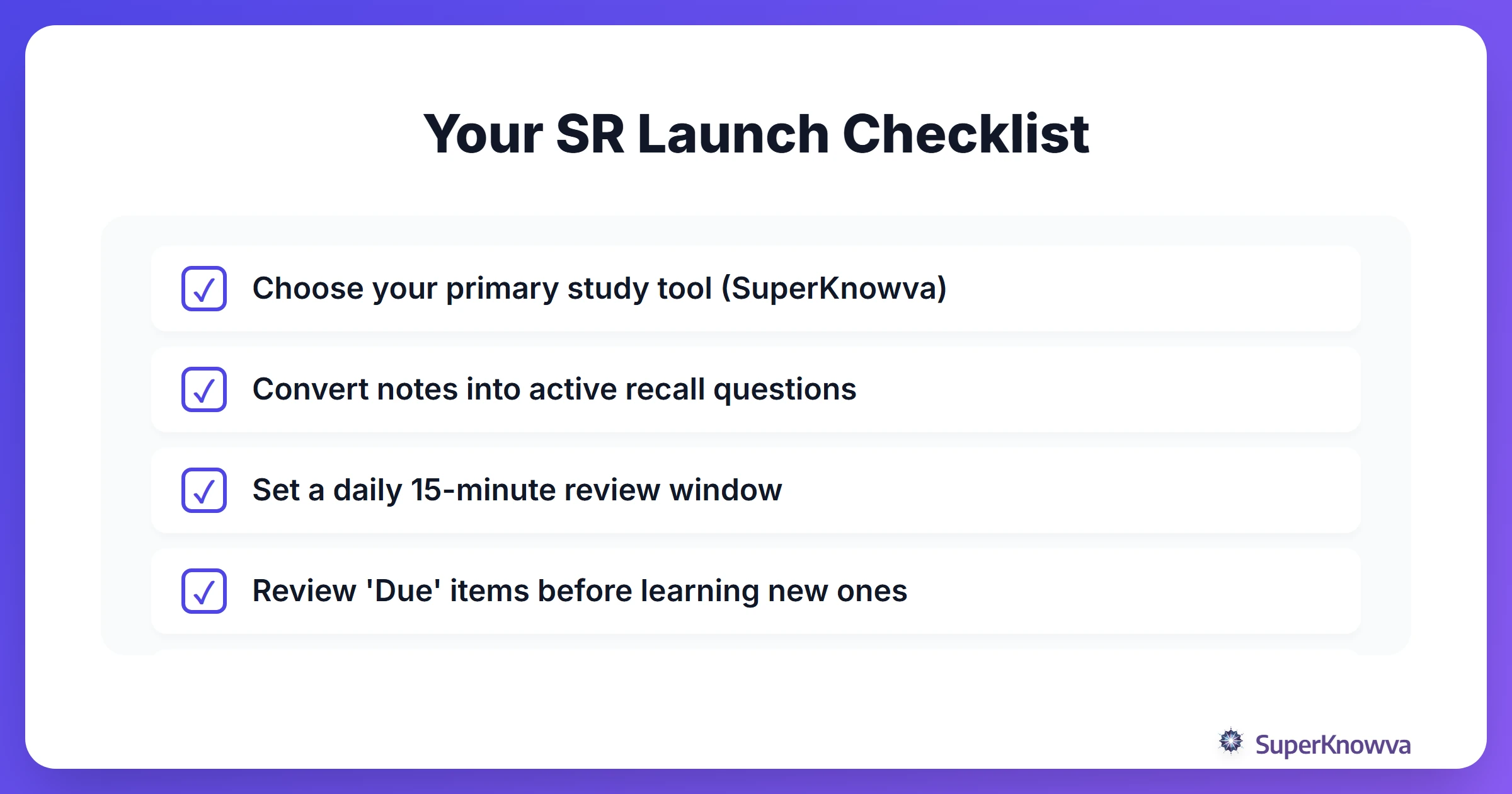
- Centralize Your Materials: Upload your lecture slides or notes to SuperKnowva and let the AI build your initial question sets.
- Break it Down: Don't try to memorize whole paragraphs. Keep facts "atomic" and simple.
- The Daily Streak: Spaced repetition lives and dies by consistency. Set a 15-minute window every morning to clear your "Due" items.
- Trust the Math: Sometimes the algorithm will schedule a review for three months out. It feels a bit scary, but trust the process. Your brain is stronger than you realize.
By using the science of spaced repetition for students, you aren't just studying for a test; you’re building a permanent library of knowledge. Start with SuperKnowva today and see what it feels like to never forget.