Picture this: You’ve got your snacks, your laptop is charged, and your friends are ready to crush some midterms. Fast forward three hours, and you’ve somehow ended up three seasons deep into a Netflix true-crime doc or scrolling through a TikTok rabbit hole. Your textbooks? Still untouched.
We’ve all been there. The intention is to learn together, but the reality is usually just a glorified hangout. It’s frustrating. But here’s the good news: effective group study sessions don't have to depend on luck or a sudden burst of collective willpower. By bringing AI into the mix, you can flip the script and turn these social hours into actual powerhouse learning sessions.
In this guide, we’re going to look at how to rebuild your study group from the ground up using AI-powered workflows that actually move the needle on your grades.
Why Traditional Study Groups Often Fail
If you spend five minutes on student Reddit, you’ll see the same complaint everywhere: the "communal distraction" trap. Most traditional study groups lack structure, meaning the session is usually 80% gossip and 20% panic-reading.
The main issue is the "leeching" problem. Often, one or two people do the heavy lifting while everyone else waits to copy the answers. This is a poor outcome for everyone. The "smart" students burn out, and the passive students do not learn. To fix this, your group needs to stop just "sharing answers" and start sharing insights. This requires a tech-driven structure.
The 5 W's of AI-Enhanced Collaboration
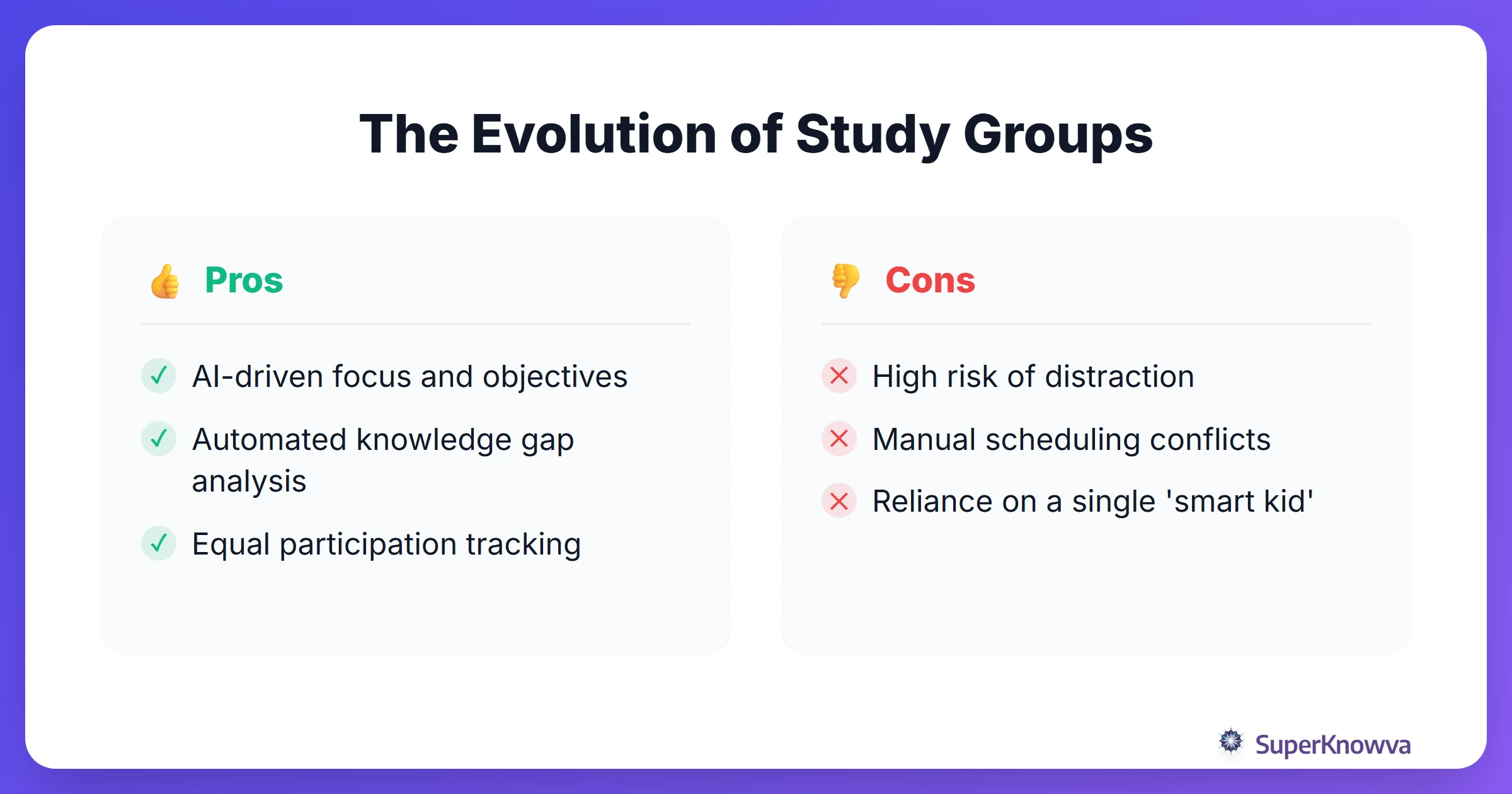
To get things back on track, we can take the classic The 5 W's of Study Groups and give them a digital upgrade. This framework is a lifesaver when the semester starts getting heavy.
- Who: Use digital platforms to find partners who share your goals. It is not just about who you sit next to in lecture; find the people who are as driven as you are.
- What: Do not walk into a session blindly. Use AI to analyze your syllabus and generate clear objectives. Know exactly what needs to be mastered before you open your laptop.
- Where: Choose a workspace that works. The best groups use a mix of synchronous (live video for chatting) and asynchronous (shared AI knowledge bases) tools.
- When: Stop the scheduling back-and-forth. Use AI tools to find times when everyone is energized, not exhausted after a long day of labs.
- Why: Aim higher than just passing. Use AI to achieve deep concept mastery by finding the logic behind the complex material that usually shows up on the final.
Setting Digital Norms (So You Actually Get Work Done)
Structure is the only thing standing between you and a wasted afternoon. As CU Boulder's academic coaching program points out, you need ground rules. In a digital-first group, try these:
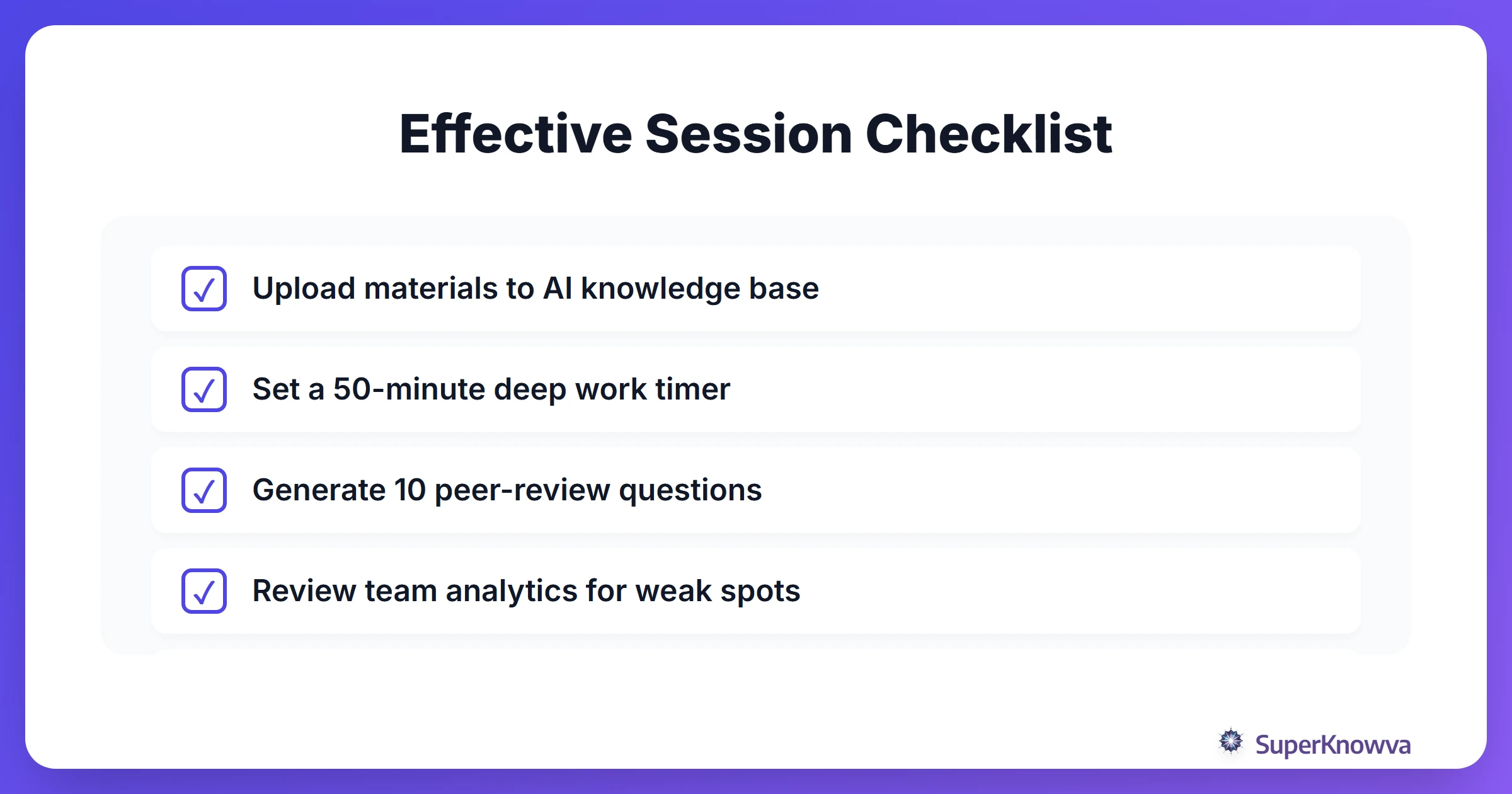
- Deep Work Intervals: Try 45 minutes of "mics off, cameras on" focus time. No talking, just work.
- Shared Knowledge Bases: Don't let one person be the "resource bank." Upload notes and slides to a shared AI platform. This way, everyone can ask the AI questions independently rather than bugging the same person over and over.
- Pre-session Prep: Make it a rule: everyone reviews an AI-generated summary of the reading before the call starts. No one shows up cold.
- The 5-Minute Rule: Struggling to get started? Use the 5-minute rule. Commit to just five minutes of focused work. Usually, that’s all it takes to break the procrastination spell.
Leveraging AI for Data-Driven Study Groups
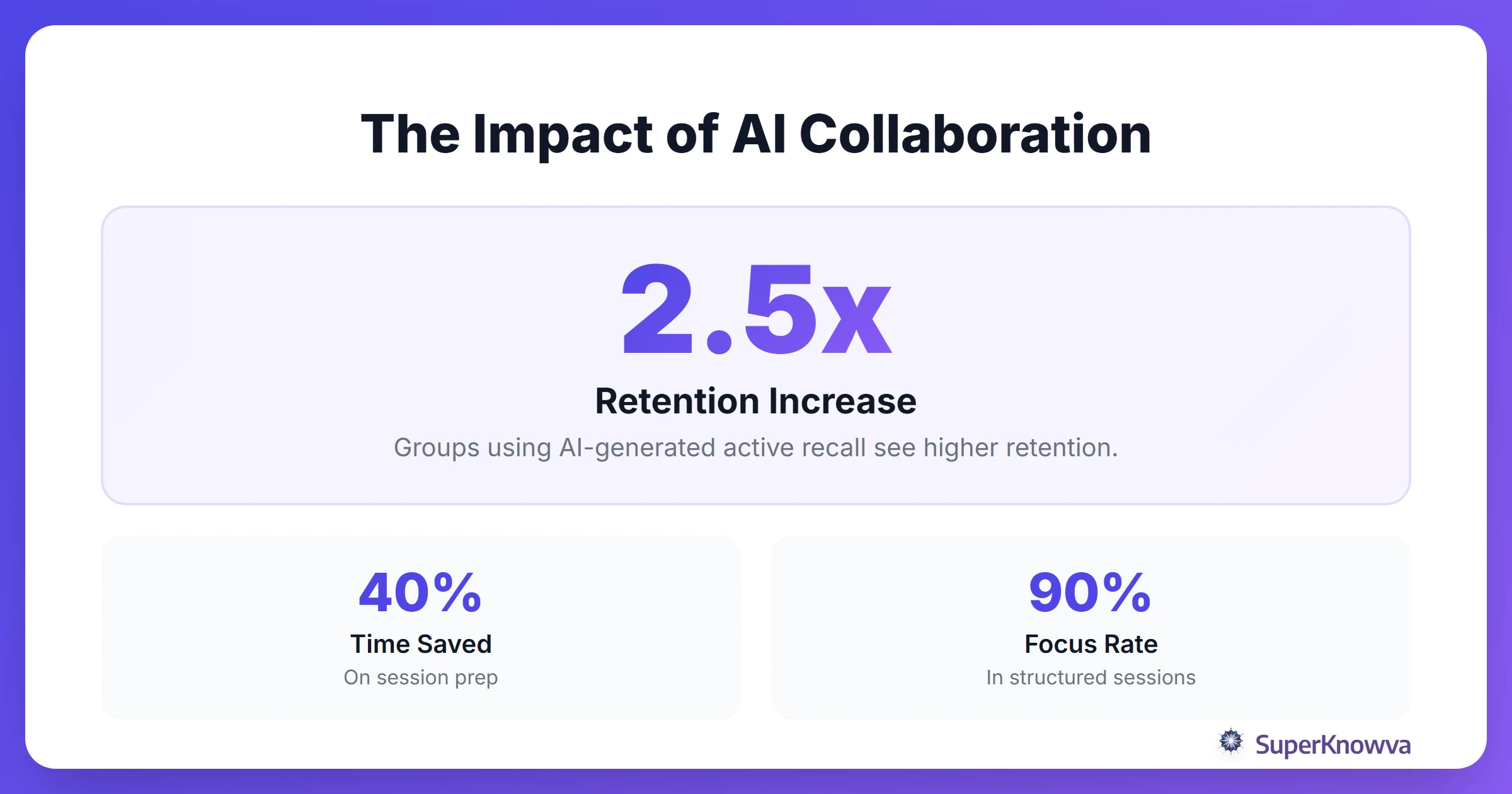
The real "aha!" moment happens when you stop guessing what you need to study. Instead, use AI to analyze group-wide knowledge gaps. If everyone uploads their notes to a central hub, AI can spot the patterns.
It can tell you, "Hey, everyone in this group is struggling with Chapter 4, but you’ve all mastered Chapter 2." From there, you can generate group-specific practice exams that target those weak spots. It turns your group chat from a place of confusion into a data-driven learning hub.
Need to find the right tools for the job? Check out our list of The Best Study Apps for Students in 2026.
Active Recall: The Secret to High-Impact Sessions
When you're planning your time, remember: Active Recall vs. Re-reading is the difference between an A and a C. Reading your notes out loud to each other is a waste of time.
Instead, use AI to turn your lecture notes into competitive group quizzes. Or, try the "Feynman Technique" with a twist: Have one person explain a concept while the others use an AI-generated rubric to grade the explanation. If you can’t explain it simply, you don’t know it well enough yet. This forces you to actually retrieve information from your brain, which is how memory is built.
Balancing Productivity with Social Connection
Let’s be real: you’re in college to have a life, too. Effective group study is actually the best way to balance a high GPA with a social life. You don't have to be a robot; you just need a better schedule.
Structure your social breaks. Try 50 minutes of deep work followed by 10 minutes of "mics on" catching up. Use AI for administrative tasks, such as summarizing chapters or scheduling meetings, so that when you do talk, it is about big ideas (or where you're going for dinner). Building a supportive community helps prevent academic burnout.
By bringing AI into your study group, you turn a common source of stress into your biggest academic advantage. Study more effectively together.