Think back to the university library of the 1990s. You’d see rows of heavy textbooks, flickering fluorescent lights, and groups of students huddled over shared, coffee-stained notebooks. Today, while the goal remains surviving that impossible chemistry exam, the atmosphere has completely changed. We’ve moved past the era of just "studying together." We’re now entering an age where peer to peer learning ai integration is an essential tool for academic success.
By mixing human intuition with artificial intelligence, you aren't just reviewing notes anymore. You're building a high-performance learning engine. Let’s break down how to lead an AI study group that actually works and use social learning strategies to crush your finals this May.
From Library Cubicles to Intelligent Algorithms
Back in the day, peer-to-peer (P2P) learning was limited by physics. It was the "one-room schoolhouse" vibe: you learned something, then you explained it to the person sitting next to you to make sure it actually stuck. It worked, but you were limited by who was in the room and what books you had on hand.
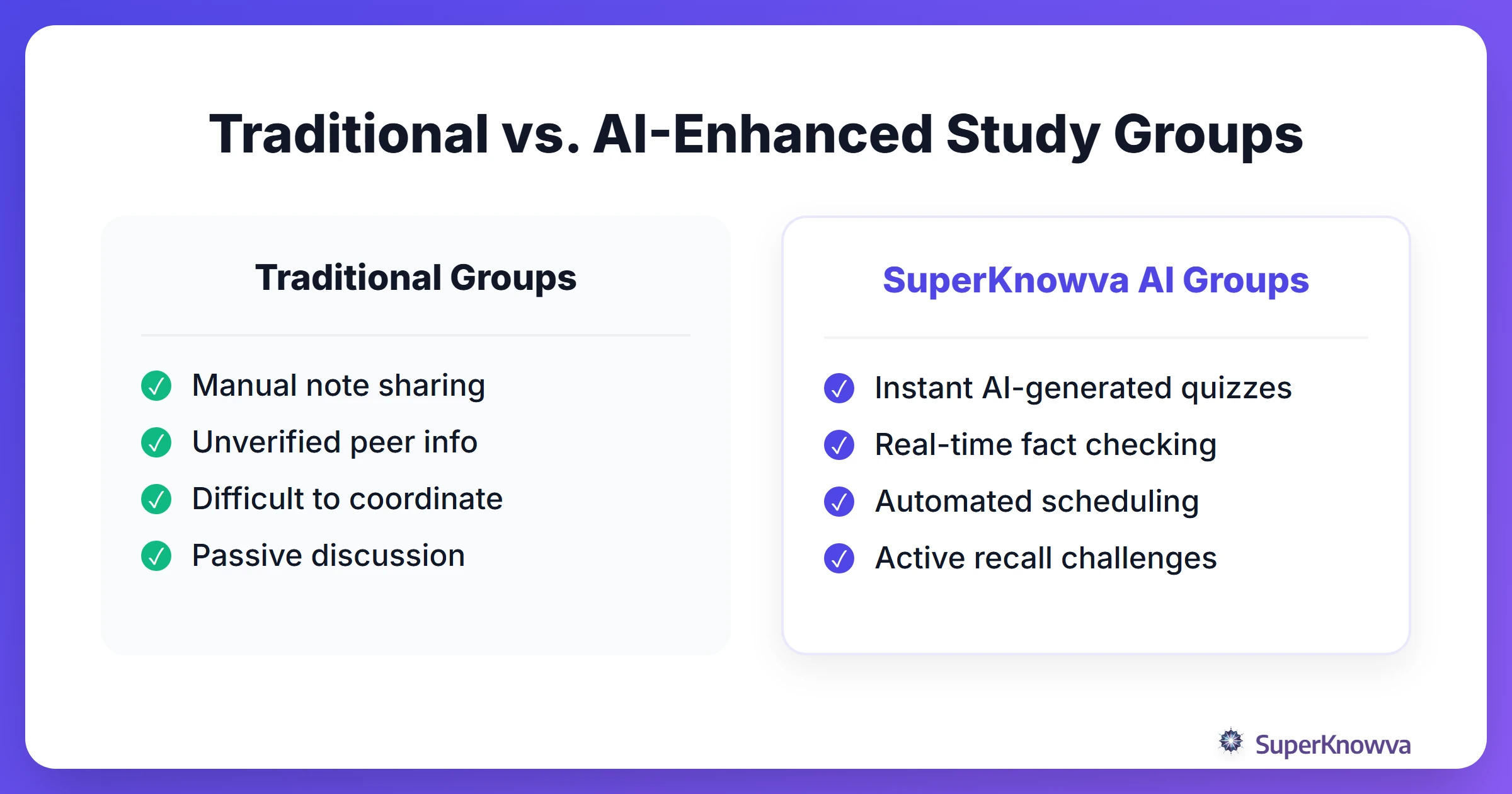
The internet changed the "where" by giving us Discord and Zoom, but the "how" stayed mostly the same. We were still talking at each other through screens. Decentralized learning uses AI as a digital moderator to create an intelligent workspace rather than just a chat room. AI does not replace the conversation; it keeps it on track, verifies facts, and ensures the group makes progress instead of just venting about the professor for two hours.
Why AI and Peer Learning are the Ultimate Power Couple
Ever noticed how you suddenly understand a topic better the moment you try to explain it to a friend? Psychologists call this the "Protege Effect." It’s the boost in effort and clarity we get when we know someone else is relying on us to teach them. When you add AI to that mix, the results are explosive.
AI fills the "knowledge gaps" that usually derail a good study session. We’ve all been there: a group of four friends arguing for twenty minutes over a single formula because nobody can find the right page in the textbook. With SuperKnowva, the AI acts as your group’s objective source of truth. It provides data-driven accuracy to back up your human nuance.
Scientific studies on retrieval practice show that collaborative testing beats solo reviewing every time, especially when an AI can give you instant, objective feedback. Instead of just "going over" notes, use AI to generate active recall challenges for each other. To understand why this is effective, read our article on Active Recall vs. Re-reading.
How to Build Your AI-Powered Study Squad
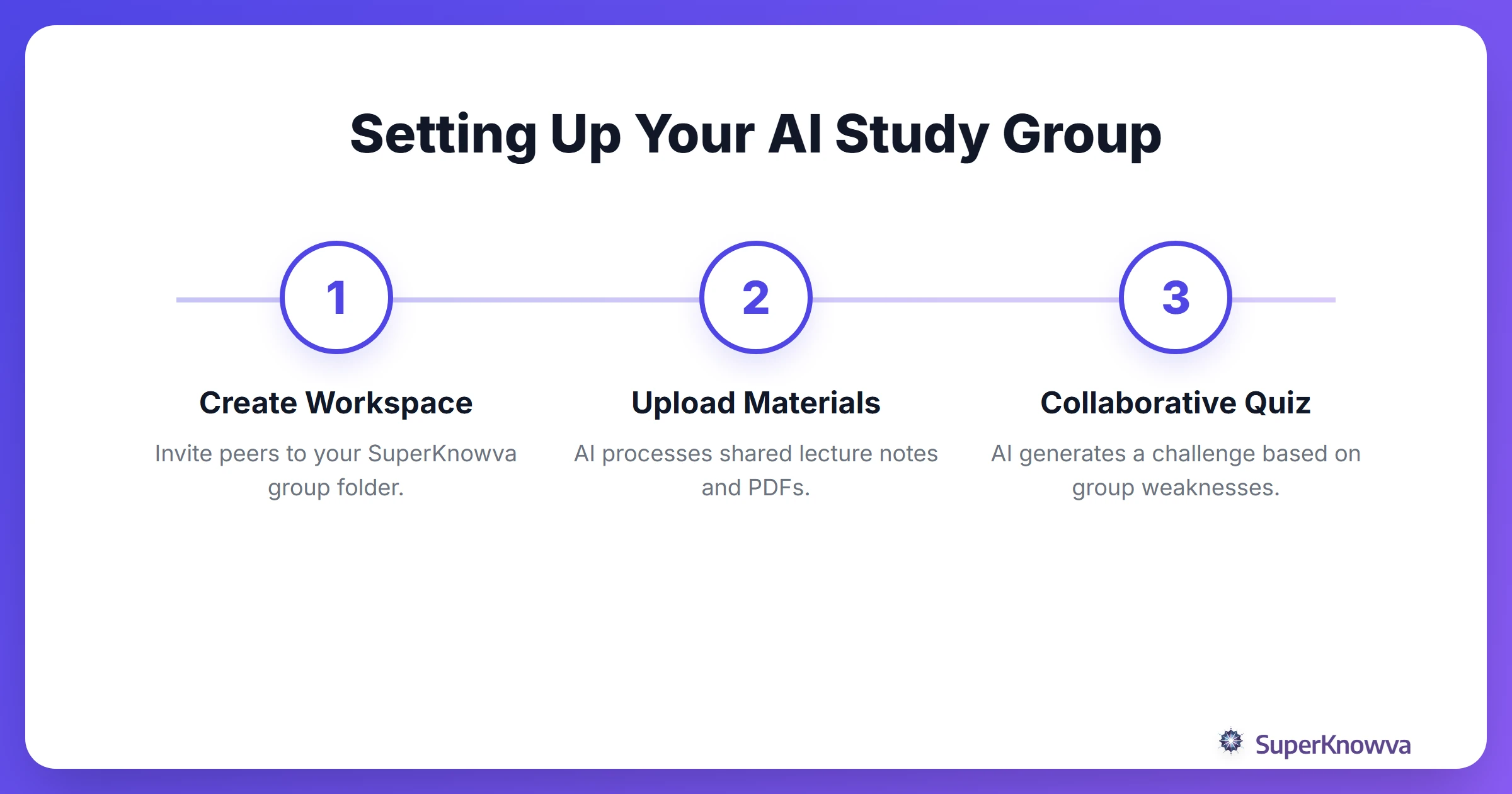
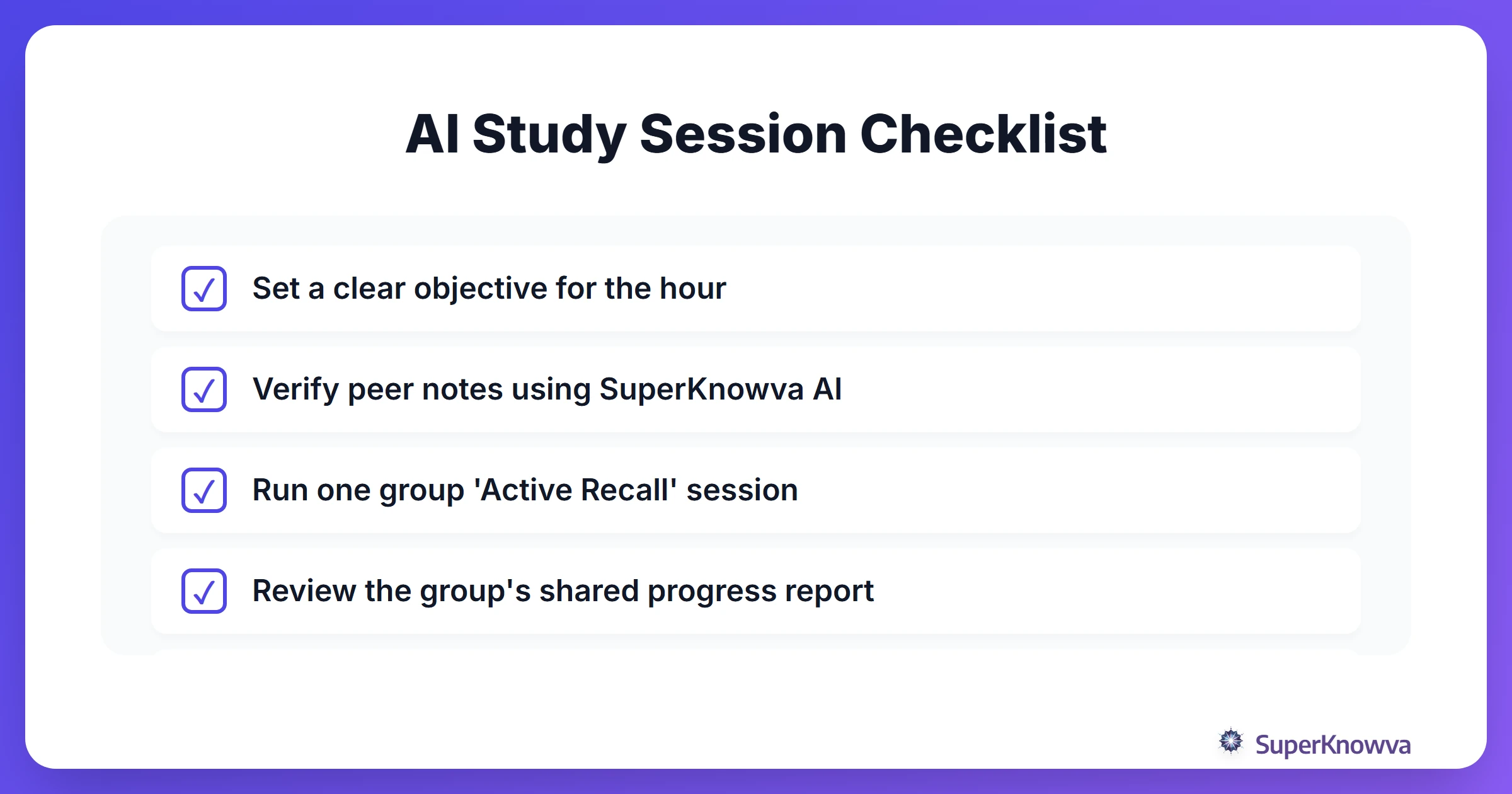
Ready to upgrade your study group? SuperKnowva collaboration tools are designed to turn a chaotic group chat into a structured powerhouse. Here is your game plan:
- Sync Your Sources: Invite your squad to a shared SuperKnowva folder. This is your "Source of Truth" where everyone drops their best notes.
- Feed the Machine: Upload your shared lecture notes, PDFs, and those confusing slide decks. The AI will digest them to understand exactly what your specific course requires.
- Assign "AI Roles": Don't just sit there. Give everyone a job to keep the momentum going:
- The Fact-Checker: Uses the AI to verify peer explanations and catch "hallucinations" or errors.
- The Recap King/Queen: Directs the AI to create "TL;DR" summaries of those massive 50-page chapters.
- The Quizmaster: Prompts the AI to build weekly challenges based on the topics the group is struggling with most.
Using AI to Kill the Awkwardness of Accountability
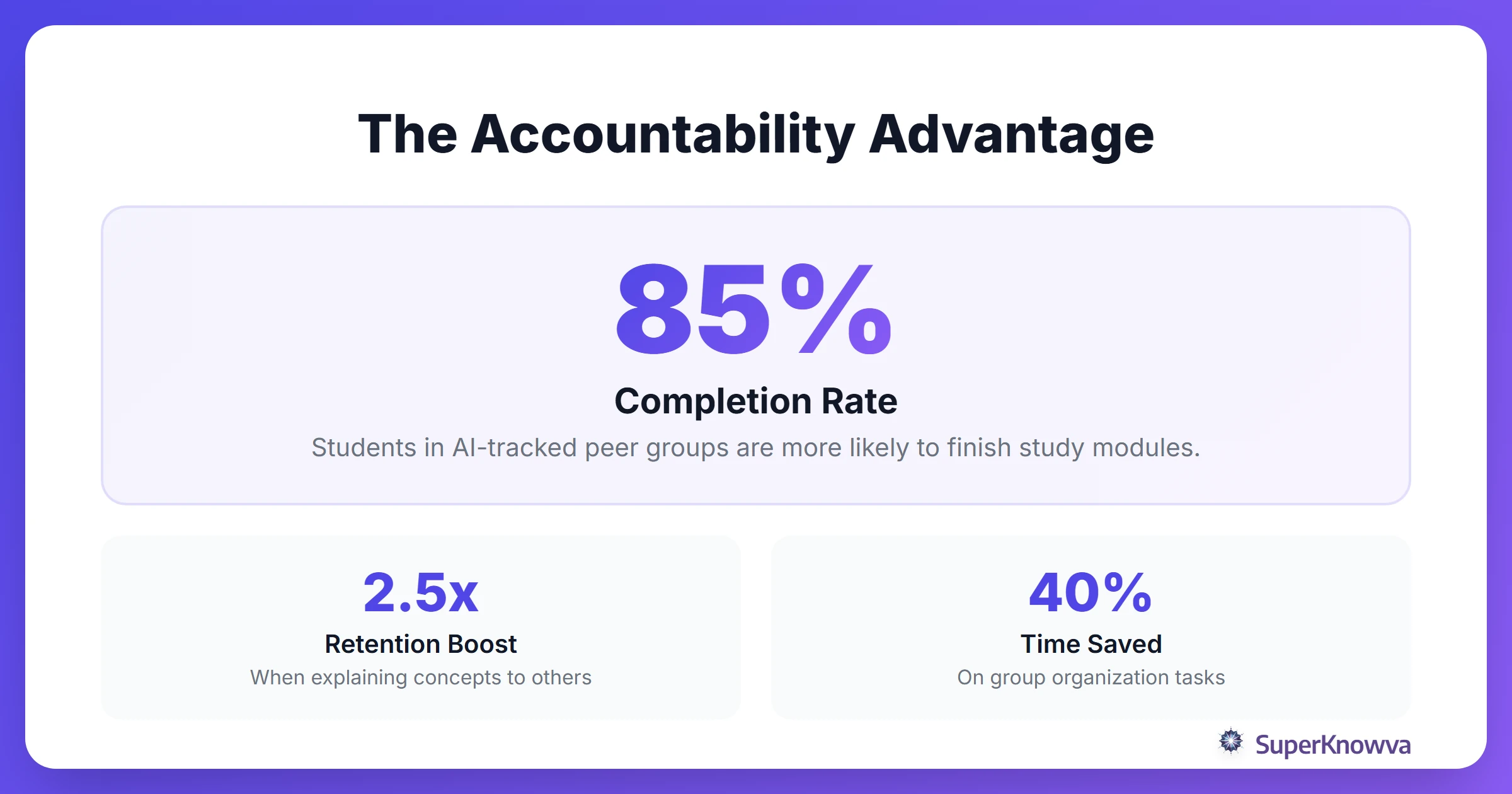
Let’s be real: nobody wants to be the "study group police." It’s awkward to nag your friends about whether they actually did the reading. AI solves this by making accountability objective, not personal.
SuperKnowva’s leaderboards and progress tracking turn studying into a bit of a game. You can see, at a glance, which topics the group has mastered and where the red flags are. It allows you to spot who needs help without making it a "thing." This data-driven approach is the best way to socialize while staying productive, helping you balance a high GPA with a social life.
Dodging the Usual Study Group Traps
Even the best-intentioned groups can fall apart. Here is how to use AI to keep the wheels from falling off:
- Stop "Social Loafing": We all know that one person who shows up, eats the snacks, and contributes nothing. AI fixes this by assigning personalized "Active Recall" tasks that members must complete to contribute to the group's overall score.
- Verify Everything: Peer explanations are great for morale, but they can be wrong. Use SuperKnowva to fact-check every "I think this is what he meant" moment in real-time.
- Beat the Procrastination Bug: If the group is struggling to get started, use the 5-minute rule. Start one collaborative AI quiz together. Usually, once the first question pops up, the competitive drive takes over.
The Future: Your Own Personalized Learning Network
The distinction between human and machine knowledge is narrowing. Tech communities are discussing P2P AI Training Discussion, where a study group does more than use an AI. They help train a personalized model that understands their specific shorthand and learning style.
This is the beginning of a move toward decentralized, democratic education. Knowledge isn't trapped in an expensive textbook anymore; it’s something you and your friends co-create using smart algorithms. SuperKnowva is already being called one of the best study apps for 2026 because it prepares you for this world.
Don't study in a vacuum. Grab your friends, fire up the AI, and turn your next session into a breakthrough rather than a chore.