Does looking at a list of 1,500 high-level GRE words make you want to close your laptop and take a nap? Many students find the process overwhelming. If you’re prepping for the GRE, you already know the Verbal Reasoning section is tough. It’s not just about memorizing "big words"; it’s about grasping nuance, tone, and the subtle logic that connects ideas.
Traditional rote memorization is slow, boring, and, frankly, it doesn't work well for an exam this rigorous. This is where GRE vocabulary AI flashcards step in. They don't just help you memorize; they help you master high-frequency words with the kind of speed and retention that old-school paper cards can't touch.
In this guide, we’ll look at how AI-driven tools are completely flipping the script on how students tackle the GRE word list.
The Challenge of Mastering 1,500+ GRE Words
The sheer volume of vocabulary you need for a top-tier Verbal score is, in a word, staggering. Most experts recommend having a working knowledge of at least 1,000 to 1,500 "high-frequency" words. We’re not talking about everyday terms here. These are academic, abstract words that often shift meanings depending on the sentence.
Most people use outdated study methods. Staring at a word and its definition on a paper card is passive. This leads to "benightedness" in your study habits. You spend hours "studying" but fail to move that information into your long-term memory. When you see a word like laconic or equivocal in a vacuum, your brain has nothing to hook it to. By the time you take your next practice test, the meaning has evaporated.
How AI Flashcards Change the Game
Static cards are a relic. Modern AI study tools for GRE prep offer a dynamic experience that actually learns you.
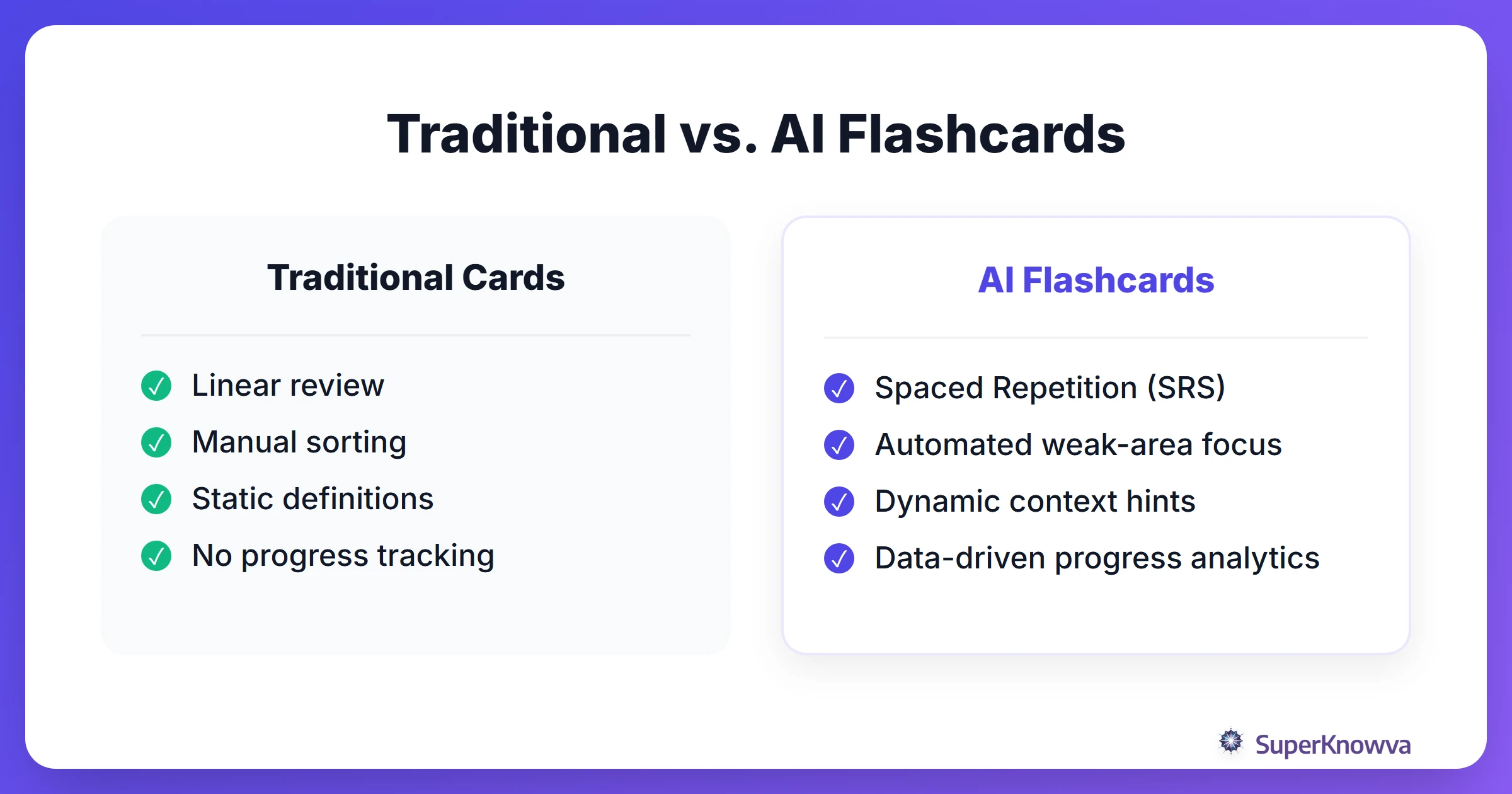
Think about a standard deck: you see every card with the same frequency, regardless of whether you know it or not. AI-powered systems use smart algorithms to track your performance in real-time. If you keep tripping over the word fastidious, the AI notices. It will prioritize that card, showing it to you more often until it finally sticks. Meanwhile, the words you’ve already mastered get pushed to the back of the line so you don't waste time on them.
Even better? These tools provide personalized AI-generated hints. Instead of a dry, robotic dictionary definition, the AI can create a hint based on your interests or your specific mistakes. It builds a custom mental bridge between what you know and what you're trying to learn.
Context-Based Learning: Moving Beyond Definitions
Ever fallen into the "dictionary trap"? That’s when you know exactly what a word means on paper, but you have no idea how it functions in a complex sentence. AI flashcards solve this through GRE context-based learning.
Context-based learning is how we naturally learn language: by seeing words used in various scenarios. AI tools like Scafwording can take an abstract GRE word and instantly generate relatable, modern sentences. For example, instead of just learning that anomaly means "a deviation from the norm," the AI might show you a sentence about a weird data spike in a social media trend.
Seeing words used in diverse academic and professional contexts is a must. To see how these skills translate to other parts of your exam, you can also learn how to Improve Reading Comprehension with AI, which reinforces the same contextual logic you'll need for vocab mastery.
The Power of Spaced Repetition Systems (SRS)
The foundation of AI flashcards is the Spaced Repetition System (SRS). It’s based on the "forgetting curve," a psychological theory that says we lose information over time unless we review it at very specific intervals.
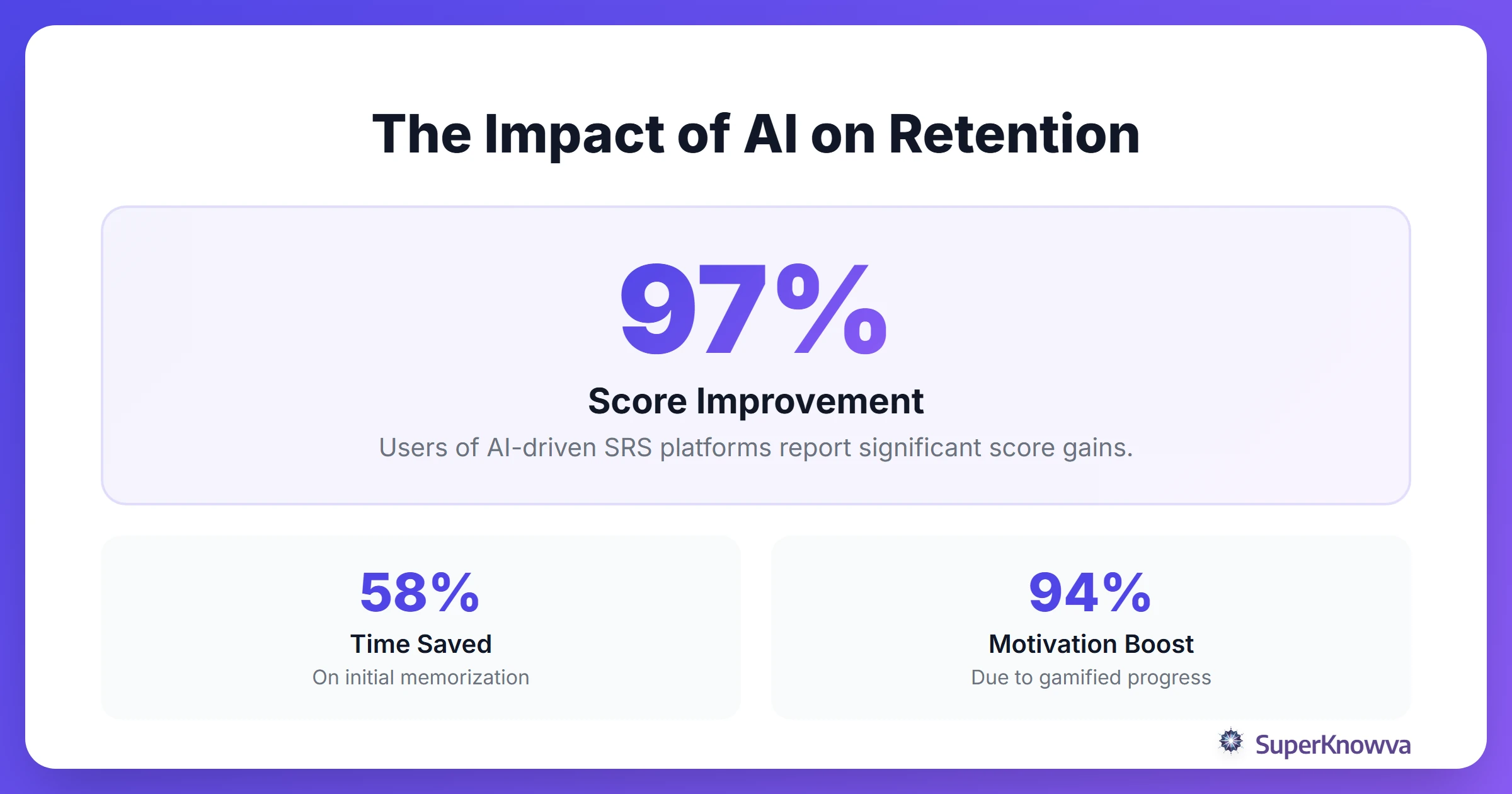
AI optimizes the timing of these reviews with surgical precision. By showing you a word at the exact moment you’re about to forget it, the AI strengthens the neural pathways associated with that word. It’s significantly more efficient than linear studying. Why spend three hours reviewing the "A" section of the dictionary only to forget it all by breakfast?
Platforms like Magoosh GRE Vocabulary Flashcards and the ETS GRE Brainscape Digital Flashcards use these algorithms to make sure every minute you spend studying actually counts toward your final score.
A 4-Week Strategy for GRE Vocab Mastery
Mastering 1,500 words is a marathon, not a sprint. But with GRE vocabulary AI flashcards, you can turn that marathon into a highly effective 4-week push.
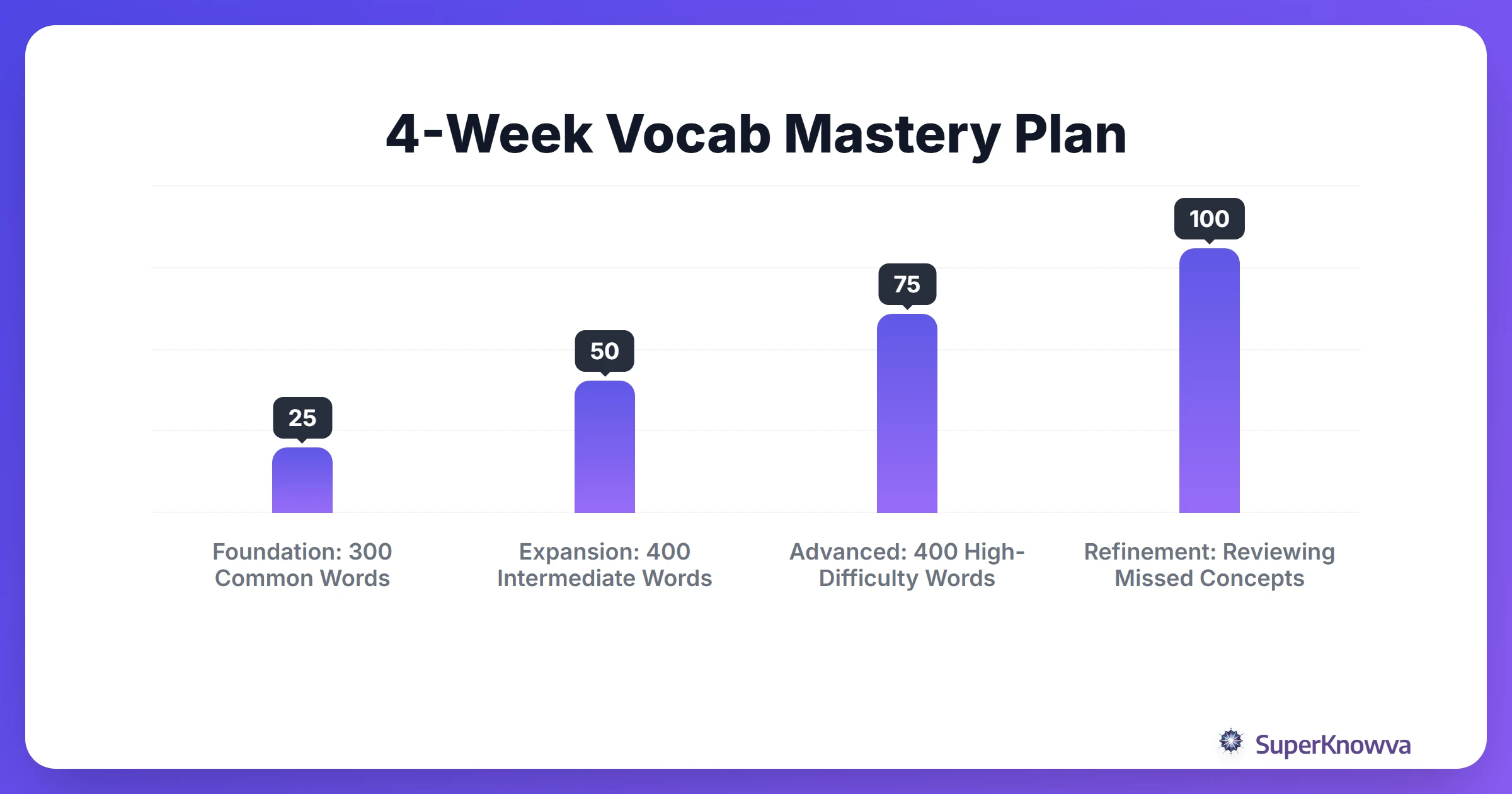
- Week 1: The Foundation. Focus on the 300 most common GRE words. Set your AI tool to "High Frequency" mode to learn the fundamentals.
- Week 2: Expansion. Add 400 intermediate words. Use AI-generated context hints to distinguish between words that seem similar but have different connotations.
- Week 3: Intensive Study. Study 400 high-difficulty words. Balance your workload by checking our AI-Powered GRE Quant Guide to ensure your math skills stay sharp while you focus on vocabulary.
- Week 4: Refinement. Focus exclusively on the "trouble words" your AI dashboard has flagged. Read high-level journals like The Economist to see these words used in context.
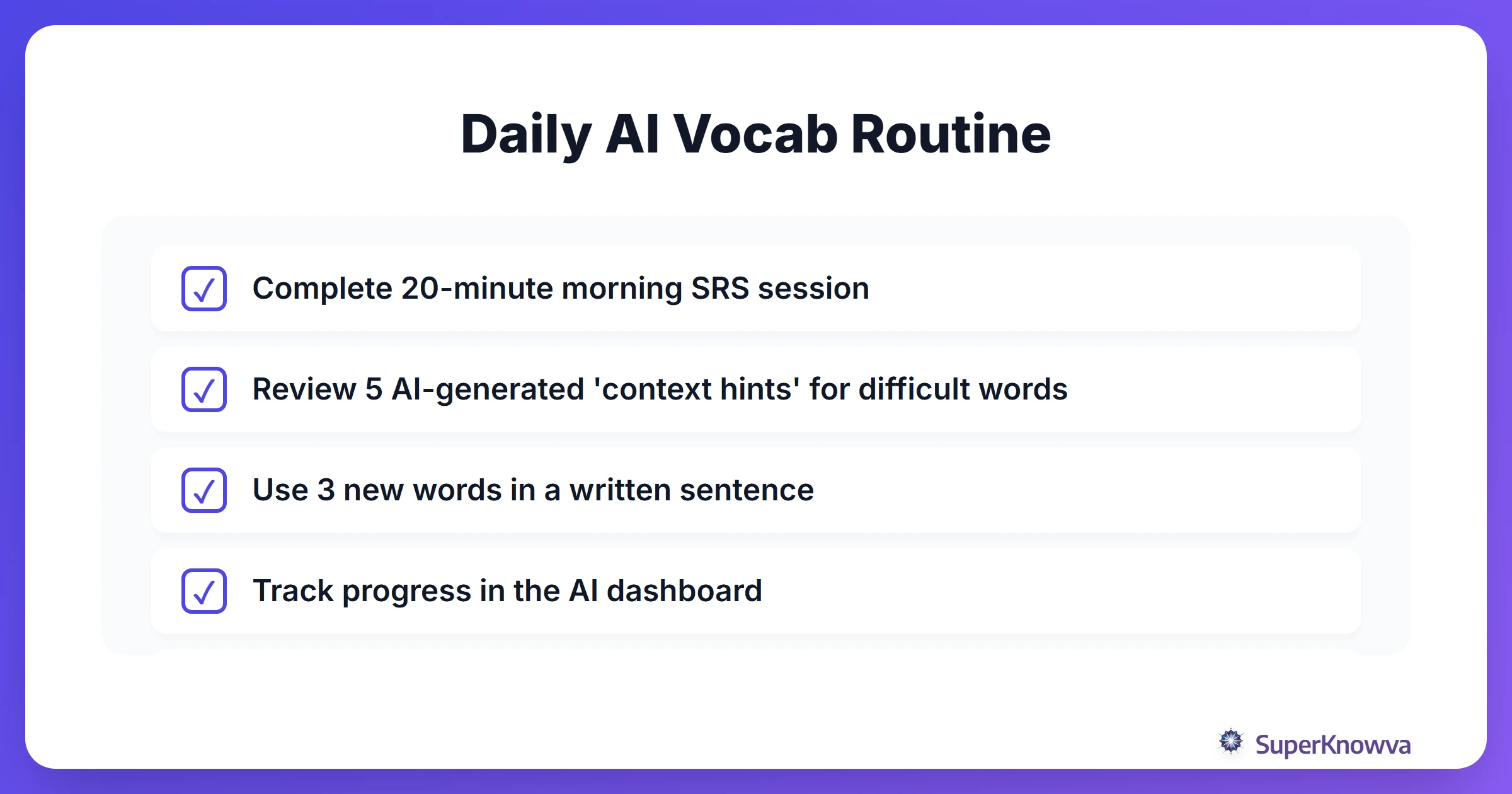
Remember: 20 minutes every day is much better for your brain than a 5-hour Sunday cram session.
Integrating Vocab with Full GRE Verbal Prep
Vocabulary is the bedrock of the GRE, but it doesn't exist in a vacuum. Your word knowledge directly impacts how you handle Text Completion (TC) and Sentence Equivalence (SE) questions.
When you Ace GRE Verbal Reasoning with AI, you start to see patterns. AI tools help you identify "trigger words" (like although, moreover, or despite) that signal how a sentence is about to shift. By connecting your vocab study to broader verbal reasoning skills, you move from simple recognition to true mastery.
Conclusion
Don't let a massive word list keep you from your target score. By using GRE vocabulary AI flashcards, you can stop the "benighted" cycle of traditional studying and embrace a faster, more scientific way to learn. Start your AI-powered preparation today. Your future self (and your Verbal score) will thank you.