Ever feel like a math god while doing your homework, only to turn into a deer in headlights the second the exam hits your desk? You aren't alone. It’s a frustratingly common cycle: you put in the hours, you "know" the material, but you freeze during the high-pressure moments.
The problem usually isn't your brain; it is your strategy. Most students rely on study methods that feel effective in the moment but fail during a test. If you want to stop blanking out and improve your exam scores, you need to master interleaved practice for math.
In this guide, we’ll look at why your current habits might be setting you up for a false sense of security and how AI tools like SuperKnowva can help you bridge the gap between "doing the work" and "getting the grade."
The Illusion of Mastery: Why Blocked Practice Fails
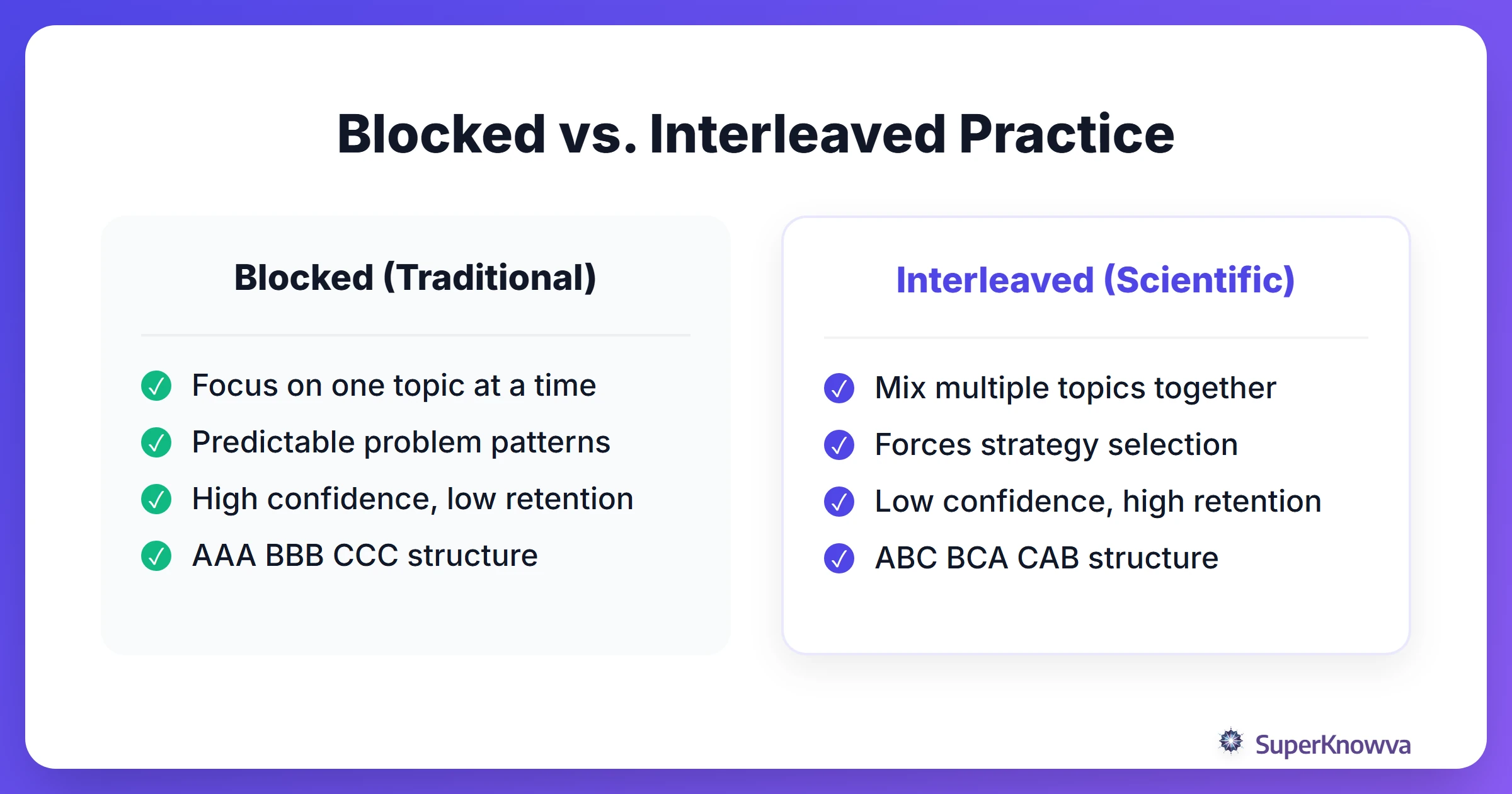
Take a look at your math textbook. It’s likely organized into neat, tidy chapters. You learn how to factor quadratic equations, and then you solve twenty factoring problems in a row. This is called blocked practice.
It feels great because you get into a rhythm. But that rhythm is exactly the problem. Blocked practice creates an illusion of mastery. Since you already know every problem in the set requires the same formula, your brain goes on autopilot. You aren't learning how to choose a strategy; you’re just repeating a mechanical motion.
This is why students so often say: "I knew how to do it during the homework, but I forgot everything on the test." On an exam, problems aren't labeled by chapter. They’re mixed together. If you’ve only ever practiced in blocks, you haven't trained for the variety and unpredictability of the real thing.
What is Interleaved Practice for Math?
Think of it as a circuit workout for your brain. Instead of the traditional AAA BBB CCC approach, interleaved practice for math involves mixing different types of problems within a single session (the ABC BCA CAB approach).
Instead of doing ten exponent problems followed by ten logarithm problems, you’d do one exponent problem, then a geometry problem, then a logarithm, and then circle back.
The cognitive science here is simple but powerful. Interleaving forces your brain to "discriminate" between problem types. Every time you start a new question, you have to restart your mental engine and ask: "What kind of problem is this, and which tool do I need to solve it?"
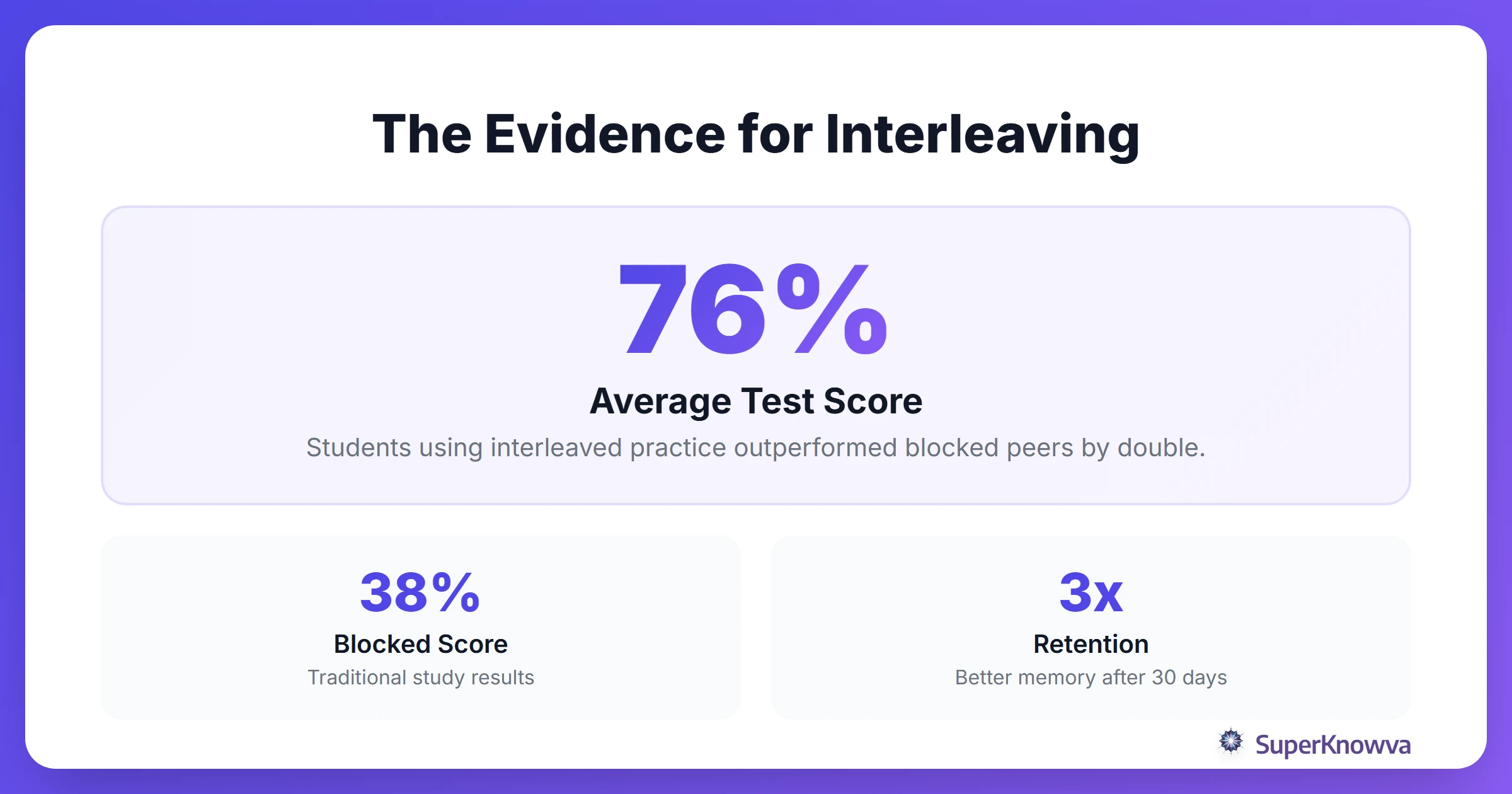
The results speak for themselves. Research on Interleaving in Math shows that students using this method outperformed their peers by nearly double on final assessments. It feels harder while you're doing it, but the long-term retention is night and day. If you're new to the concept, check out our interleaving practice guide for the basics.
The Science of Discrimination: Choosing the Right Strategy
The hardest part of a math exam isn’t usually the arithmetic. It’s knowing which formula to use.
When you practice in blocks, that choice is made for you. When you interleave, you’re training your brain to spot the "cues" in a problem statement that signal a specific method. Psychologists call this a "desirable difficulty."
Learning shouldn't always feel easy. When you struggle to remember a formula, you’re engaging in active recall techniques. That struggle is actually the moment the information sticks. By making your practice sessions harder, you make the actual exam feel significantly easier.
How to Create an Interleaved Math Study Plan
Ready to switch? It takes a little more prep than just opening a textbook to page 50, but the payoff is worth the effort.
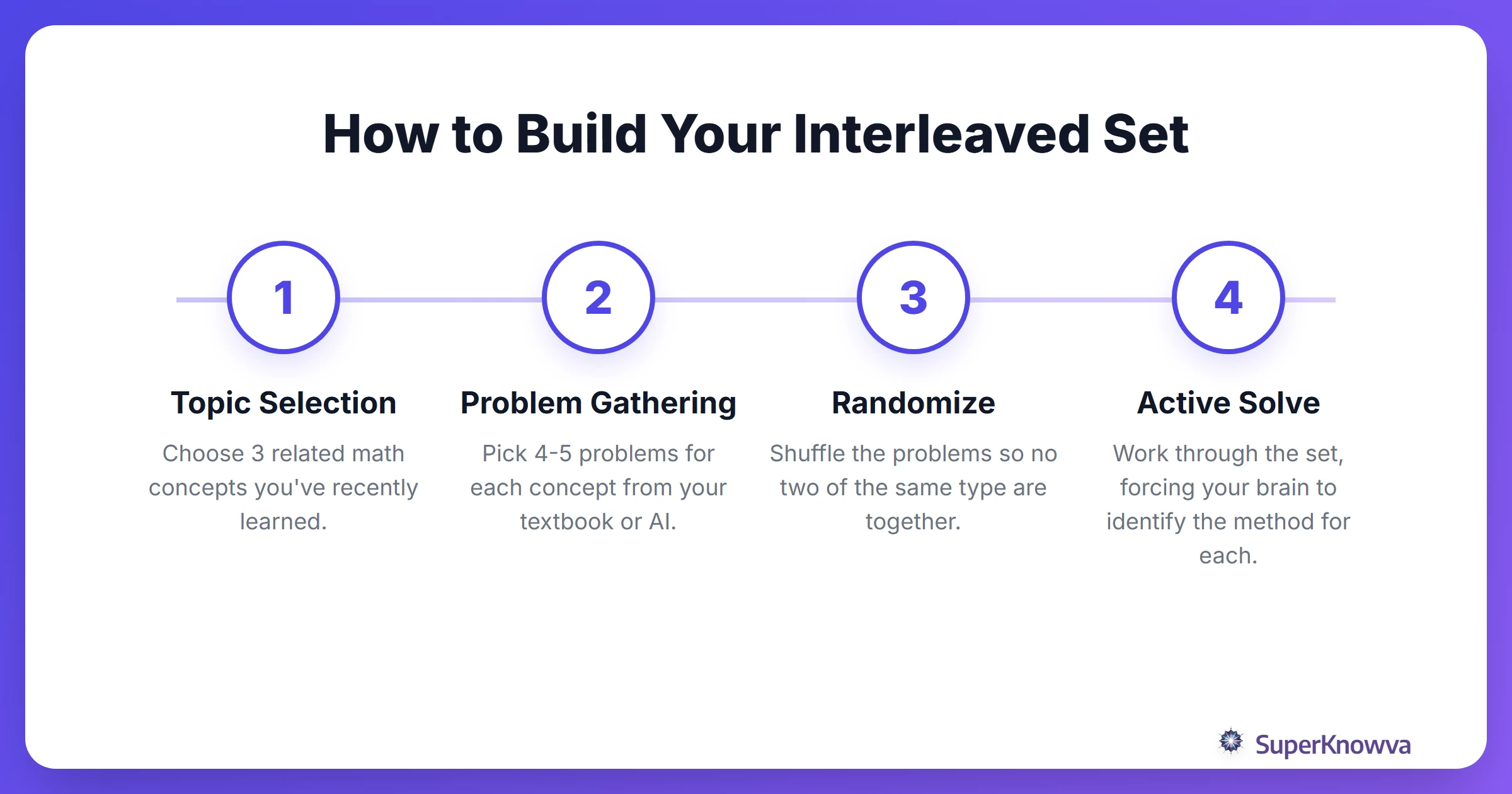
Here is how to build your own "chaos set":
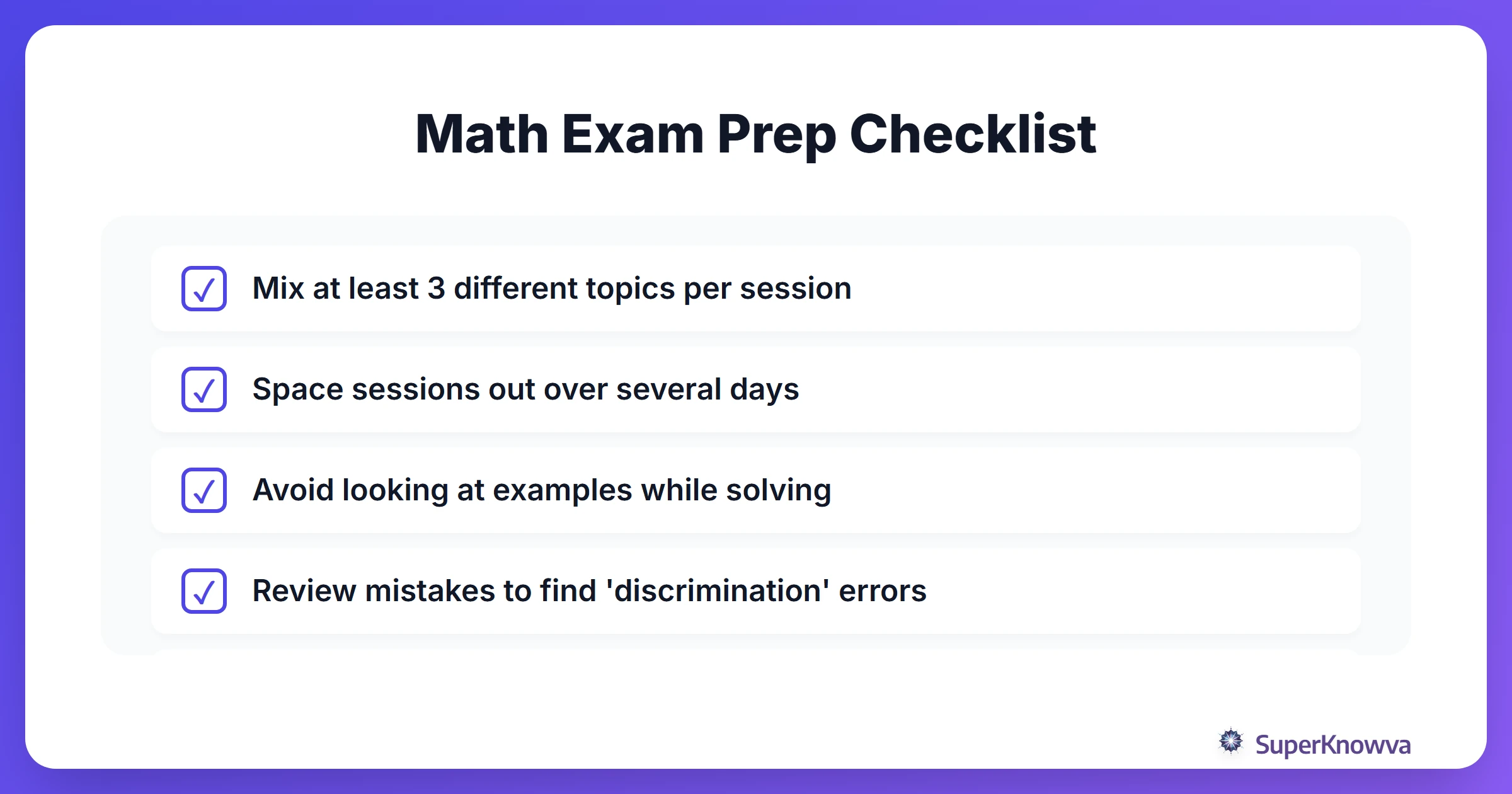
- Pick 3-4 Topics: Choose concepts that are related but distinct (like fractions, decimals, and percentages).
- Gather Your Problems: Pull 4-5 problems for each topic from textbooks, old quizzes, or AI generators.
- Shuffle the Deck: Mix them up so you never do two of the same type in a row.
- No Peeking: Don’t check the solutions until you’ve finished the entire set.
A Sample 60-Minute Interleaved Session:
- 0-10 mins: Quick refresh on the rules for Topics A, B, and C.
- 10-40 mins: Mixed Practice Set (12 problems, 4 from each topic, shuffled).
- 40-50 mins: Grade your work. Look for "discrimination" errors (where you used the right math for the wrong problem type).
- 50-60 mins: Use the Feynman Technique to explain the hardest problem of the day out loud.
Using AI to Automate the Boring Stuff
Let’s be real: flipping through five different chapters to find a variety of problems is a chore. Most students stop interleaving because the manual setup takes too long. This is where AI math practice changes the game.
Platforms like SuperKnowva can instantly generate mixed practice sets from your uploaded notes or syllabus. Instead of spending 20 minutes hunting for variety, the AI does it in seconds.
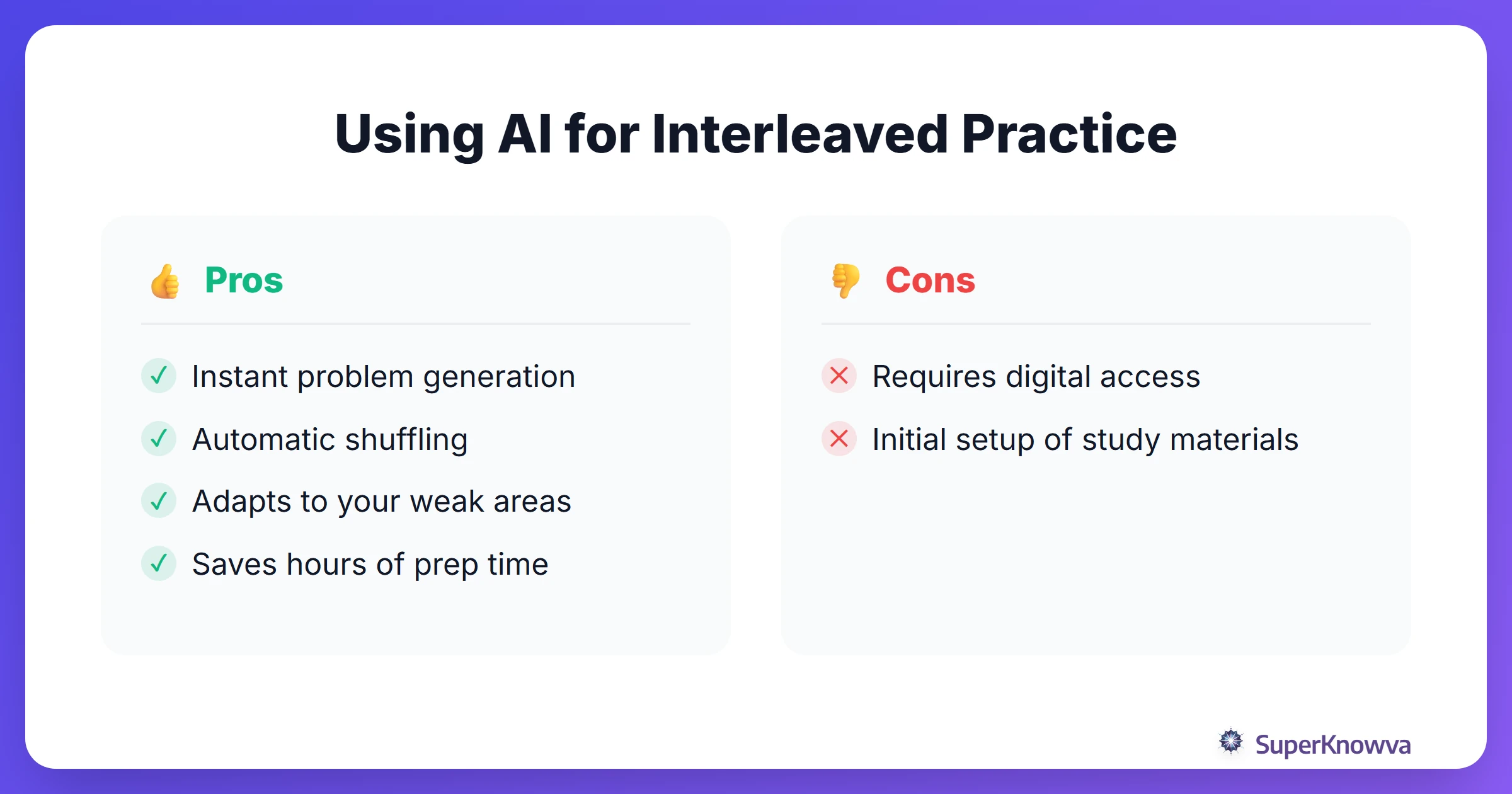
Even better, AI can track your weak spots. If you’re consistently nailing "integration by parts" but failing when it’s mixed with "U-substitution," the system will intelligently adjust your sets to give you more practice on that specific "discrimination" skill. This leads to deep work for students that is targeted and efficient.
Overcoming the 'Frustration Gap'
We have to be honest: interleaved practice feels slower. You will likely get more answers wrong at first than you would during a standard homework block. We call this the "Frustration Gap."
Don't let it discourage you. Lower scores during practice are data, not a sign of failure. Every mistake you make during an interleaved session is a mistake you won't make on the final.
By the time you walk into that exam room, you won't just know the math; you'll know exactly when and how to apply it. For a deeper look at structuring these sessions, see this Interleaving Practice Guide.
Stop doing the same problem over and over. Embrace the challenge of interleaved practice, let AI handle the organization, and watch your math scores actually reflect your hard work.