
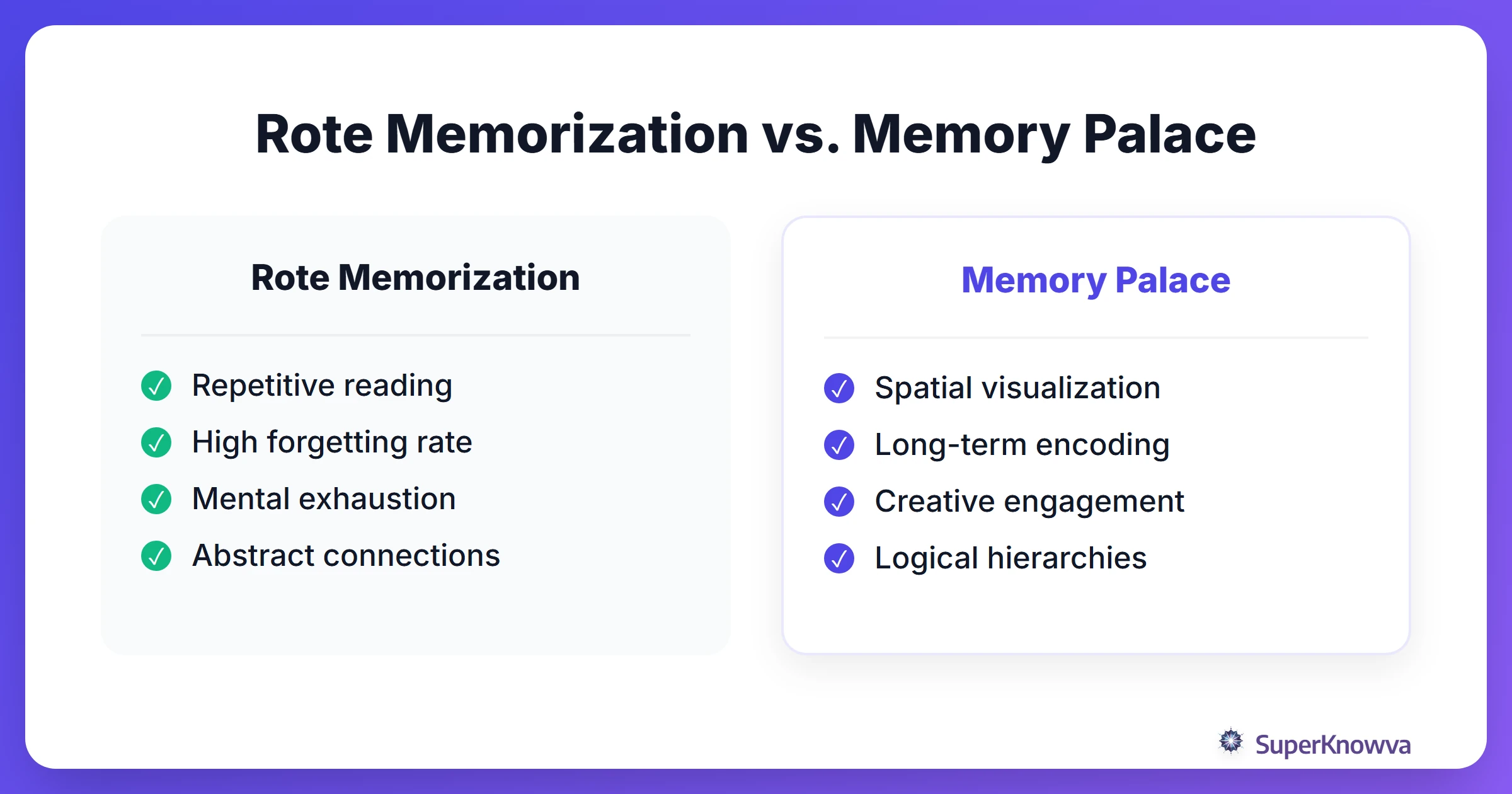
Studying for the Bar or the USMLE involves processing hundreds of pages of complex material. When the volume of information reaches a certain point, traditional rote memorization, the "read it until you go numb" method, tends to fail. If crucial facts are forgotten during practice tests, a more reliable study strategy is needed.
The memory palace technique isn't just another study tip. It is one of the most effective visual learning strategies ever devised. By working with your brain’s natural wiring instead of against it, you can turn dry, abstract information into a mental map that is hard to forget.
The Science of Spatial Memory: Why Palaces Work
The memory palace technique, or the method of loci, isn't some new-age "hack." It actually dates back to Ancient Greece. Orators back then didn't have Teleprompters; they used mental maps to memorize epic poems and hours-long speeches.
Why does it work? Evolution. Our ancestors didn't need to remember long strings of digits or complex legal statutes. They needed to remember where the clean water was and how to get back to camp without getting eaten.
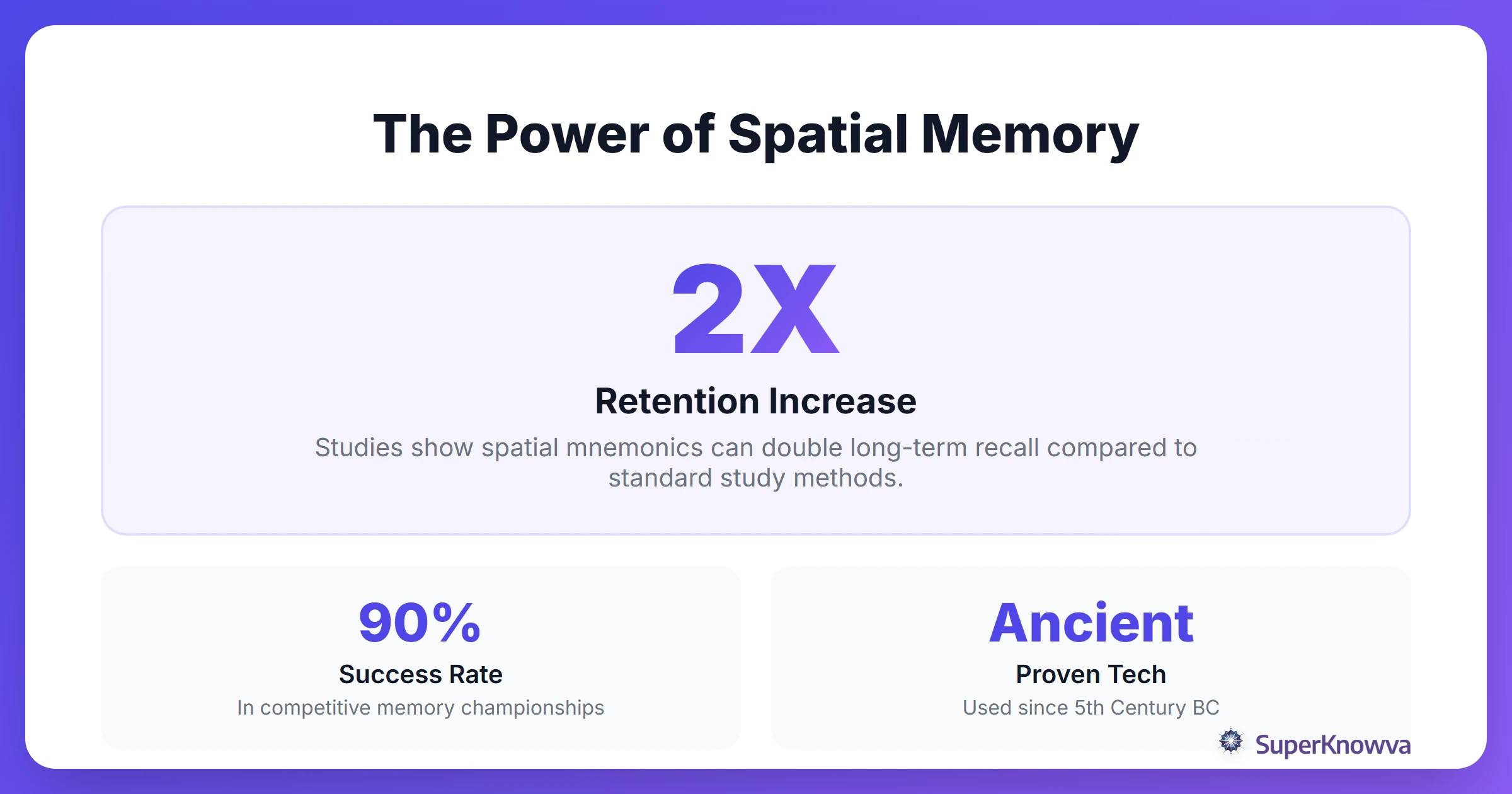
Because of this, our brains are hard-wired for spatial memory. When you anchor a piece of data to a physical location, it becomes "sticky." Research into mnemonic devices shows that spatial encoding can drastically improve long-term retention compared to simple repetition. You aren't just memorizing a list; you're "storing" it in a room you already know well. For a deeper look at the history, check out Aristotle and the Nuclear Alphabet of Memory.
Choosing Your Blueprint: Selecting the Right Palace
A memory palace is only as strong as its foundation. For professional exam preparation, you need a space that you know like the back of your hand.
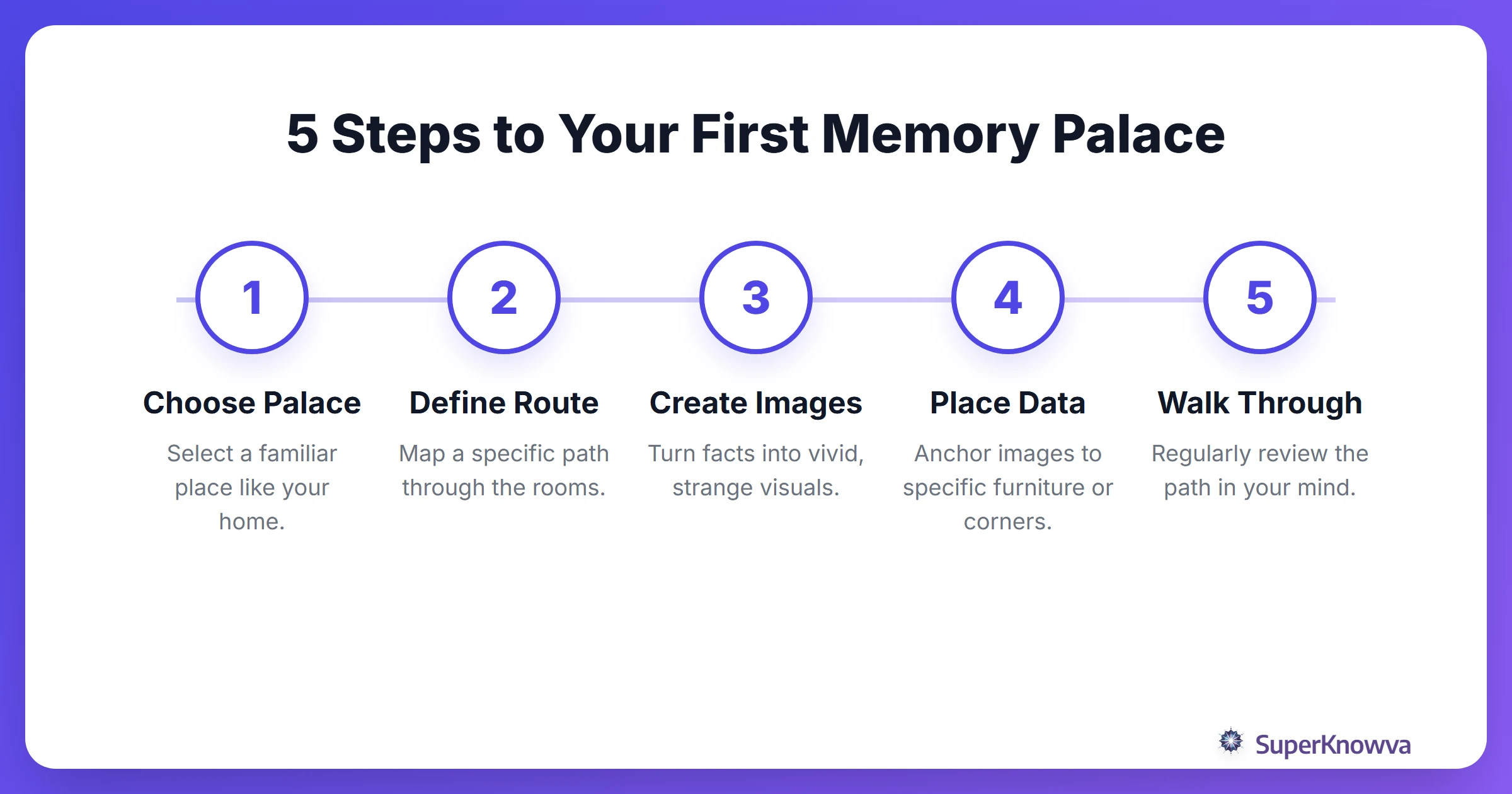
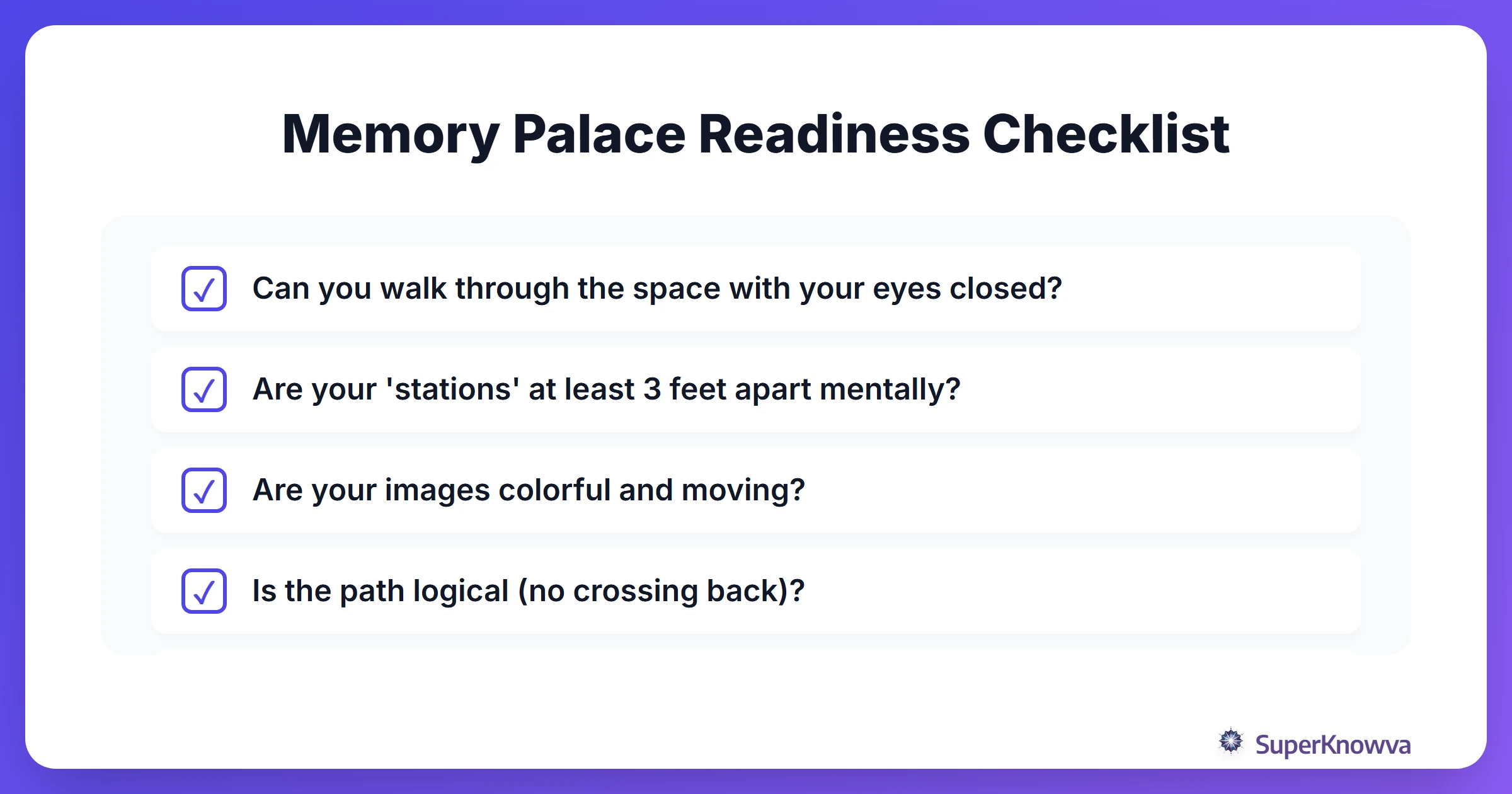
- Stick to the Familiar: Your childhood home, your current apartment, or even the route you take to the gym work best. If you can't "walk" through it with your eyes closed, don't use it.
- Establish a Path: You need a fixed route. Always enter through the same door, move clockwise, and hit the same corners. This keeps your data organized and ensures you don’t accidentally skip over a vital concept during the exam.
While the palace handles the "where," tools like Mind Mapping 101 can help you organize the "what" before you start building.
The Art of Association: Creating Vivid Mental Images
Populate your palace. The goal is to turn an abstract concept, such as a symptom of a rare disease or a specific legal rule, into a tangible, multisensory image.
The "Vividness Rule" is simple: the weirder, the better. If an image is boring, your brain will delete it. If it’s shocking, hilarious, or totally bizarre? It stays. If you need to remember the "Statute of Frauds," don't just picture a law book. Picture a giant, weeping strawberry (Frauds/Fruits) blocking your front door. It’s hard to ignore a giant strawberry.
- Make it Move: Static images are easy to forget. Moving, interactive images stick.
- Use Emotion: If an image makes you laugh or feel grossed out, it’s going into long-term memory.
Before you start visualizing, it often helps to use The Feynman Technique to strip a concept down to its simplest form. It's much easier to create a punchy image for a simple idea than a complex one.
Step-by-Step: Building Your First Exam Palace
Ready to give it a shot? Follow this workflow to anchor your first set of data points.
- Identify Your Data: Start small. Pick a list of 10 items (like the Bill of Rights).
- Map Your Stations: Pick 10 specific spots (loci) in your room: the sofa, the lamp, the coffee table.
- Create Unique Images: Turn each item on your list into an exaggerated visual.
- Deposit the Images: Mentally "place" the weeping strawberry on your sofa.
- The Mental Walk-Through: Close your eyes and walk through the room. Interact with the images. Does the strawberry smell like fruit? Is it getting juice on the cushions?
Advanced Techniques for Professional Exams
When you're dealing with the massive datasets required for law or medicine, one room won't cut it. You’ll need to scale your visual learning strategies.
- Nested Palaces: Assign different buildings to different subjects. Your house is "Torts," your office is "Constitutional Law."
- Hierarchical Rooms: Use specific rooms for specific chapters or sub-topics.
- Managing "Ghosting": If you need to clear out a palace for a new exam, visualize the rooms as empty for a few days. However, for core professional knowledge, it's usually better to give each subject its own permanent "real estate."
To test if your palace is holding up, try The Blurting Method. Try to write down everything in your palace onto a blank sheet of paper without looking at your notes.
Common Pitfalls and How to Avoid Them
Even the best-designed palace can crumble if you aren't careful. Watch out for these:
- Overcrowding: Don't try to shove 50 facts into a tiny bathroom. If the images are too close together, they’ll start to "bleed" into each other.
- Fuzzy Images: If the mental picture is blurry, the memory will be too. Take an extra 30 seconds to make it high-definition.
- Skipping Reviews: Even the method of loci needs maintenance. Walk through your palace 24 hours after you build it, then again a week later.
For more tips on refining your technique, check out this guide on how to build a memory palace to store and revisit information.
Is the Memory Palace Right for You?
The initial setup takes more effort than just highlighting a page, but the payoff is massive.
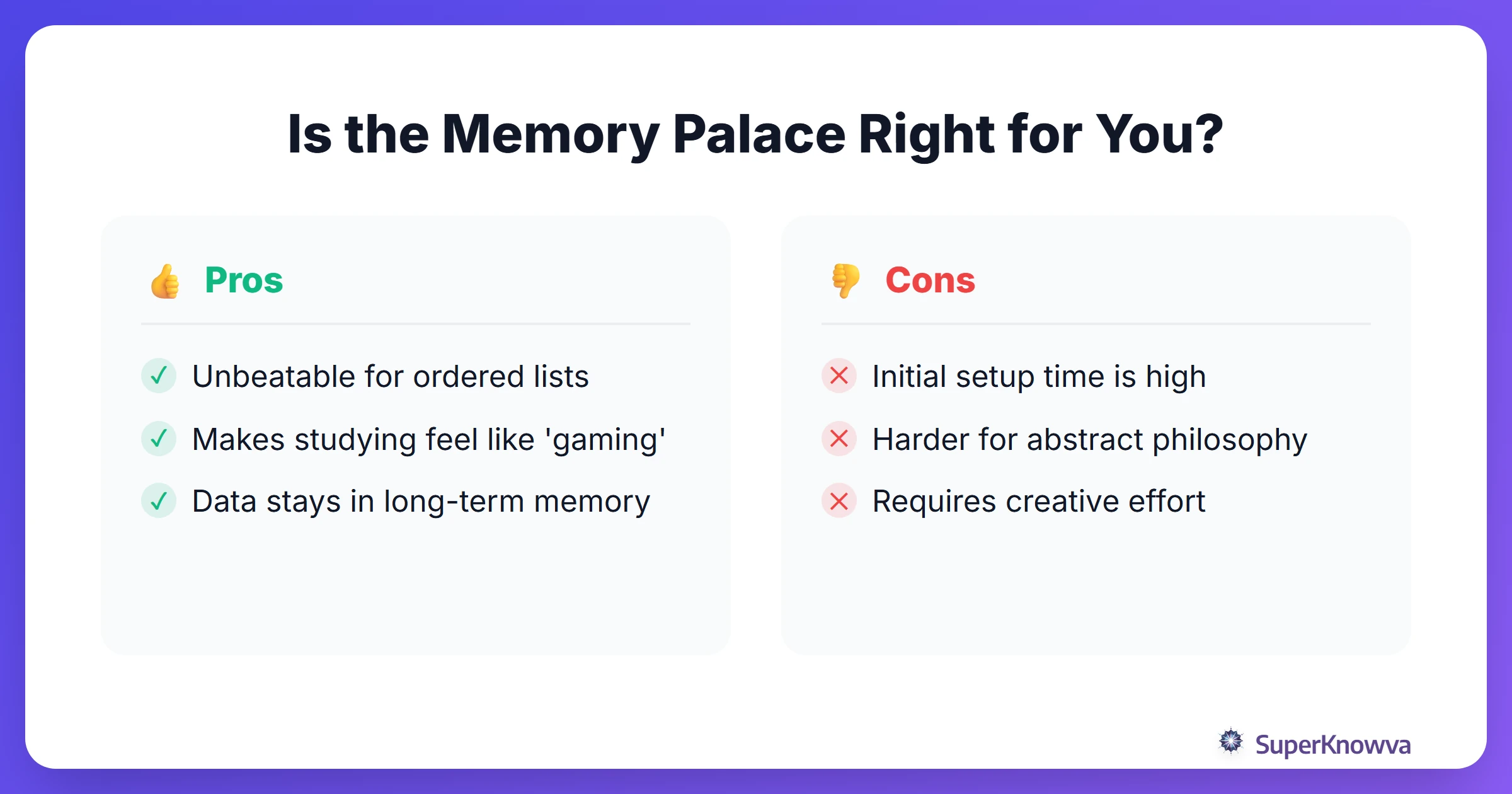
By turning your study sessions into a creative exercise, you aren't just cramming for a test. You are building a library of knowledge that stays with you. Stop memorizing and start visualizing.