Ever felt like your brain is a browser with 50 tabs open, three of them are playing music you can’t find, and the whole system is about to freeze?
During finals week, this isn’t just a metaphor; it’s a biological reality. When you juggle complex formulas, historical dates, and essay structures, your brain eventually hits a wall. You aren't "bad" at studying; you are likely just overloaded. Cognitive load management is essential for studying effectively without reaching total mental exhaustion.
By understanding how your brain actually processes information, you can stop fighting your biology and start using effective learning strategies that respect your natural limits.
What is Cognitive Load Theory?
At its simplest, Cognitive Load Theory (CLT) suggests that our working memory has a limited capacity. Think of your working memory as a narrow funnel. You can only pour so much information through it at once before it overflows. When the "load" exceeds your capacity, learning stops, frustration begins, and you find yourself staring at the same page for twenty minutes without registering a single word.
Cognitive scientists call this the bottleneck of working memory. Because we can only hold five to nine items in short-term memory at once, we must be strategic about what we let in. If we try to process too much at once, we hit mental processing limits that lead to "overheating," or what we call burnout.
The Three Pillars of Mental Processing
To manage your brain's resources, you first need to identify the three different types of "weight" your mind carries during a study session.
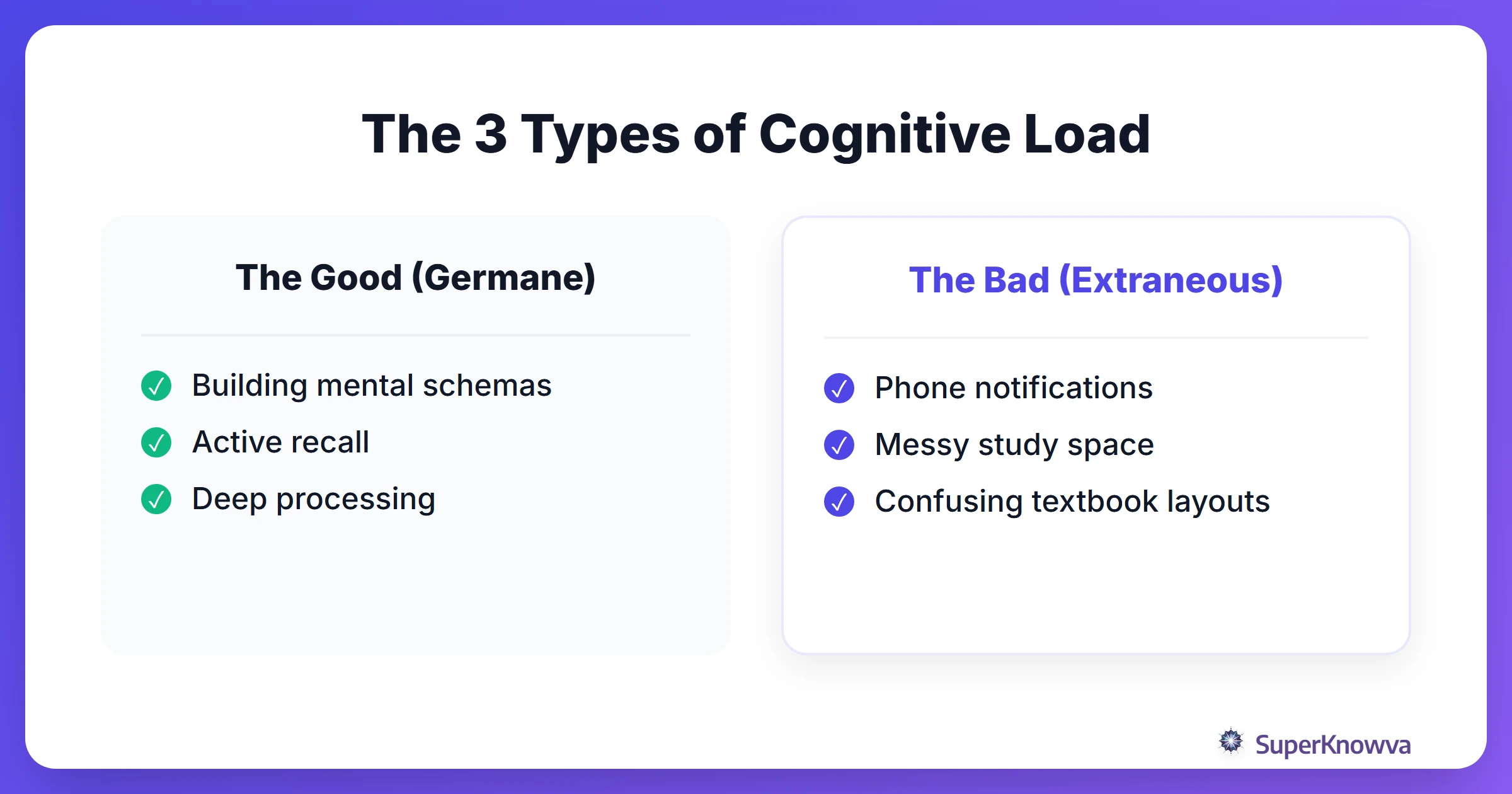
- Intrinsic Cognitive Load: This is the inherent difficulty of the subject. Understanding quantum physics has a higher intrinsic load than memorizing a grocery list. You can’t change the difficulty of the topic, but you can change how you break it down.
- Extraneous Cognitive Load: This is "bad" load. It’s the unnecessary mental effort caused by a cluttered desk, a loud roommate, or a confusingly written textbook. It takes up space in your "funnel" without helping you learn.
- Germane Cognitive Load: This is the "good" load. This is the mental energy used to actually process information, find patterns, and create permanent "schemas" (mental maps) in your long-term memory.
Minimizing Extraneous Load: Clearing the Path
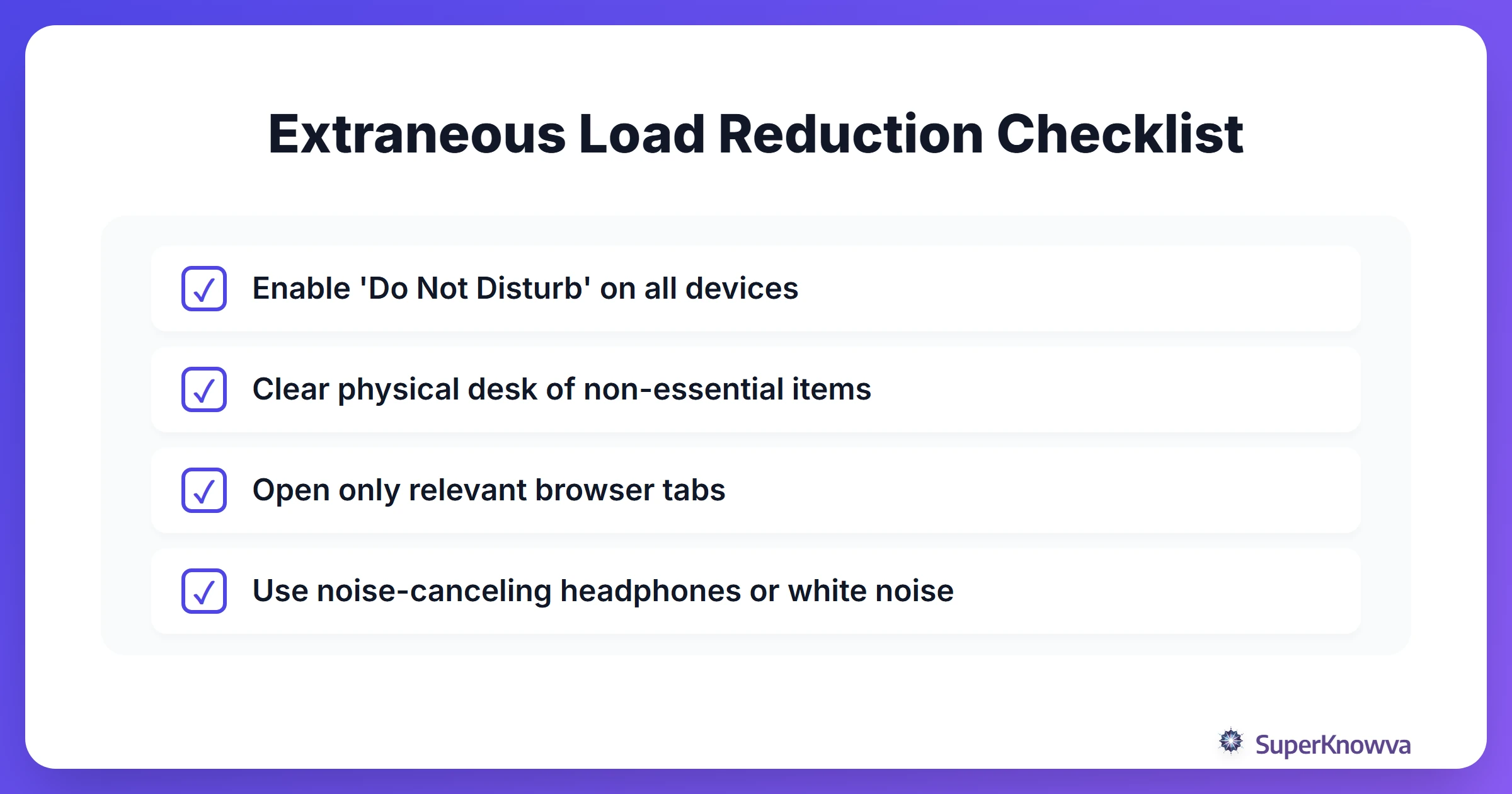
The quickest way to boost your study efficiency is to eliminate extraneous cognitive load. Every time your phone buzzes or you look up at a messy room, your brain spends energy processing that "noise" instead of your coursework.
Digital distractions are primary obstacles. Every notification requires a "task switch" that consumes oxygenated glucose, the same fuel your brain needs for deep thinking. Multitasking is a myth; you are not doing two things at once, but exhausting your brain by switching back and forth. Students use Digital Minimalism for Students to stay focused.
Managing Intrinsic Load: Breaking Down Complexity
While you can't make Organic Chemistry "easy," you can manage the intrinsic cognitive load by "chunking" the information. Chunking allows you to bypass the working memory bottleneck by grouping individual pieces of data into a single, manageable mental unit.
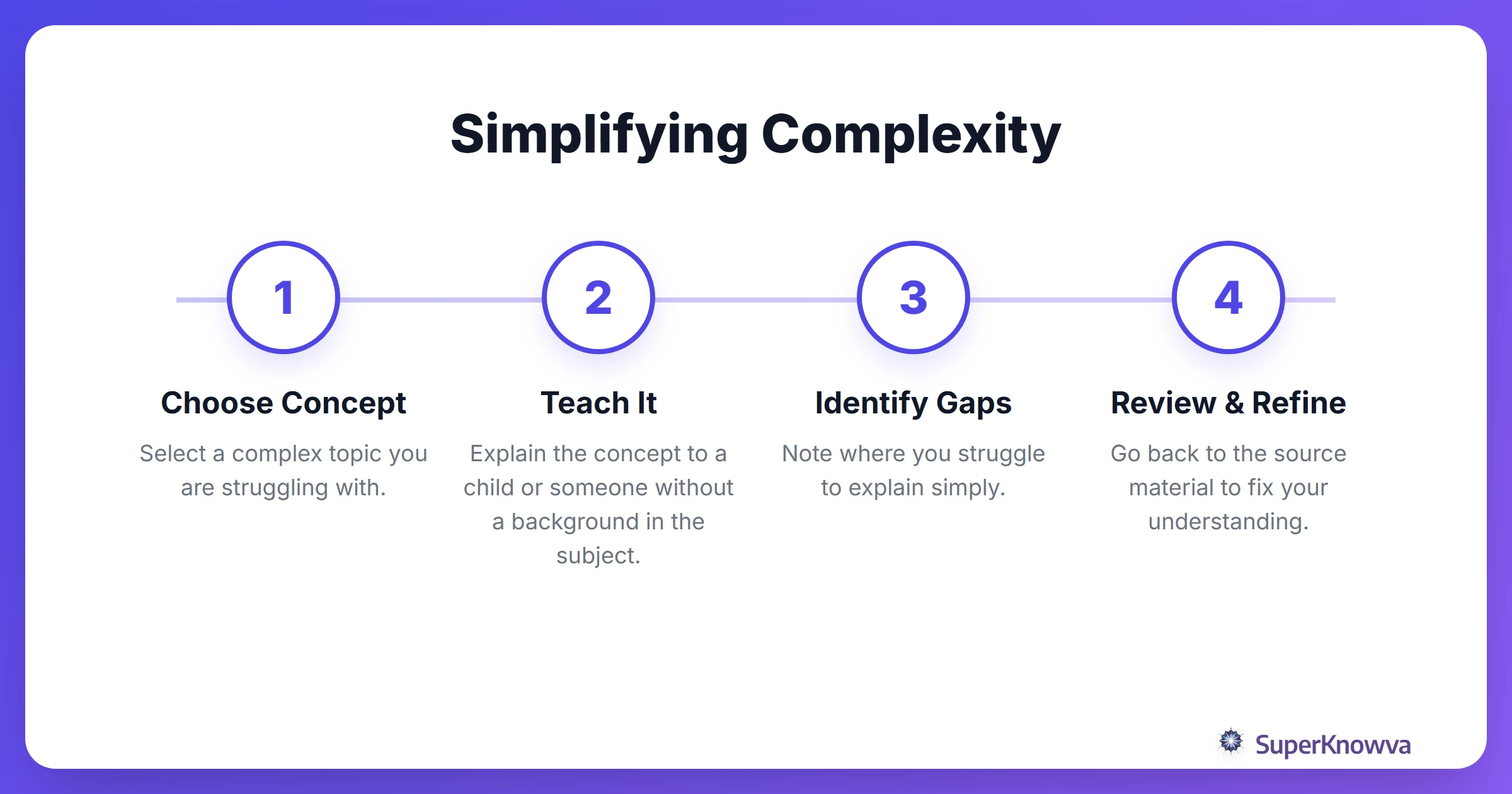
One of the most effective ways to simplify hard concepts is The Feynman Technique. By trying to explain a concept in plain, simple terms, you quickly identify exactly where your understanding breaks down. Another vital strategy is scaffolding: never jump into advanced problems until you have mastered the basics. If the foundation is shaky, the intrinsic load of the advanced topic will be too heavy to carry.
Maximizing Germane Load: Making Learning Stick
The goal isn't just to make studying easier; it's to ensure the effort you do put in actually sticks. This is where germane cognitive load comes in. You want to spend as much of your mental energy as possible on building deep connections.
Stop passive reading. It feels easy, but it is mostly a waste of time. Instead, use active strategies. The Blurting Method forces your brain into active recall, strengthening neural pathways. Also, try interleaving by mixing up different subjects or types of problems in one session. It feels harder in the moment (which increases the load), but it teaches your brain to distinguish between different types of information much more effectively.

Rest and Recovery: Cooling Down the CPU
Your brain is a biological organ, not a machine. Study burnout prevention requires scheduled downtime. During sleep, your brain performs "synaptic pruning" and memory consolidation, moving information from temporary working memory into long-term storage.
To manage your energy levels throughout the day, experiment with different timing techniques. You might prefer the strict intervals of the Pomodoro Technique, or the deeper immersion of Flowtime. You can find out which fits your style in our guide on Pomodoro vs. Flowtime.
Recognizing the physical symptoms of cognitive fatigue, such as reading the same sentence four times without understanding it, is your cue to step away. To learn more about the science, check out this Cognitive Load Theory Faculty Guide or explore the Neuroscience of Memory Consolidation.
By reducing the "noise," breaking down heavy topics, and leaning into active learning, you can get through finals week with a clear head and a cool "CPU." You've got this. Happy studying!