
Ever spent three hours straight crushing a single topic, felt like an absolute genius, and then realized a week later you can’t remember a single thing?
It’s a frustratingly common experience. You’ve likely fallen for the "illusion of mastery." While traditional study habits tell us to focus on one subject until we’ve "got it," modern cognitive science suggests that’s actually the slow way to learn. If you want to actually remember what you’re studying, you need to start mixing things up.
By using the interleaving study strategy, you can train your brain to stop memorizing and start understanding. This guide explains how switching topics and using AI learning tools like SuperKnowva improves retention and efficiency.
Understanding Interleaving: Beyond Blocked Practice
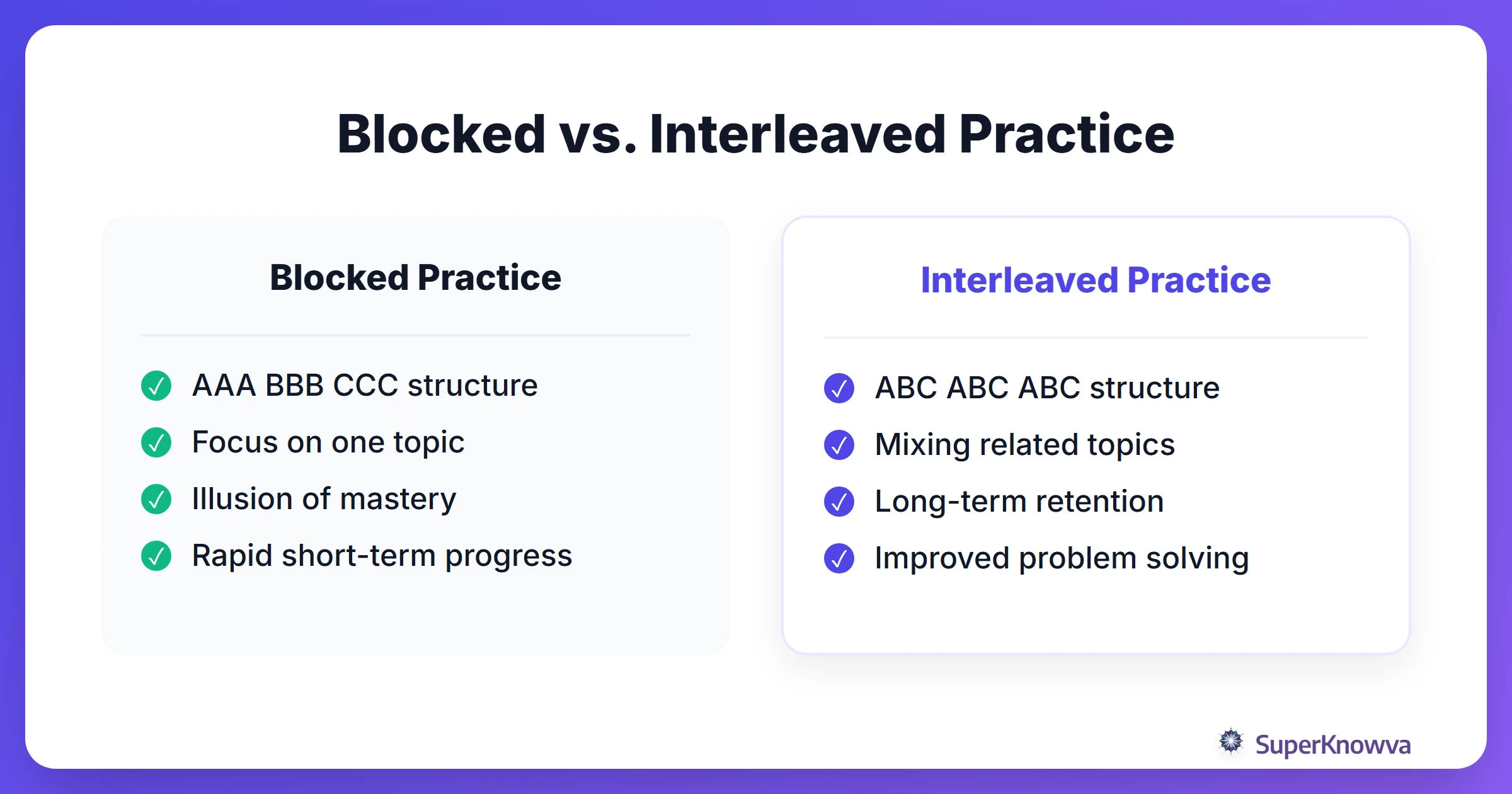
Most of us were raised on blocked practice. You study Topic A for two hours, then Topic B for two hours, and call it a day.
On the surface, this feels great. You get into a rhythm. The answers come fast. But that’s the trap. Because the information is sitting right there in your short-term memory, you feel like you’ve mastered it. In reality, you’re just repeating a pattern.
Interleaving flips that logic. Instead of staying on one subject until you’re bored to tears, the interleaving study strategy involves alternating between different subjects or problem types in a single session. Think: 20 minutes of Biology, 20 minutes of Chemistry, then back to Biology.
Scientists call this desirable difficulty. By forcing your brain to "re-load" information every time you switch, you’re building memories that actually stick.
The Cognitive Science: Why Mixing Topics Works
Why is a "messier" study session more effective than a focused one? It comes down to a concept called discriminative contrast.
When you do the same type of math problem ten times in a row, your brain goes on autopilot. You stop asking which formula to use; you just plug in the numbers. Interleaving forces you out of that haze. You have to constantly ask yourself: "Wait, what kind of problem is this? Which strategy applies here?"
You aren't just memorizing a solution; you’re learning how to identify the problem. Research shows that this constant mental shifting strengthens neural pathways. For a deeper look at how this works, check out our comprehensive guide to interleaving practice.
Interleaving vs. Blocked Practice: Which Wins?
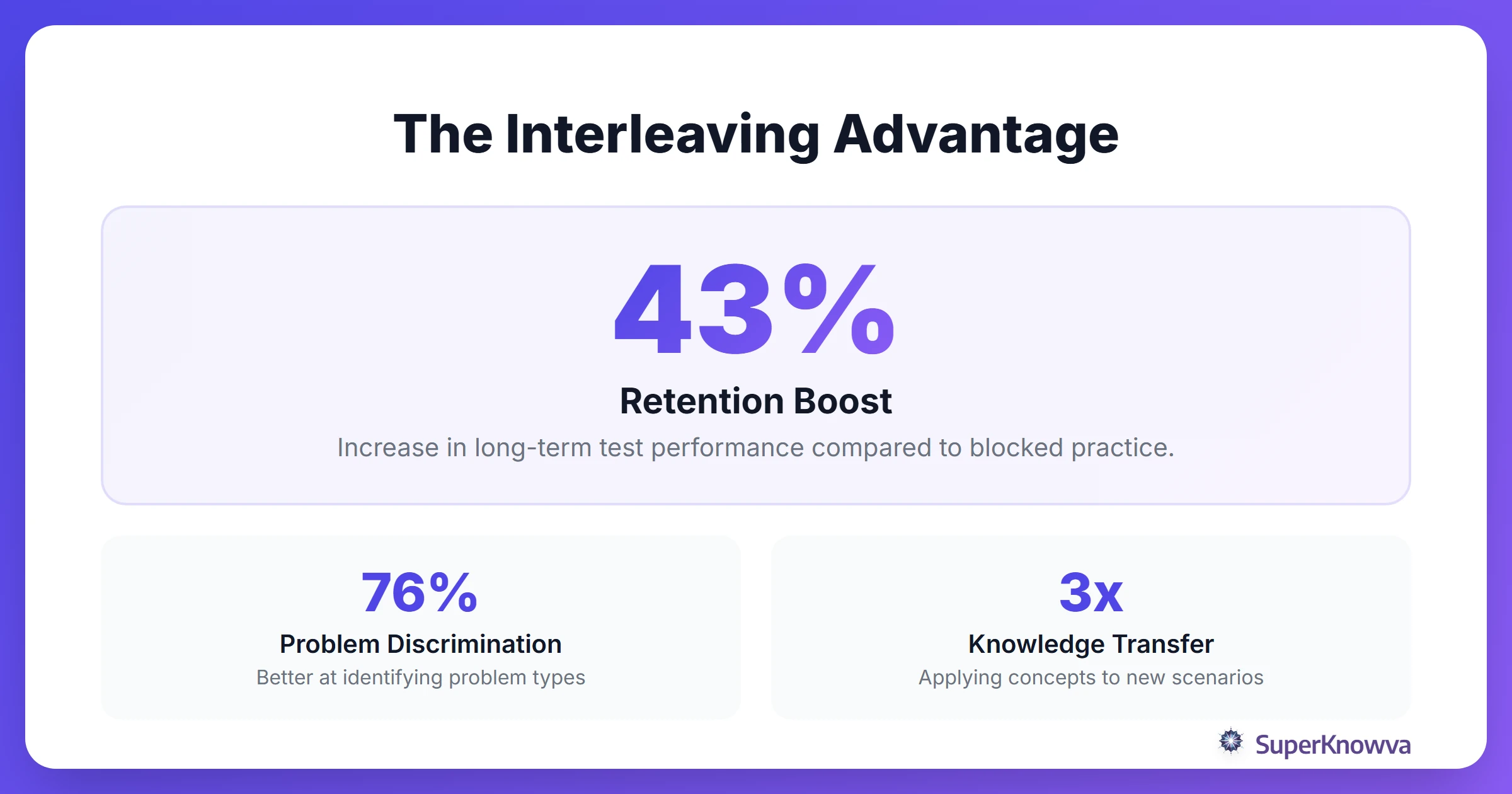
If you only care about a quiz happening in ten minutes, blocked practice might win. But if you care about the final exam (or actually knowing the material), interleaving is the undisputed champ.
- Long-Term Retention: Interleaving makes knowledge "sticky." Because you’ve practiced retrieving info after a break, it’s much more likely to show up when you need it during finals week.
- Transfer of Knowledge: It helps you apply concepts to new, weird situations. This is a lifesaver for subjects like Physics or Calculus, where the exam questions never look exactly like the practice ones.
- Beating Burnout: Staring at the same chapter for four hours is exhausting. By keeping your brain engaged with variety, you maintain a higher level of study efficiency without the mental fatigue.
The Challenge: Why Manual Interleaving is Hard
If interleaving is so great, why isn't everyone doing it? Honestly? Because it’s a pain to organize.
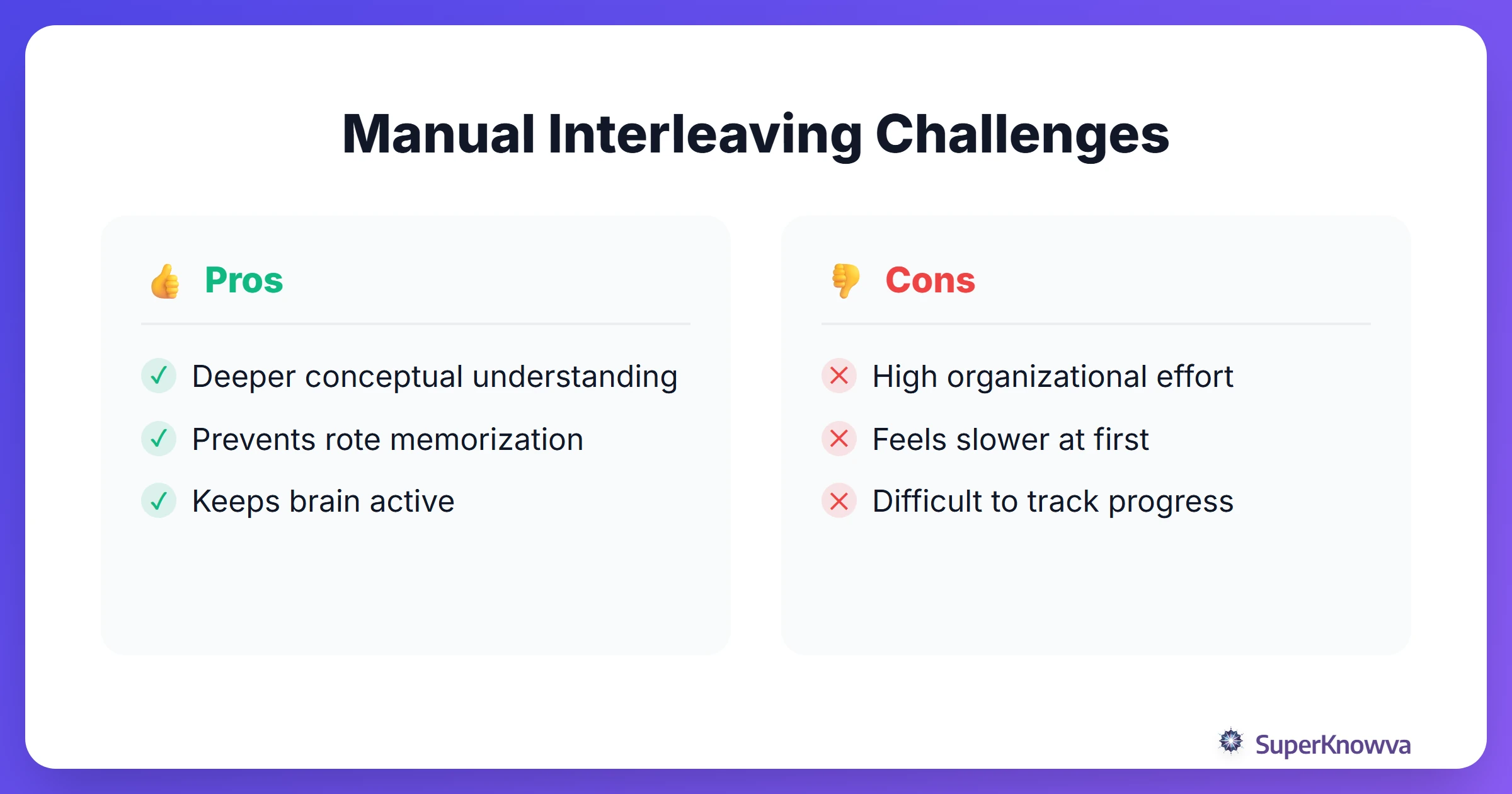
- The Logistic Mess: Switching between three different textbooks and four sets of notes every 20 minutes is a nightmare.
- The "Slow" Feeling: Because interleaving is harder, it feels like you’re learning more slowly. Without a way to track your progress, it’s easy to get discouraged and go back to easier, less effective methods.
- The Timing Problem: Knowing exactly when to switch topics to hit your "forgetting curve" just right requires more data than most students have.
SuperKnowva AI: Your Personal Interleaving Engine
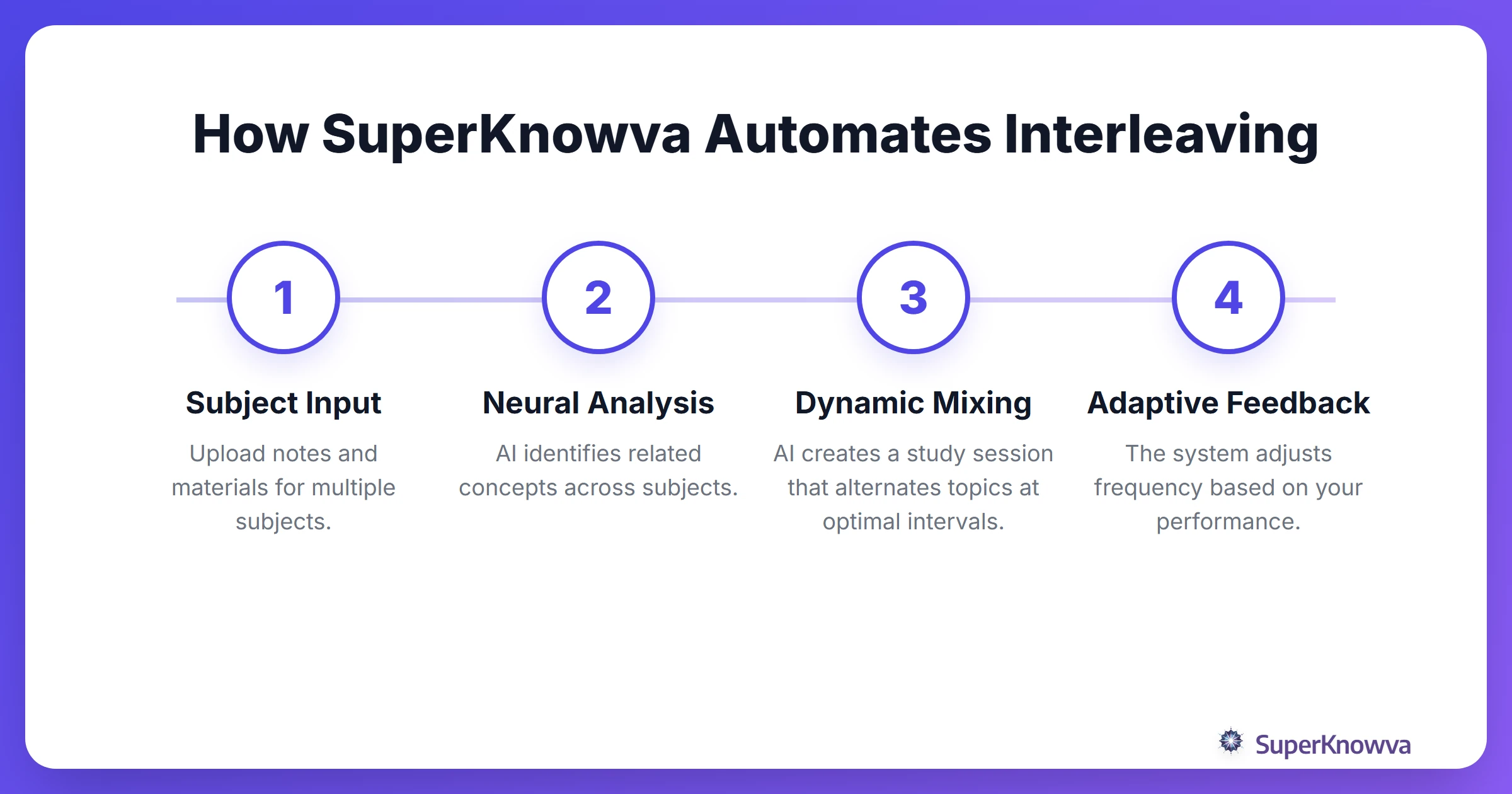
This is where SuperKnowva steps in. Think of it as your personal study architect that removes all the friction of planning.
SuperKnowva’s AI doesn't just shuffle your subjects randomly. It uses personalized scheduling based on how you’re actually performing. If the AI sees you’re struggling with a specific concept in Physics, it will strategically interleave that topic with related Calculus problems to boost your learning.
By combining interleaving with other heavy-hitters like spaced repetition and the blurting method for active recall, SuperKnowva makes sure you’re always studying at your peak.
How to Implement Interleaving in Your Daily Routine
Ready to ditch the "illusion of mastery"? Here’s how to start:
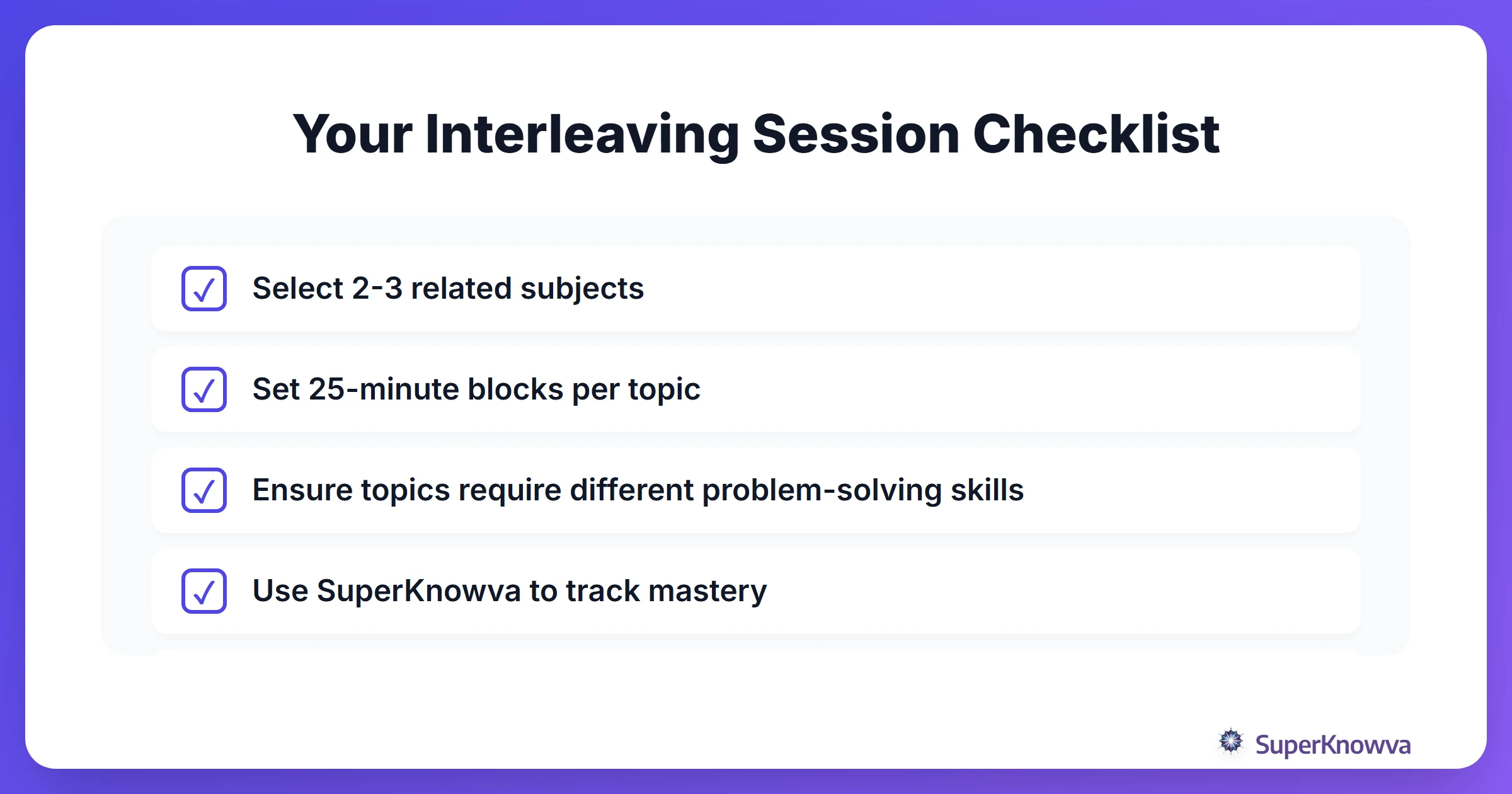
- Mix "Cousin" Subjects: Interleaving works best when topics are related but distinct. Try mixing Spanish and Italian, or Algebra and Geometry.
- Find Your Rhythm: Don’t switch every two minutes; that is just a distraction. Aim for 20-30 minute blocks. It is long enough to get deep, but short enough to avoid the autopilot trap.
- Automate Your Schedule: Use SuperKnowva to handle the scheduling so you can spend your energy on learning, not logistics.
- Stack Your Strategies: Interleaving works well with other methods. Try pairing it with deep work strategies for students or find your timing sweet spot by comparing Pomodoro vs. Flowtime.
For more on the science of how we learn, check out external resources like How to Use Interleaving for Deeper Learning or the research at Learning Scientists.
Improve your study habits. By using the interleaving strategy with SuperKnowva, you aren't just passing the next test, you are mastering the material for the long term.