Ever feel like your brain is short-circuiting trying to imagine how a capacitor actually works in a complex circuit? Or maybe you’re staring at a sliding block problem, trying to "see" the friction, but all you see is a confusing mess of variables.
You aren't alone. AP Physics is widely considered one of the toughest mountains to climb in high school. Why? Because it demands a massive leap from simple math to deep, abstract intuition. To help you bridge that gap, we’ve pulled together the most effective ap physics study tips to change how you look at the subject. It’s time to stop memorizing formulas and start achieving true mastery with the help of AI-driven tools.
The Challenge of AP Physics: Beyond Rote Memorization
Here is the hard truth: being a math whiz doesn't guarantee an A in Physics. While algebra is the language of the course, the exam itself wants to see if you can "think like a physicist." Over the last few years, AP Physics 1 and 2 have pivoted. They’ve moved away from "plug-and-chug" numerical problems and toward qualitative-quantitative translation.
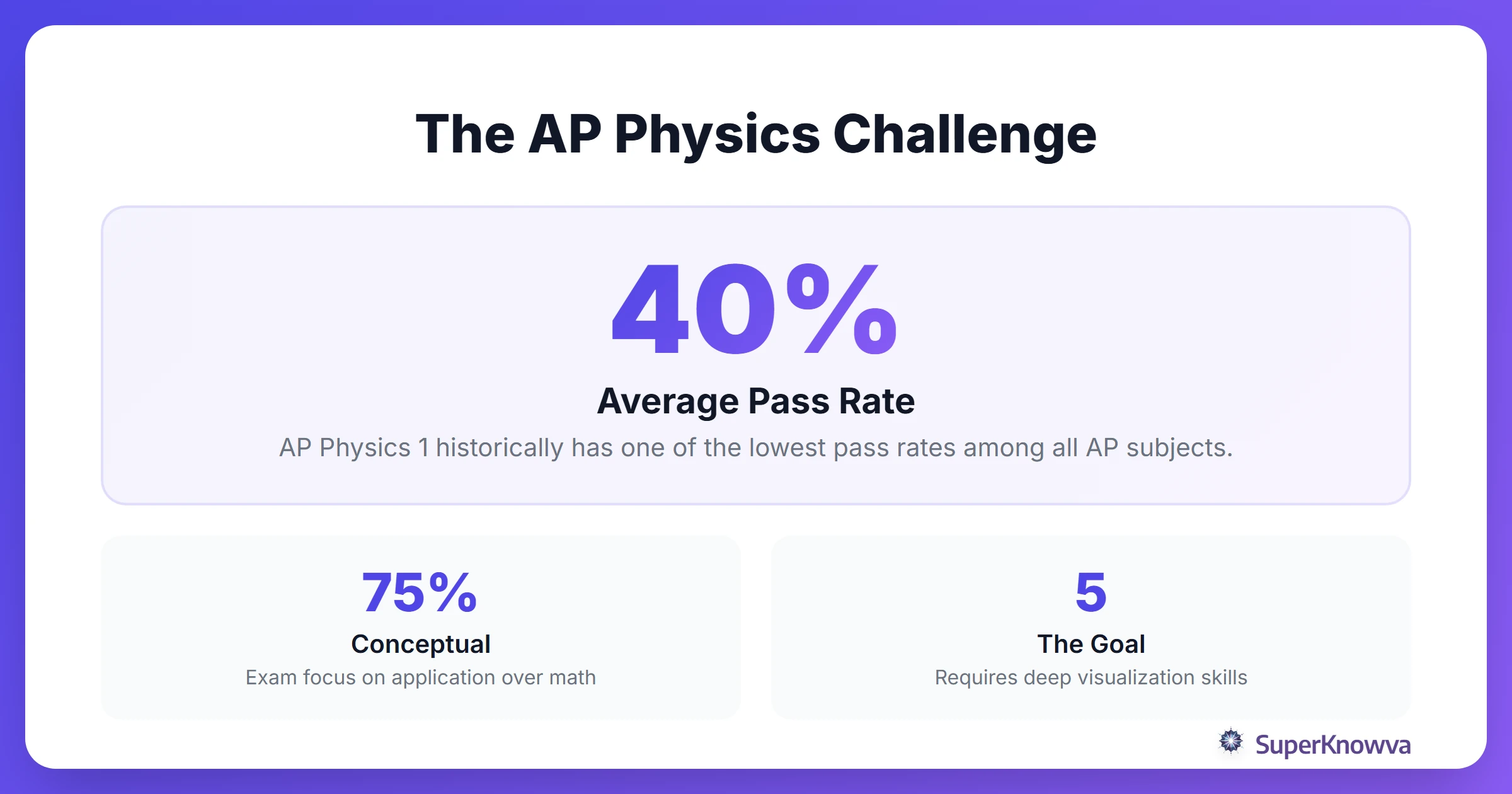
The real test is in the application. You are an investigator, not just a calculator. On exam day, you will predict what happens to a system if a single variable changes, often without using any numbers at all. This is why an ap physics 1 review feels daunting. It requires a shift in how you process information.
Why Visualization is the Key to Physics Mastery
In subjects like history or literature, improving reading comprehension with AI helps you synthesize complex themes. In physics, the equivalent is building "mental models." To understand Kinematics or Dynamics, you have to be able to see the invisible forces at play.
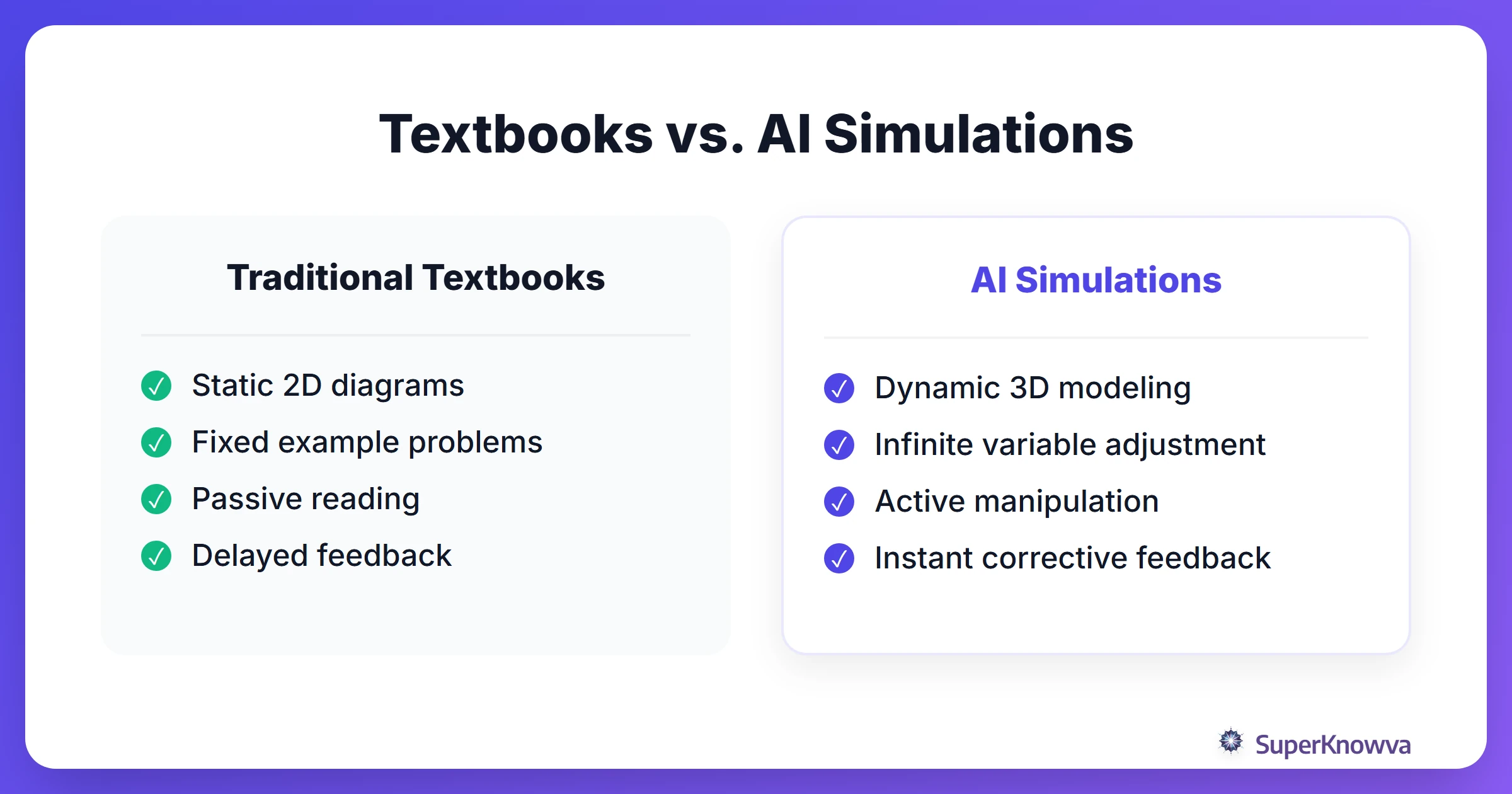
Static diagrams in old-school textbooks usually fall flat. A drawing of a projectile with a single arrow doesn’t show you how the vertical velocity vector shrinks to zero at the peak before growing again. This is where ai for physics students changes the game. AI-driven simulations act as a bridge between abstract equations and physical reality. They let you visualize force vectors and energy transfers in real-time.
AI Simulations vs. Traditional Problem Sets
Traditional studying usually means solving the same types of problems over and over until your eyes glaze over. Practice is essential, sure, but passively reading through solutions rarely leads to that "lightbulb moment."
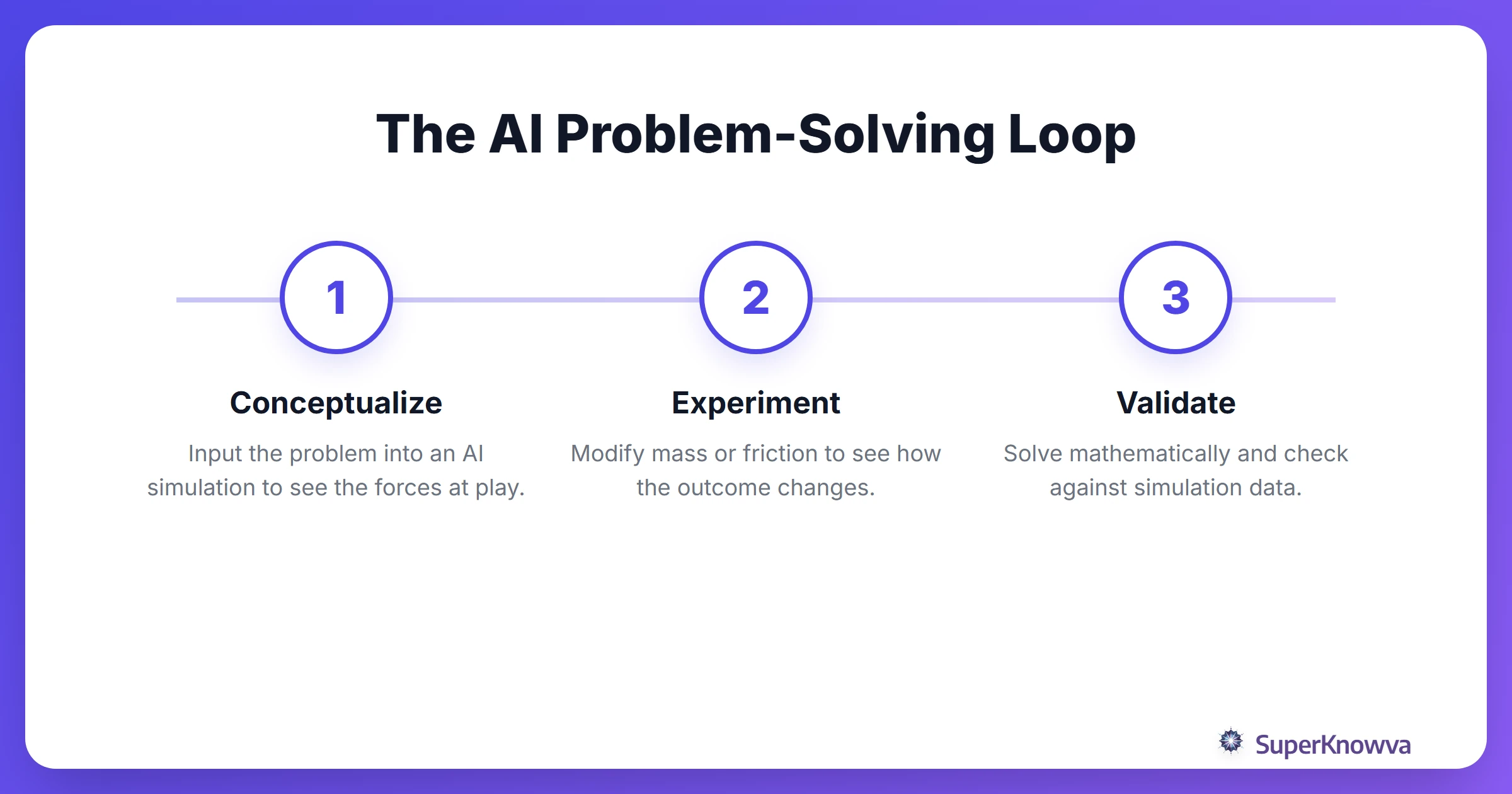
When you use physics simulation software powered by AI, you stop being a passive observer and start experimenting. Instead of just reading about how mass affects centripetal force, you can actually toggle the mass of an object in a digital environment. You see the tension in the string change instantly. This interactive feedback loop speeds up the learning process by giving you immediate, corrective data. You finally understand the "why" behind the "what."
How to Use AI to Master Mechanics and Electricity
If you want to know how to study for ap physics without burning out, you need to target the heavy hitters: Mechanics and Electricity & Magnetism.
- Projectile Motion & Newton's Laws: Use AI simulations to solve complex ap physics mechanics practice problems. By adjusting air resistance or the angle of an incline, you can observe how force vectors, such as normal force and gravity, shift dynamically.
- Circuitry: Electricity is difficult to learn because the flow is invisible. AI tools simulate current and potential difference, making the logic of Kirchhoff’s Laws easier to grasp.
- Breaking Down FRQs: Free Response Questions (FRQs) often require you to derive an expression or justify a claim in a paragraph. Inputting a complex FRQ prompt into an AI tutor provides a logical overview of the concepts needed before starting calculations.
A Strategic Study Timeline for a 5
Success on the AP exam isn't the result of a caffeine-fueled week of cramming. It’s a marathon, not a sprint. Much like mastering quantitative reasoning for the GRE, physics requires building a rock-solid foundation and then layering on the complexity.
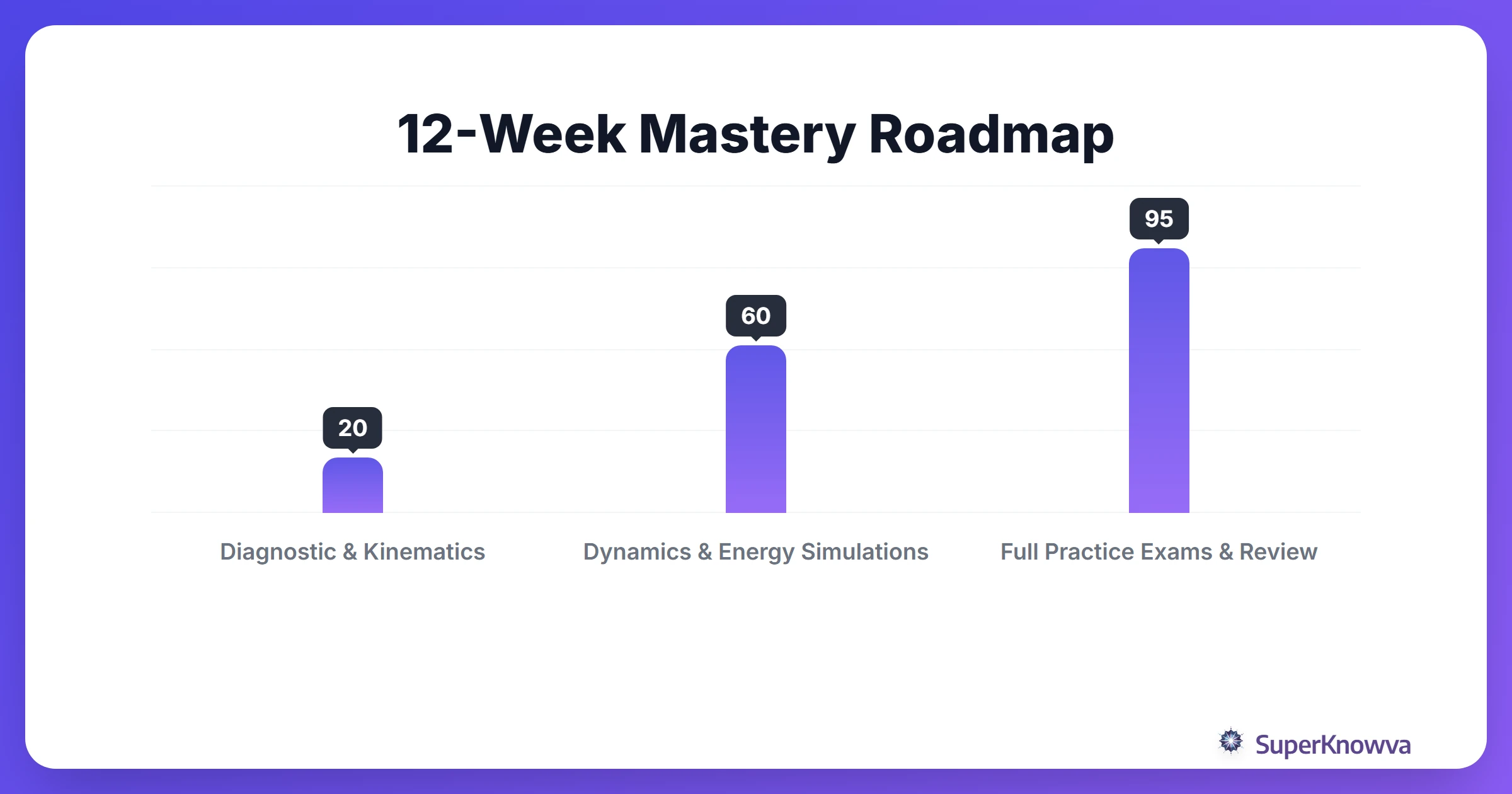
- Months 1-2 (Foundation): Focus on Kinematics and Dynamics. Use AI-powered question banks to stress-test your understanding of Newton’s Laws.
- Months 3-4 (Energy & Momentum): Move into Work, Energy, and Impulse. This is where simulations of collisions are worth their weight in gold.
- Month 5 (Electricity & Waves): Focus on the fields. Use AI to visualize electric field lines and wave interference patterns that are otherwise impossible to see.
- Final Month (Review): Take full-length practice exams. Use AI to analyze your mistakes and provide clear explanations for the concepts you missed.
Common Pitfalls and How AI Helps You Avoid Them
Many students fall into the "perfectionist trap," getting discouraged the moment a practice set goes sideways. Others develop a "formula-hunting" habit, scanning a problem for numbers and frantically looking for a formula that fits without understanding the physics involved.
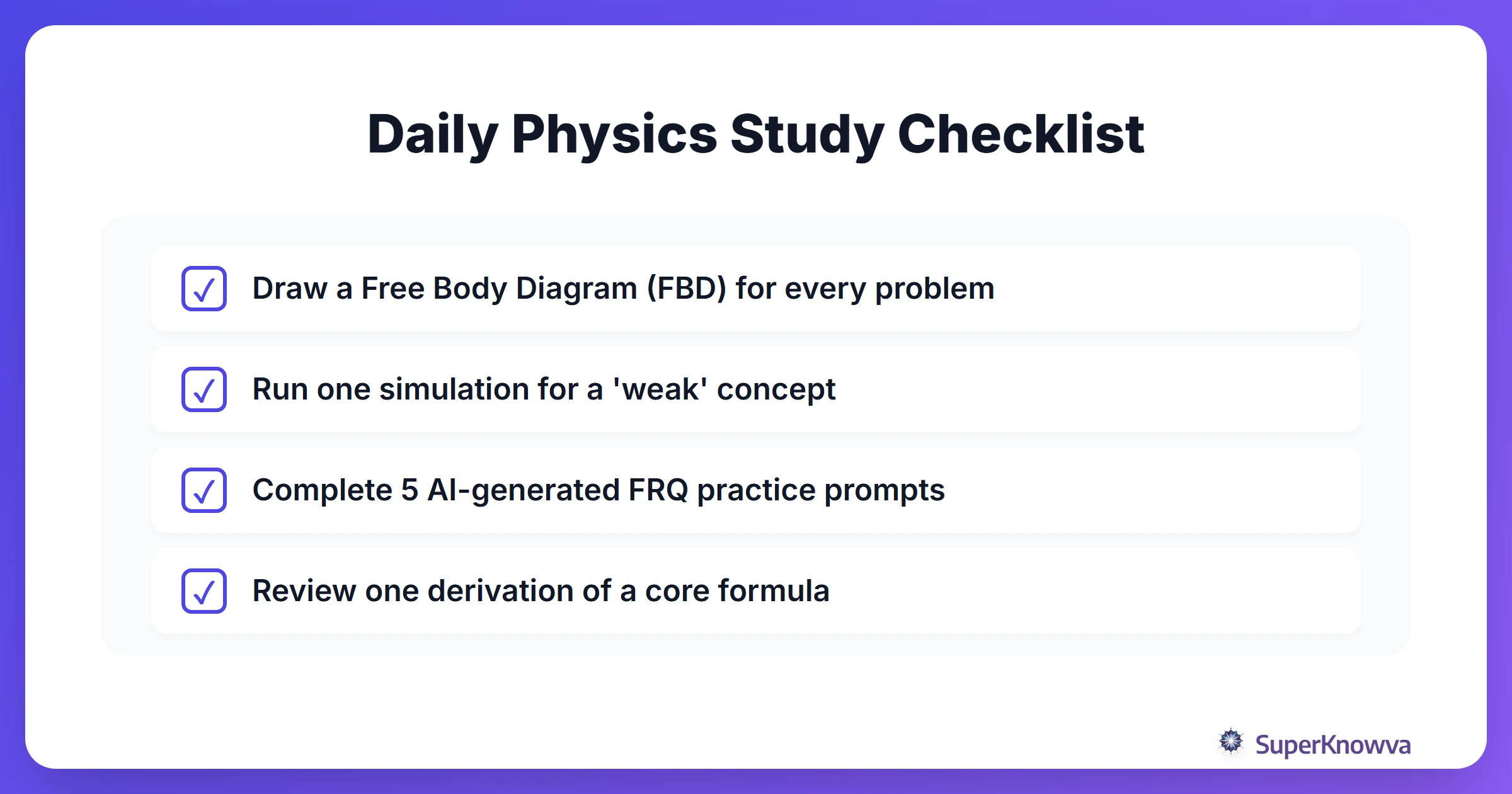
AI helps you break these habits by forcing you to focus on the concept. When a simulation shows you that a heavier object doesn't actually fall faster in a vacuum, it shatters the misconceptions that formulas alone can't fix. By using AI to automatically identify the gaps in your knowledge, you can spend your energy where it actually moves the needle.
For more support, join the AP Physics Student Community to talk through tricky concepts with your peers, and use SuperKnowva's tools to visualize complex theories. Don't just study physics. Experience it.