You know that feeling. The library lights are a little too bright, the clock is ticking way too loud, and your heart is thumping against your ribs like it’s trying to escape. Whether it’s a final, a professional certification, or a high-stakes entrance exam, the pressure can feel heavy enough to crush you.
While study tools like SuperKnowva help you master the material, your mental state drives your performance. If you have ever frozen up the moment you opened a test booklet, you know that knowing the answers isn't enough; you have to be able to access them. That’s where meditation for exam anxiety comes in. It is a practical study habit that helps you stay focused.
The Weight of the Storm: Understanding Exam Anxiety
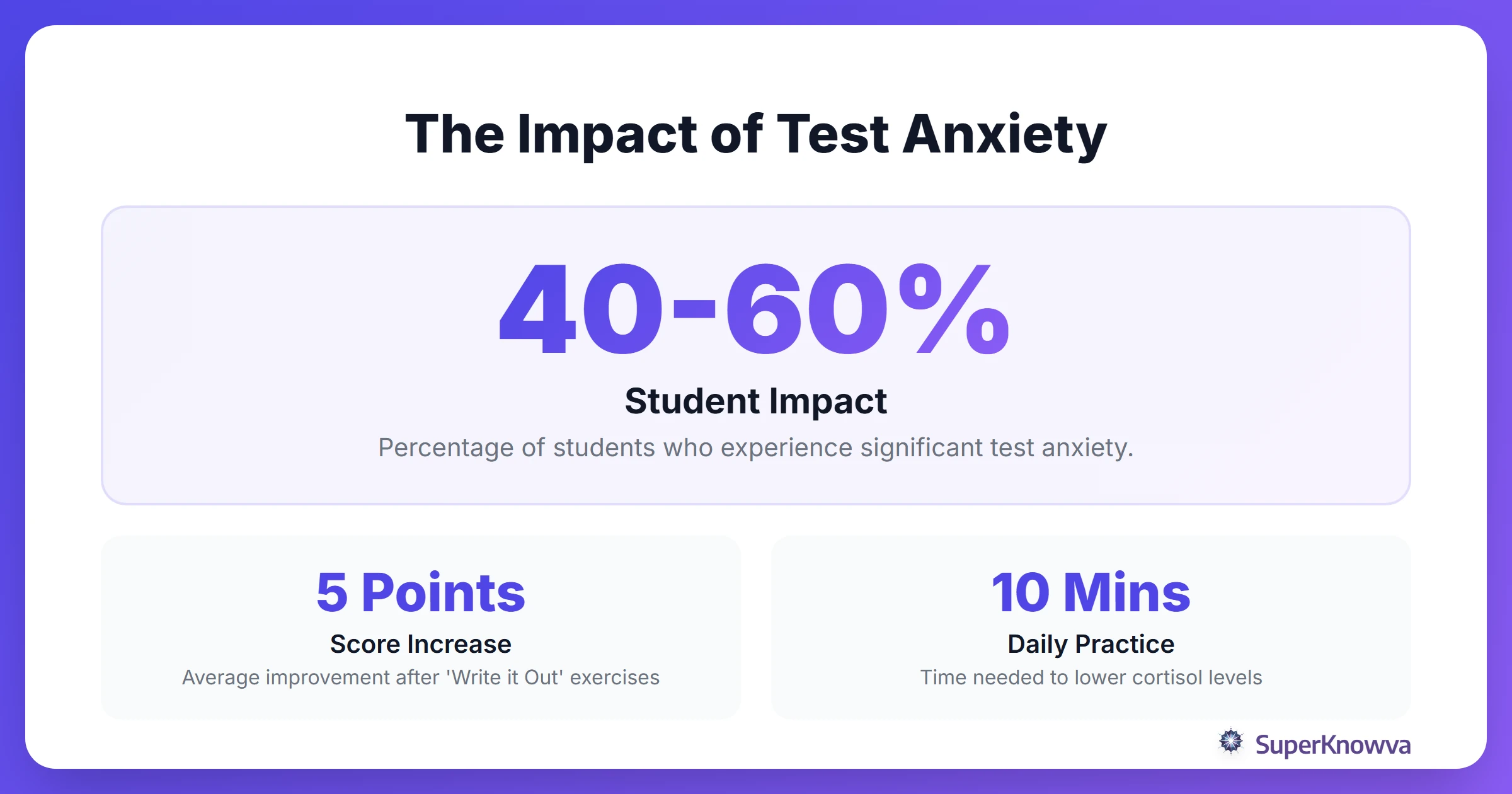
Test anxiety is more than just a case of the jitters. It’s a physical hijack. You might get sweaty palms, a racing pulse, or that dreaded "brain fog" where everything you studied just... vanishes.
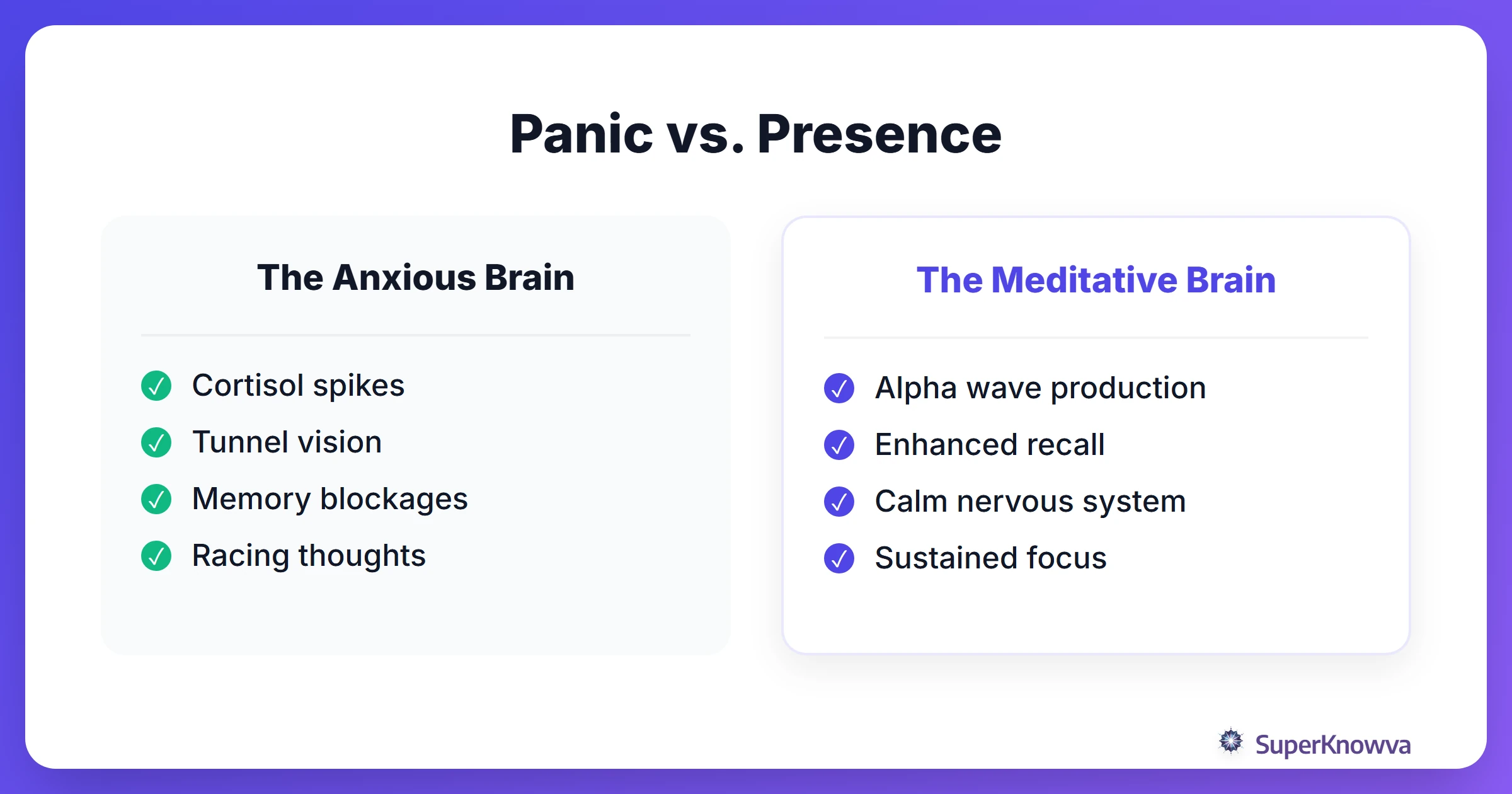
Why does this happen? Meet your "Fight or Flight" response. When your brain decides an exam is a threat, it floods your body with cortisol and adrenaline. A little bit of adrenaline keeps you sharp, but too much of it actually shuts down the neural pathways to your hippocampus. That’s the part of your brain responsible for memory. Essentially, your brain is so busy trying to "survive" the exam that it forgets the date of the Magna Carta.
If you don't get a handle on this, the stress builds up. Recognizing the early signs of student burnout is the first step toward making sure your anxiety doesn't become a permanent roommate.
The Science of Stillness: How Meditation Rewires the Student Brain
Meditation isn’t about "emptying your mind" or sitting perfectly still for hours. Think of it as a physiological reset button. Research shows that consistent mindfulness can actually shrink the amygdala (your brain's alarm system) while beefing up the prefrontal cortex, which handles focus and decision-making.
By activating the "Relaxation Response," you give your nervous system an antidote to panic. Instead of a loop of "what-ifs," meditation helps your brain produce alpha waves. This puts you in a state of "relaxed alertness," a flow state where information retrieval feels easy, not forced.
If you’re a total beginner, don’t overcomplicate it. Start with these simple meditation techniques for focus to lay the groundwork.
The 'Write It Out' Technique: Clearing Mental Space
Sometimes your brain is just too "loud" to meditate. When that happens, try a brain dump. Research from Northwestern University's 'Breathe' initiative suggests that writing down your fears can actually offload them from your working memory. You’re essentially clearing out the "cache" of your brain so there’s more room for the actual exam material.
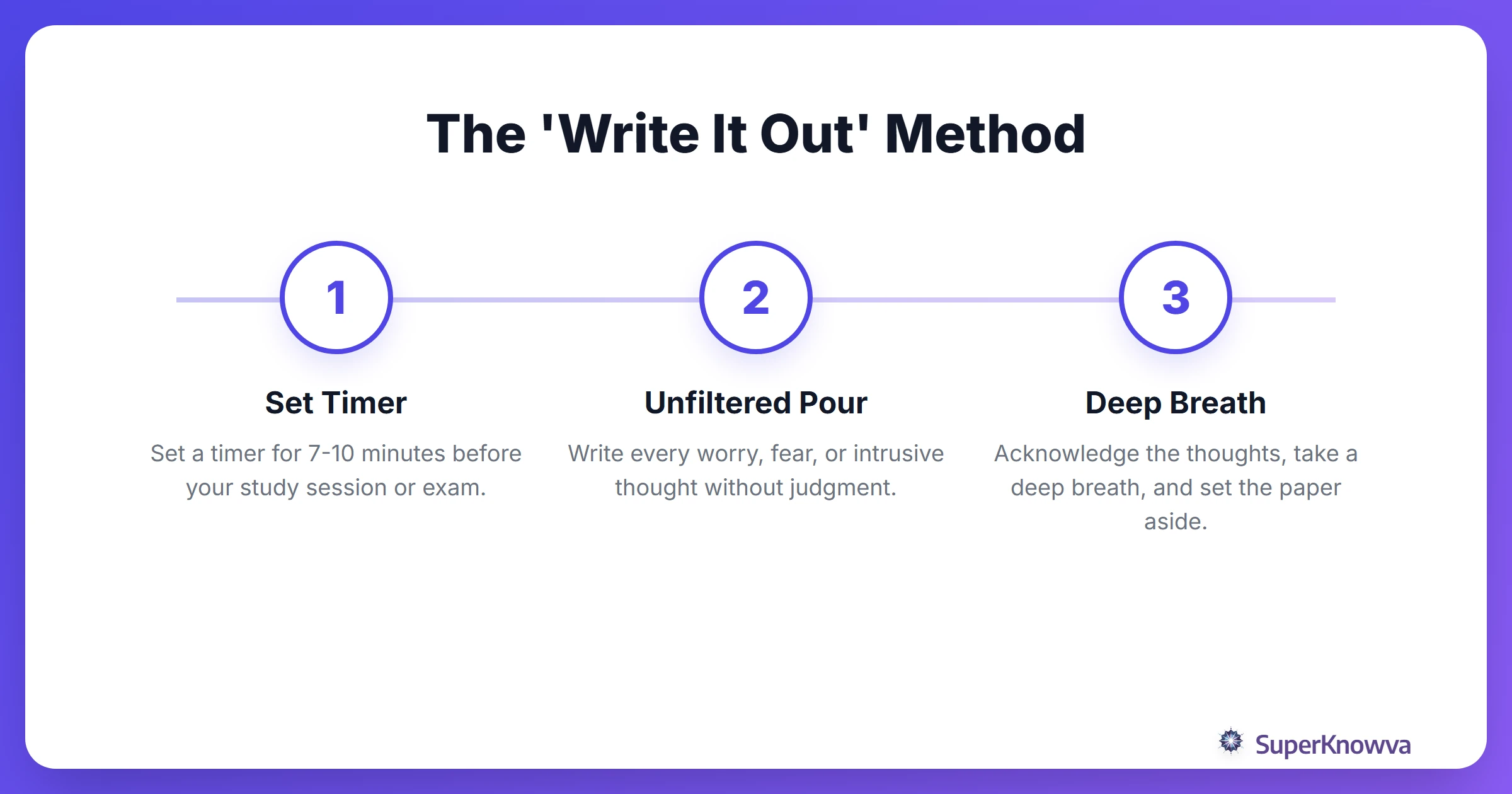
The 7-Minute 'Worry Dump':
- Set a Timer: Give yourself 7–10 minutes before you start studying.
- Unfiltered Pour: Write down every single ugly thought. "I'm going to fail," "I'm not smart enough," "I'll never get this." Don't edit it. Just get it out.
- The Release: When the timer dings, take three slow, deep breaths. Acknowledge that those thoughts are now on the paper, not taking up space in your head.
Mindful Movement: Walking Off the Stress
Can't sit still? Don't force it. If your anxiety makes you feel restless or "bouncy," try mindful walking. Unlike traditional meditation, this allows you to burn off that extra adrenaline while keeping your mind anchored.
As you walk, focus on the physical sensations: the soles of your feet hitting the pavement, the rhythm of your breathing, the wind on your face. It’s about being here, not in the hypothetical future where the exam has already gone wrong. Beyond sitting in stillness, research shows that physical activity boosts cognitive function, making it a perfect partner for mindfulness.
In the Moment: Strategies for During the Exam
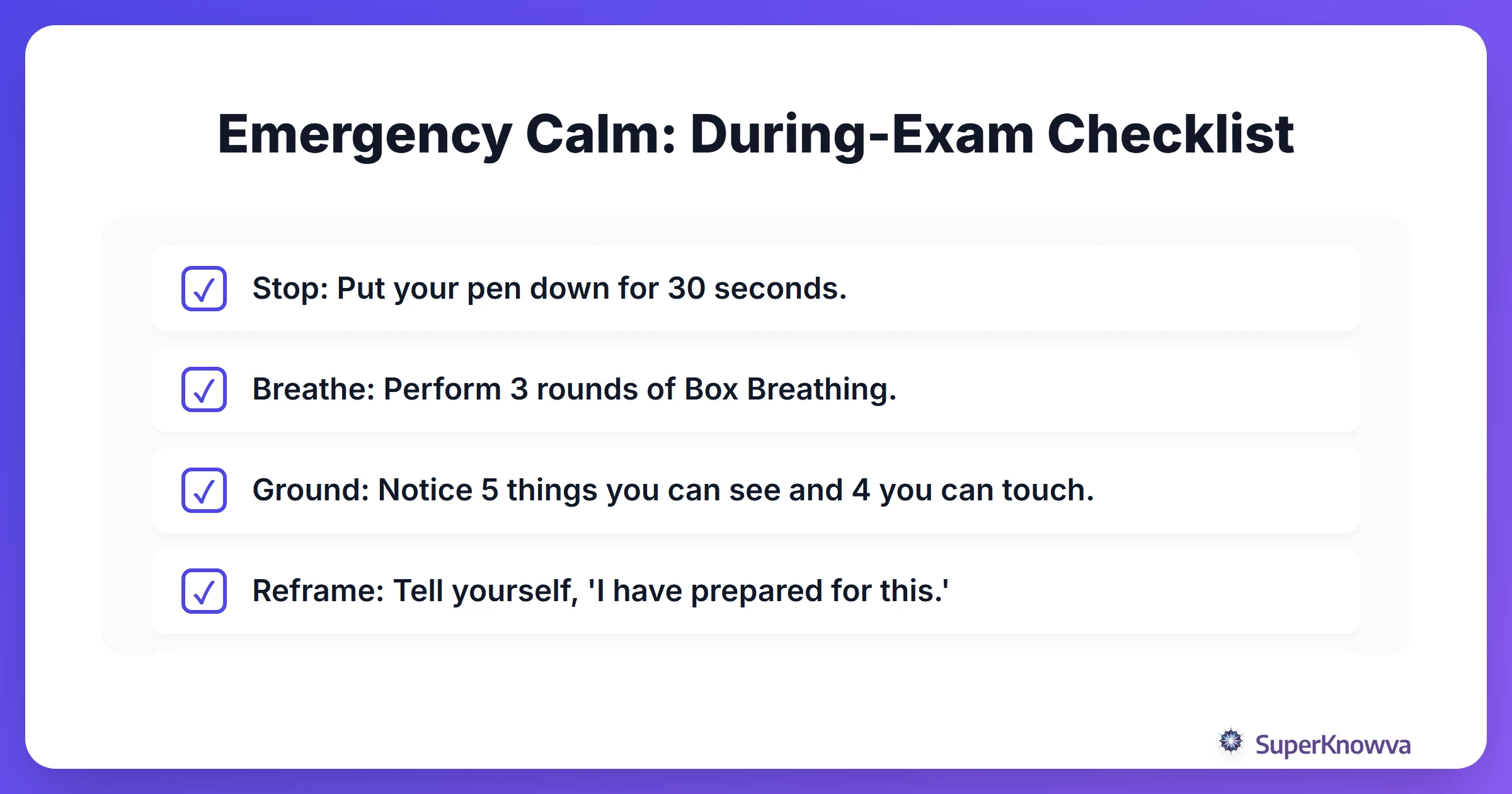
What do you do when the panic hits in the middle of Question 14? You don't need a yoga mat to find your cool. You can use "micro-meditations" right at your desk without losing more than a few seconds.
- Box Breathing (4-4-4-4): Inhale for 4 seconds, hold for 4, exhale for 4, and hold for 4. It’s a technique used by Navy SEALs to stay calm under pressure. If it works for them, it’ll work for your calculus final.
- The 5-4-3-2-1 Grounding Technique: If your mind starts to spiral, stop. Identify 5 things you see, 4 things you can touch, 3 things you hear, 2 things you smell, and 1 thing you can taste. It snaps you back to reality.
- Silent Mantras: Pick a short, boring phrase. "One question at a time" or "I am prepared." Repeat it like a broken record to drown out the panic.
You can find more tips from other students on practicing mindfulness in the moment during high-pressure situations.
Building Your Pre-Exam Meditation Routine
Consistency is everything. You wouldn’t wait until the morning of the test to start studying, so don’t wait until you’re panicking to try meditation for the first time.
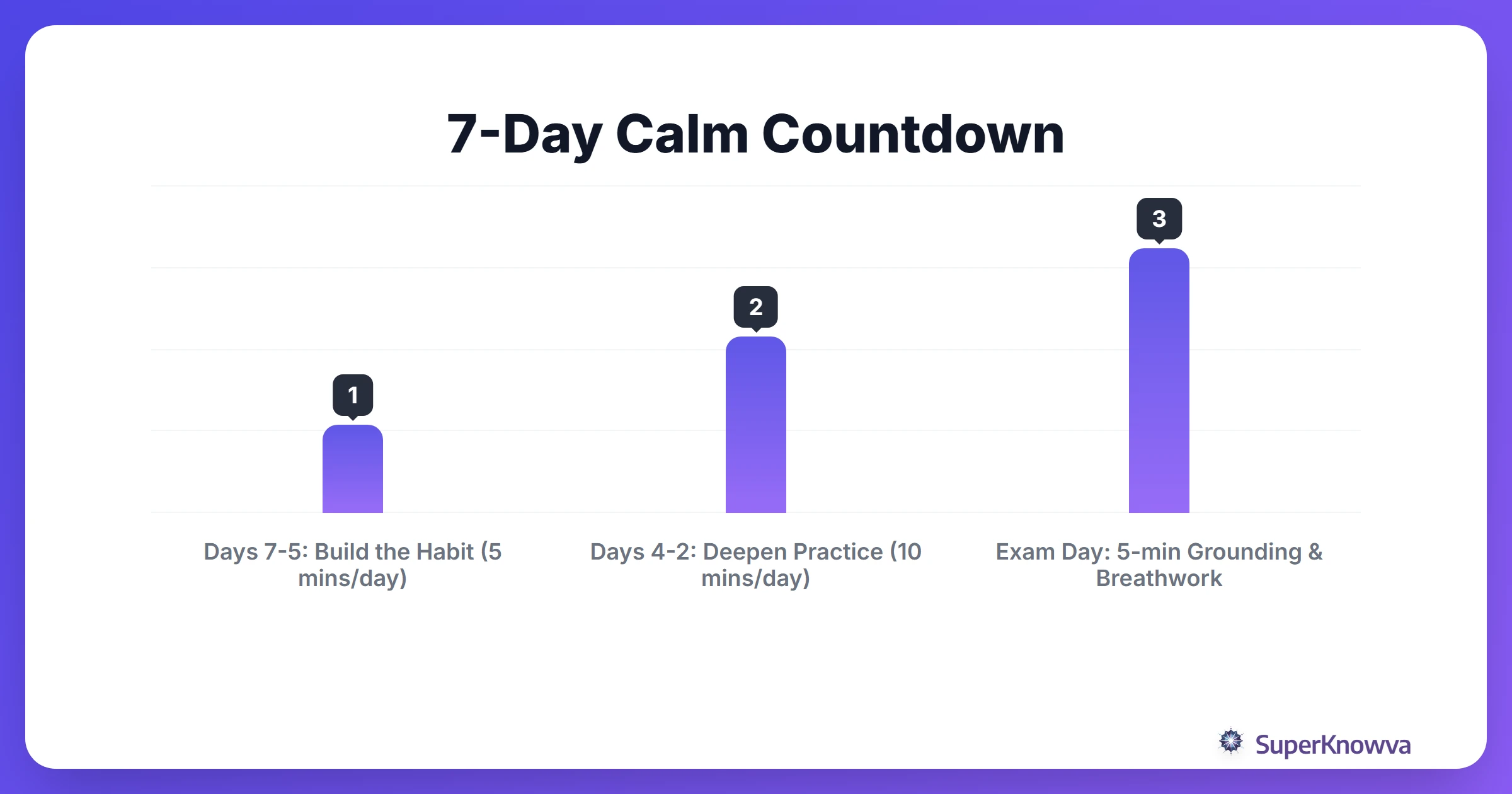
The 7-Day Calm Countdown:
- Days 7-5: Just 5 minutes every morning. The goal here is just to show up.
- Days 4-2: Bump it to 10 minutes. Try a session before bed to help your brain actually process what you studied that day.
- Exam Day: Do a quick 5-minute grounding session before you leave the house. Right before the "start" signal, do three rounds of Box Breathing.
During this week, watch how you talk to yourself. Many students find that overcoming imposter syndrome is half the battle. Remind yourself: you’ve done the work. You belong in that chair.
Final Thoughts
Exam anxiety is challenging, but meditation helps you stay focused. It's not about getting rid of the nerves entirely, as a little nervous energy can actually help you perform, but about making sure those nerves don't get in the way of your hard work. Focus on the material and trust what you have learned.