Have you ever spent three hours highlighting a textbook, only to realize you can’t explain a single concept you just "studied"?
It is a frustrating realization. You feel like you have done the work, but you have not retained the knowledge. This is a common challenge for students, but the solution is not necessarily studying longer. It is about studying more effectively. To master complex subjects, you need to develop metacognition for student learning.
Metacognition is the ability to step outside your own head and watch yourself work. It’s the difference between a student who survives a course and one who masters it. In this guide, we’ll break down how to use metacognitive strategies and AI tools like SuperKnowva to take total control of your academic success.
Understanding Metacognition: The 'Thinking About Thinking' Framework
At its core, metacognition is the awareness and management of your own thought processes. According to the MIT Teaching + Learning Lab, it’s the process by which learners use knowledge of the task and knowledge of themselves to plan their learning.
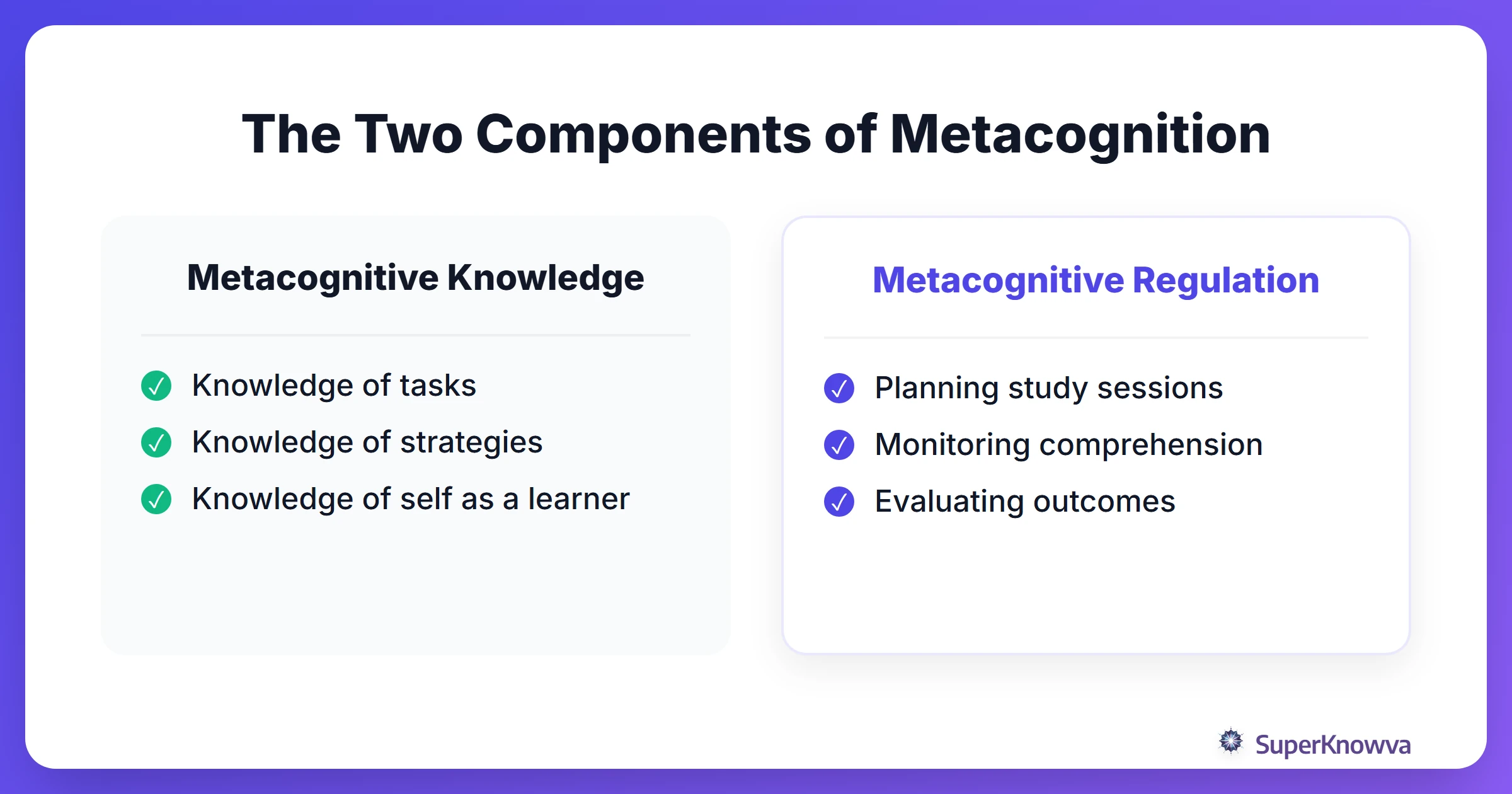
In the world of educational psychology, researchers split this into two categories:
- Metacognitive Knowledge: This is what you know about learning. It’s the realization that "I learn better with visuals," or acknowledging that "This chemistry exam requires problem-solving, not just memorization." It’s about knowing which metacognitive strategies actually work for your brain.
- Metacognitive Regulation: This is the "doing" part. It’s the active management of your brain: checking your progress, switching gears when you’re stuck, and deciding where to spend your limited energy.
Experts use these skills to organize information more effectively than novices. While a beginner might see a wall of disconnected facts, a metacognitive expert looks for the underlying structure and the "why" behind the concepts.
The Three Pillars: Planning, Monitoring, and Evaluating
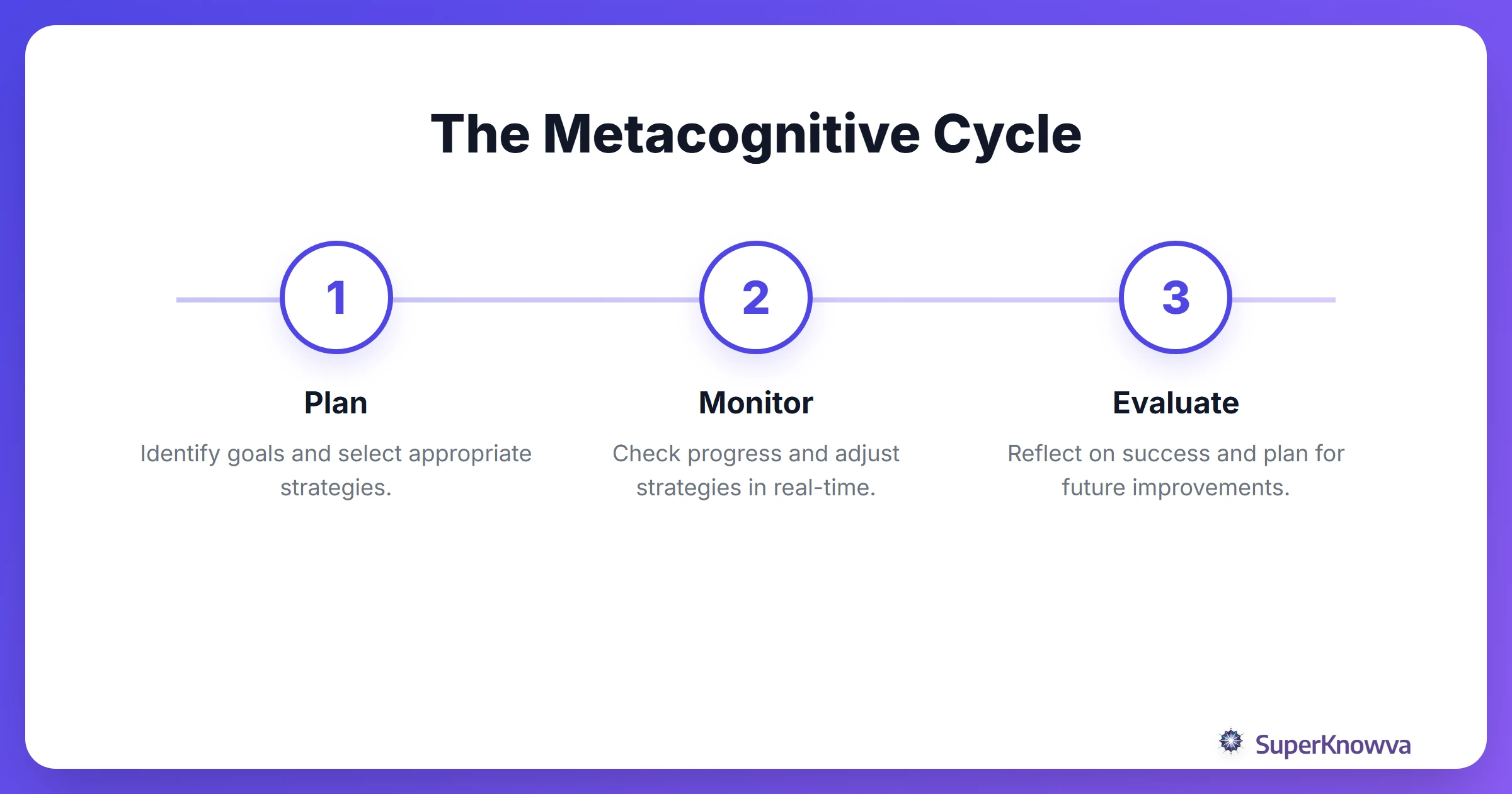
To turn metacognition into a habit, think of it as a continuous cycle. It’s not a one-and-done task; it’s a loop.
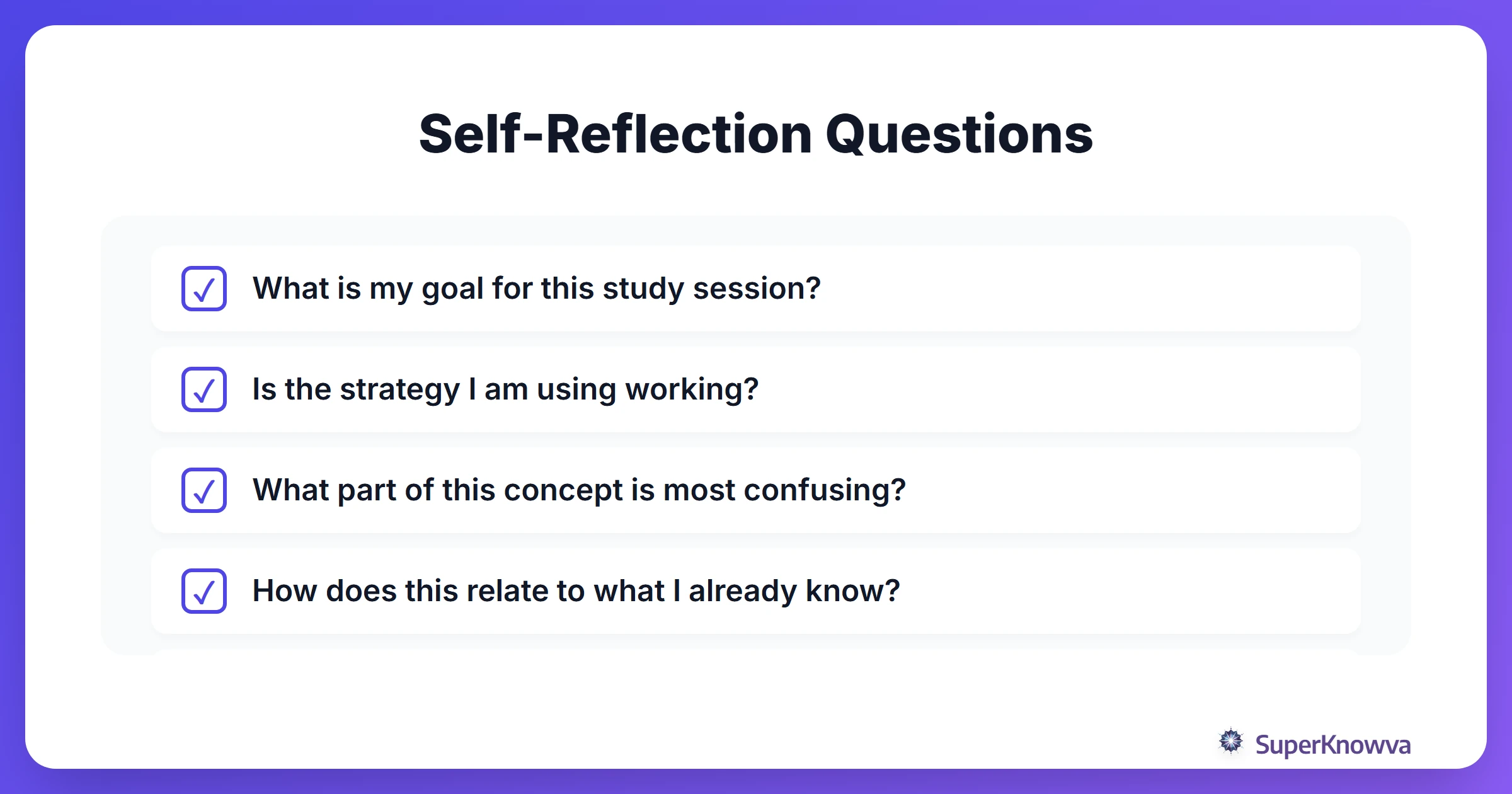
- Planning: This happens before you open a book. Instead of diving straight into your notes, take five minutes to set a roadmap. Ask: What do I actually need to accomplish? What resources do I need? Metacognitive planning is the foundation of a successful Deep Work session.
- Monitoring: This is cognitive monitoring in action. While you study, keep a pulse on your comprehension. Are you actually "getting" it, or are your eyes just moving across the page? If your mind starts wandering or a concept stays blurry, stop. Adjust your strategy in real-time.
- Evaluating: After the session, do a post-game analysis. Did your strategy work? What was the hardest part? This reflection helps you refine your approach so the next session is even more efficient.
The Expert Advantage: Why These Skills Matter
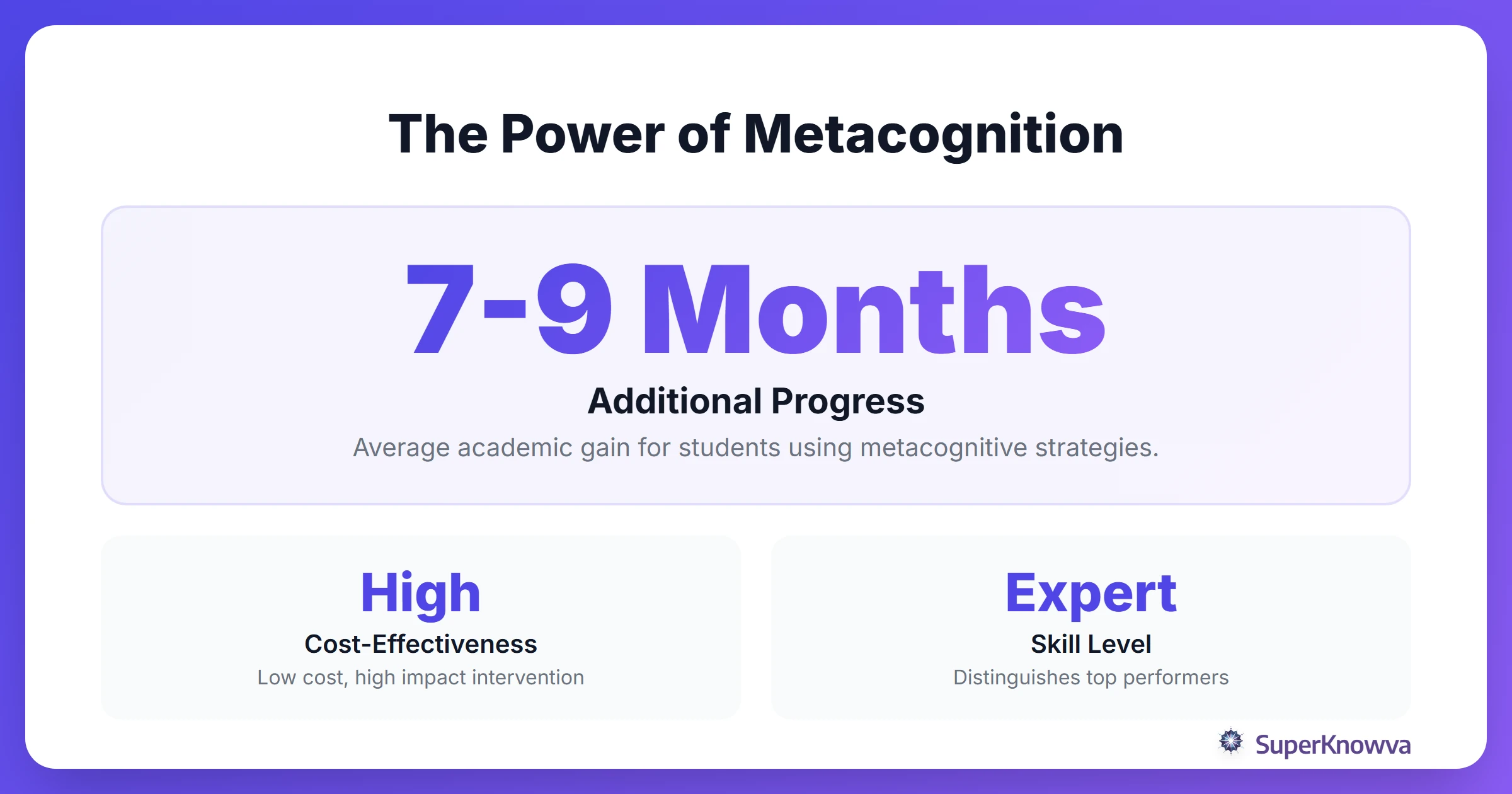
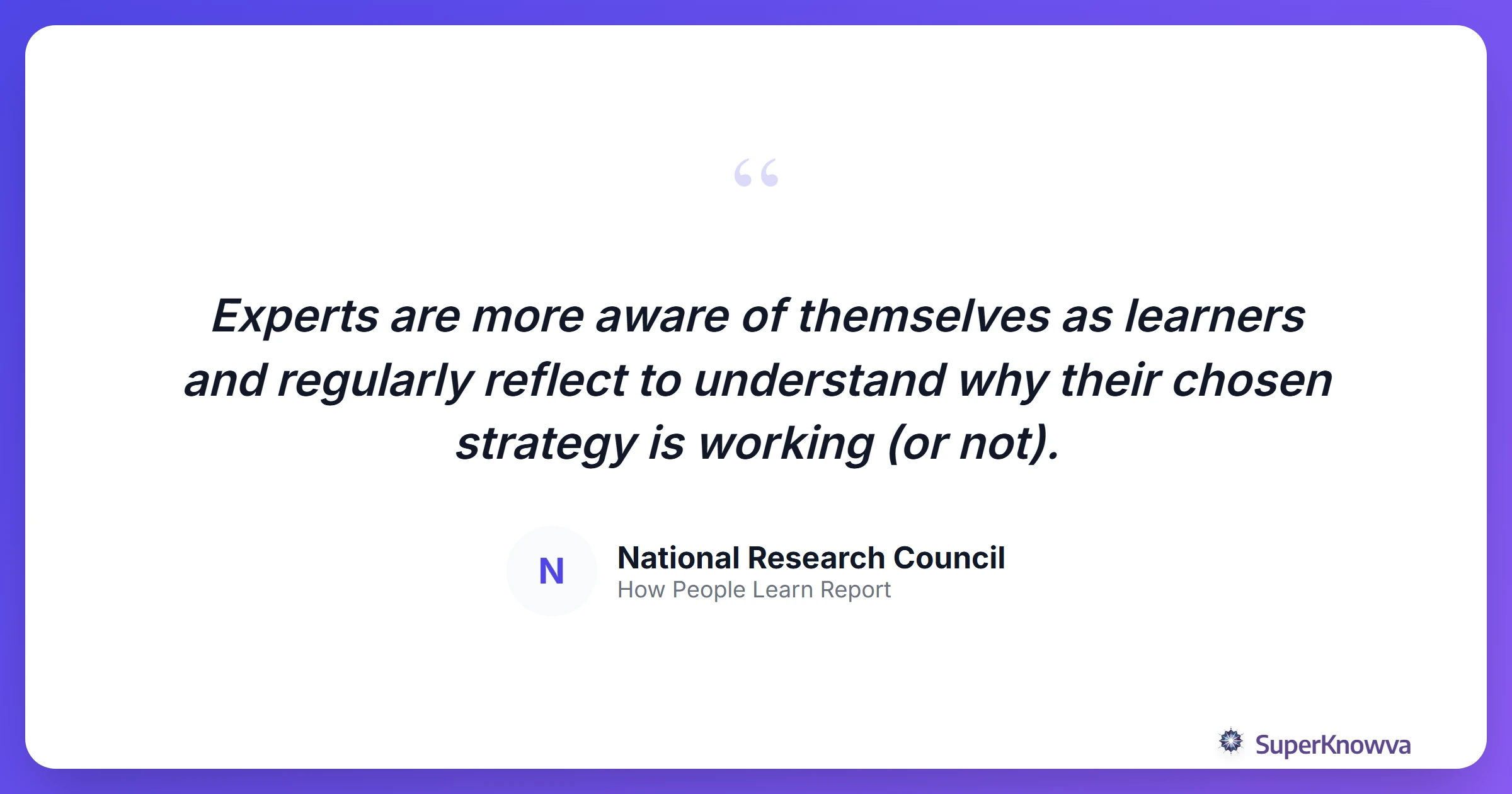
The difference between a "good" student and an "expert" student often comes down to how they handle friction. The National Research Council (2000) notes that expertise isn't just about knowing more; it is about how that knowledge is organized.
Experts recognize patterns that novices miss. If an expert hits a piece of information that contradicts what they already know, they stop and investigate. A novice might ignore the inconsistency and just keep reading. By using metacognition, you can redirect your effort toward your "weak links" rather than wasting time on what you already know.
Metacognitive Strategies for Active Learning
To move from passive reading to active learning, you need a toolkit. Here are a few ways to force your brain to engage:
- Self-Questioning: Don't wait for the exam to find out you're lost. Ask yourself: "How would I explain this to a friend?" or "What is the most important takeaway here?" The Feynman Technique is one of the best ways to identify gaps by forcing you to simplify complex ideas.
- Thinking Aloud: Try verbally explaining your thought process. If you can't say it out loud, you probably don't understand it as well as you think. It feels silly at first, but it catches logical fallacies instantly.
- Active Recall: Test the limits of your memory. Instead of looking at the answer, try to retrieve it from your brain first. It’s harder, and that’s exactly why it works.
Using AI to Fill Your Knowledge Gaps
One of the hardest parts of metacognition is being an objective judge of your own progress. We are all biased toward thinking we know more than we do. This is where AI-powered platforms like SuperKnowva become your external "monitor."
- Targeted Quizzes: Use SuperKnowva to generate quizzes from your specific lecture notes. These quizzes expose "illusions of competence" by forcing you to produce answers rather than just recognizing them on a page.
- AI-Driven Analytics: By tracking your performance, AI can show you exactly which concepts require more cognitive effort, helping you regulate your study time effectively.
- Knowledge Management: Organizing your digital study life helps you manage the different components of your knowledge, often referred to as building a second brain.
Overcoming the Illusion of Competence
The biggest enemy of learning is the "illusion of competence." This happens when you read a chapter and feel like you’ve mastered it just because the writing is clear. But familiarity is not the same as mastery.
Metacognitive monitoring keeps you honest. It shifts you from passive consumption to active engagement. To see where you really stand during the evaluation phase, try the Blurting Method. It’s a simple way to see what information you can actually retrieve without the safety net of your notes.
Conclusion
Mastering metacognition for student learning is a marathon, not a sprint. By planning your sessions, monitoring your understanding in real-time, and evaluating your results, you stop being a passive observer of your education and start being an active scholar.
When you combine these psychological strategies with SuperKnowva, you learn faster and achieve a deeper understanding.
Ready to put your thinking to the test? Start your next study session by asking: "What do I want to learn today, and how will I know when I've actually learned it?"