When working memory hits its limit, the brain feels like a browser with fifty open tabs, three of them frozen, and music playing from an unknown source. This often leads to staring at a textbook page for twenty minutes without processing a single word.
The truth is, mastering a complex subject isn’t about grinding for more hours. It’s about reducing cognitive load while studying so your brain can actually do its job: encoding and retaining information.
By understanding the science of how we process data, you can stop fighting your biology and start making learning feel, well, a lot less like a chore.
Understanding the Brain's Bottleneck: What is Cognitive Load?
Think of your working memory as a literal bottleneck. While your long-term memory is essentially a bottomless warehouse, your "processing center" can only handle a tiny amount of new info at once. In psychology, this mental effort is called cognitive load.
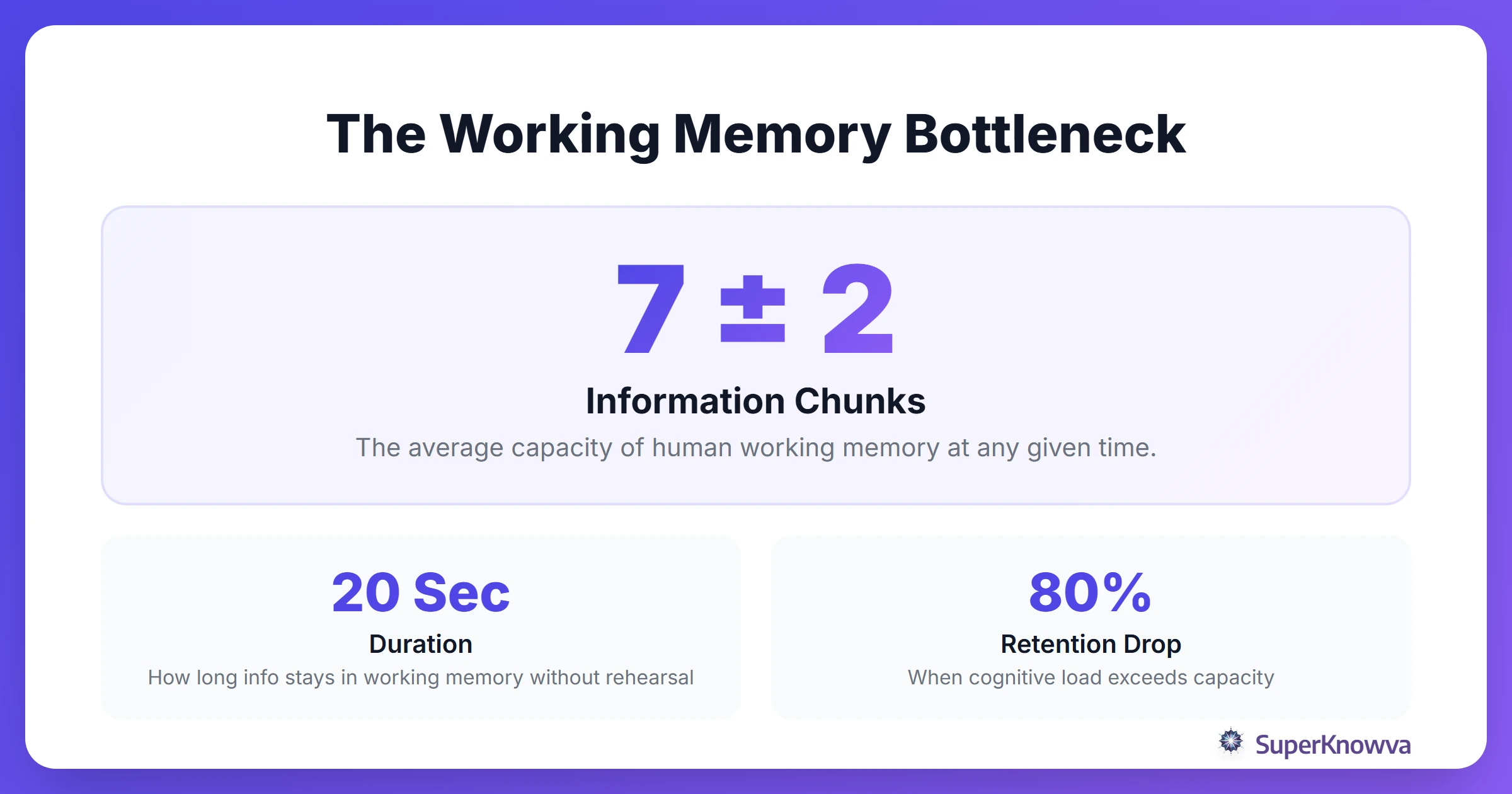
John Sweller, an educational psychologist, developed Cognitive Load Theory to explain why this bottleneck matters. When you try to cram too much in at once, your brain experiences "overload." This is why you feel burnt out after just thirty minutes of dense reading. It’s not that you aren’t smart enough; it’s that you’ve pushed past your cognitive limit without giving your brain the structure it needs to organize the data.
The Three Types of Cognitive Load
To boost your study efficiency, you need to realize that not all mental effort is "good" effort. Sweller’s theory breaks it down into three categories:
- Intrinsic Load: This is just how hard the topic is. Quantum physics is naturally harder than a grocery list. You can’t change the difficulty, but you can change how you tackle it.
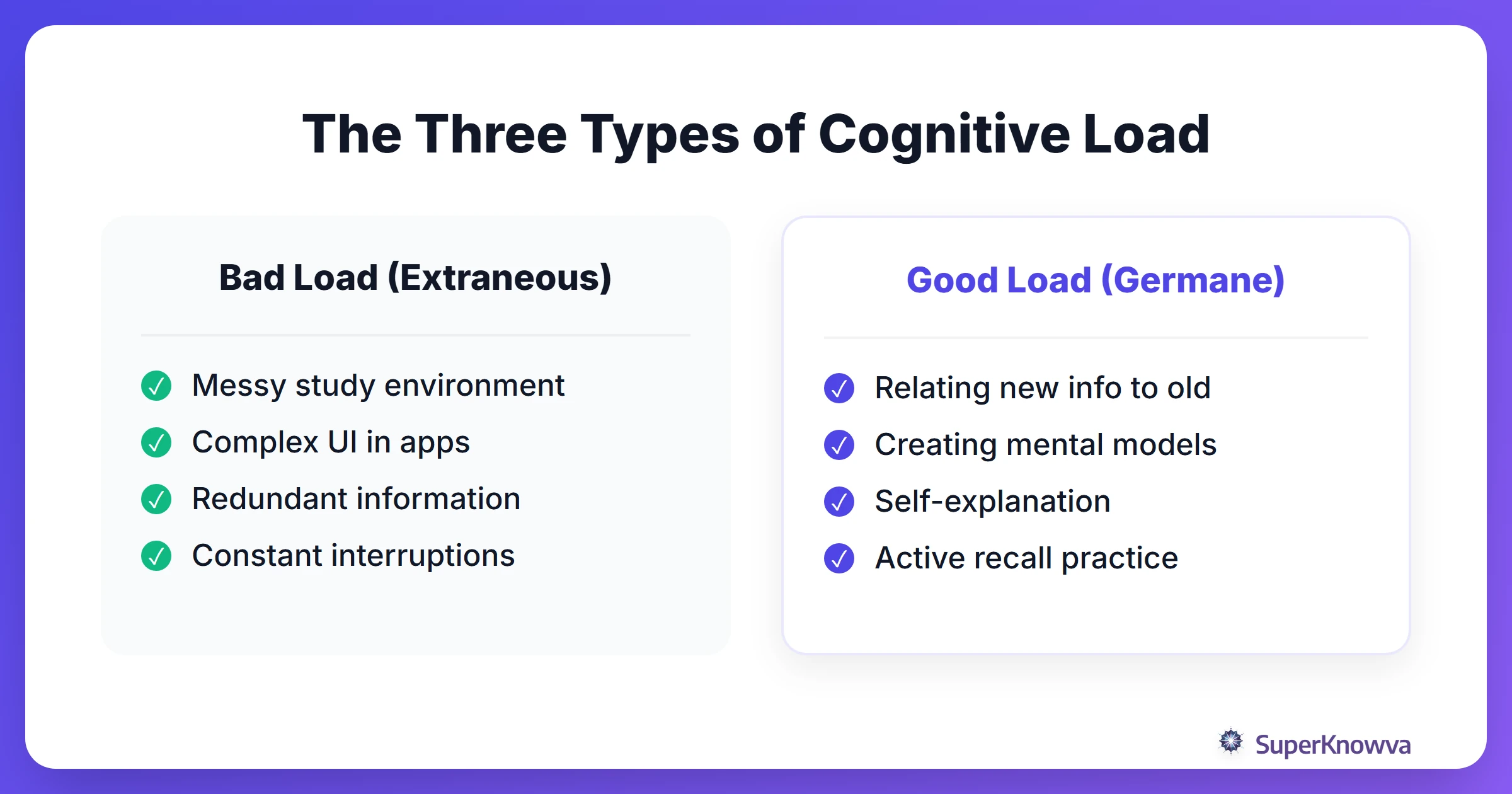
- Extraneous Load: This is "bad" load. It’s the extra work caused by a messy desk, a confusing textbook layout, or annoying distractions. This takes up space in your head without helping you learn a thing.
- Germane Load: This is the "good" stuff. It’s the mental energy you use to actually link new facts to things you already know, creating mental models (schemas) that stick.
Your goal? Minimize the extraneous, manage the intrinsic, and clear the deck for the germane. This is how you reach a state of Deep Work where the real progress happens.
Strategy 1: The Modality Effect and Dual Coding
Want to expand your brain’s capacity? Use more than one "channel." Your brain processes visual and auditory information separately. If you try to read a dense paragraph while someone is talking about something else, your brain jams up.
If you use these channels together, such as looking at a diagram while listening to an explanation, you double your capacity. This is called Dual Coding.
How to use Dual Coding:
- Skip the subtitles: Don’t read a transcript while listening to a lecture. It actually creates more work because your brain has to reconcile the two text streams.
- Talk to yourself: When looking at a chart or map, explain it out loud.
- Sketch and Speak: Draw a simple map of a concept while narrating the key steps.
Research from the University of Kentucky shows that designing your study flow around these principles protects your brain from unnecessary strain.
Strategy 2: Stop the "Split-Attention" Struggle
Ever had a textbook tell you to "See Figure 1.2" on page 10, while the explanation is on page 12? That’s the split-attention effect, and it’s a productivity killer. Your brain wastes energy flipping back and forth, trying to hold the image in your mind while your eyes hunt for the text.
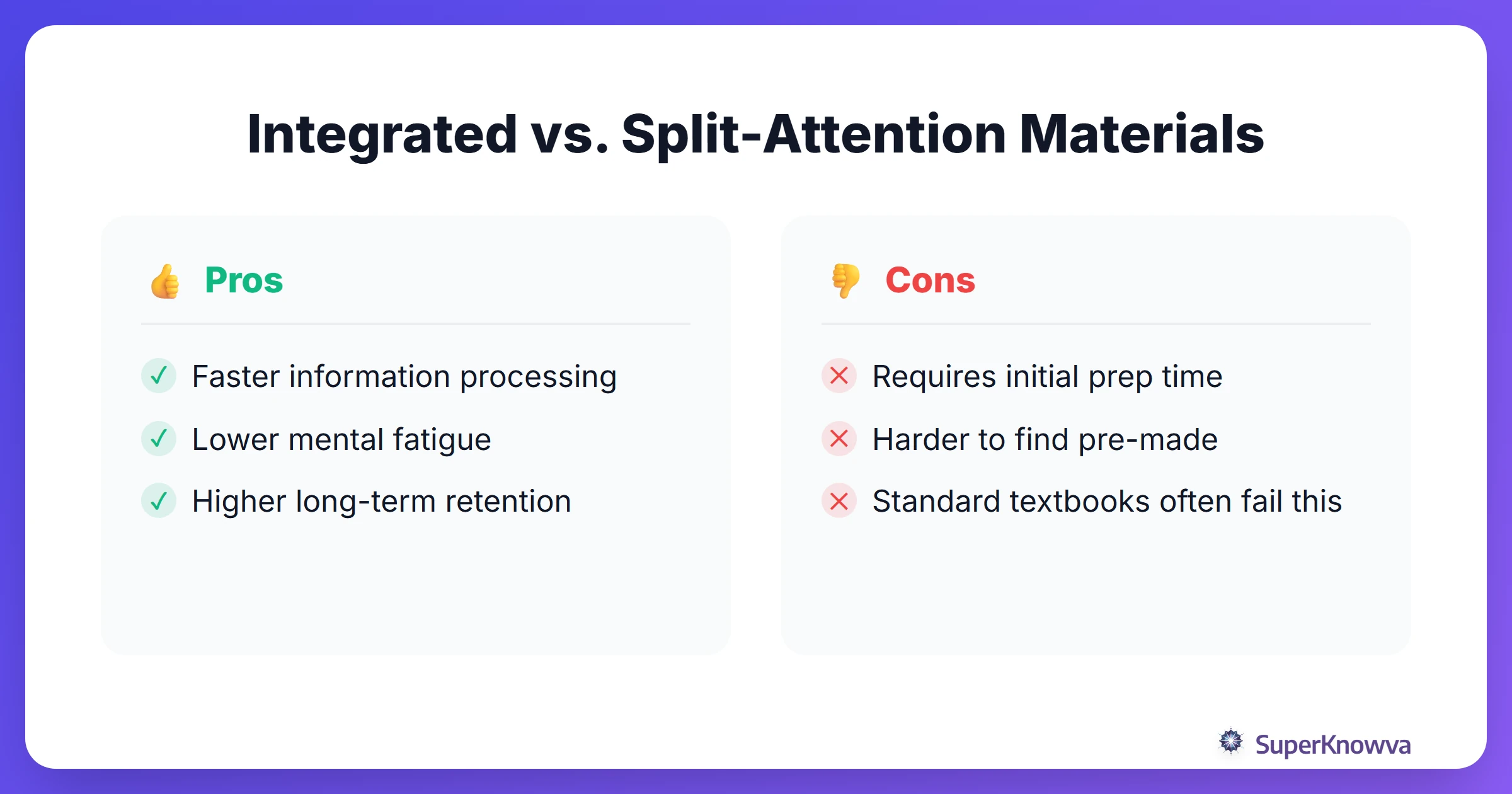
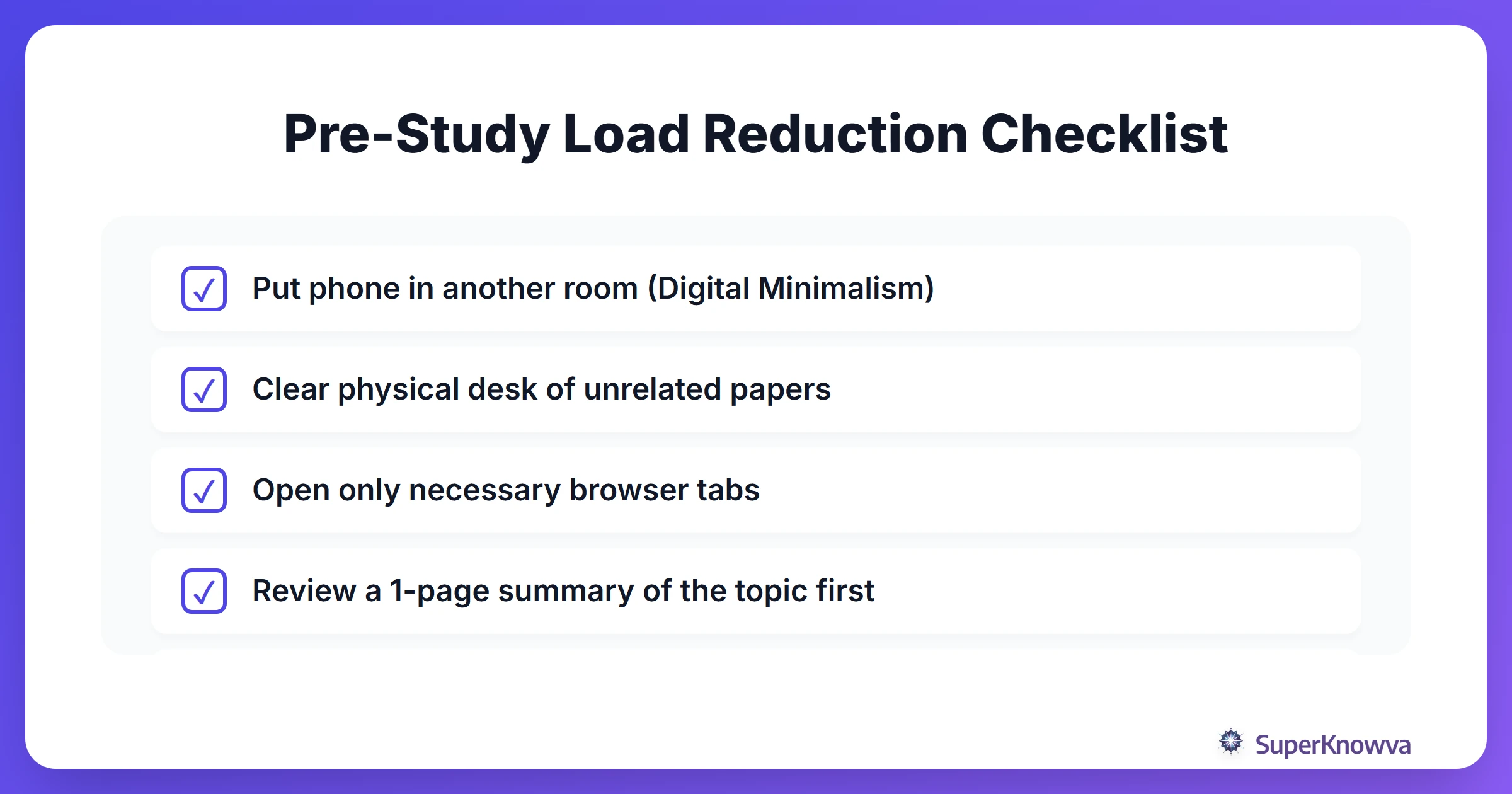
To fix this, embrace digital minimalism. If you’re studying online, take a screenshot of that diagram and paste it right next to your notes. By putting everything in one view, your brain can focus on the meaning of the content rather than the location of it.
Clearing your digital environment by closing extra tabs and silencing your phone is the fastest way to reduce extraneous load.
Strategy 3: Chunking and Scaffolding
When a topic feels too heavy, you need to "scaffold" it. This just means breaking big, scary concepts into smaller, bite-sized "chunks."
The 4-Step Chunking Process:
- Identify: Find the big ideas in a chapter.
- Group: Put related facts together.
- Connect: Link a new idea to something you already understand.
- Automate: Practice until that "chunk" feels like second nature.
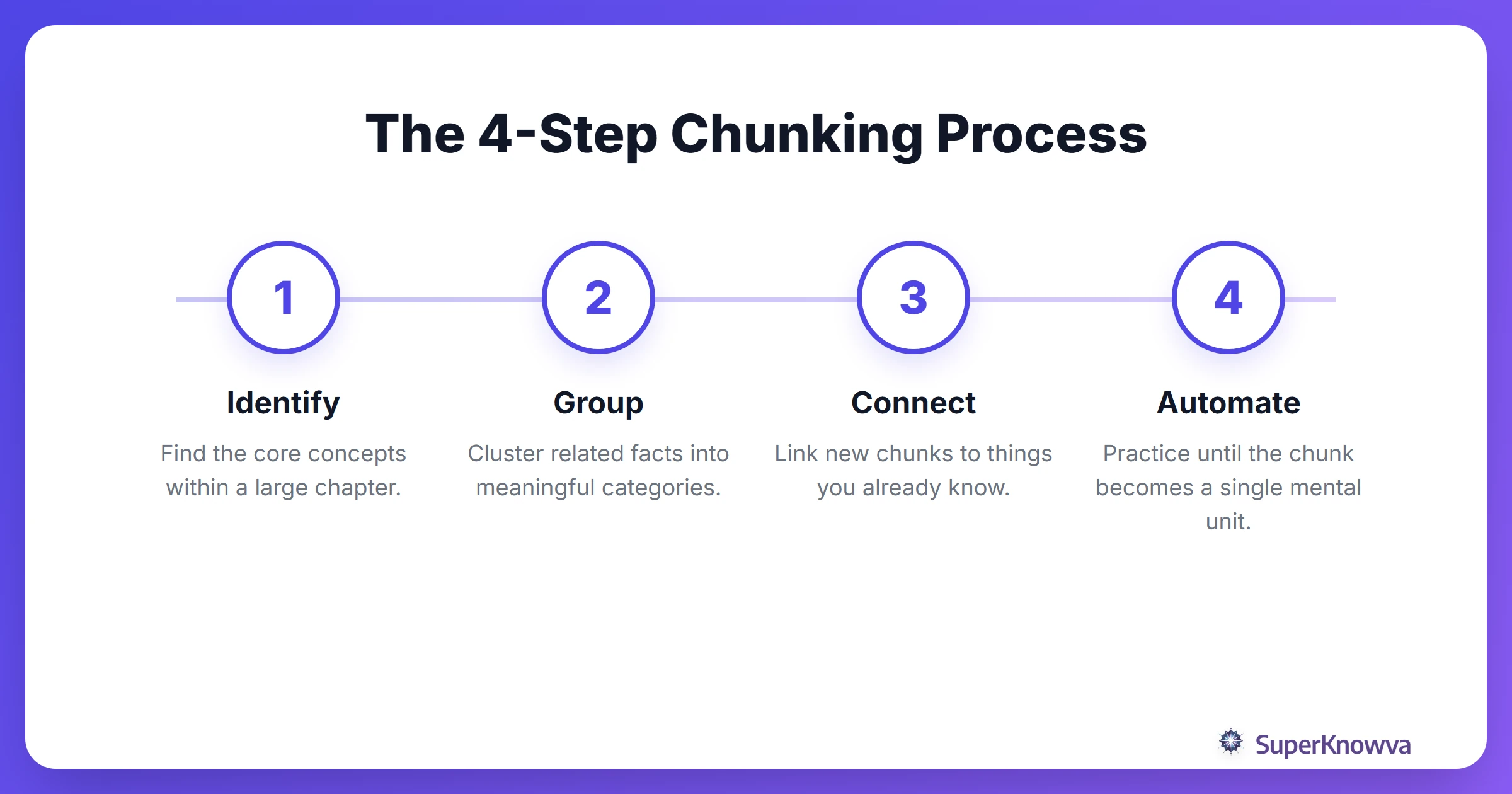
Using mind mapping helps you see these connections visually. Another pro tip: "pre-train" your brain. Watch a five-minute intro video or read a one-page summary before diving into a heavy chapter. It gives you a mental map so the details have a place to "slot in" later. You can also use interleaving practice to mix these chunks up, which keeps your brain on its toes and helps info stick long-term.
Let Technology Do the Heavy Lifting
You don't have to manage all this mental weight on your own. AI platforms like SuperKnowva are built to act as an external "Second Brain," taking the organizational grunt work off your plate.
- Instant Structure: AI can take a messy, 50-page PDF and turn it into clear, structured bullet points, organizing a poorly written document.
- Decision Fatigue: One of the hardest parts of studying is deciding what to study. Automated tools can handle your schedule so you can save your energy for the actual learning.
- Active Retrieval: By turning your notes into instant quizzes, technology requires active recall, the most efficient way to build germane load.
Applying these strategies can completely change your relationship with your coursework. Before you start your next session, run through this checklist to make sure your brain is actually ready to work.
The Bottom Line
Reducing cognitive load isn't about being lazy or avoiding hard work. It’s about making sure your hard work actually leads to results. By cutting out distractions, integrating your visuals, and chunking complex data, you’re clearing the path for your brain to do what it does best. Stop fighting your biology and start working with it.