It is 11:00 PM in the library. Your coffee is cold, your neck hurts, and you have spent the last three hours "studying." In reality, you have been scrolling TikTok while a textbook sits open next to your phone.
We call this "performative studying." It feels like work because you’re at a desk, but your brain isn't actually absorbing anything. If you’re tired of the marathon library sessions that yield zero results, it’s time to change the game. To actually master your material and reclaim your sanity, you need to lean into deep work for exam season.
At SuperKnowva, we don’t care how many hours you log. We care about the intensity of your focus. By shifting your habits, you can get more done in a focused three-hour block than most students manage in an entire distracted day.
The Philosophy of Deep Work for Students
The term "Deep Work" comes from Cal Newport, a computer science professor and author of Deep Work. He defines it as distraction-free concentration that pushes your cognitive capabilities to their absolute limit.
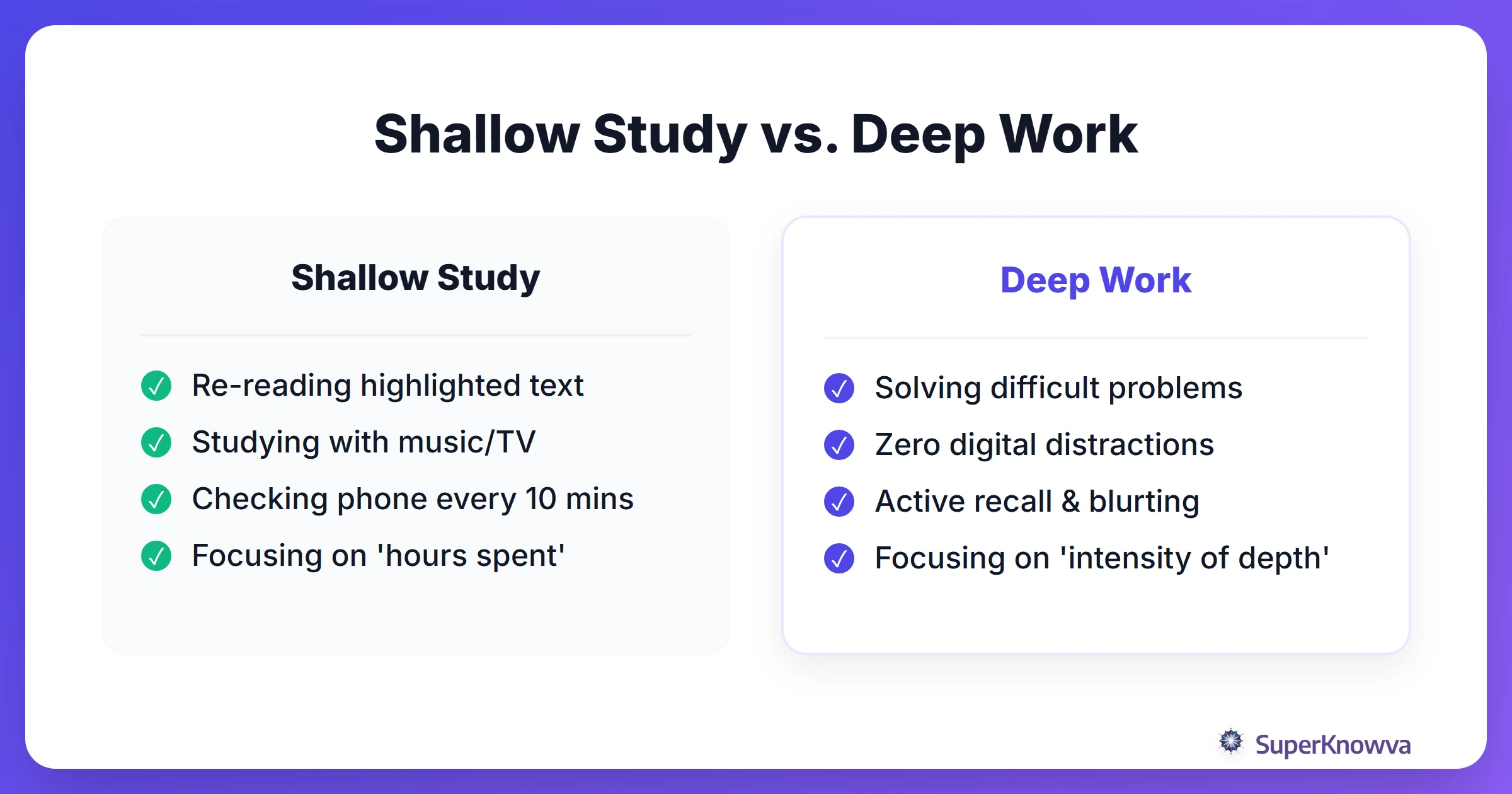
For a student, this is the polar opposite of "Shallow Work." Shallow work is the "busy work" of academia: reorganizing your Notion folders, re-reading highlighted text for the fifth time, or color-coding a calendar. These tasks feel productive, but they don’t actually help you understand complex concepts. They’re a safety blanket for the brain.
Newport’s formula for success is simple:
High-Quality Work Produced = (Time Spent) x (Intensity of Focus)
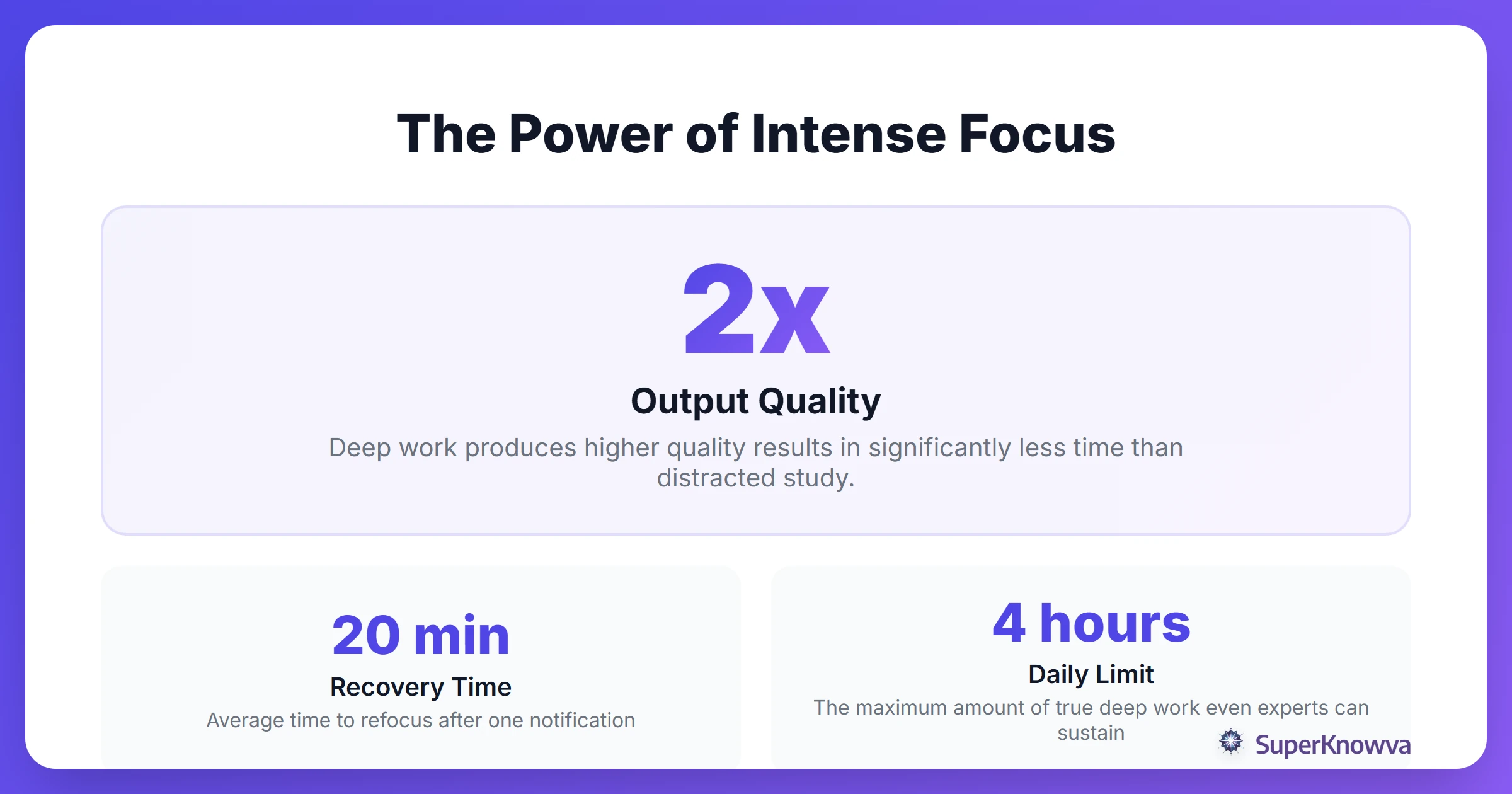
Think about it. If your focus is a 2/10 because you’re checking your phone every five minutes, you have to work five times longer to get the same result as someone with a 10/10 focus. During finals, time is the only currency you have. Why waste it?
Choosing Your Deep Work Scheduling Philosophy
You can't just "do" deep work; you have to schedule it. Depending on your May timetable, one of these three approaches will likely fit best:
- The Rhythmic Philosophy: This is the standard for most students. You pick a fixed block, such as 8:00 AM to 11:00 AM, and you do deep work every single day at that time. No thinking, no "deciding" to work. It just becomes what you do.
- The Bimodal Philosophy: Best if your exams are spread out. You might dedicate Tuesdays and Thursdays as "Deep Days" where you disappear into the library, while using the rest of the week for classes and errands.
- The Journalistic Philosophy: This is for the pros. If your schedule is a mess, you learn to "switch on" deep work whenever a 90-minute gap appears. It’s effective, but it requires serious mental discipline.
Look at your exam dates. If you have a week-long gap between finals, try the Bimodal approach. If your exams are clustered together, the Rhythmic philosophy will keep you from burning out. To see how these stack up against other methods, check out our guide on Pomodoro vs. Flowtime.
Eliminating Digital Distractions and Shallow Habits
The biggest killer of grades isn't a lack of intelligence; it’s "Attention Residue."
When you glance at a text message, your brain doesn't immediately snap back to your Calculus problem. A "residue" of that distraction lingers for up to 20 minutes. If you check your phone every 15 minutes, you are literally never functioning at 100% capacity.
To fix this, you have to get serious about Digital Minimalism for Students. Turning your phone face down isn't enough. Put it in another room. Use app blockers like Freedom or Forest.
You also need to stop the "passive consumption" trap. If your studying doesn't feel mentally taxing, you probably aren't doing deep work. Reading is easy; solving problems is hard. Choose hard.
Ritualizing Your Study Sessions
Deep work is a workout for your brain, and your brain will try to talk you out of it. You can bypass that resistance by creating a "ritual" that signals it’s time to focus.
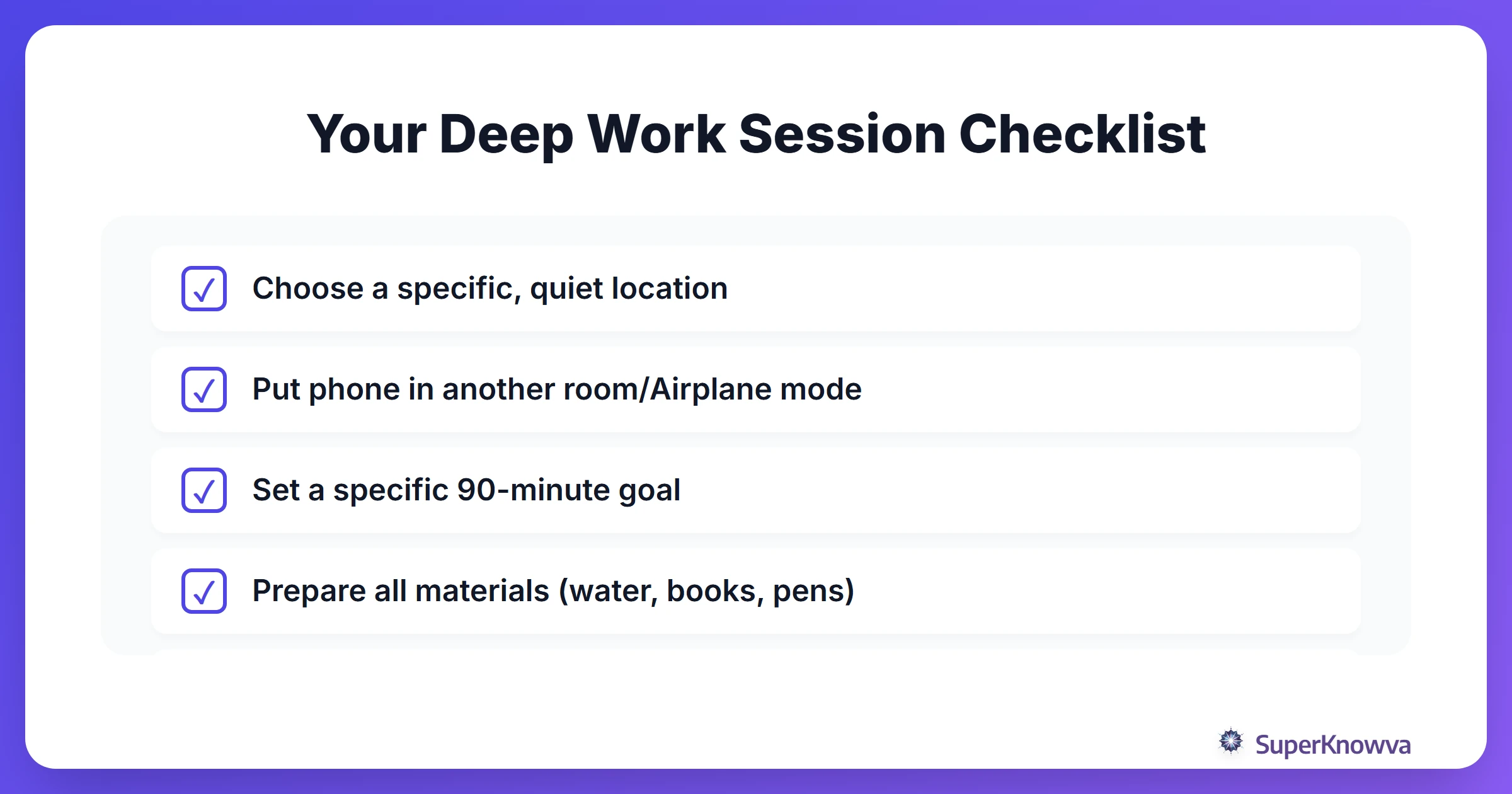
First, find a Deep Work Sanctuary. This is a specific spot, such as a quiet corner of the library or a hidden cafe, that you only use for intense study. If you’re at that desk, you aren't scrolling. You aren't texting. You’re working.
Next, build a start-up ritual:
- Clear your desk of everything except one subject.
- Grab a specific drink (tea, coffee, seltzer).
- Put on a specific "Deep Work" playlist and set a timer for 90 minutes.
Finally, use a shutdown ritual. When you’re done, physically close your books and say, "Work finished." It sounds cheesy, but it tells your brain it’s okay to relax. This "off" time is actually when your brain consolidates memory and recovers for the next day.
The No-Note Lecture Method and Active Engagement
Deep work doesn't just happen at your desk; it can start in the lecture hall. One of the most aggressive study focus techniques is the "No-Note" Lecture Method.
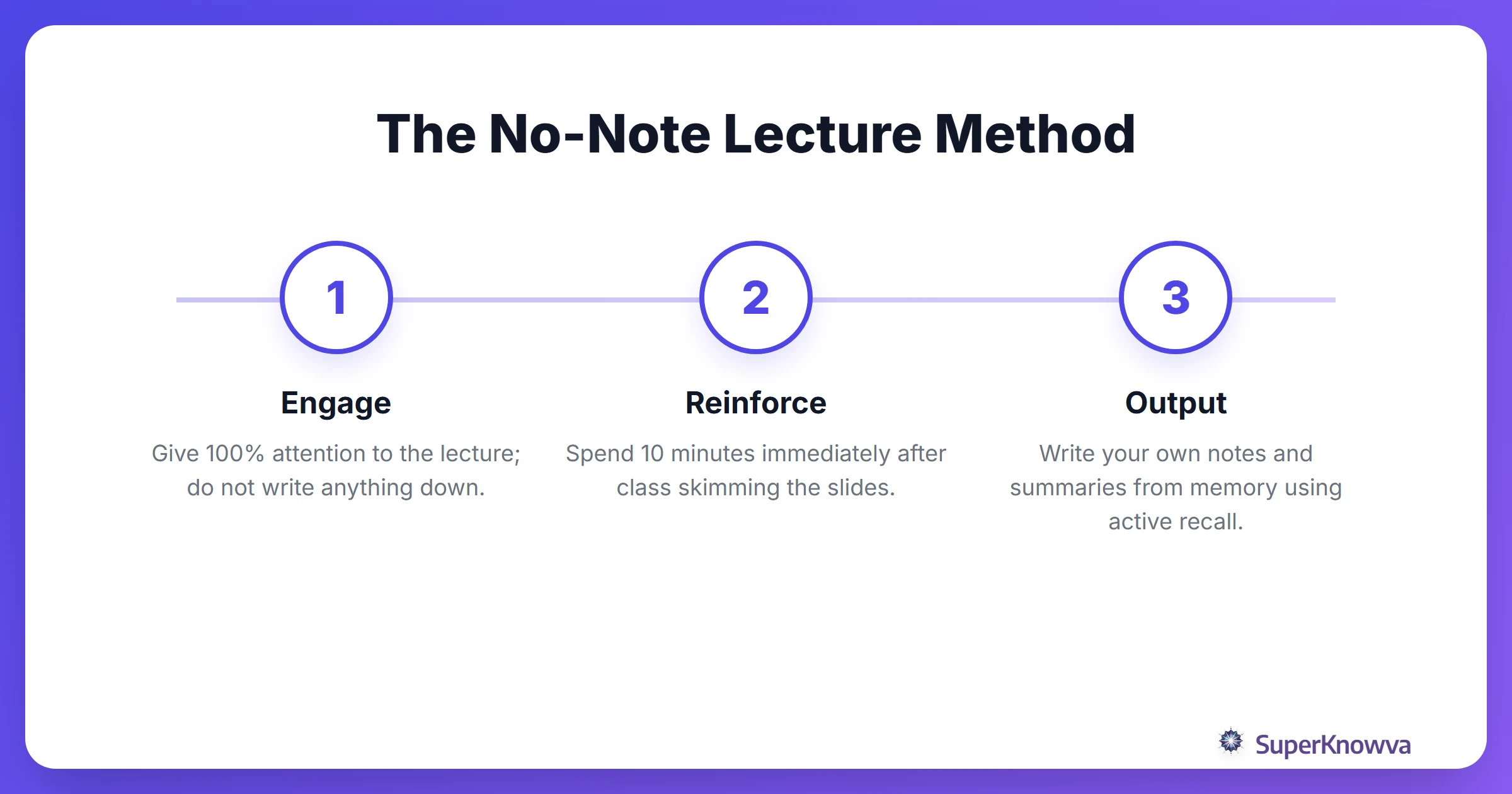
Instead of acting like a human stenographer, stop writing. Give 100% of your attention to understanding the logic of what the professor is saying. Then, the second the lecture ends, spend 10 minutes performing The Blurting Method by writing down everything you can remember from memory.
To take it a step further, use The Feynman Technique. Try to explain a concept out loud as if you’re teaching it to a ten-year-old. Use weird analogies. The more "active" you are, the deeper the neural paths become.
Tracking Depth: Pursuing Clarity Before Results
In deep work, we track "lead measures" (how much effort you put in) rather than "lag measures" (the final grade). Keep a simple tally: how many hours did you spend in a state of true, zero-distraction focus today?
But remember: depth requires clarity. Don't sit down and say "I'm going to study Biology." That's too vague. Say, "I am going to solve five practice problems on DNA replication without looking at my notes." When the goal is crystal clear, your brain locks in faster.
If you have a bad day and your deep work hours are low, don't sweat it. It is always better to do two hours of high-intensity work than eight hours of distracted "zombie studying."
Conclusion
Mastering deep work for exam season is a superpower. It’s the difference between the student who lives in the library and the student who aces the exam and still has time for a life.
Stop being "busy" and start being productive. Ready to take your focus to the next level? Use SuperKnowva to turn your notes into active recall quizzes instantly. That way, you can spend your deep work sessions actually testing your knowledge rather than just staring at a page.
Stay focused, stay deep, and go ace those exams!