Ever feel like your brain is just a sieve for Maxwell’s equations or the Krebs cycle? You aren't alone. Most students drowning in STEM coursework make the same mistake: they try to record everything. But when it comes to note taking for complex subjects, scribbling down every word a professor says usually turns you into a "data hoarder" rather than a master of the material.
In technical fields like organic chemistry or physics, the challenge involves more than capturing data; it requires synthesis. At SuperKnowva, the right strategy and tools help you manage your time and turn study sessions into focused learning.
The Transcription Trap: Moving from Memorization to Synthesis
Many students treat their notebooks like "S3 storage" for their brain: a place where data is dumped, encoded, and stored, but never actually processed. This is the transcription trap. When you focus on word-for-word copying, you are performing a clerical task, not a cognitive one.
Think about it: if you're just a human typewriter, when are you actually learning?
As Werner Vogels explains in his thoughts on synthesis vs. memorization, the goal of learning is to make sense of information, not just archive it. In Physics, a perfect transcript of a lecture on electromagnetism won't help you solve a complex problem on a midterm. You need conceptual mapping.
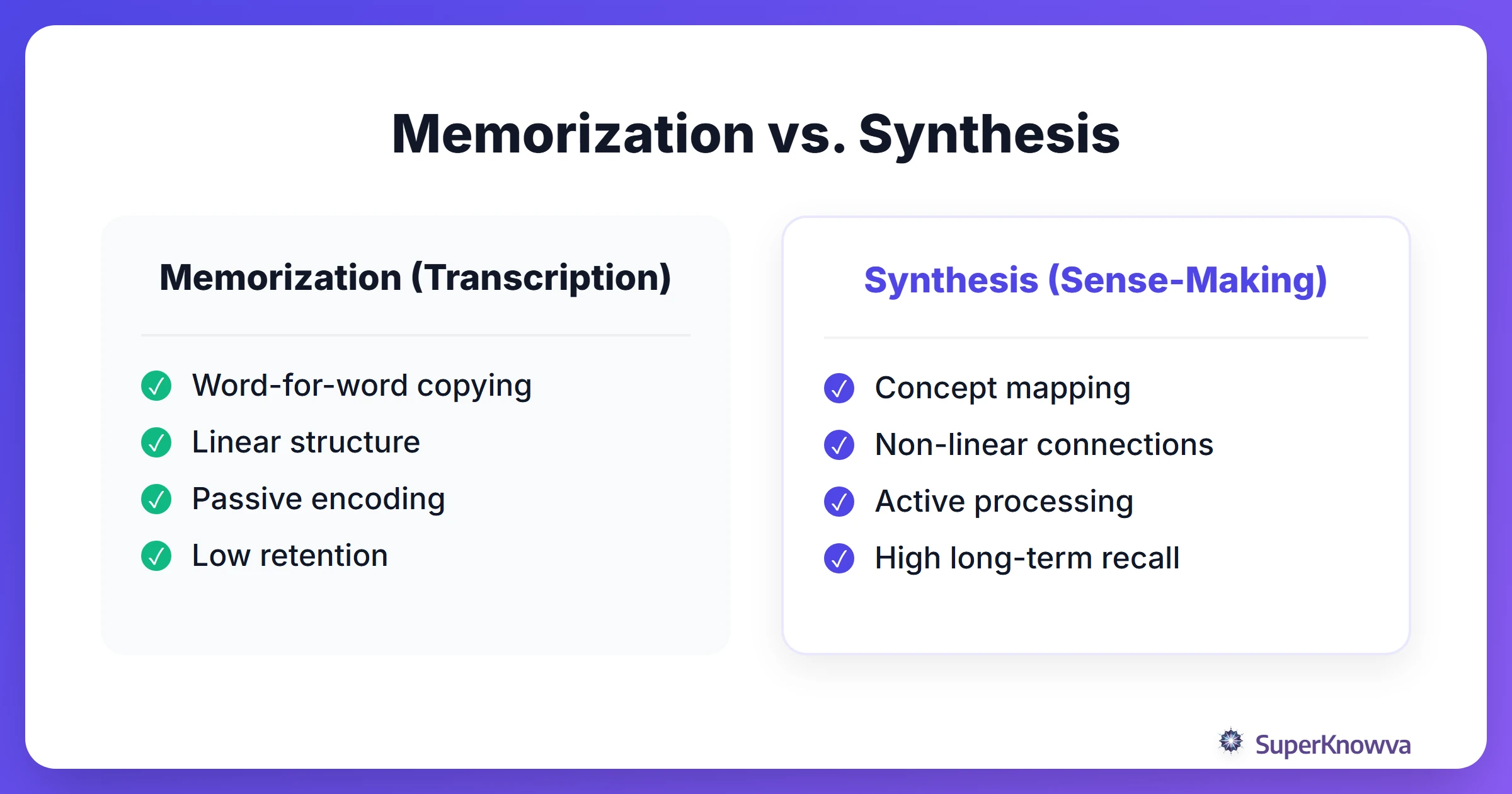
Stop asking "what did the teacher say?" and start asking "how do these concepts connect?" That's the first step toward mastery. Instead of recording facts, start recording relationships.
Visual Note-Taking for Technical Complexity
Linear, bulleted notes are often the enemy of non-linear subjects. If you are taking organic chemistry notes, a numbered list of steps for a Grignard reaction is a nightmare to memorize. A visual map of electron flow, however, tells a story your brain can actually remember.
This is where visual note taking and "Sketchnoting" become effective tools. By using visual metaphors for reaction mechanisms or force diagrams, you engage the spatial reasoning part of your brain. You do not need to be an artist. Just build a "visual vocabulary" of simple, consistent symbols for catalysts, equilibrium, or vectors to condense three paragraphs of text into one clear image.

When you are taking notes from a textbook, try to represent the "complicated" sections, where simple diagrams fail, as a flow chart of "if-then" scenarios. This forces you to nail down the logic behind the science.
The 'Heptabase' Approach: Visual Sense-Making
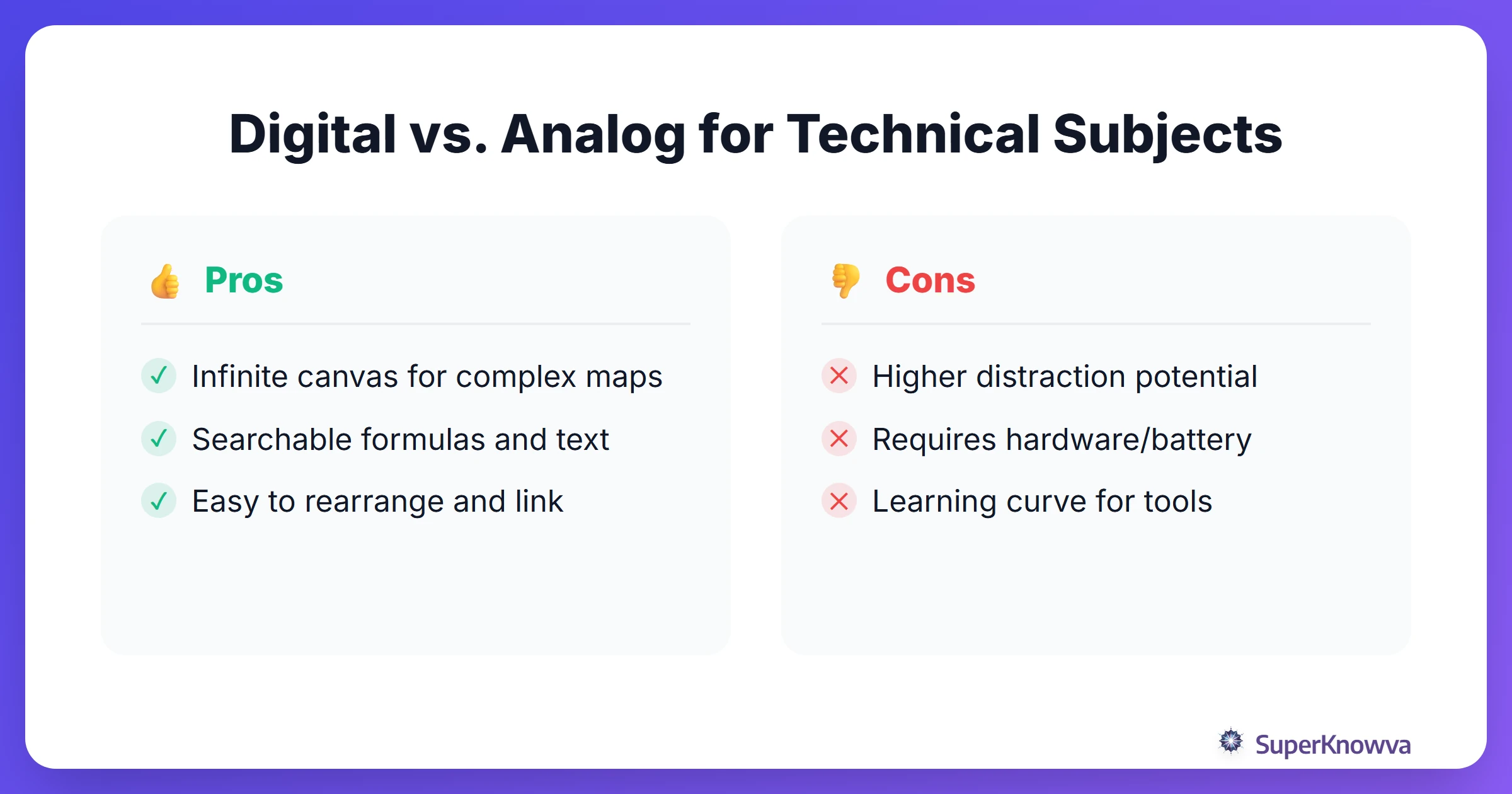
If traditional note-taking apps feel like a digital straightjacket, the "Heptabase" approach might be your game changer. It’s a move away from the "page" and onto an "infinite canvas."
By using tools like Heptabase or a combination of Notion and Figma, you can map out interconnected theories. This method relies on atomic notes: small, self-contained pieces of info that you can move, stack, and link.
- Infinite Canvases: These allow you to see the "big picture" of an entire semester’s worth of physics laws in a single view.
- Interconnectivity: You’ll start seeing how a concept in Chapter 2 is actually the foundation for that weird derivation in Chapter 10.
- Flow: Visual tools help you stay in "deep work" mode because you’re building a map of your own mind, not just filling a white screen.
AI-Assisted Formatting for STEM Notes
Let's be honest: formatting LaTeX formulas or drawing perfect hexagonal rings for carbon chains is a massive time-sink. The rise of AI study tools has changed the game here. You should be spending your time thinking, not formatting.
SuperKnowva AI bridges the gap between your messy lecture scribbles and a polished study guide. Use AI to:
- Clean up transcripts: Turn a rambling, 50-minute lecture transcript into a crisp, hierarchical outline.
- Generate LaTeX and Structures: Use AI to generate complex chemical structures or physics equations from simple text descriptions.
- Automate Hierarchy: Let the AI categorize your notes into primary laws, secondary derivations, and practical examples.
By offloading the "grunt work" to AI, you save your mental energy for the actual heavy lifting: understanding how the world works.
Structuring Your Workflow: The Synthesis Pipeline
To master physics note taking or any technical field, you need a repeatable system. We recommend the Synthesis Pipeline, a four-phase workflow designed to move information from the whiteboard into your long-term memory.
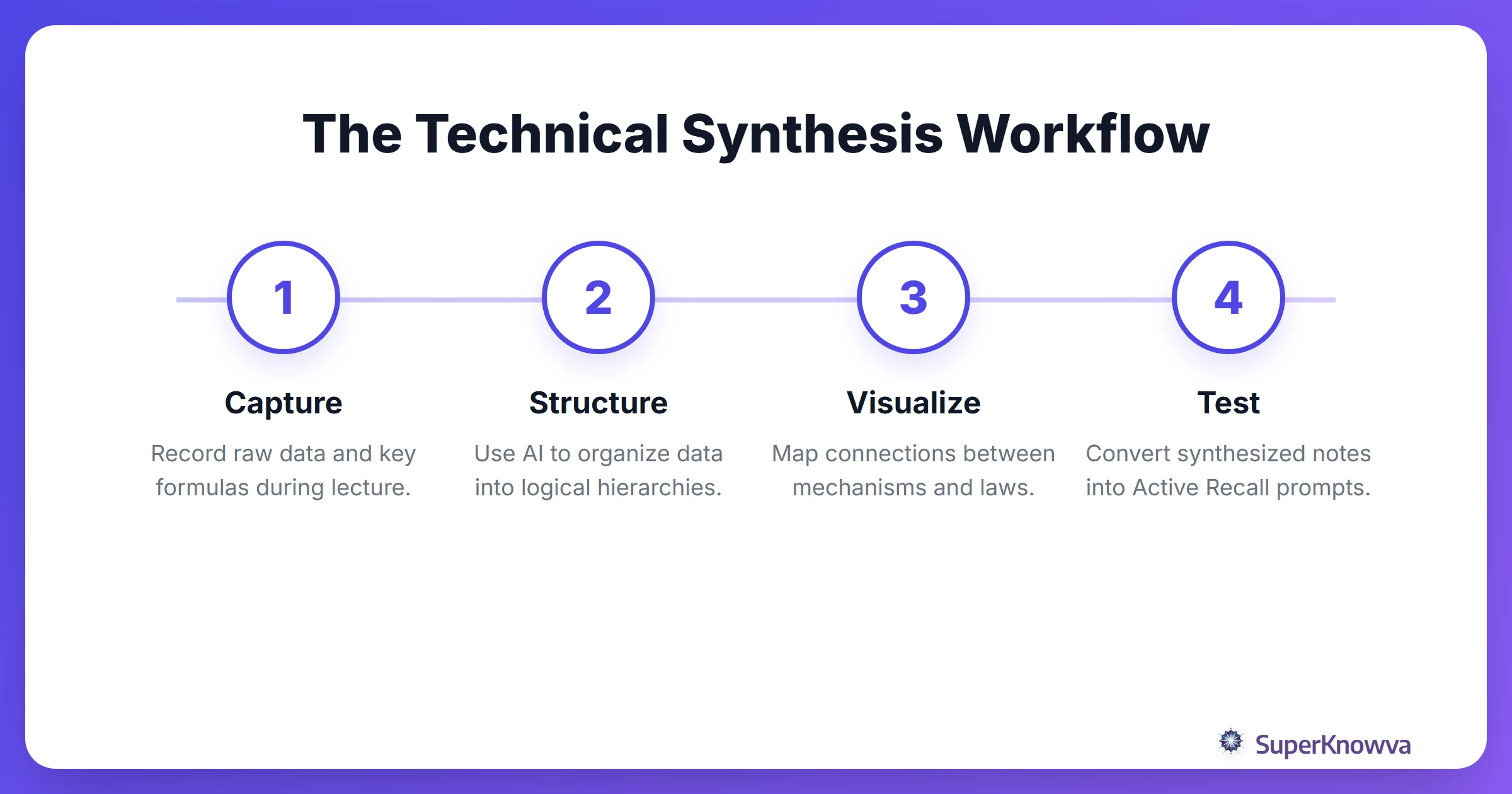
- Phase 1: Raw Capture: Get the core data down fast. Don't worry about aesthetics; just get it right.
- Phase 2: Structuring: Within 24 hours, use AI to categorize these concepts. This is where you decide what is a "Law" and what is just an "Example."
- Phase 3: Visual Linking: Connect this new info to what you already know. How does this new reaction relate to the one you learned last week?
- Phase 4: Active Recall Integration: This is the make-or-break step. Turn your synthesized notes into testable units. When comparing active recall vs. re-reading, the data is clear: testing yourself is the only way to make it stick.
Case Study: Organic Chemistry vs. Physics
While the pipeline works for both, the logic changes depending on the subject:
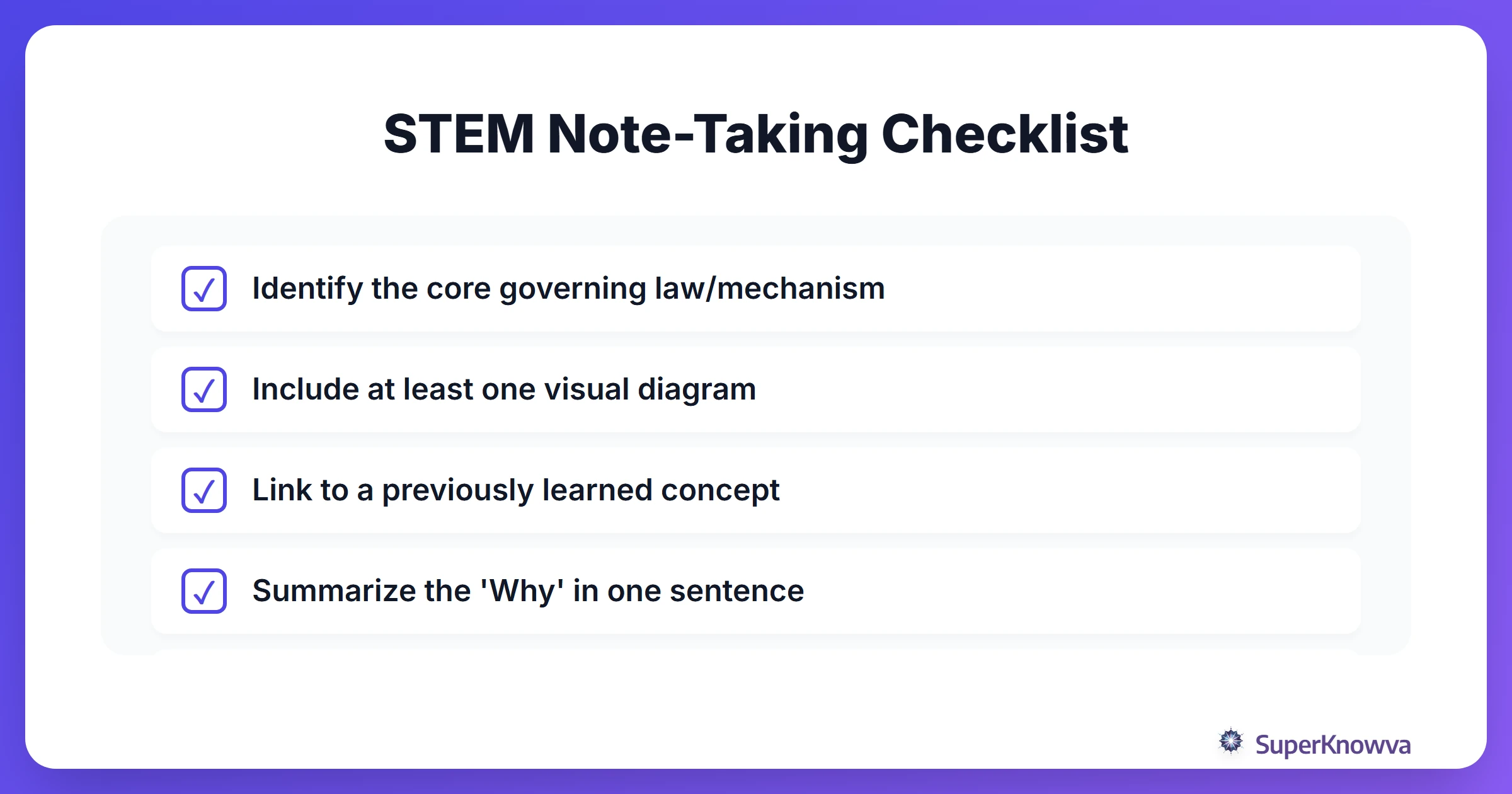
- Organic Chemistry: Focus on patterns. Don't memorize 100 individual reactions; memorize the 5 patterns of electron flow that govern them. Use color-coding specifically for functional groups so they pop off the page.
- Physics: Focus on derivation trees. Start with a first principle (like F=ma) and branch out. If you can't derive the formula, you don't really own the concept yet.
A pro tip? Avoid capturing every single derivation step the professor writes. Instead, capture the assumptions they made at the start and the conclusions they reached at the end. When the math gets heavy, less is usually more.
Conclusion
Mastering note taking for complex subjects isn't about the volume of words you produce; it's about the connections you make. By ditching passive transcription and leaning into visual synthesis and AI-assisted tools, you can handle even the most daunting technical workloads without the burnout.
Ready to level up your study game? Explore the best study apps for students and learn how to study for long hours without burnout with SuperKnowva’s AI-driven insights. Your next "A" starts with the way you take notes today.