Ever spent hours highlighting a textbook, only to realize you can’t explain a single concept once you close the cover? It’s a gut-sinking feeling. You aren't alone, though. Most of us mistake "looking at words" for "learning words." True mastery isn't about memorization; it’s about deep, conceptual understanding.
One of the most effective ways to bridge that gap is the Feynman technique with AI. By using an AI study tutor, you stop being a passive reader and start being an active teacher. It’s the fastest way to solidify your knowledge and hunt down those hidden weaknesses in your understanding.
In this guide, we’ll show you how to turn the world’s most famous mental model into a high-tech study routine using SuperKnowva.
What is the Feynman Technique?
The Feynman Technique is a four-step framework designed to help you learn anything, no matter how complex the subject. It was popularized by Richard Feynman, a Nobel Prize-winning physicist known as "The Great Explainer." Why? Because he could break down dense quantum mechanics into language a regular person could actually understand.
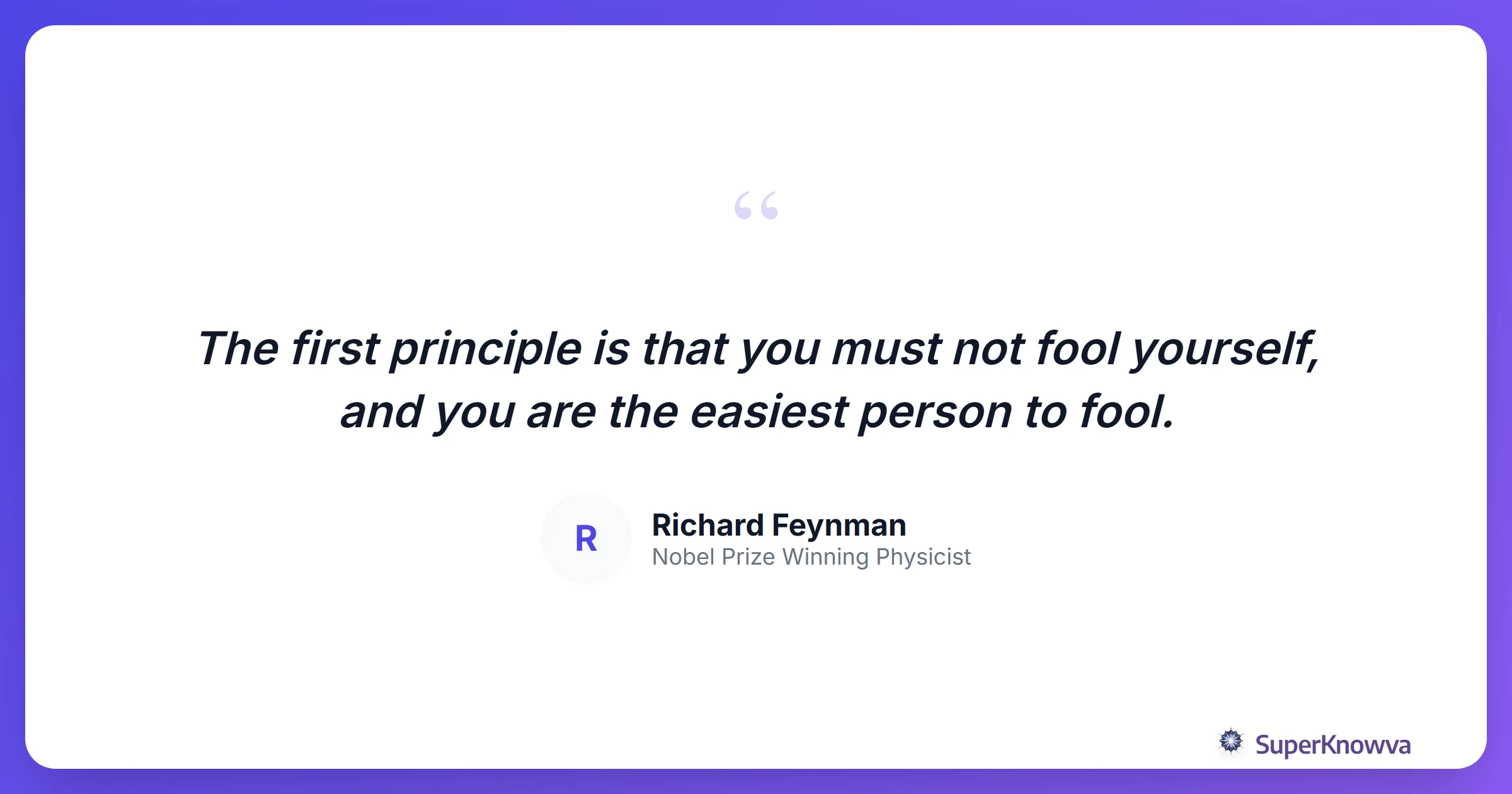
His philosophy was blunt: If you can't explain it simply, you don't understand it well enough.
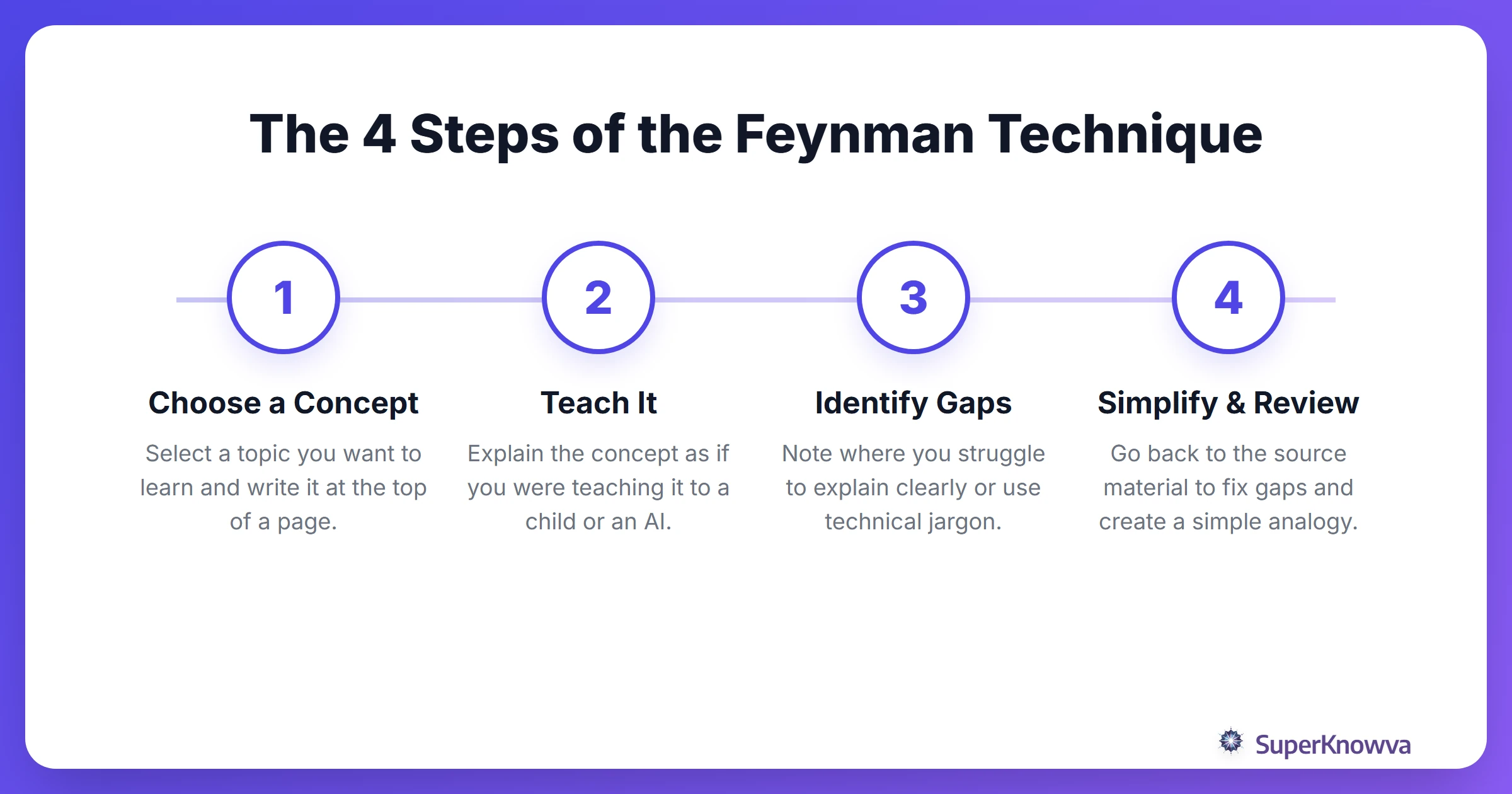
Traditionally, the technique works like this:
- Choose a concept you’re struggling with.
- Teach it to a toddler (or at least someone without a PhD in the subject).
- Identify your gaps. Note exactly where you get stuck or start using "smart-sounding" jargon to hide your confusion.
- Review and simplify until your explanation is clear.
This is the gold standard of active recall strategies. It forces your brain to retrieve and reorganize information rather than just recognizing it on a page. If you want to dive into the history of this method, check out our full guide on The Feynman Technique: How to Learn Anything Faster.
Why AI is the Ultimate 'Student' for Learning
The biggest problem with the Feynman Technique? Finding someone to listen to you. Not everyone has a patient friend or a younger sibling willing to sit through a 20-minute lecture on mitochondrial DNA or macroeconomics at 11:00 PM.
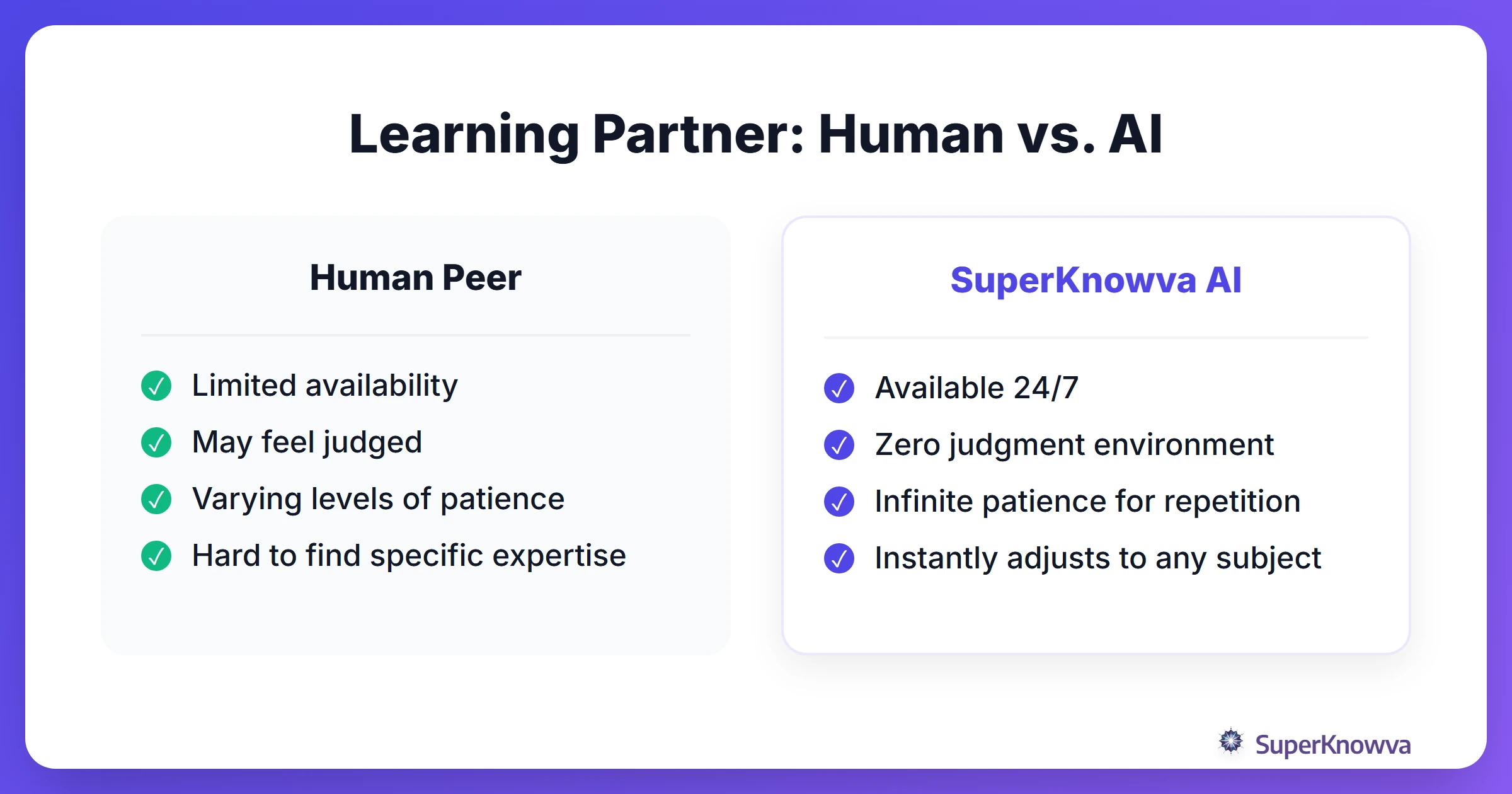
This is where an AI tutor changes the game. Unlike a human partner, an AI offers:
- Infinite Patience: You can explain the same concept ten different ways. It won't get bored.
- Objective Feedback: AI can instantly spot when you’re using "filler words" to mask a lack of understanding.
- Customizable Personas: You can tell the AI to act like a five-year-old, a curious peer, or a skeptical professor.
By teaching to learn, you kill the "illusion of competence," that dangerous feeling of knowing a subject just because your notes look familiar.
Setting the Stage: Prompting Your AI Tutor
To get the most out of the Feynman technique with AI, you have to set the right stage. You don't want the AI to just nod and say "Great job!" You want it to be a "difficult" student who asks the "why" behind every statement.
Effective prompting is everything. Based on community discussions on Effective AI Prompts for the Feynman Technique, the best results come from giving the AI a strict persona.
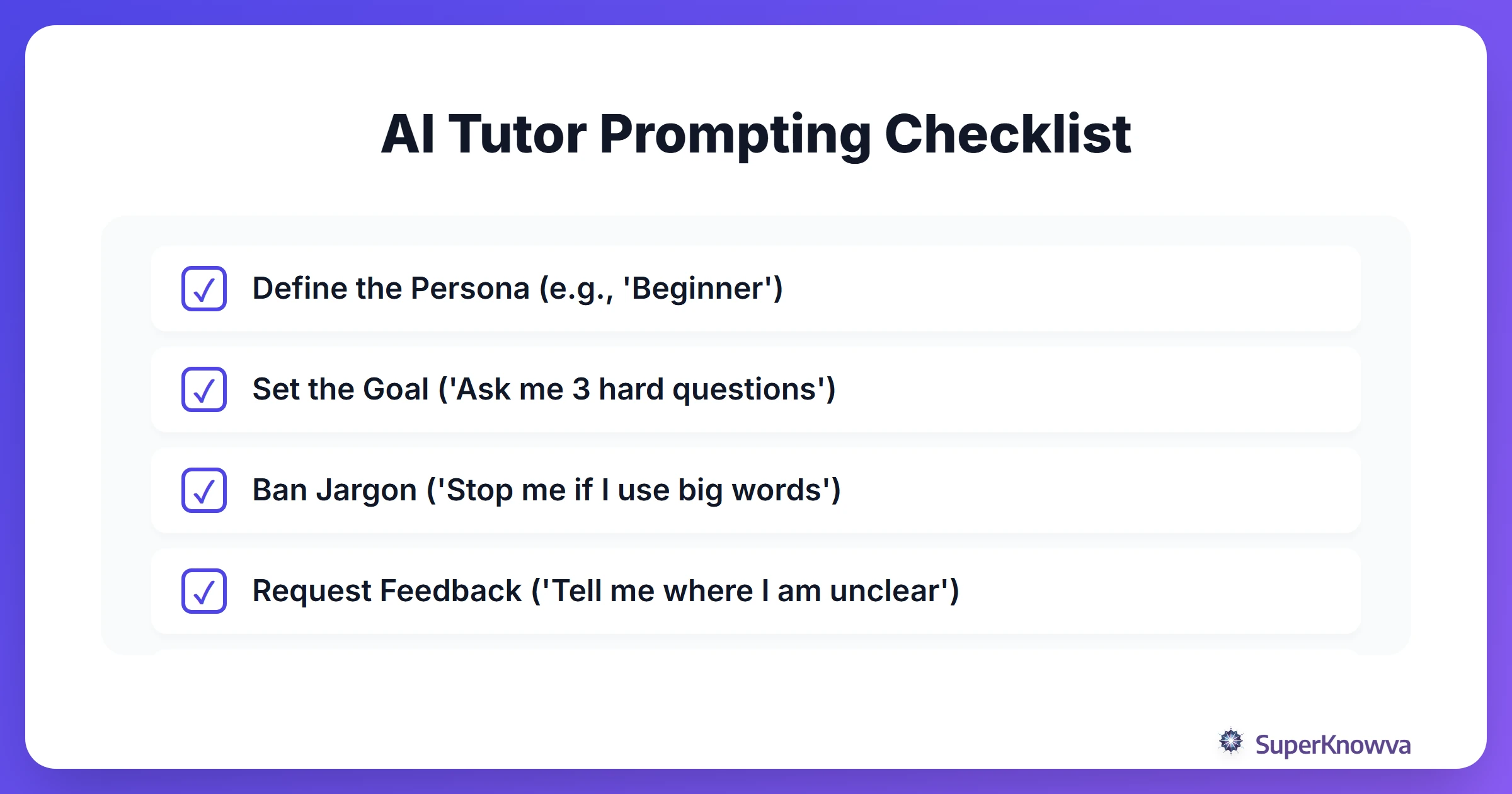
Try these prompt structures in SuperKnowva:
- For Organic Chemistry: "Act as a student who has never taken chemistry. I am going to explain SN2 reactions to you. Stop me every time I use a word you wouldn't understand and ask me to explain it with an analogy."
- For Macroeconomics: "I am going to explain Inflationary Gaps. Act as a curious peer. After my explanation, ask me three questions that challenge my logic or point out missing links in my argument."
Step-by-Step: Practicing the Technique with SuperKnowva
Ready to actually master your next exam? Here is how to execute the Feynman technique with AI using SuperKnowva:
- Step 1: The Initial Explanation. Open a chat and explain the concept in your own words. Don't look at your notes. Just "dump" what you know.
- Step 2: Review the AI’s Questions. SuperKnowva’s AI will analyze your input. Pay attention to where it pushes back. If the AI asks, "But why does the price go up if the supply is low?" and you can't answer simply, you’ve just found a knowledge gap.
- Step 3: Fill the Gaps. Stop guessing. Use SuperKnowva’s uploaded resources or lecture summaries to find the exact info you were missing.
- Step 4: The Final Simplification. Re-explain it. This time, use a simple analogy. Think: explaining an electrical circuit like water flowing through pipes.
Identifying and Closing Knowledge Gaps
The real magic happens when you realize you’re using jargon as a crutch. We often use big words to hide the fact that we don't actually understand how something works. When you use the Feynman technique with AI, the AI acts as a built-in jargon detector.
As noted in recent articles on Applying the Feynman Method with Artificial Intelligence, the "Aha!" moment usually hits during Step 4. When you're forced to simplify, you often find a logic error you totally overlooked before.
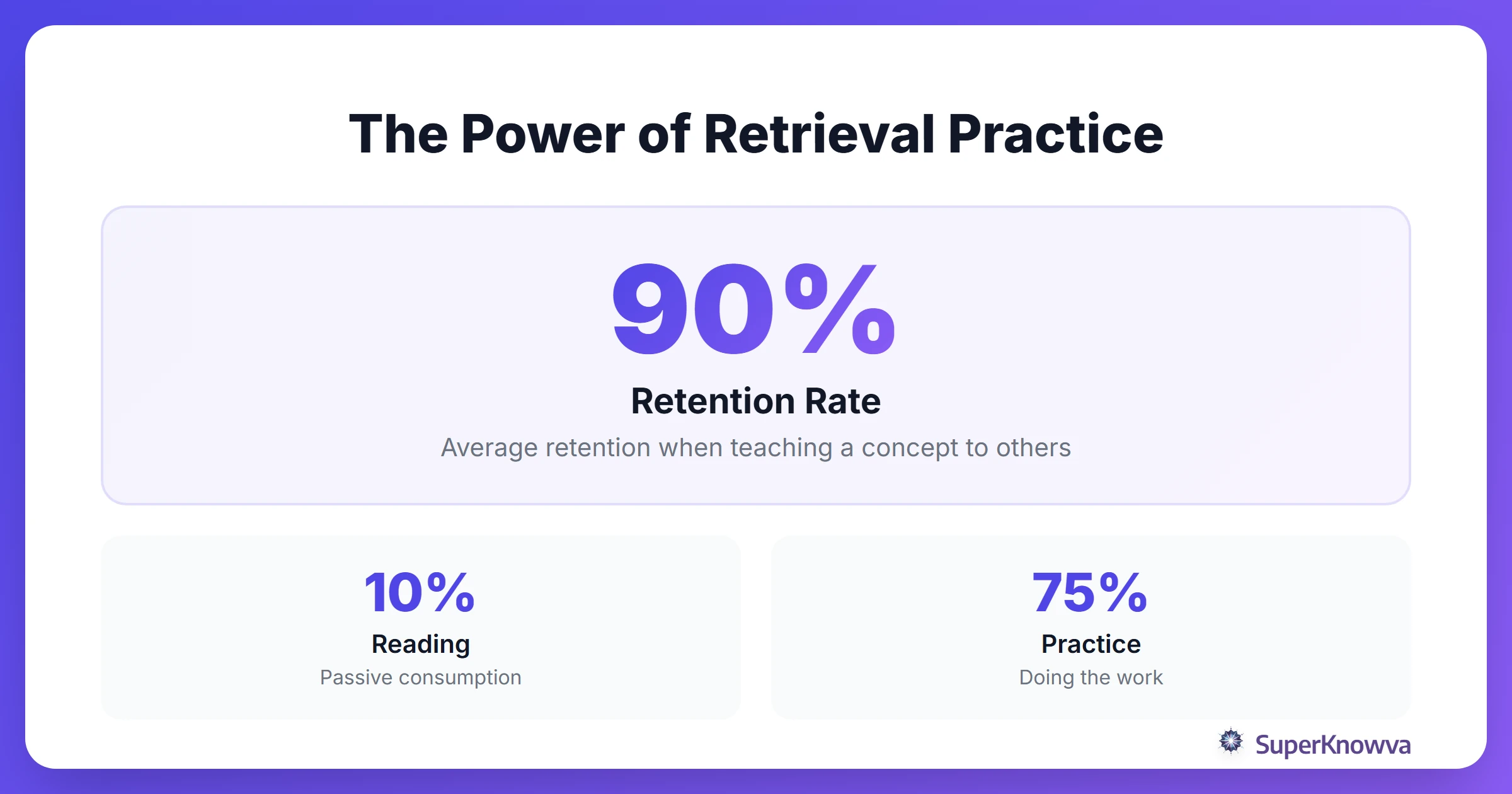
Teaching is the gold standard of learning. Passive reading? That usually gets you about 10% retention. Identifying knowledge gaps and teaching the material? That can boost your retention to 90%.
Integrating Feynman with Other Study Methods
The Feynman Technique is a powerhouse, but it’s even better when you stack it with other strategies.
- Mind Mapping: Before you start teaching, try visualizing complex concepts with mind mapping. It gives you a visual "map" to follow during your explanation.
- The Blurting Method: Use the Blurting Method for active recall to prime your brain before you even talk to the AI.
- Deep Work: Don't do this while distracted. Schedule your teaching sessions during periods of mastering deep work focus to make sure the feedback actually sticks.
By turning your AI into a student, you are not just studying for a grade. You are studying for mastery. Start your first teaching session on SuperKnowva today and see how complex subjects become clear.