Staring at a mountain of cases and wondering how you’ll ever reach the summit? You aren't alone. For most 1Ls, the transition to law school feels less like a step up and more like being buried under an avalanche of paper. But here’s the truth: survival isn't about working more hours. It’s about changing how you consume information. You need to master speed reading for law.
Let's move past the idea of "reading" and start talking about "processing." Here is how you stay ahead of the curve without losing the details that win cases.
The Myth of the "Slow" Law Student
There is a common myth in legal education: to be a "good" student, you must labor over every comma and semicolon. While precision is essential, the volume of reading, often 50 to 100 pages per night, makes traditional reading habits unsustainable.
Most students show up to law school reading at a comfortable 200–250 words per minute (wpm). Then, they hit a wall of dense legal prose, and that speed drops to a grueling 150 wpm. The problem isn't your intelligence. It’s your approach. Traditional reading is linear, like a novel. Processing a case is architectural. You aren't reading a story; you’re dissecting a logical structure.
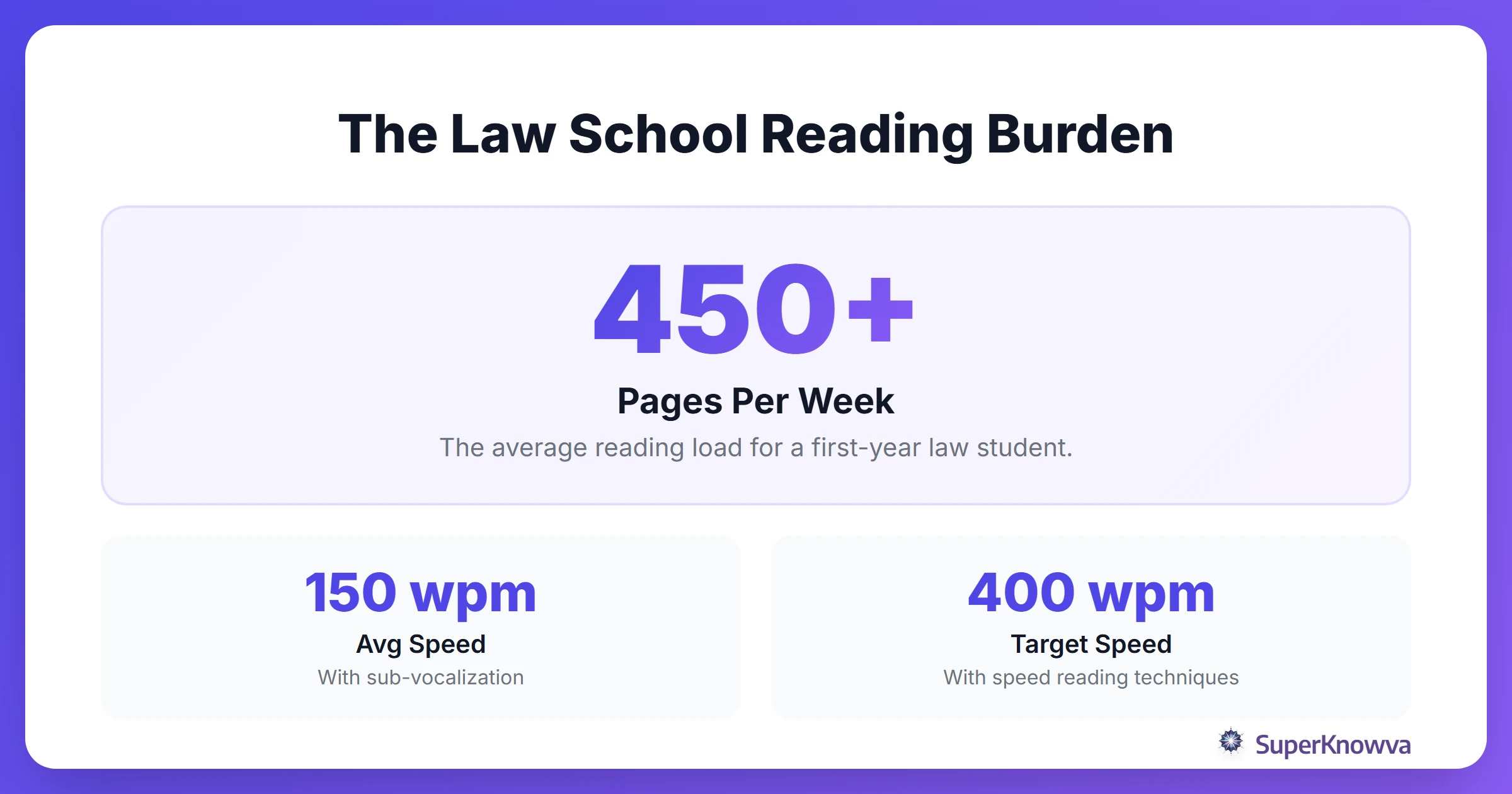
When your weekly load exceeds 450 pages, "slow and steady" just means you’ll be awake at 3:00 AM with a headache. You need to prioritize high-level comprehension over word-for-word recitation.
Pre-Reading: The Ultimate Cheat Code
If you dive straight into the first paragraph of a case, you’re flying blind. The secret to speed? Reduce the cognitive heavy lifting of your "main pass" by pre-reading.
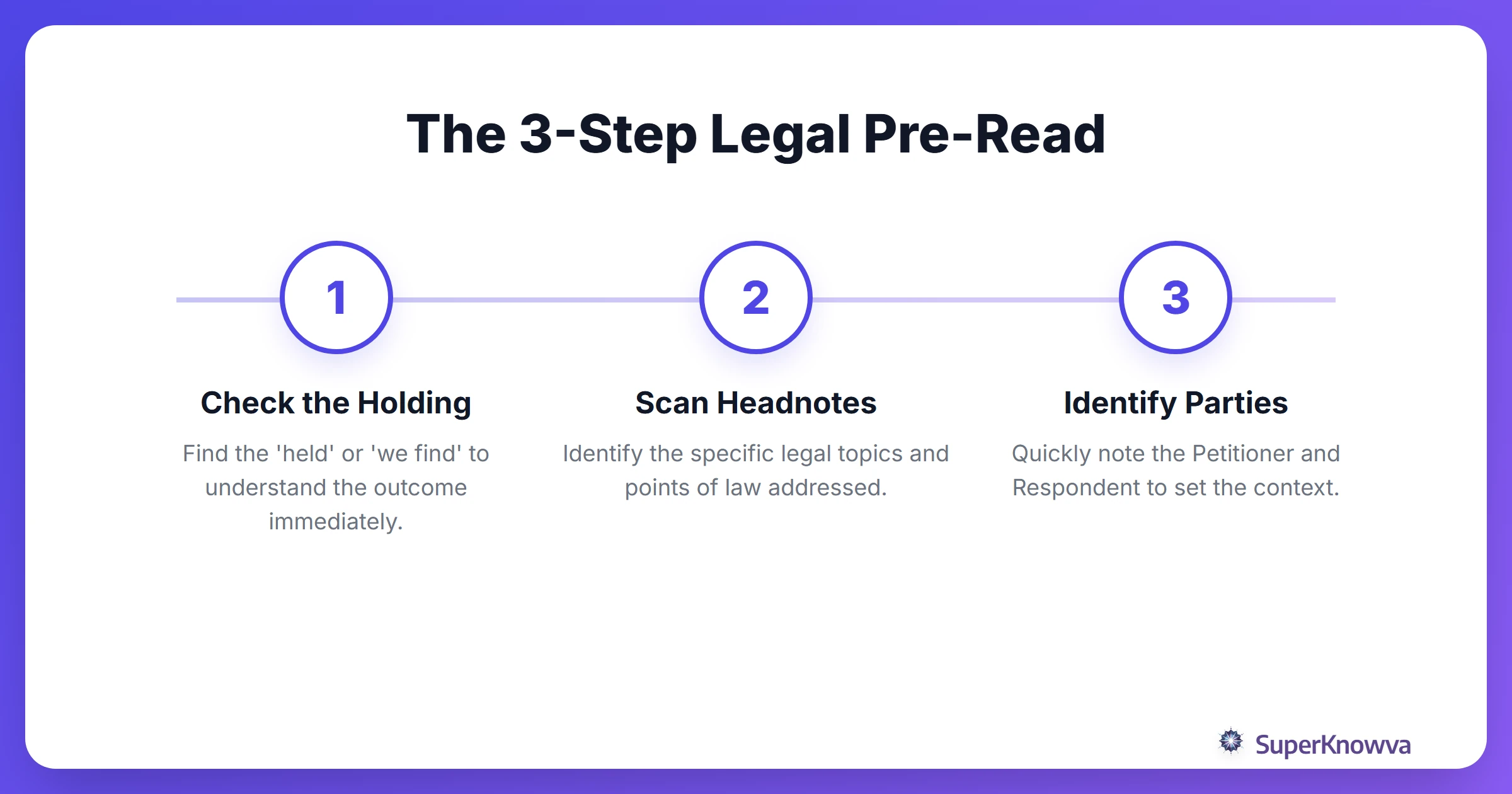
Before you get into the weeds, scan the Table of Authorities and the Headnotes. These are your roadmap for the legal issues the court is about to tackle. Next, find the procedural posture. How did this case even get here? Knowing whether you’re looking at an appeal of a summary judgment or a jury verdict completely changes how you perceive the facts.
Most importantly: Find the "Holding" first. If you know the ending before you read the reasoning, you’ve built a mental framework. You won't spend twenty minutes wondering "where is this going?" Instead, you’ll see exactly how the court builds its logic toward that inevitable conclusion.
The Sweep and the Hop
Once the framework is in place, you can let your eyes move. There are two main techniques that can double your speed without sacrificing your sanity:
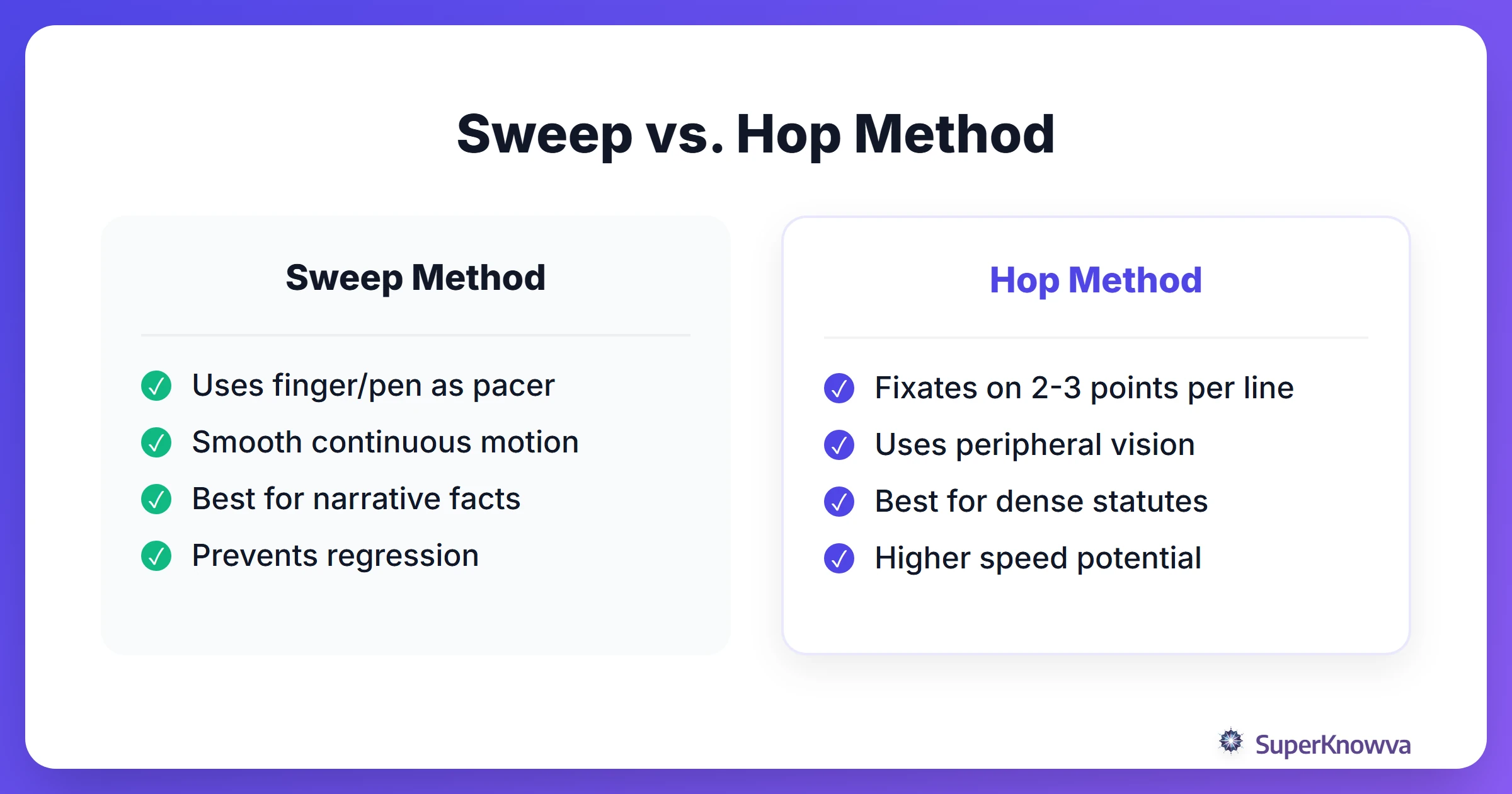
The Sweep Method
Stop letting your eyes wander. Use a pacer like a finger, a pen, or even a cursor to guide your eyes across the line. By keeping that pacer moving at a constant, slightly-faster-than-comfortable speed, you eliminate the habit of "regression" (re-reading the same sentence three times). Your brain is forced to keep up with the motion.
The Hop Method
Stop reading every word. Seriously. Legal sentences are often bloated with "legalese" that serves no purpose other than taking up space. The Hop Method trains you to fixate on "keyword clusters." By "hopping" your gaze to just two or three points per line, your peripheral vision picks up the context while your focus hits the core meaning.
When you use these, think of it as an "Accordion" approach. Speed through the narrative facts of the case, but slow way down when you hit the "Rule" or the "Analysis." You don’t need the same level of focus for a description of a fender-bender as you do for a nuanced interpretation of the Commerce Clause.
Killing the Voice in Your Head
The biggest speed limit on your brain is sub-vocalization: that little voice in your head "saying" the words as you read. Since we can only speak at about 150 wpm, that voice acts as a hard cap on your reading speed.
To break this, try listening to instrumental music or focusing purely on the visual shape of the words. This is highly effective for dry statutory reading, where the "sound" of the text matters far less than the logical connections between the clauses.
After a fast pass, use the Feynman Technique to check your work. If you cannot explain the core of the case to a non-lawyer in plain English, you went too fast. True speed comes from mastering deep work and staying focused while you are on the clock.
Active Reading: Annotate So You Only Read Once
Speed reading doesn't mean you're being sloppy. It means you only want to look at the page once. This is where "Book Briefing" becomes your best friend. Instead of wasting an hour writing a separate, three-page case brief, mark up your casebook using a simple system of symbols for IRAC elements:
- [I] for the Issue
- [R] for the Rule
- [A] for the Application/Analysis
- [C] for the Conclusion
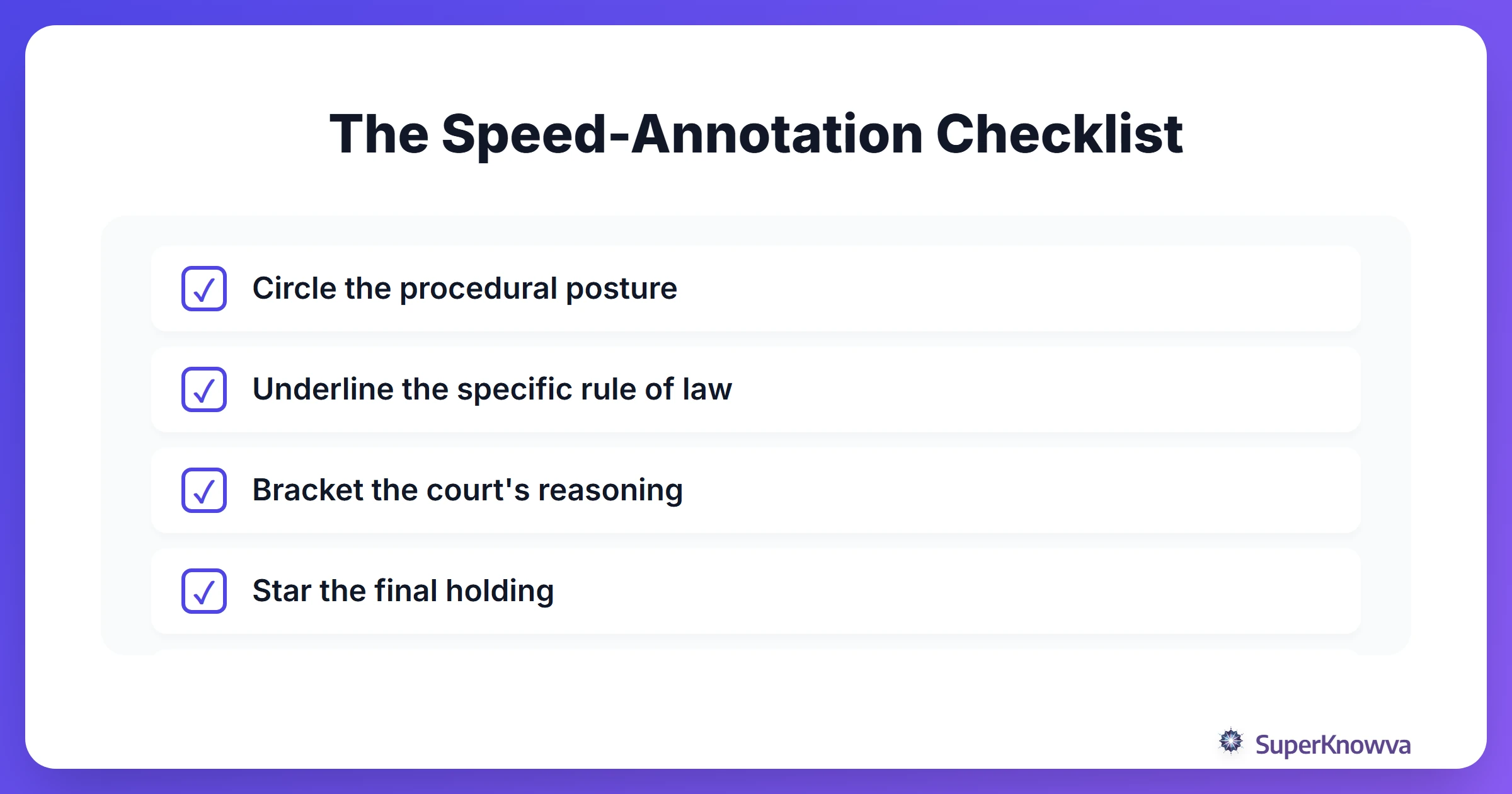
By turning your margins into a visual map, you’re preparing for the Socratic method. When you’re called on in class, you won't be frantically scanning paragraphs; you’ll see your "Star" next to the holding and your "Circle" around the procedural posture instantly. For more on this, check out the Regent University Speed Reading Module or browse the Law Student Community Reading Tips on Reddit.
Building Your Legal Second Brain
The goal isn't just to finish your homework. You need to extract the "black letter law" and store it for finals. This is the core of Building a Second Brain. Once you’ve speed-read and annotated your cases, move those insights into a digital system like SuperKnowva.
Organize your cases by subject and use mind mapping to link concepts across different classes. You will see how a Torts concept might bleed into a Constitutional Law issue. High-intensity reading is exhausting. Protect your focus, avoid distractions, and get some sleep. Your brain consolidates complex legal logic while you sleep.
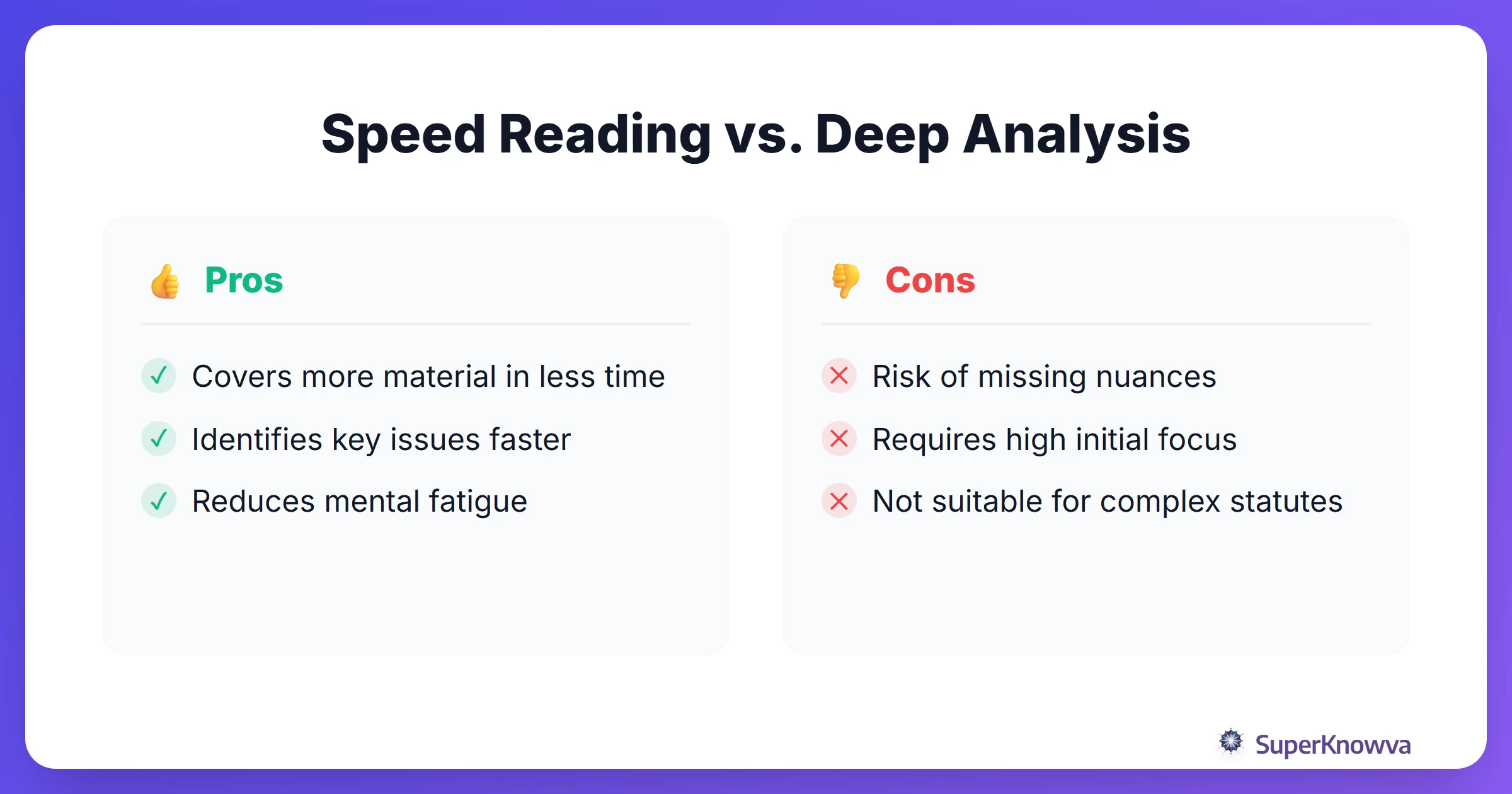
Speed reading for law isn't a "gift" some people are born with; it’s a muscle you build. By moving from passive reading to active processing, you can reclaim your time and master your casebooks with confidence. Ready to try it? Grab your highlighter and start the Sweep Method tonight.