
Have you ever spent three hours grinding through a single math concept, felt like a genius by the end of it, only to realize a week later that you’ve completely forgotten how to apply it?
We’ve all been there. It’s the classic "cram and forget" cycle. Most of us were taught to focus on one topic until we "get it" before even thinking about moving on. But here’s the kicker: cognitive science suggests this "blocked" approach might actually be what's holding you back.
If you want to stop renting information and start owning it, you need to try the interleaving study technique. By strategically mixing different subjects or problem types, you can move past temporary memorization and achieve deep, long-term mastery.
What is Interleaving? Beyond the Blocked Study Habit
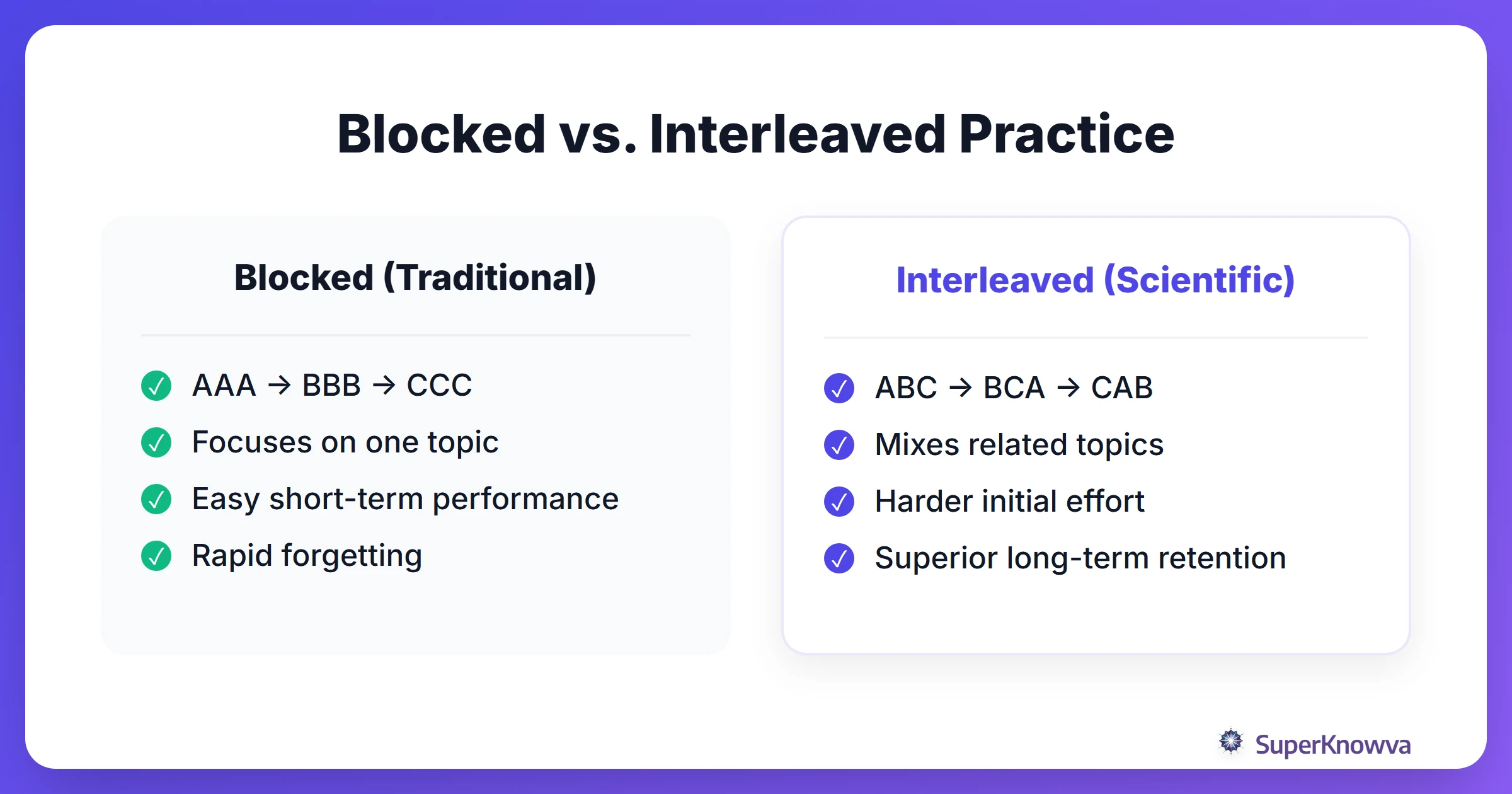
At its core, interleaving is just a fancy word for variety. It’s the practice of alternating between different subjects or types of problems within a single study session.
Instead of studying Topic A for two hours and then Topic B for two hours, you might spend 30 minutes on Topic A, 30 on Topic B, and then 30 on Topic C.
This is the opposite of "blocked practice," the traditional method of focusing on one specific skill for an extended period. While blocked practice is the most common of all study strategies for students, research in the cognitive psychology of learning shows it is often a trap.
The idea isn’t exactly new. It dates back to motor-learning studies in the 1970s, but recent research has confirmed its power in the classroom. Our brains thrive on variety. When we encounter diverse information, our neural networks stay active and engaged. When we repeat the same thing over and over, we go on autopilot.
The Science of Discrimination: How Your Brain Learns to Tell the Difference
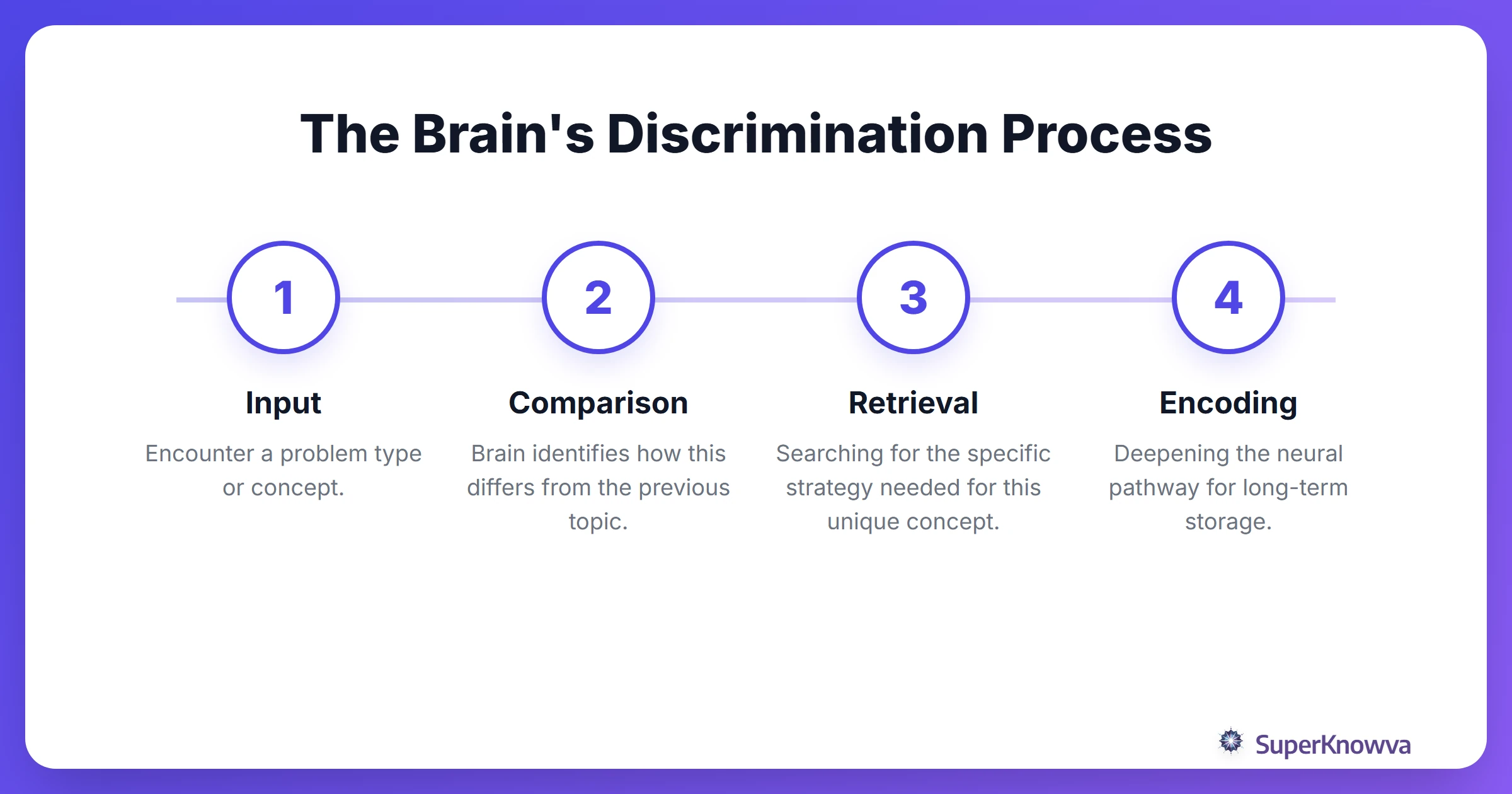
Why does mixing things up work so well? It comes down to a process called "discrimination."
When you use the interleaving study technique, your brain is forced to constantly figure out which strategy or piece of information is actually required for the task at hand. In blocked practice, you already know the "answer" is the formula you’ve been using for the last hour. You aren't thinking; you're just repeating.
In interleaved practice, you have to choose the right tool from your mental toolbox every single time you switch. This creates what psychologists call a "desirable difficulty." It makes the session feel harder and more frustrating, but that struggle is exactly what strengthens your neural pathways.
By preventing the brain from drifting into autopilot, interleaving helps you move from simple rote memorization to high-level conceptual understanding. You aren't just learning how to solve a problem; you’re learning when to use a specific solution.
The Illusion of Mastery: Why Blocked Practice Feels Better but Fails
One of the biggest hurdles to adopting interleaving is something called the "fluency heuristic."
When you study one topic for hours, you get fast. You feel focused. This fluency tricks you into thinking you’ve mastered the material. Unfortunately, this is usually an illusion. The information stays in your short-term working memory, ready to disappear the moment you close the book.
Interleaving is humbling because it exposes gaps in your knowledge early. It’s annoying to realize you don't know a concept as well as you thought when you can't recall it after a 20-minute break. But as A Beginner's Guide to Interleaving points out, this struggle is precisely what leads to long-term memory retention.

How to Implement Interleaving in Your Daily Routine
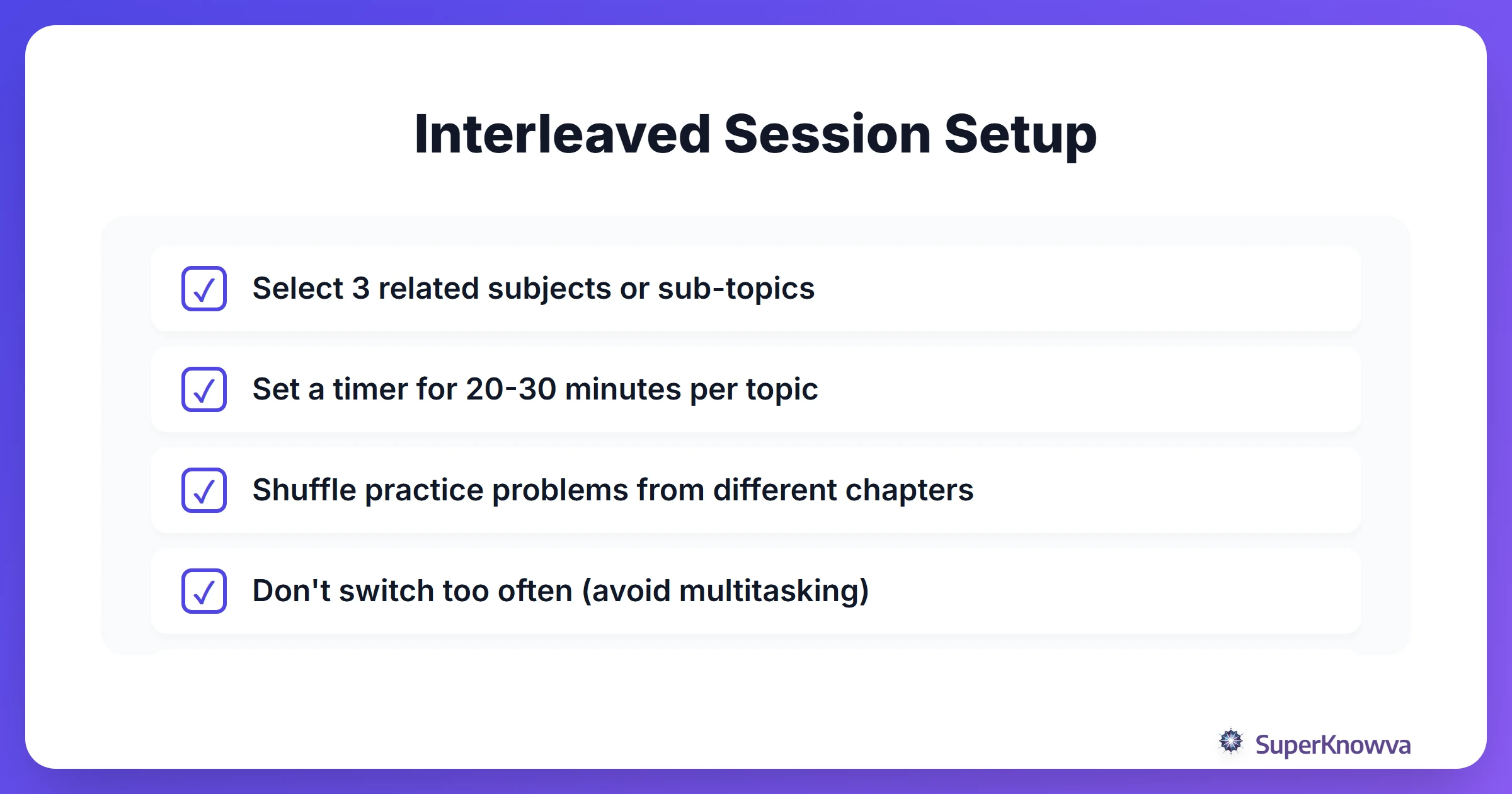
Implementing interleaving requires better organization rather than more time. Here is how to restructure a typical 3-hour study session:
- Choose "Related but Distinct" Topics: Don't mix Physics with Art History. That’s just confusing. Instead, mix Algebra, Geometry, and Calculus. The topics should be similar enough that your brain has to work to tell them apart.
- The Rule of Three: Try to mix three different sub-topics per session. This provides enough variety to keep your brain sharp without causing total cognitive overload.
- Timed Blocks: Use a timer to stay on track. You might find success combining this with Pomodoro vs. Flowtime methods to maintain focus during the switches.
- Shuffle Your Problems: If you are using a textbook, don't do all the problems in Chapter 1, then all in Chapter 2. Pick two from Chapter 1, two from Chapter 2, and two from Chapter 3. Then repeat.
To make this even more effective, make sure you are practicing Deep Work for students by ditching your phone. These high-intensity switches require your full attention.
Combining Interleaving with Spaced Repetition and Active Recall
Interleaving is a powerhouse, but it works best when it’s part of a broader system. When you combine it with effective revision methods like spaced repetition and active recall, your retention levels skyrocket.
For example, you can use active recall prompts to test yourself as you switch between interleaved topics. Instead of just reading the next chapter, try the blurting method to dump everything you remember about the previous topic before starting the new one.
If you hit a concept that feels particularly confusing during your mix, pause and use the Feynman Technique to break it down into simple terms before throwing it back into the rotation.
Digital tools like SuperKnowva can automate this for you by generating mixed quizzes from your notes, ensuring you are constantly challenged to retrieve information from different areas of your syllabus.

Interleaving for Different Subjects: STEM vs. Humanities
While interleaving is a gold standard for STEM, it works for almost any field.
- STEM (Math & Physics): Mix different types of word problems. This forces you to identify which formula applies to which scenario, rather than just mindlessly plugging numbers into the same equation.
- Language Learning: Don't just study "past tense" verbs for an hour. Mix grammar practice, vocabulary flashcards, and listening exercises. How to Use Interleaving for Deeper Learning suggests this variety mimics real-world conversations where you never know what’s coming next.
- Humanities: If you are studying History, try comparing different historical eras or literary themes simultaneously. This helps you see "big picture" connections that you’d miss if you studied them in isolation.
According to the experts at Learning Scientists, the key is to adjust your frequency. If a topic is brand new, spend a bit more time on the basics before you start mixing it in with other concepts.
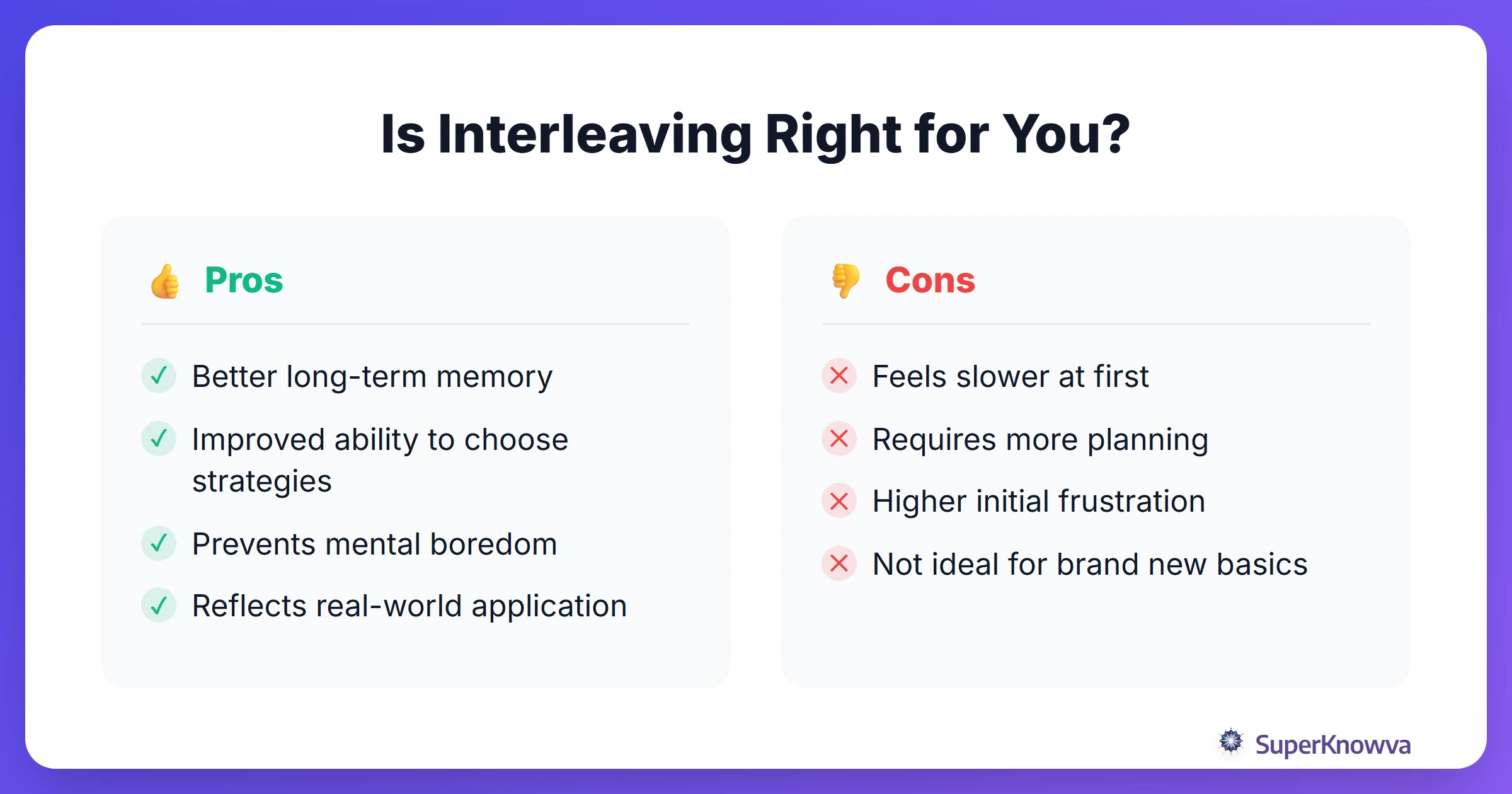
By moving away from blocked practice and adopting the interleaving study technique, you are learning more effectively. It might feel slower and more difficult at first. But the results, including higher test scores, better problem-solving, and improved retention, are worth the effort.