Staring at a 100-slide lecture deck and a 400-page textbook? We’ve all been there. You know active recall is the "gold standard" for acing exams, but there’s a massive problem: most students spend more time making the study materials than actually studying them.
It feels productive, but is it? This is where automated flashcard generation steps in to save your Sunday afternoon.
By using an AI flashcard maker, you can finally break the cycle of mindless copy-pasting. It’s time to stop acting like a data entry clerk and start acting like a student. Here is how to let AI handle the heavy lifting so you can focus on the actual learning.
The Flashcard Fatigue: Why Manual Creation is a Bottleneck
There is a hidden trap in traditional study habits: the "creation-to-study" ratio. If you’re spending 80% of your time meticulously crafting the "perfect" deck and only 20% actually reviewing it, your system is broken. This is "Flashcard Fatigue," and it’s a one-way ticket to academic burnout.
The problem isn't just the typing; it’s the mental exhaustion. Deciding exactly what is "important" enough to merit a card while you’re still trying to wrap your head around a concept is draining. This friction leads to procrastination. Suddenly, starting a new chapter feels impossible because you know it means hours of manual labor before the real work begins.
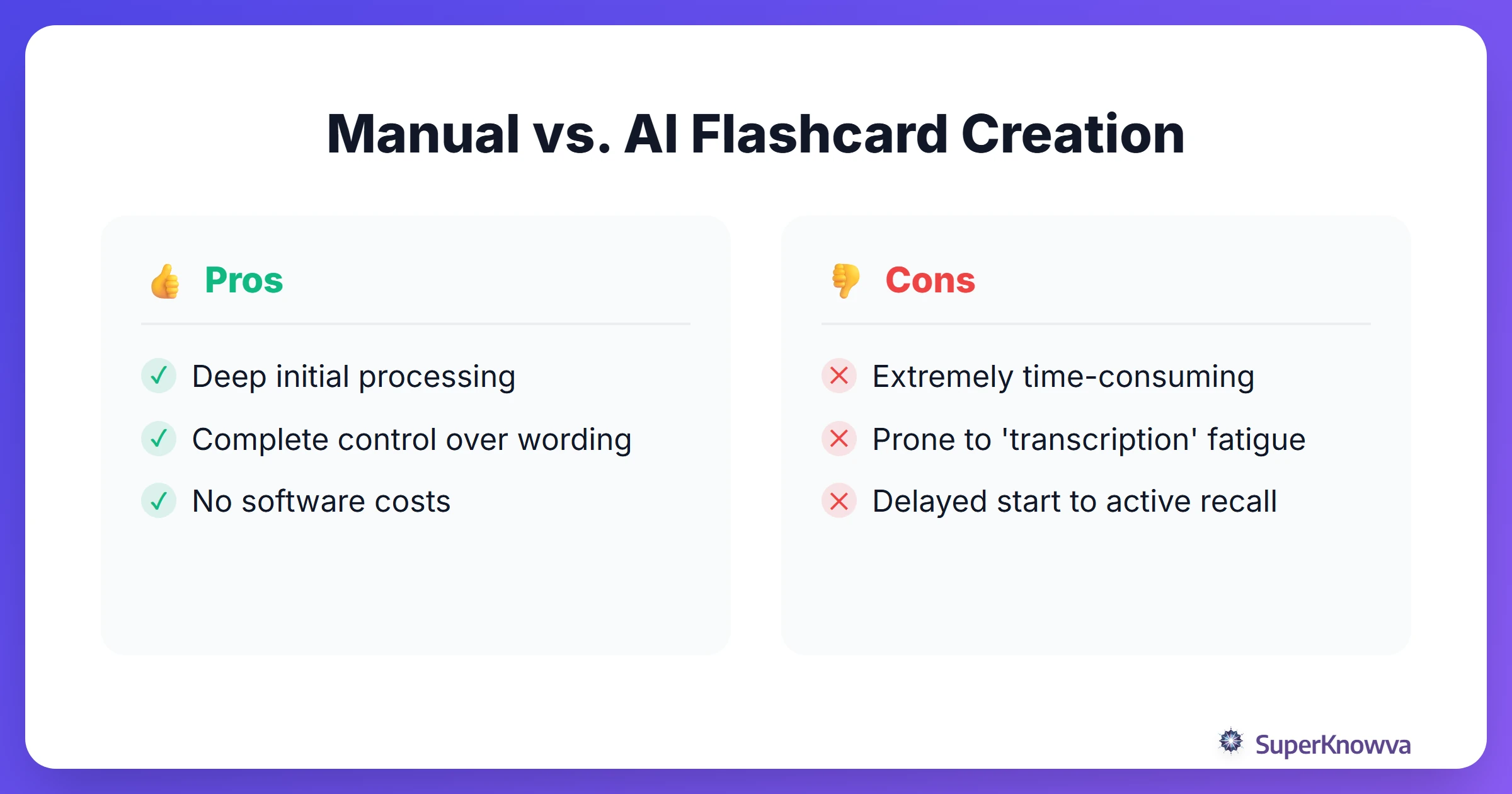
Manual entry often turns into "mindless transcription." You’re just moving text from a PDF to a card without processing a single word. By the time the deck is finished, you’re too wiped out to engage in the active recall strategies that actually move the needle on long-term retention.
How AI Solves the Two Hardest Parts of Study Prep
Modern AI doesn't just "copy" text; it understands it. Large Language Models (LLMs) are built to solve the two biggest hurdles in study prep:
- Identifying High-Yield Information: AI can scan hundreds of pages in seconds, filtering out the "fluff" to find core concepts, key terms, and the kind of high-yield topics that actually show up on exams.
- Knowledge Composition: Phrasing the question is the hardest part of making a card. AI can instantly convert dense paragraphs into effective Q&A pairs that follow the science of "Atomic Cards."
What are Atomic Cards? They are small, bite-sized pieces of information. While a tired student might create "clunky" cards with way too much text, an AI-powered tool ensures each card tests exactly one concept. This is the secret to Deep Work for students who want to maximize their focus and minimize their study time.
From PDF to Deck: The 3-Step Automated Workflow
Switching to an automated workflow is easier than you think. Whether you need to convert PDF to flashcards or turn your messy lecture slides into a quiz, the process is straightforward:
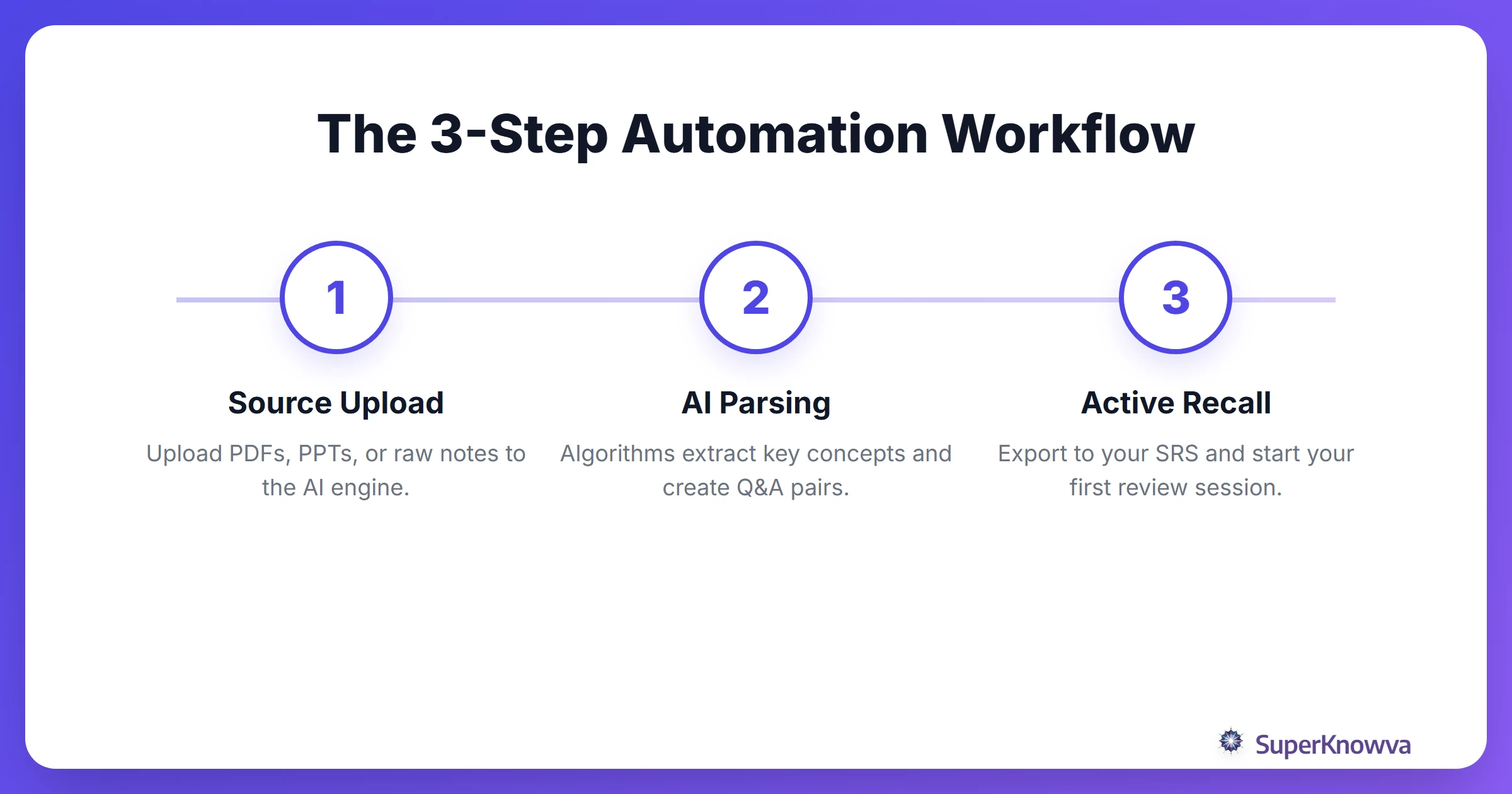
- Step 1: Uploading Source Material: Drag and drop PowerPoints, PDFs, or personal notes from platforms like Obsidian.
- Step 2: AI Analysis: The AI parses the text, identifying definitions, causal relationships, and lists to generate a draft deck.
- Step 3: Review and Export: Review the cards to ensure they meet your exam goals, then export them to Anki or directly into SuperKnowva.
This Anki automation allows you to move from a raw lecture file to a functional study deck in the time it takes to pour a cup of coffee.
Fine-Tuning the Machine: Getting the Best AI Outputs
To get the most out of automated flashcard generation, remember: garbage in, garbage out. High-quality, well-organized source material will always give you better results than a blurry scan of a handout.
Once the cards are generated, use The Feynman Technique to verify the outputs. If you can’t explain an AI-generated answer in simple terms, it’s a sign you need to slow down and study that specific topic more thoroughly.
You can also customize the "vibe" of your cards. Many AI tools allow you to tell the generator to "format these questions for a medical board exam" or "keep the tone simple for an intro course," letting you tailor the difficulty to exactly where you are in the semester.
Integrating Automation into Your Digital Second Brain
The most successful students don't just "study"; they build systems. By integrating AI tools into your workflow, you are building a second brain that works for you 24/7.
Imagine a pipeline where your reading highlights flow directly into an AI generator, which then populates your active recall schedule. This creates a fluid transition from consuming information to mastering it. This level of study efficiency ensures that memory consolidation happens without the friction of manual entry, keeping you in a state of flow for longer.
The Impact: Real-World Efficiency Gains
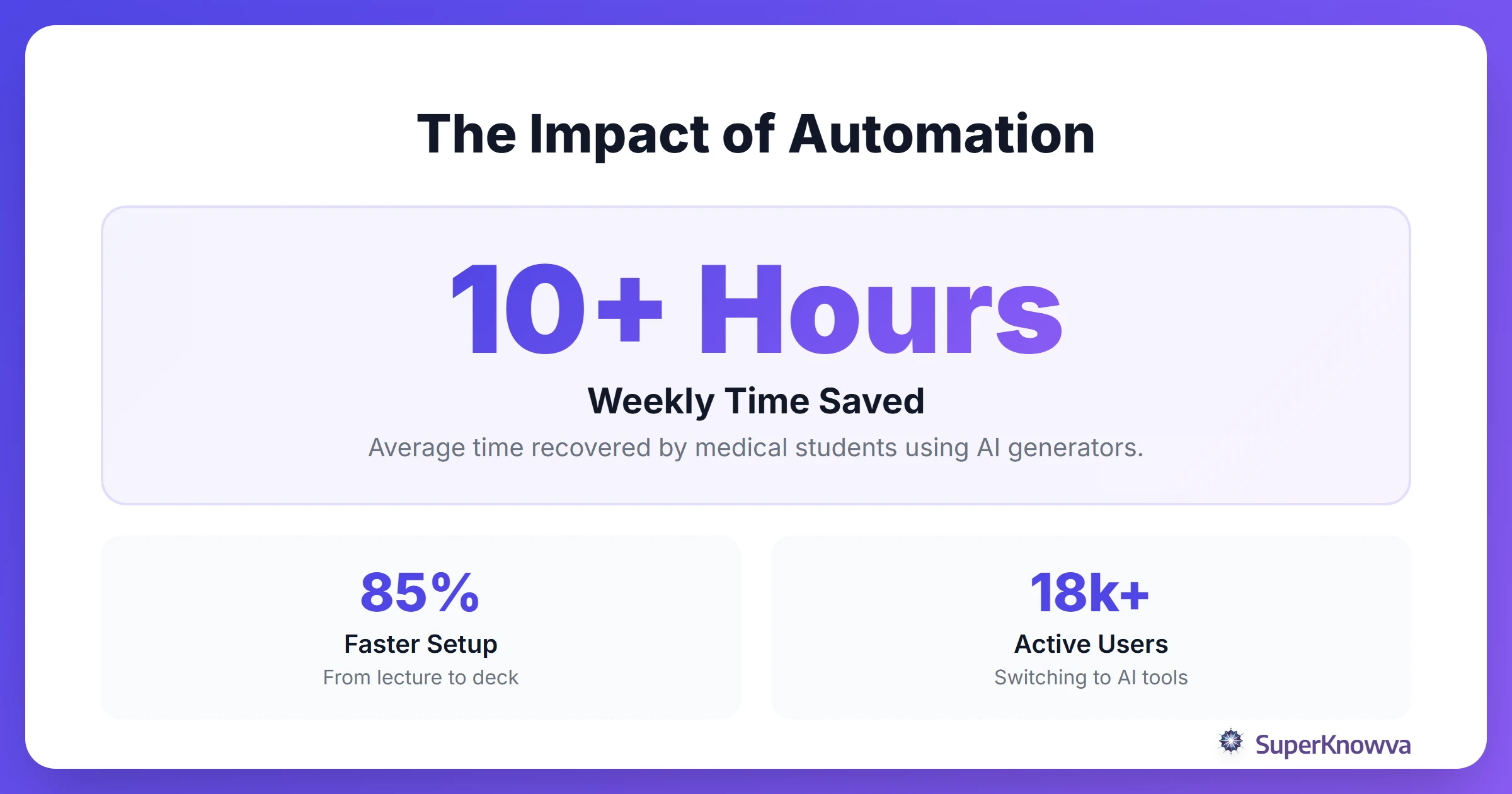
The results of switching to AI-driven prep aren't just theoretical. In a recent AnkiBuddy Case Study, researchers found that students in high-intensity fields like medicine and law saved upwards of 10 hours per week by automating their card creation.
The return on investment is high. While manual creation is "free" in terms of dollars, it is expensive in terms of time, your most limited resource. Using tools like Revisely's AI Flashcard Maker or SuperKnowva’s internal generators helps you move from simply organizing notes to mastering the material.
Stop wasting your weekends on data entry. Embrace the power of AI, automate your workflow, and spend your time where it actually counts: learning.