
Ever spent hours crushing practice problems, felt like a genius at 11 PM, and then stared at your exam the next morning like it was written in a foreign language?
Most of us were taught to study in "blocks," hitting one topic over and over until we think we've got it, then moving on to the next. It feels productive and fast. According to cognitive science, it is actually one of the least effective ways to make information stick.
Interleaved practice for students is the fix. It’s a strategy that involves mixing up different topics or problem types within a single study session. It’s definitely more frustrating than traditional studying, but that's exactly why it works. If you want to master complex subjects like math or science, you have to stop practicing until you get it right and start practicing so you can't get it wrong.
What is Interleaved Practice?
Basically, interleaved practice is the opposite of "blocked practice."
In a blocked session, you might spend two hours grinding through nothing but quadratic equations. In an interleaved session, you’d shuffle the deck. You’d do a quadratic equation, then a geometry proof, then maybe a calculus limit, and then circle back.
Think of it like a baseball player in the batting cage. If a machine throws 50 fastballs in a row, the batter will start timing them perfectly by the tenth swing. But does that make them a great hitter? Not really. In a real game, they don't know what’s coming. Interleaved practice for students is like practicing against a random mix of fastballs, curveballs, and sliders. It forces you to stay sharp.
So why don't we do this more often? Because blocked practice feels better. It gives us a sense of "flow" or momentum. But that feeling is usually a "fluency trap": a false sense of security that disappears the moment the exam starts.
The Science: Why Mixing It Up Works
Why does adding variety actually lead to better grades? It comes down to a concept called discrimination learning.
When you study one topic in a block, you already know which "tool" to use before you even read the prompt. You aren't learning how to choose a strategy; you're just practicing the execution. When you interleave, your brain has to work harder. It has to first identify the problem type and then dig through your mental toolbox for the right solution.
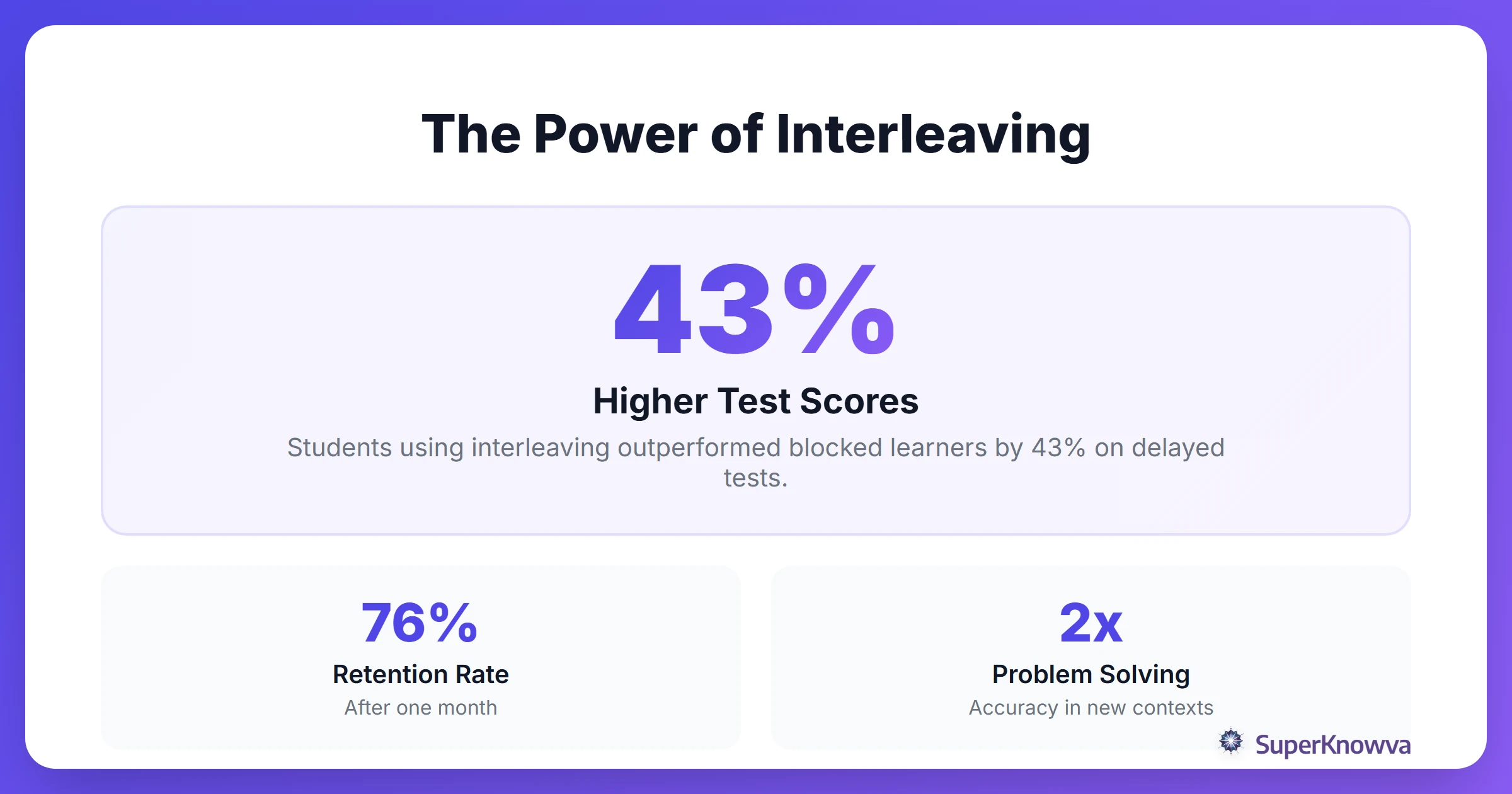
This constant switching forces your brain to "reload" information from your long-term memory over and over again. This is Neuroscience of Memory Consolidation in its purest form. By breaking the "autopilot" mode of blocked practice, you’re giving your brain a high-intensity workout that results in much higher long-term retention.
While blocked learners often perform better during the initial study session, interleaved learners outperform them on actual tests by as much as 43%.
Blocked vs. Interleaved Practice: A Comparison
To see the difference, look at how you structure your time:
- Blocked Practice: AAABBBCCC (All of Topic A, then all of B...)
- Interleaved Practice: ABCABCABC (A mix of A, B, and C)
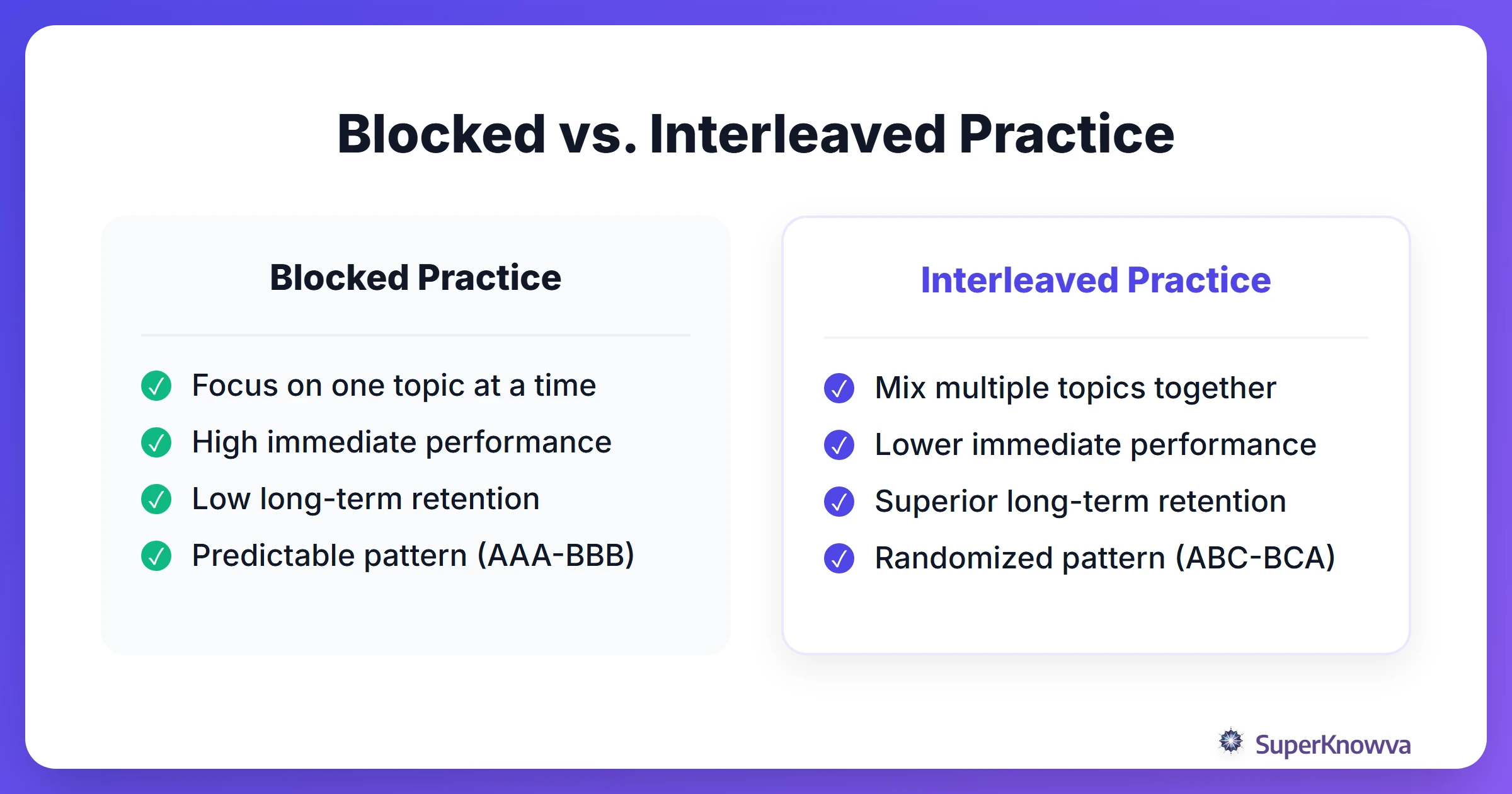
The biggest danger of blocked practice is the "Illusion of Mastery." Because you’re repeating the same motion, you feel confident. But that confidence is brittle. The second the context changes, such as on a final exam where questions are randomized, the knowledge vanishes.
Is blocked practice ever okay? Sure. When you’re learning a brand-new concept for the very first time, a small block of practice helps you get the "gist." But once you understand the basic mechanics, you need to switch to interleaving as fast as possible.
Interleaving in Math and Science
Math and science are where interleaved practice for students really shines. These subjects are cumulative; the hard part isn't just doing the math, it's knowing which math to do.
- Mathematics: Instead of doing 20 problems on the volume of a cylinder, mix in surface area of spheres and the volume of cones. This forces you to look at the shape first rather than just mindlessly plugging numbers into the same formula you used for the last ten questions.
- Science: When studying chemistry, don't just balance equations for an hour. Mix in stoichiometry, periodic trends, and Lewis structures.
This is also the perfect time to use the Feynman Technique. Try explaining why you chose a specific formula for a specific problem in your mix. If you can't explain the "why," you haven't mastered the concept yet.
How to Implement Interleaved Practice in Your Routine
Ready to stop wasting time? Here is how to integrate interleaving into your next SuperKnowva session:
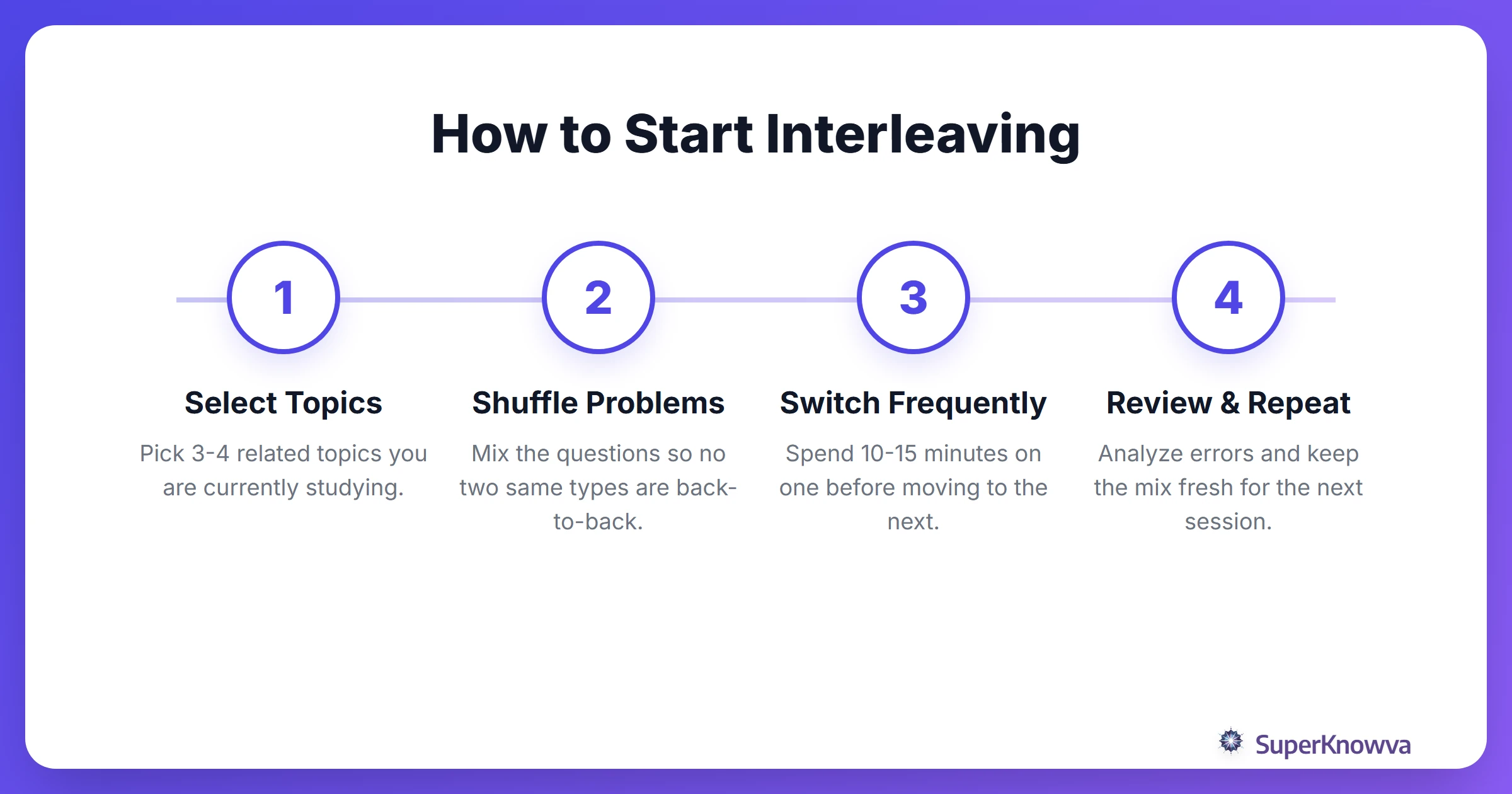
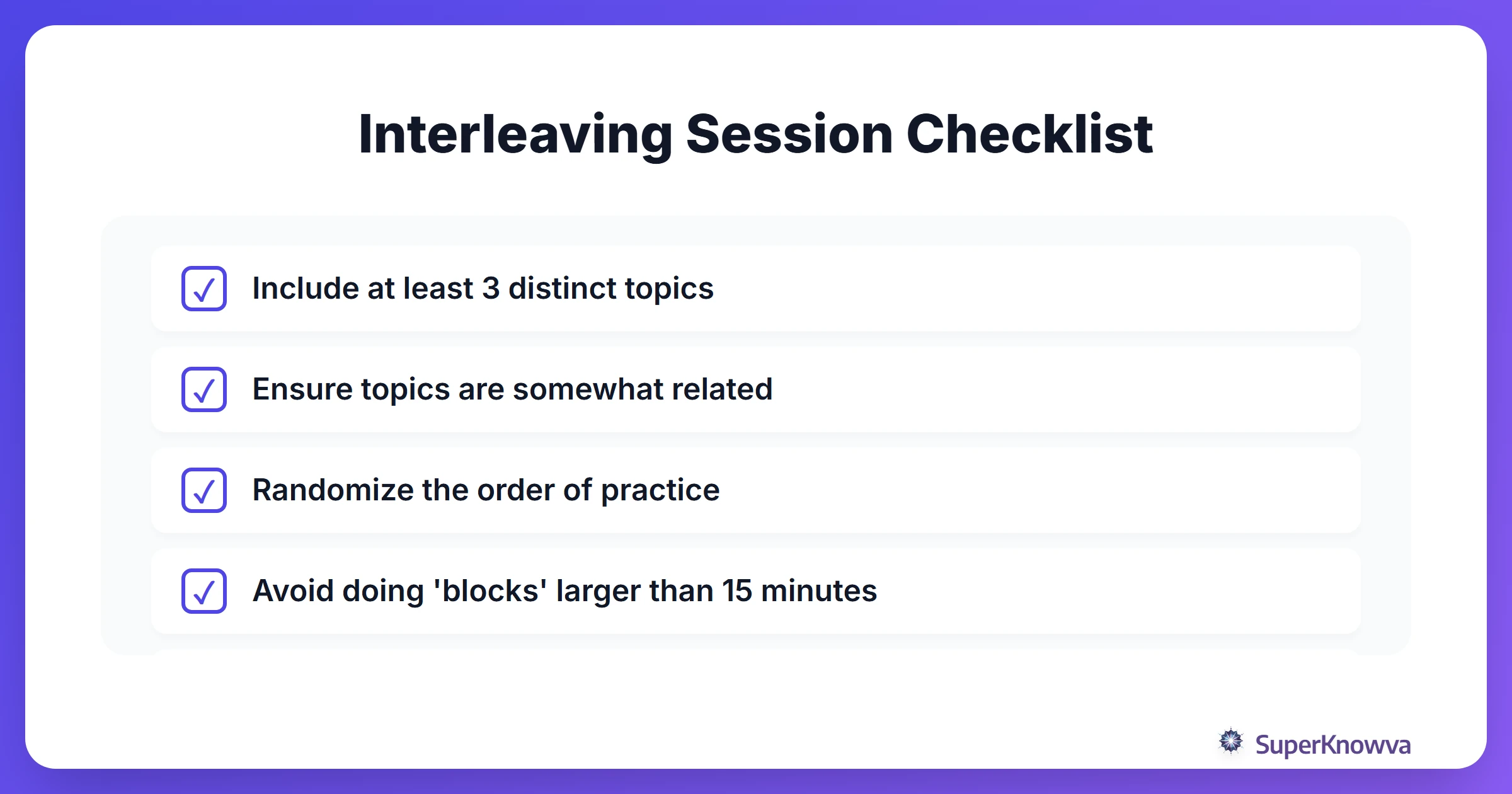
- Pick 3-4 Related Topics: Don't mix Shakespeare with Physics. It's just confusing. Instead, mix different sub-topics within the same subject (e.g., three different chapters of Biology).
- Randomize Your Questions: Use flashcards or digital question banks. If you’re a fan of The Blurting Method, try "blurting" out key concepts from three different modules in one sitting rather than just one.
- Fight the Urge to Switch Back: When it feels difficult, your brain is working harder. Don't go back to blocked practice just because it feels "smoother."
- Pair it with Focus: Use interleaving as the core of your Deep Work for Students sessions to study more effectively.
The Difficulty Paradox: Why It Feels Harder (But Is Better)
In the world of cognitive psychology for students, there’s a term called "Desirable Difficulties." These are tasks that make learning feel slower and more annoying in the short term, but lead to massive wins in the long run. Interleaving is the ultimate desirable difficulty.
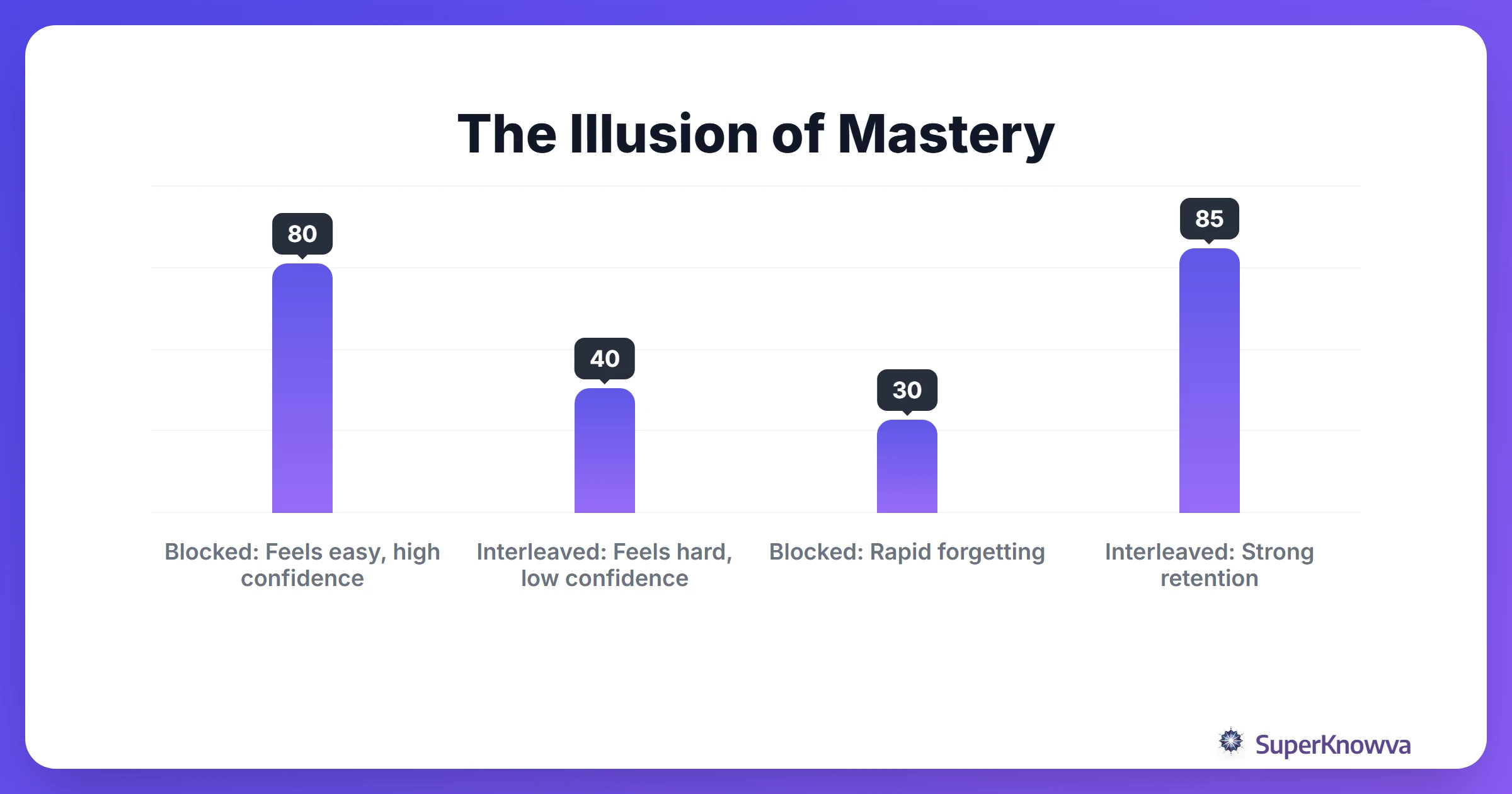
It is completely natural to feel frustrated when you can't get into a "rhythm." You might even get more answers wrong than usual at first. But don't let that discourage you. As noted in The 'One Quick Trick' of Learning Principles, the goal isn't to make studying easy; it's to make it effective.
Stay consistent. Your goal isn't to feel good during the study session; it's to feel prepared on exam day. By varying your methods, you train your brain to be a versatile, effective problem solver.