
Have you ever spent five hours straight grinding through biology, felt like an absolute genius by midnight, and then realized two days later you can’t remember a single thing?
It’s a gut-punch. You likely fell for the "illusion of mastery." You felt like you were winning because the information was fresh, but it never actually moved into your long-term storage. To truly lock in knowledge for those high-stakes finals, you need to stop focusing on one thing at a time and start using interleaved practice for exam retention.
In this guide, we’re going to look at the brain science behind why mixing your subjects is the ultimate "cheat code" for a better memory.
What Exactly is Interleaved Practice?
Most of us were taught to study using "blocked practice." It’s the traditional way: you hammer Topic A until you’ve got it, move to Topic B, then Topic C. In your calendar, it looks like a neat row: AAABBBCCC.
Interleaving flips that script. Instead of staying on one topic until you’re bored to tears, you rotate through them. Your session looks more like ABCABCABC.
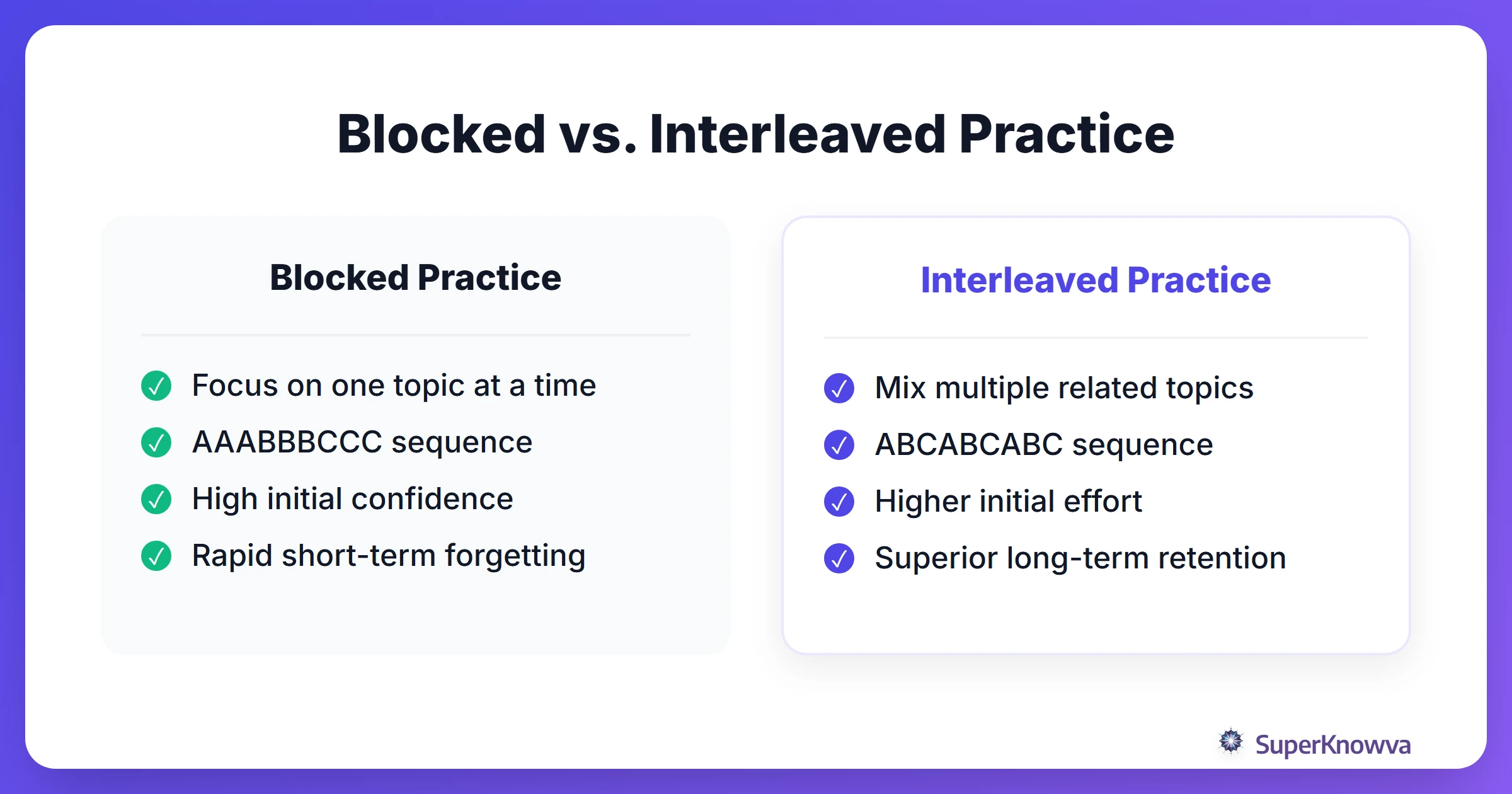
Textbooks love blocked practice. Chapter 1 problems always follow Chapter 1 text. But that is not how the real world works, and it is not how your cumulative exam works. On test day, the questions do not come in order. Interleaving prepares you for that.
The Brain Science: Why Being "Scrambled" Works
Why does your brain actually prefer this messier approach? It feels harder, but that’s exactly the point.
- Discriminative Contrast: When you only do one type of problem, your brain goes on autopilot. You know which formula to use before you even finish reading the prompt. Interleaving forces you to stop and ask, "Wait, what kind of problem is this?" before you solve it. You’re learning to tell the difference between similar concepts.
- Desirable Difficulty: Learning shouldn't feel easy. If it’s easy, you’re probably not retaining it. This added effort creates what researchers call "desirable difficulty," which physically strengthens your neural pathways.
- Memory Reloading: Because you’re constantly switching tasks, your brain has to "reload" information from your long-term memory back into your working memory over and over. This constant retrieval makes the memory stick.
- Neuroplasticity: The neuroscience of memory consolidation shows that interleaving encourages the brain to build more flexible, durable connections between different subjects.
Interleaving vs. Blocked Practice: The Performance Gap
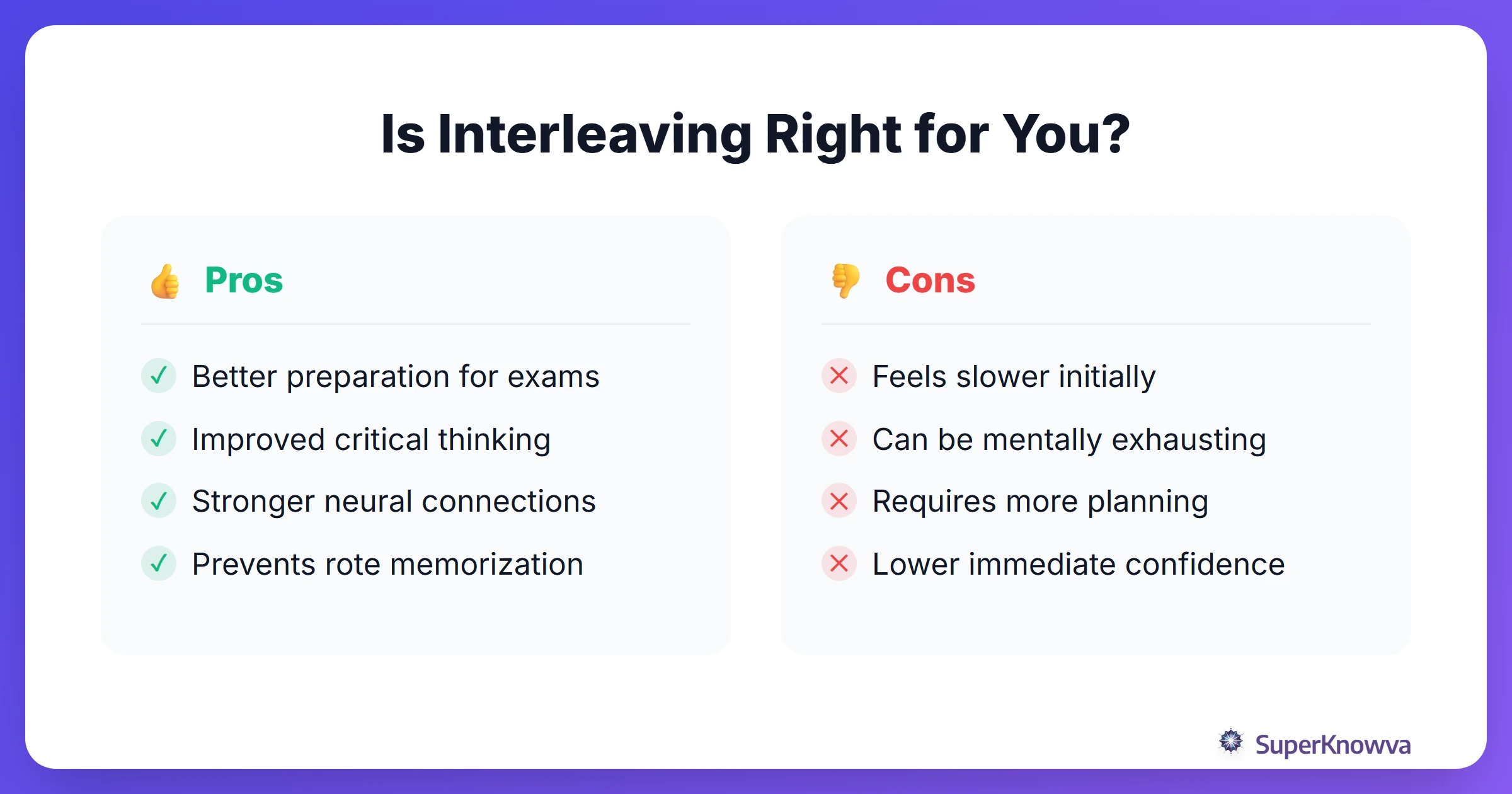
Here is the catch: blocked practice makes you feel like you’re doing better during the study session. But interleaved practice makes you perform better on the actual test.
In studies ranging from complex math to learning piano pieces, students who mixed their practice sessions outperformed the "blocked" group by massive margins when it came to long-term retention.
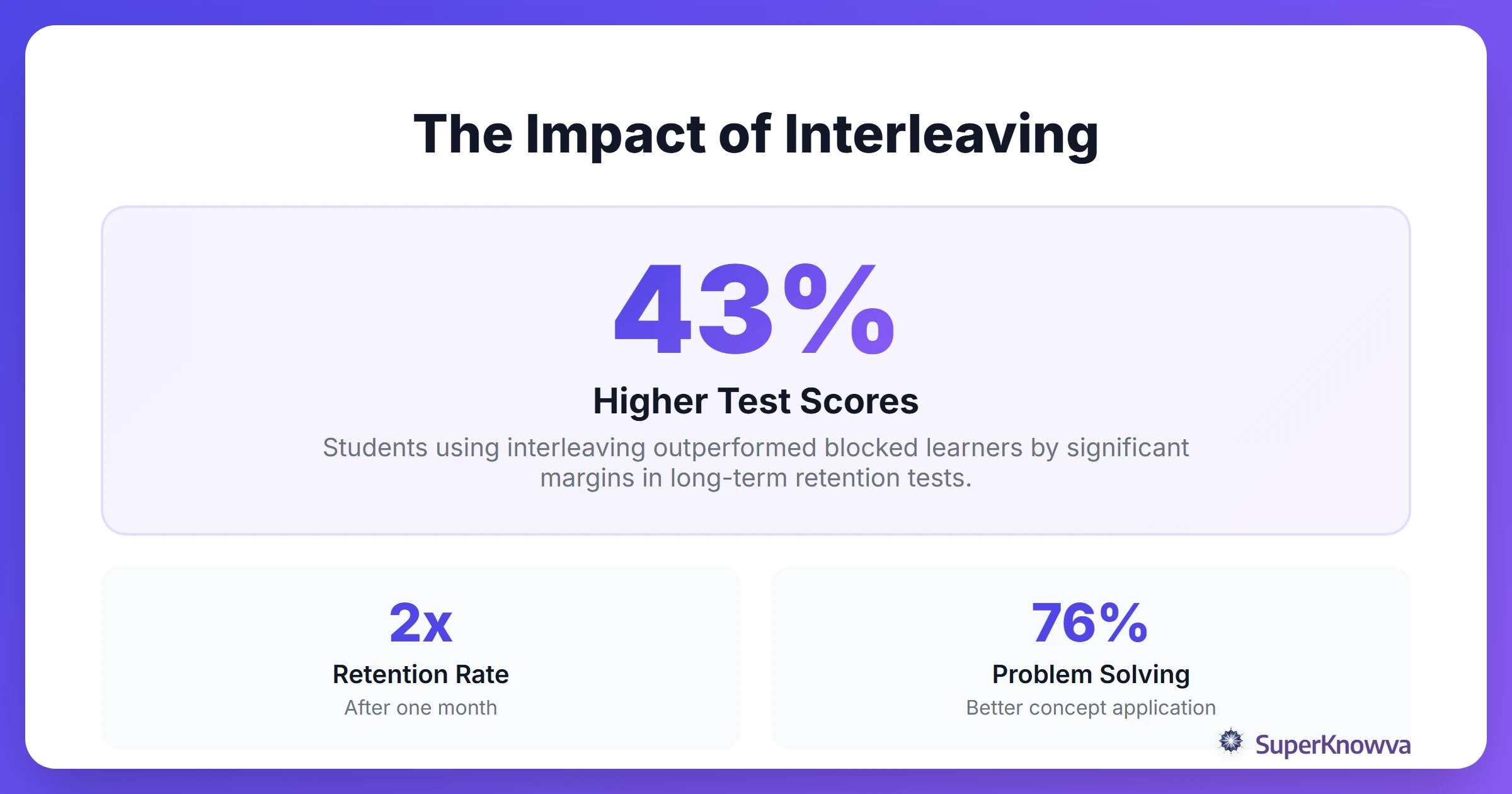
As noted by MIT Open Learning on Spaced and Interleaved Practice, mixing related concepts naturally builds in "spacing." You aren't just juggling topics; you’re creating the time gaps your brain needs for long-term memory retention.
Don't Let the "Illusion of Mastery" Fool You
The biggest reason students quit interleaving isn't because it doesn't work; it's because it feels like it isn't working.
Interleaving feels slow. It’s frustrating. You’ll probably get more questions wrong during your study session than you would if you were just "blocking." This is the Illusion of Mastery. In blocked practice, you feel "fluent" because the info is sitting in your short-term memory. You don't actually know it; you’re just familiar with the pattern of the last ten minutes.
If you want to succeed, you have to reframe the struggle. If your brain is working hard to figure out which formula to use, you’re winning. You’re building the mental muscle you’ll need on exam day.
How to Build Your Interleaved Study Plan
Ready to overhaul your study strategies for finals? Use this 4-step process to get started.
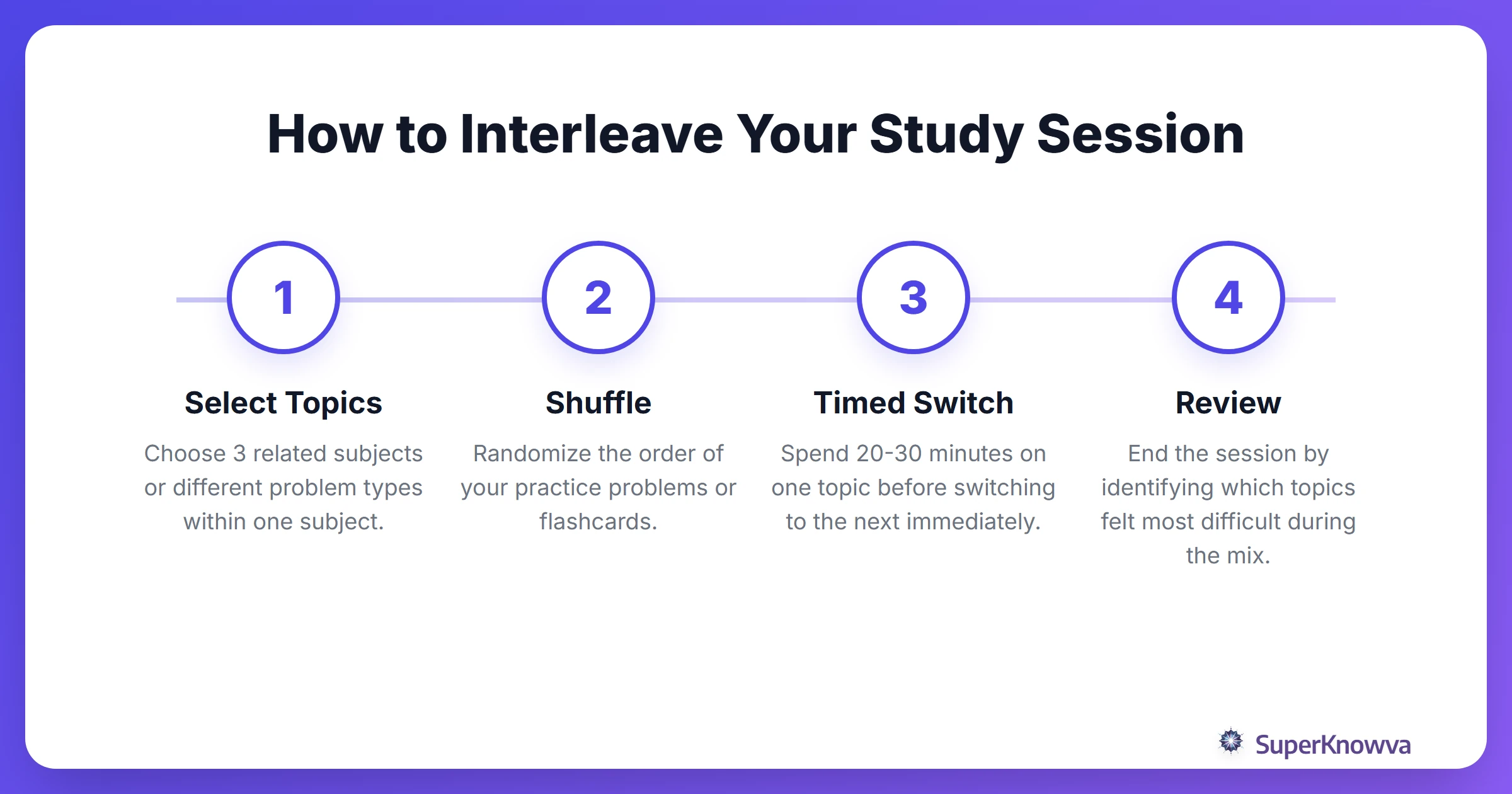
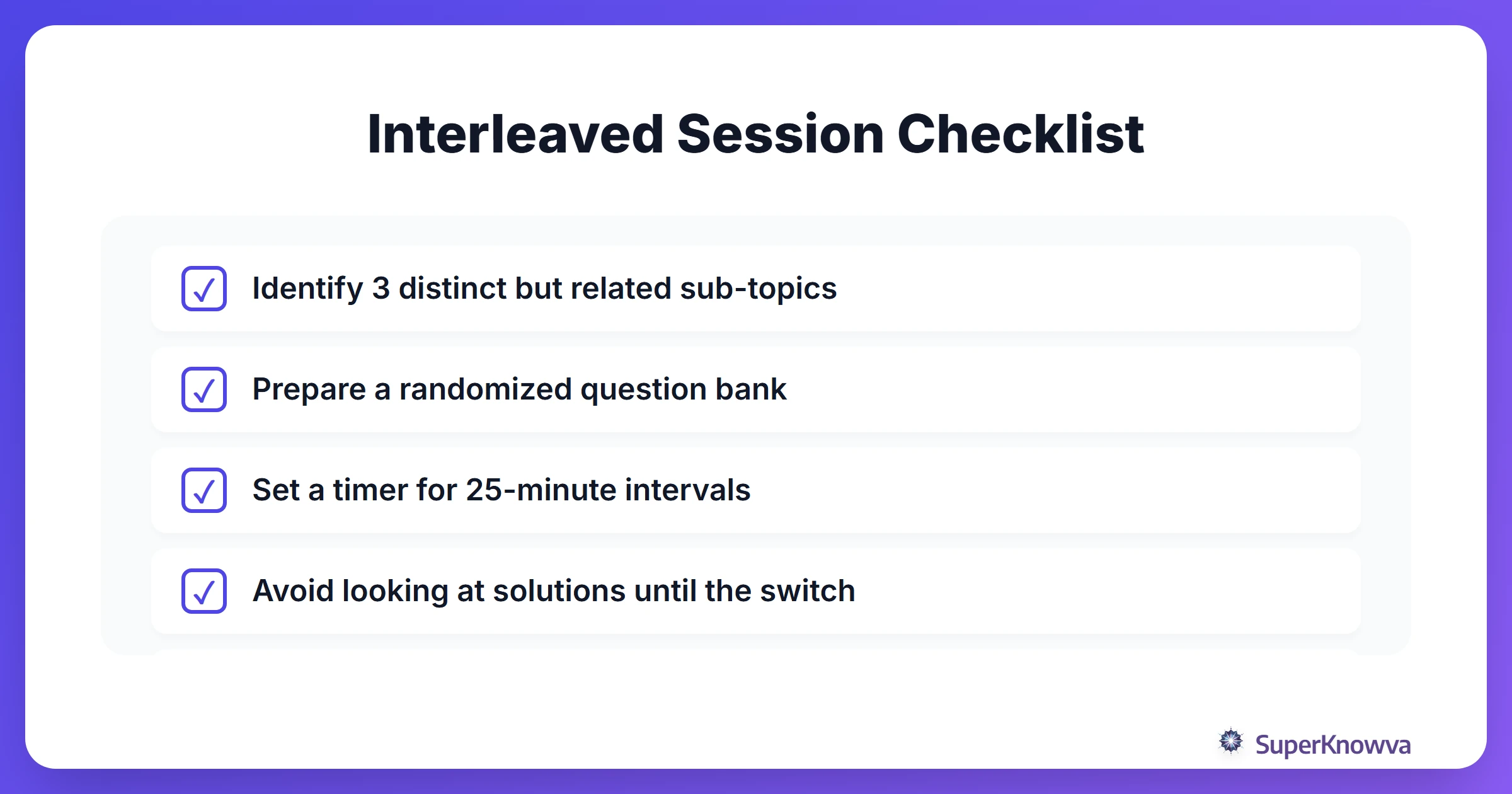
- Pick Your Trio: Choose three related but distinct subjects. If it’s finals week, try mixing Physics, Calculus, and Chemistry in one block.
- Shuffle the Deck: Use a randomized question bank. If you use a platform like SuperKnowva, you can generate quizzes that pull from all your uploaded documents at once.
- The Rule of Three: Try to mix at least three topics per session. Use the Pomodoro method to keep things moving: 25 minutes for Topic A, 25 for Topic B, and 25 for Topic C.
- Hands Off the Answers: Don't peek at the answer key the second you get stuck. That "search" for the answer in your brain is where the actual learning happens.
Level Up Your Strategy
Interleaving is a powerhouse, but it’s even better when you pair it with other evidence-based habits:
- Active Recall: Use The Blurting Method between switches. Try to "blurt" out everything you remember about a topic before moving to the next subject.
- The Feynman Technique: If you hit a concept that makes no sense during your rotation, use The Feynman Technique to simplify it. Explain it like you’re talking to a sixth-grader, then jump back into the mix.
- Prioritize Sleep: Research from The Learning Scientists highlights that interleaving works because it spaces out information. But that info only sticks if you give your brain time to synthesize it. Don't pull an all-nighter; let your brain file the data while you sleep.
Final Thoughts
Moving from blocked to interleaved practice is a challenge. It takes more planning and a much higher tolerance for making mistakes. The payoff of true mastery and higher test scores is significant.
Stop studying for the moment. Start studying for the memory. Mix it up!