Does your brain feel like a sieve? You spend three hours mastering a concept on Tuesday, only to stare blankly at your notes by Thursday. Most people study using "blocked practice," which involves grinding through one subject for hours before moving to the next. While this feels productive, it is actually one of the fastest ways to forget everything you have learned.
The fix isn't studying longer; it's studying smarter. By mixing interleaved practice with AI tools, you can tap into the cognitive science of learning to build a memory that actually sticks. Modern AI platforms handle the heavy lifting of organization, forcing your brain to work harder and retain more. Let’s break down how to use these AI study strategies to finally master your coursework.
What is Interleaved Practice and Why Does it Work?
Interleaved practice means mixing your study topics. Instead of doing 50 algebra problems and then 50 geometry problems, shuffle them. Solve one algebra, one geometry, and one trigonometry problem. Repeat the cycle.
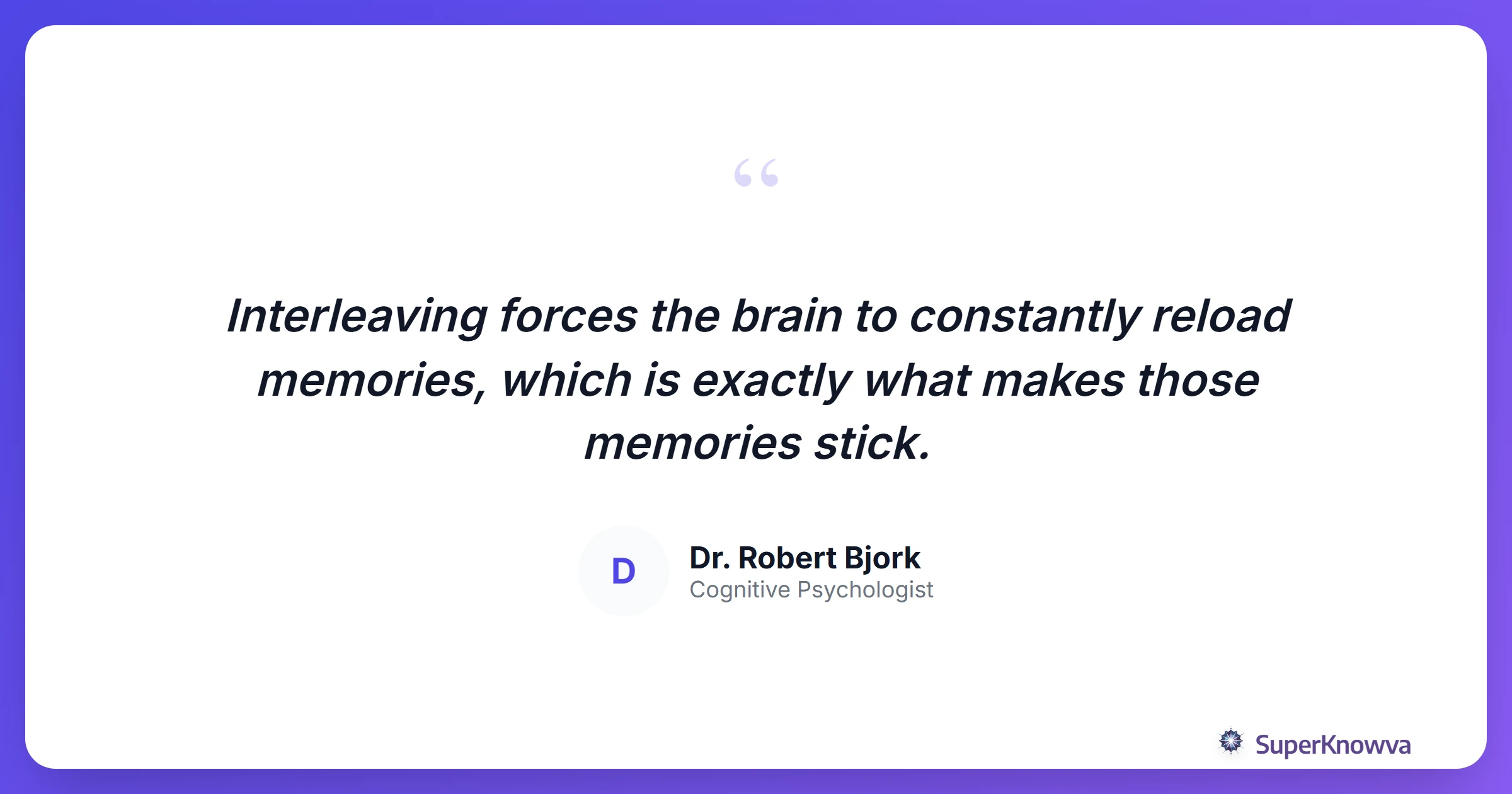
Why does this work? Because it stops your brain from going on autopilot. When you do the same type of problem 20 times, your brain stops thinking about why it’s using a specific formula and just starts going through the motions. Interleaving creates what psychologists call "desirable difficulty." It makes the initial study session feel tougher, but that extra mental "heavy lifting" builds much stronger neural pathways.
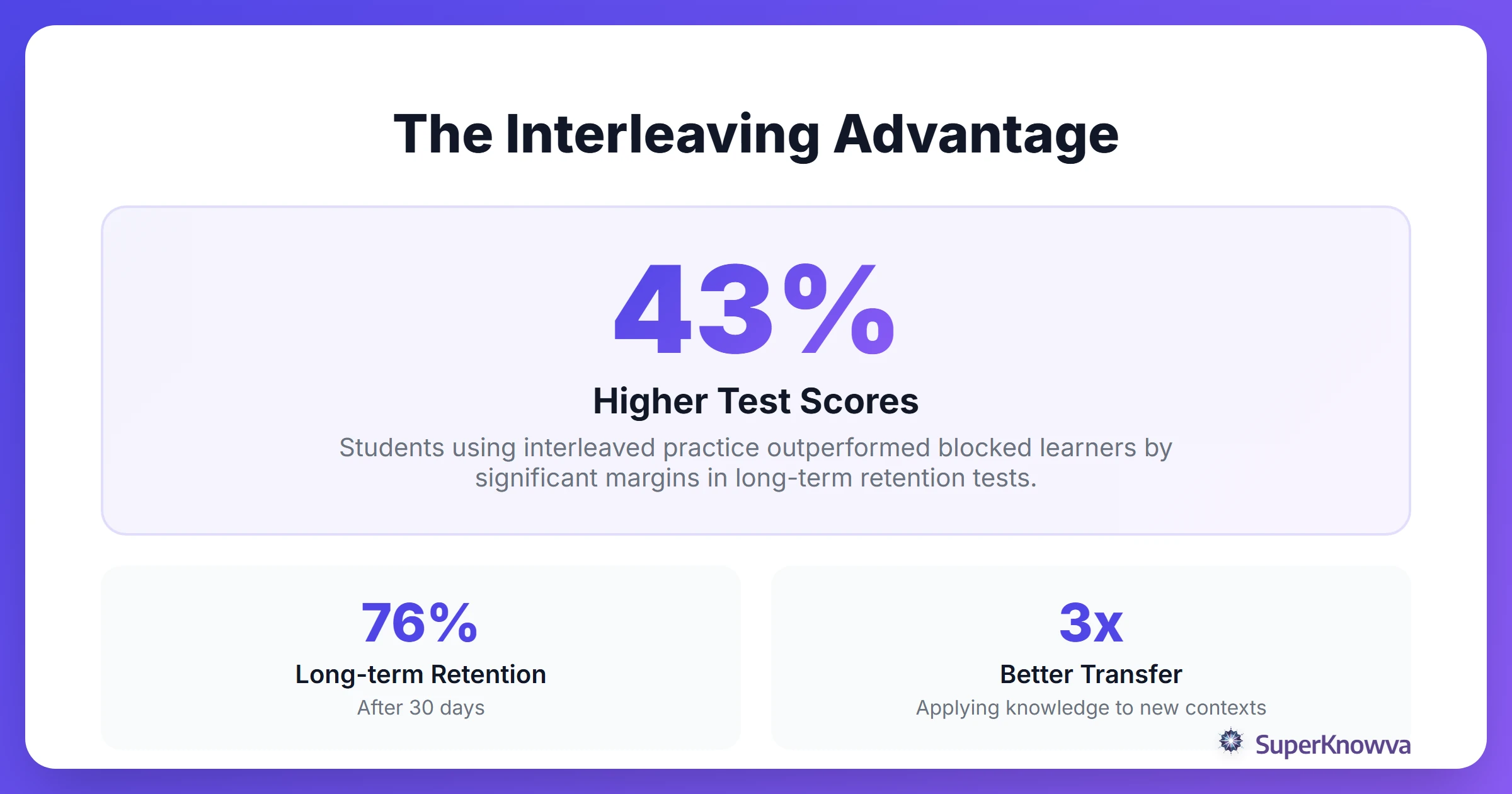
While blocked practice might help you pass a quiz tomorrow, it fails the long-term test. Interleaving ensures you can actually retrieve that information months later. For a deeper look at the fundamentals, check out our complete guide to interleaved practice.
Blocked vs. Interleaved Practice: The AI Difference
To see the difference in action, look at these two patterns:
- Blocked Practice: AAAA - BBBB - CCCC (All Biology, then all Chemistry, then all Physics)
- Interleaved Practice: ABC - BCA - CAB (A constant rotation of all three)
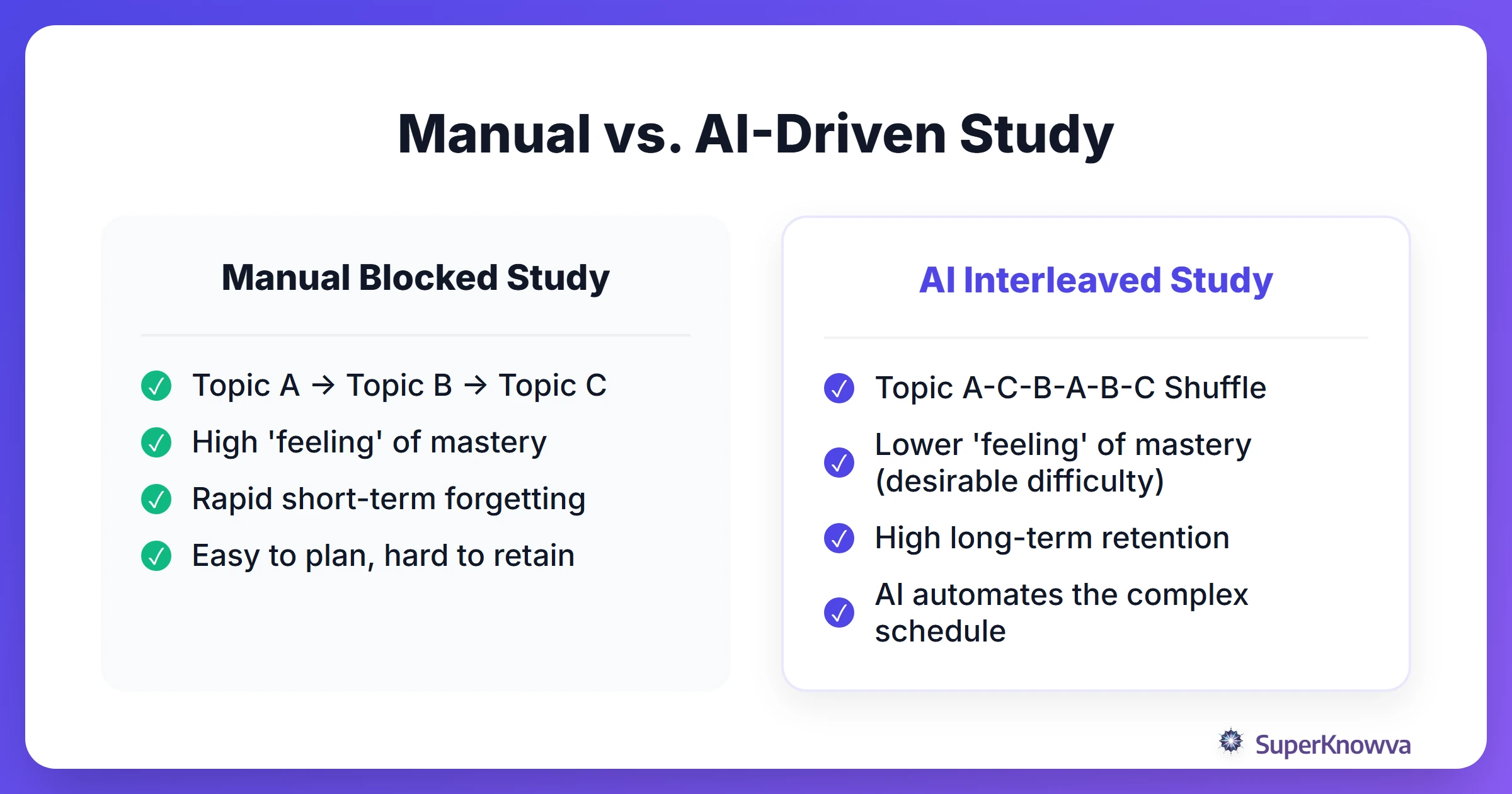
Manual interleaving is difficult to manage. Shuffling physical flashcards or hunting for specific problems across five different textbook chapters is time-consuming. This is where AI study strategies simplify the process. AI algorithms remove the "planning tax" by automatically shuffling your content. AI can also identify similar concepts, such as two different types of chemical bonds, and pair them to improve your focus.
How AI Tools Automate the Interleaving Process
Modern active recall tools powered by AI take the guesswork out of your schedule. You don't have to be an organizational genius to study like one. Here is how the tech does the work for you:
- Neural Network Flashcards: These apps use algorithms to predict your "forgetting curve." They drop interleaved topics into your feed exactly when your brain is most likely to forget them.
- Dynamic Quiz Generation: Instead of a static PDF, AI pulls questions from different modules to build a custom, mixed-subject practice exam on the fly.
- Natural Language Processing (NLP): AI reads your notes and identifies related topics that are easily confused. It then forces you to switch between them to ensure you truly understand the nuances.
- Real-Time Difficulty Adjustment: If you’re breezing through a topic, the AI shifts the "mix" to keep you challenged, keeping you in the "Goldilocks zone" of learning.
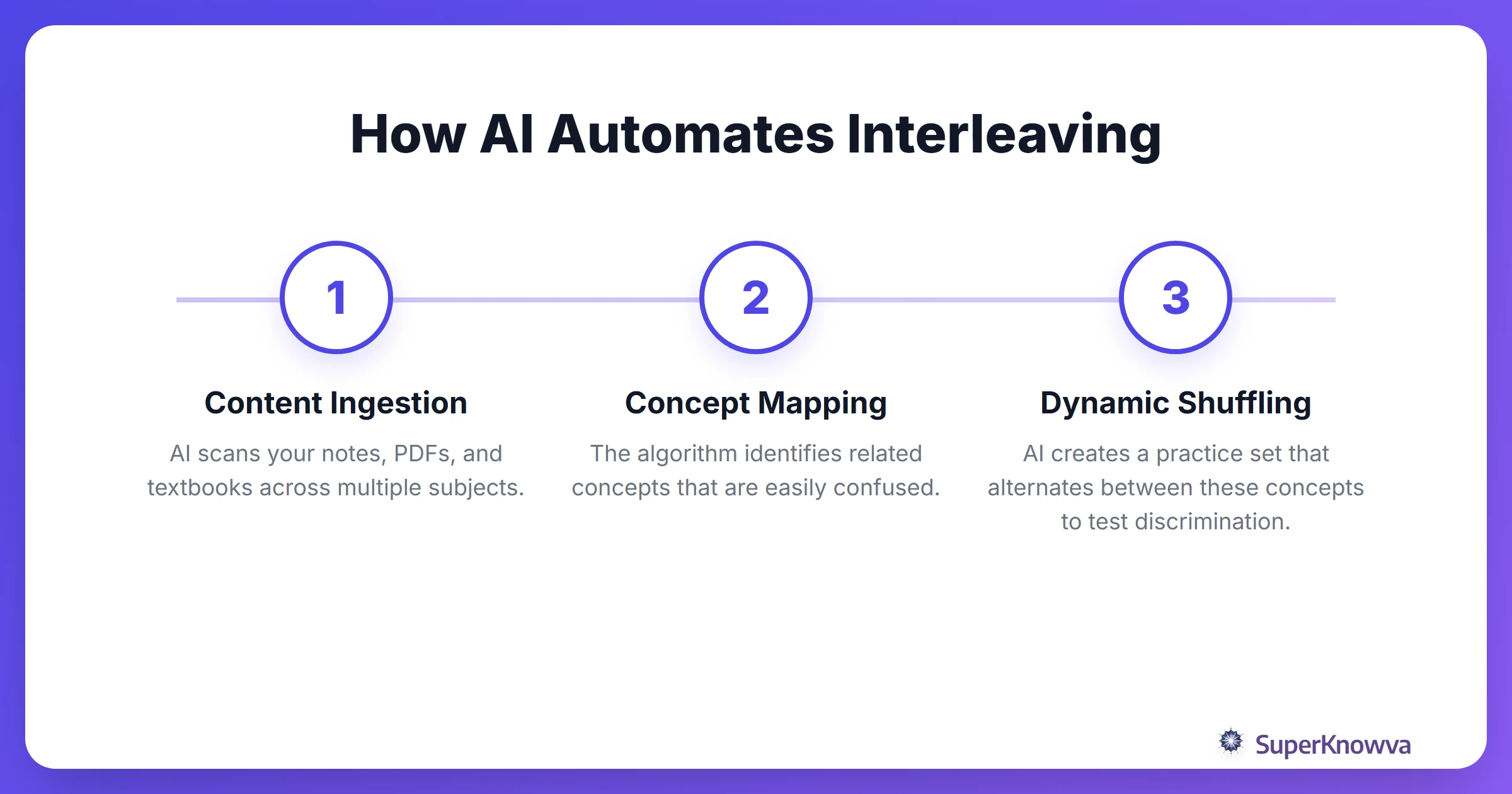
As highlighted in recent research on Using AI for Interleaving and Spaced Practice, these automated systems drastically reduce the mental energy required to switch between subjects.
Top AI Features for Interleaved Learning
When choosing a tool, don't just settle for a digital highlighter. Look for these high-impact features:
- Smart Shuffling: This isn't just randomizing. It’s an algorithm-driven sequence that pairs topics you frequently mistake for one another.
- Cross-Topic Synthesis: The system generates hybrid questions, such as a physics problem requiring a specific calculus technique, to force the use of multiple skills at once.
- Clash Reports: These analytics show exactly where you are struggling. If you consistently confuse two similar concepts, the system increases the interleaved focus on those topics.
- Automated Scheduling: This syncs your interleaved sessions with spaced repetition targets so you never have to wonder "what should I study today?"
To get the most out of these sessions, try using the blurting method for active recall during your interleaved breaks to dump everything you know about a topic before the AI switches gears.
Step-by-Step: Setting Up Your AI-Interleaved Study Session
Ready to give it a shot? Use this checklist to set up a high-performance session:
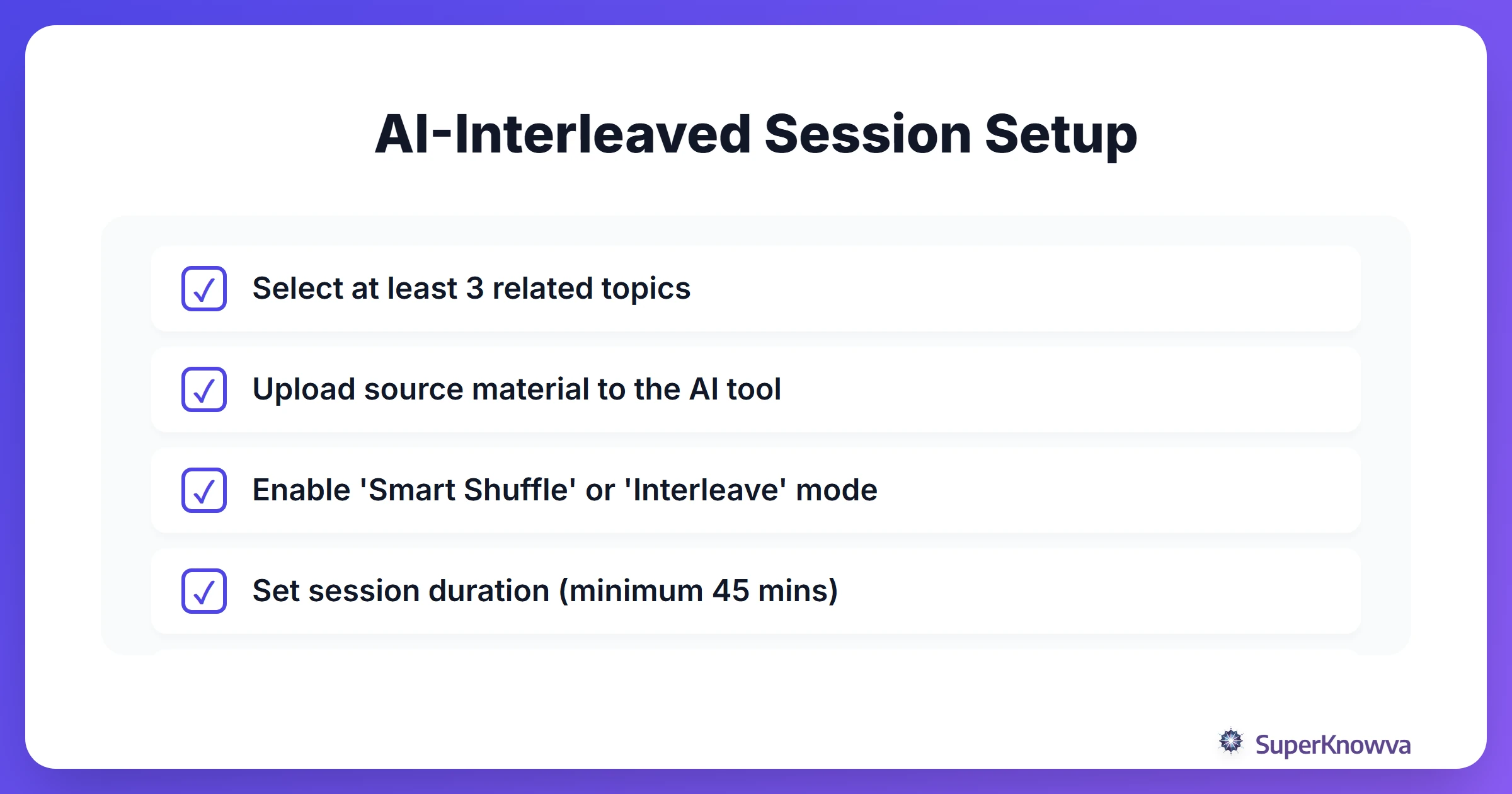
- Upload Diverse Datasets: Feed the AI your notes, PDFs, or slides for at least three related topics.
- Tag Your Concepts: Use tags (e.g., #Macroeconomics, #Microeconomics) to help the AI understand how the topics relate.
- Turn on "Smart Shuffle": Ensure the "Interleaved Mode" is active in your tool's settings.
- Review the Data: After your session, check the AI analytics to see which topics need more attention in your next round.
Pro tip: While the AI handles the "what," you can use the Feynman Technique to explain the concepts out loud as they appear.
Overcoming the 'Illusion of Mastery'
Fair warning: interleaved practice feels harder. In blocked practice, you get ten questions right in a row and feel like a genius. This is the "illusion of mastery." In reality, you're just using your short-term memory.
When you start interleaving, you’ll likely get more questions wrong at first. Don't panic.
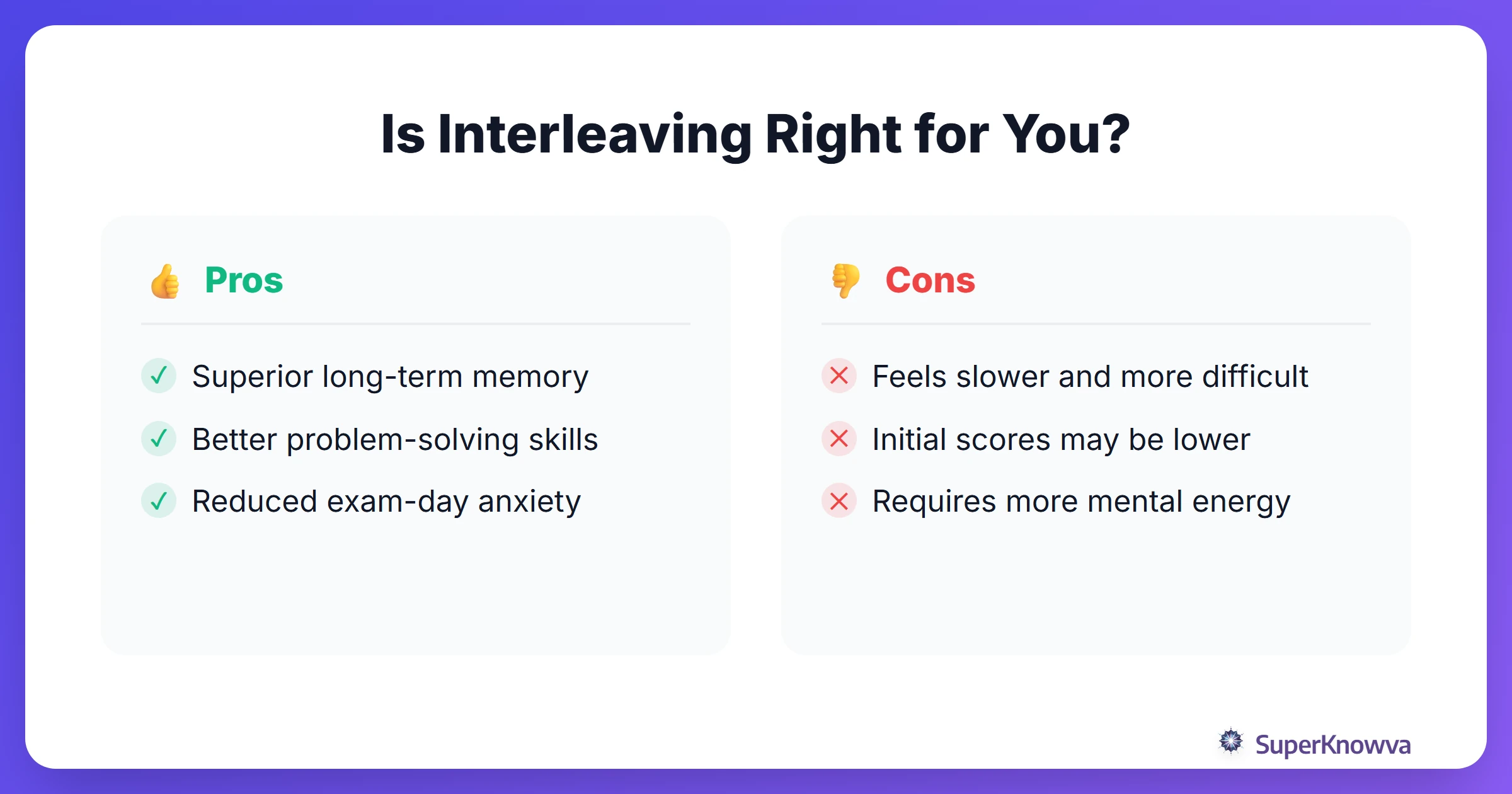
AI data visualizations prove that while your short-term performance might take a dip, your long-term retention will skyrocket. Trust the process and the data-driven schedule.
By pairing interleaving with deep work strategies, you’re building a foundation for success that lasts long after finals week is over. For more on the science behind it, check out How to Use Interleaving for Deeper Learning.
Conclusion
Think of interleaved practice with AI as a more effective way to learn. It moves you away from the stress of last-minute cramming and toward actual mastery. Start small by mixing just two related topics in your next AI-powered quiz to watch your scores and your confidence climb.