Have you spent three hours highlighting a textbook only to forget the concepts the next morning? This is a common frustration. Many students rely on passive learning, an autopilot mode where information fails to stick.
The highest achievers don't just study harder; they use a "secret weapon" to take control of their brain's performance. They use metacognition strategies.
Metacognition isn't just academic jargon. It is the literal foundation of self-regulated learning. By learning how to think about your own thinking, you can stop wasting time on habits that don't work and start mastering complex subjects without the midnight meltdowns.
What is Metacognition? The Science of Thinking About Thinking
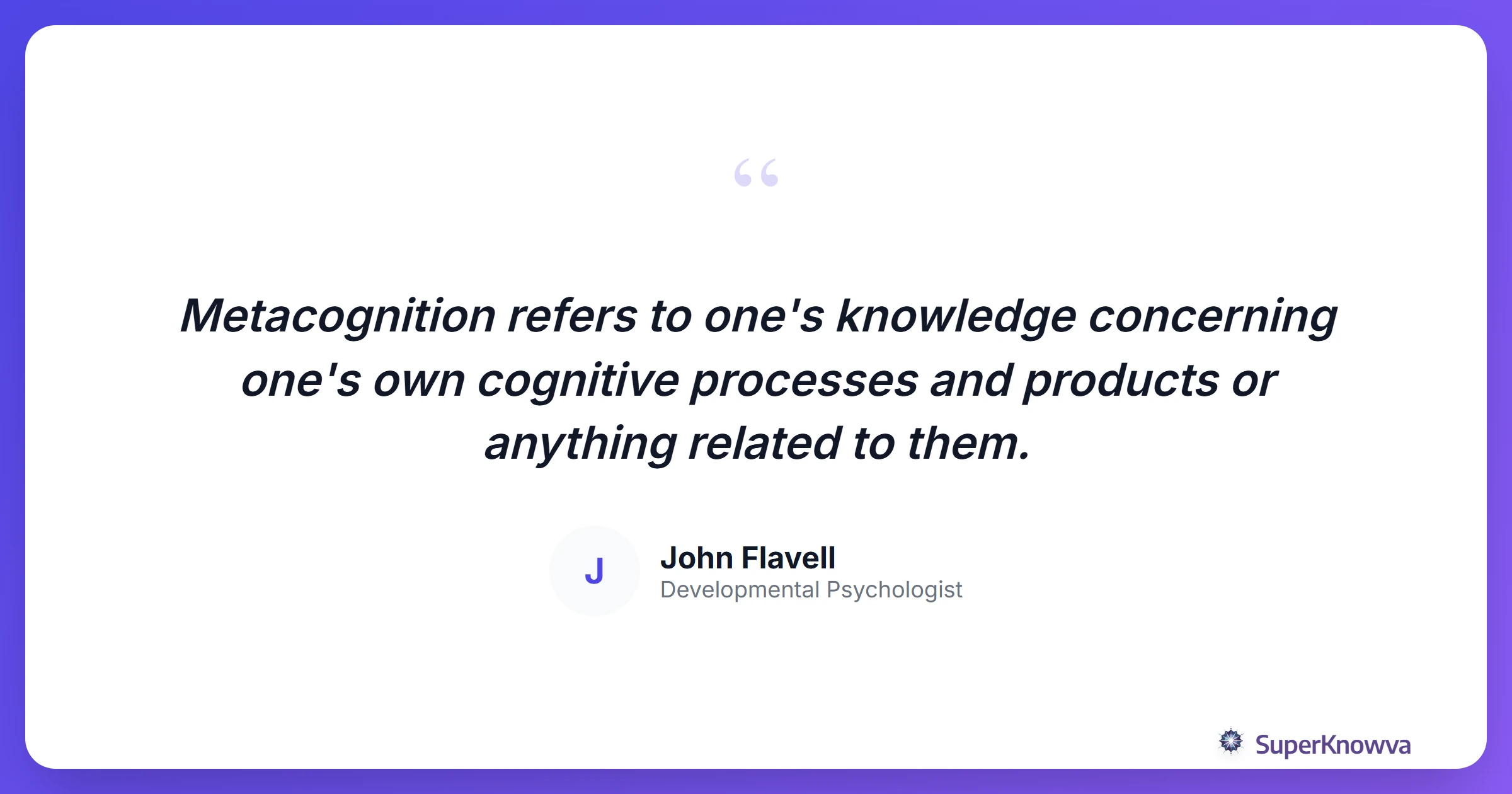
At its simplest, metacognition is "thinking about thinking." The term was coined by developmental psychologist John Flavell, who described it as our ability to understand and control our own cognitive processes.
To get a grip on how this works, you have to see the difference between cognition and metacognition:
- Cognition: The act of doing a task (e.g., solving a math problem or reading a chapter).
- Metacognition: The act of understanding how you are doing that task (e.g., realizing that the math problem is harder than usual and deciding you need a different formula).
Developing student self-awareness is like having an "inner coach." This coach watches you study and asks the tough questions: "Is this actually sinking in, or am I just moving my eyes across the page?" This level of awareness is what separates high-performance studying from mere "busy work."
The Metacognitive Cycle: Plan, Monitor, and Evaluate
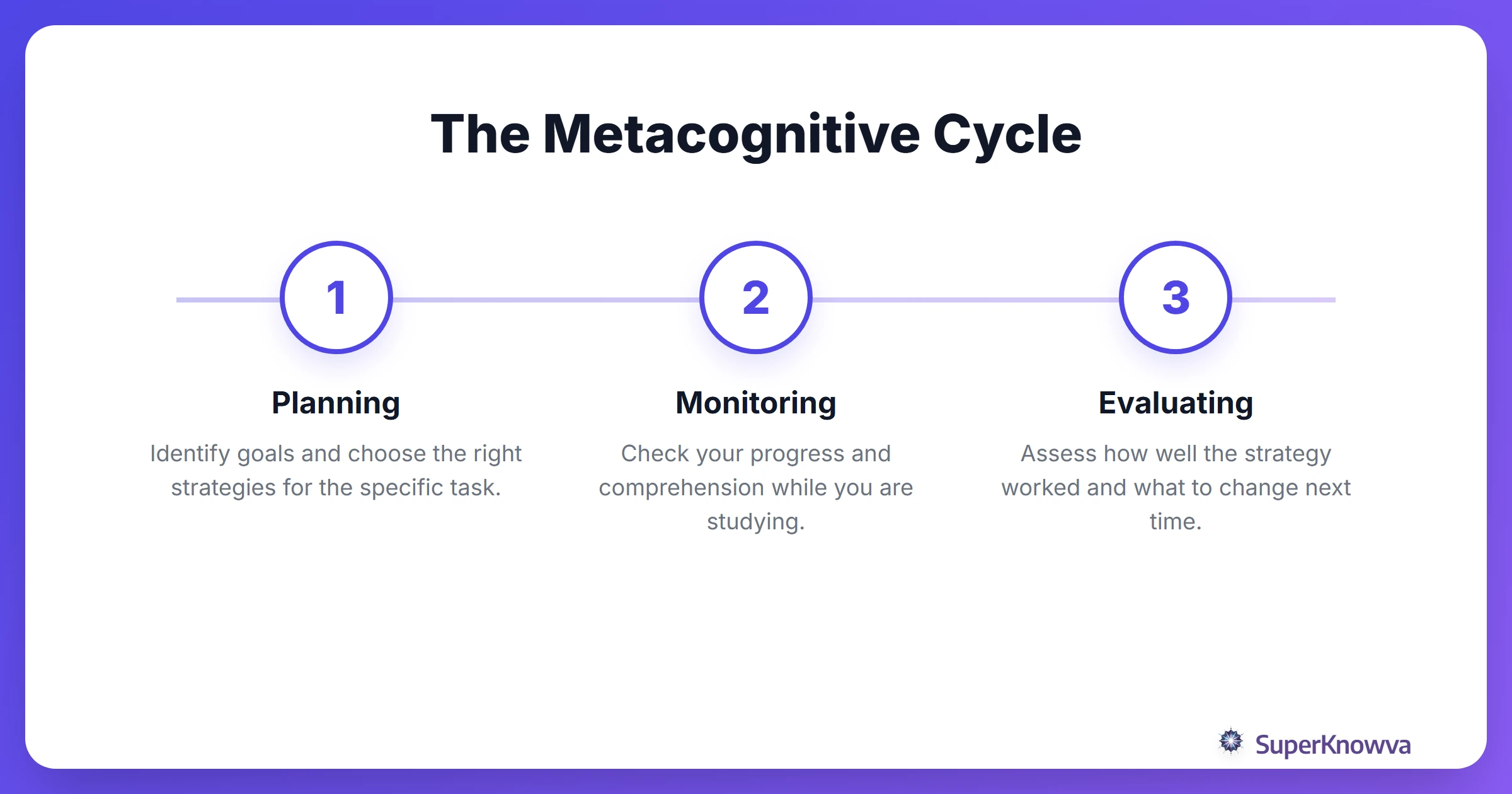
Effective metacognitive learning isn't a one-off event. It’s a loop. To sharpen your exam performance strategies, you should apply these three phases to every single study session.
Phase 1: Planning
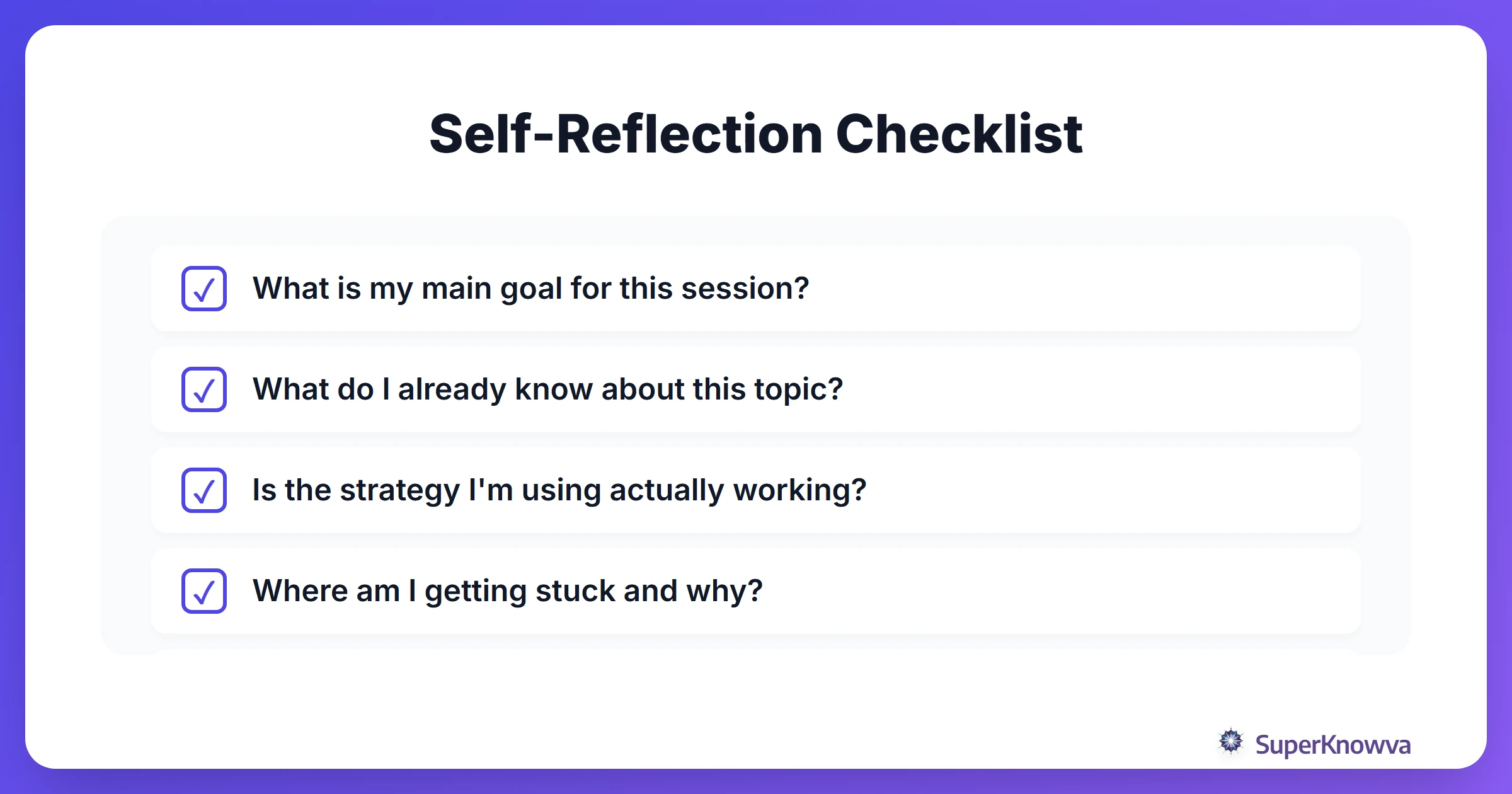
Before you even open your laptop, set the stage. Ask yourself:
- What is my specific goal for the next hour?
- Which strategies (like flashcards or practice problems) actually fit this topic?
- How much time do I realistically need before my brain fries?
Phase 2: Monitoring
This occurs during your study session. While studying, check your pulse mentally. If you notice your mind is wandering or you cannot explain a paragraph you just read, slow down, take a break, or switch tactics.
Phase 3: Evaluating
Once you’re done, look back. Did your strategy work? If you aced a practice quiz, why did it click? If you failed, was it because you didn't spend enough time or because the method was wrong? Looping through these phases creates a path for constant academic growth.
Practical Metacognition Strategies for Students
Ready to get started? Here are four proven metacognition strategies for students that you can use today:
- Self-Questioning: Don't just consume information; interrogate it. Ask, "Why am I doing this step?" and "How does this relate to what I learned last week?"
- The "Think-Aloud" Technique: Talk to yourself. Seriously. When you solve a problem out loud, you’re much more likely to spot logic gaps that you’d miss if you were just thinking silently.
- Concept Mapping: Draw it out. Create a visual web showing how new info connects to what you already know. This forces your brain to organize data rather than just trying to memorize it.
- Using Wrappers: These are quick "reflections" before and after a lecture. Before starting, "prime" your brain by thinking about what you already know. Afterward, spend three minutes reflecting on the most important takeaway.
For more ideas on independent learning, check out these 10 Metacognitive Strategies for Independent Learners.
Overcoming the Illusion of Competence
The biggest hurdle to better grades is rarely a lack of intelligence. It is the "Illusion of Competence." This occurs when you think you know the material better than you actually do.
The main culprits? Rereading and highlighting. Because the text looks familiar, your brain tricks you into thinking you’ve mastered it. It’s a classic case of the Dunning-Kruger effect, where a lack of self-awareness leads to overestimating your own abilities.
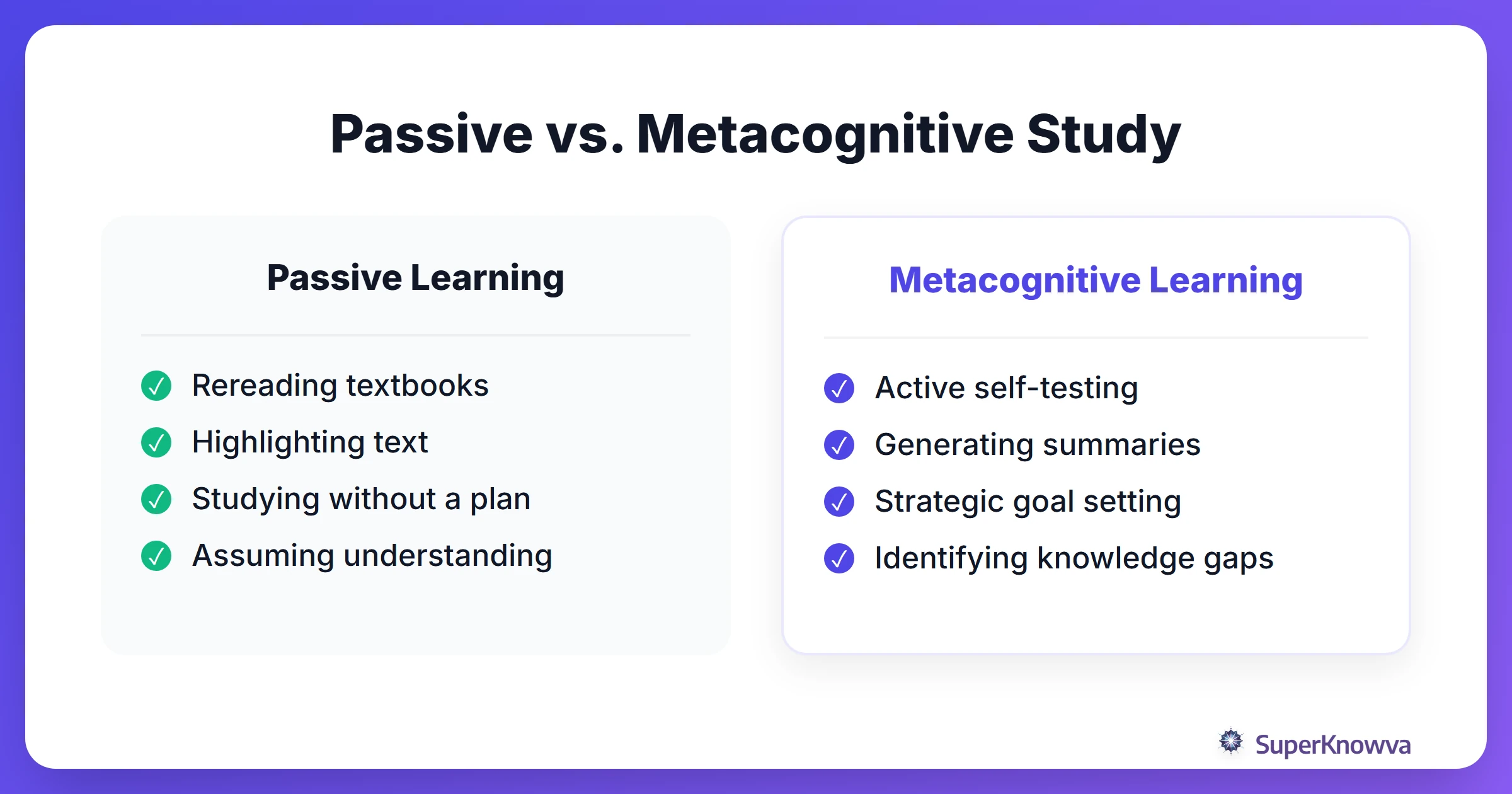
Metacognitive monitoring helps you shatter this illusion. By shifting from passive recognition (looking at notes) to active production (recreating info from memory), you find out exactly what you don't know before the exam starts.
Integrating Metacognition with Active Recall and Interleaving
Metacognition is a force multiplier for other high-impact study techniques. At SuperKnowva, we recommend building a personalized "study toolkit" based on your metacognitive feedback.
- The Feynman Technique: Use metacognition to find "bottlenecks" in your understanding. If you can’t explain a concept to a five-year-old, you haven't mastered it yet. Learn more about The Feynman Technique.
- The Blurting Method: Use metacognitive prompts during your "blurting" sessions to see which parts of your memory are solid and which are shaky. Read our guide on The Blurting Method.
- Interleaving Practice: This involves mixing up different subjects or problem types. It takes more metacognitive effort to manage the "cognitive load," but it leads to much better long-term retention. Explore how to use Interleaving Practice.
Creating a Metacognitive Study Environment
Your physical surroundings play a massive role in your ability to monitor your thoughts. Metacognitive students don't just study anywhere; they identify their optimal study conditions.
- Audit Your Environment: Do you focus better in total silence or with a bit of white noise? Are you a morning person or a night owl?
- Manage Digital Distractions: Notifications kill your "metacognitive flow." If you’re checking your phone every five minutes, you lose the ability to monitor your comprehension effectively.
- Reflection Journals: Keep a simple log of where and when you had your most productive sessions. Data doesn't lie.
To truly master your environment, you should also practice Deep Work for Students, which aligns perfectly with metacognitive goal setting. For more tips on building these habits, read about Nurturing Self-Awareness in the Classroom.
Conclusion
Metacognition is the bridge between working hard and working effectively. By planning your sessions, monitoring your progress, and being honest about your results, you take the guesswork out of studying.
Stop wondering if you're ready for your next exam. Start using these metacognition strategies for students to know with total certainty that you have mastered the material. Use SuperKnowva to generate active recall quizzes and monitor your progress today!