
Staring at a wall of text while prepping for history finals is enough to make anyone’s eyes glaze over. It’s like trying to find your way through a maze, but someone took the map away. When it comes to mind mapping for history exams, the goal is simple: stop just memorizing and start seeing the "big picture."
History and social sciences aren't just lists of dates and dead people. They are messy, complex webs of cause, effect, and human behavior. In this guide, we’ll show you how visual learning can turn your revision from a boring chore into a high-performance strategy that actually sticks.
Why History and Social Sciences Demand Non-Linear Study
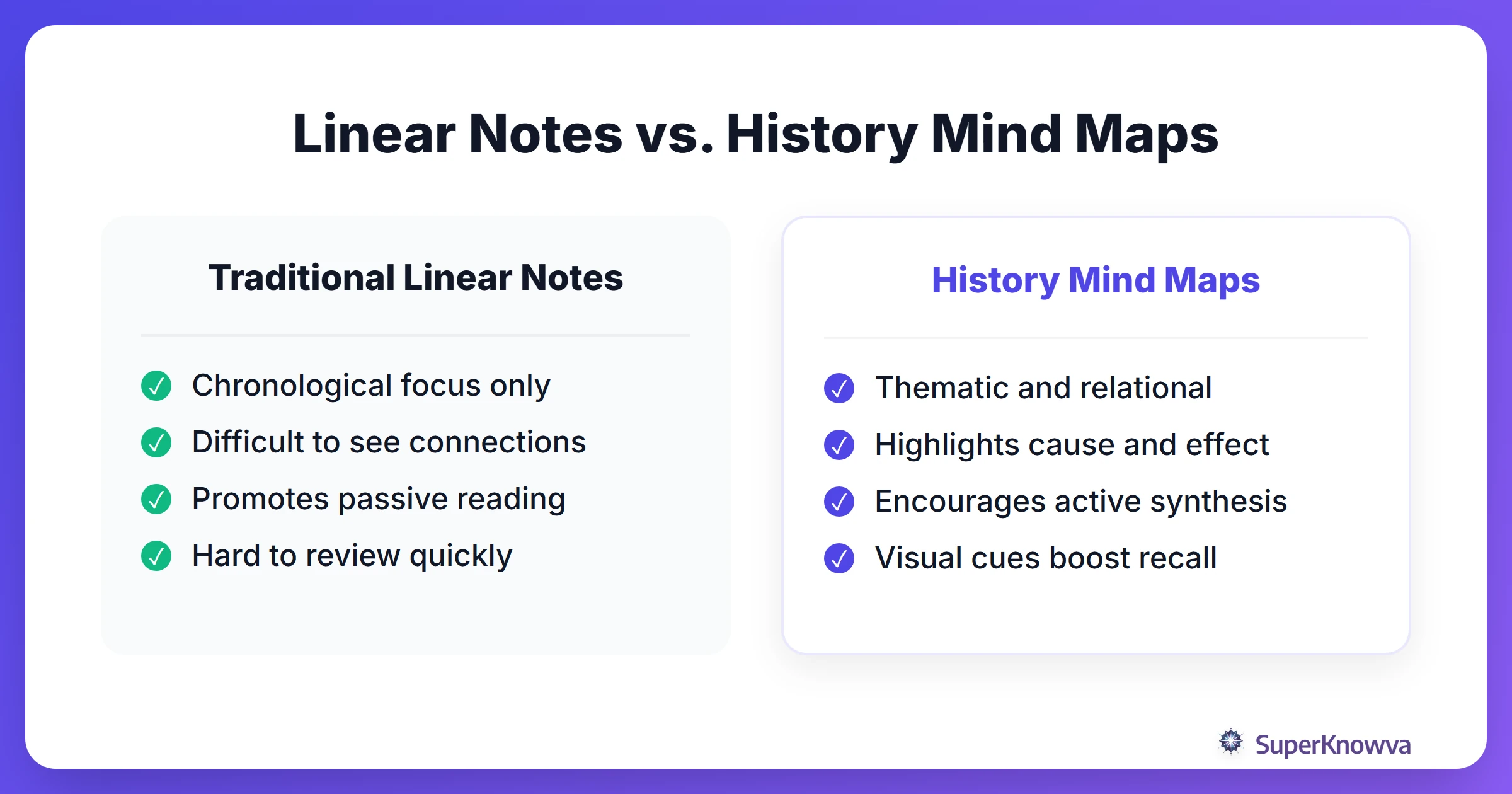
Traditional note-taking is usually a straight line from top to bottom, start to finish. While that is fine for a grocery list, it fails to capture the nuances of historical analysis. History is not isolated. An economic crash in one country might spark a revolution in another, which then flips the entire culture on its head.
Our brains aren't actually wired for vertical lists. Based on Tony Buzan mind mapping research, the brain processes information much faster when it’s radiant and interconnected. By using visual note taking for social science, you move from passive reading to active structural understanding. Instead of just reading about the Cold War, you’re physically drawing the friction between superpowers. You’re seeing the geopolitical tension, not just memorizing it.
The Anatomy of a History Mind Map
Think of your mind map like a tree. The trunk is your core topic, the big branches are your major themes, and the leaves are the small details that get you those extra marks.
- The Central Theme: Start with a specific era, conflict, or movement (e.g., "The Industrial Revolution").
- Primary Branches: Use broad categories. In history, the "PERSIA" model (Political, Economic, Religious, Social, Intellectual, Artistic) is a lifesaver. It ensures you don't miss a single angle.
- Sub-Branches: This is where you get into the weeds. Detail the specific events, key players like Napoleon or MLK Jr., and those crucial dates.
- Color-Coding and Icons: Don't skip the aesthetics. Using one color for "Causes" and another for "Consequences" acts as a massive memory trigger when you’re sitting in the exam hall.
If you’re new to this, take a quick look at our guide on Mind Mapping 101 to get the basics down before you tackle complex historical periods.
Step-by-Step: Mapping Your Way to an A
Ready to build your own? This is one of the most effective study strategies for history finals. Just follow these four steps:
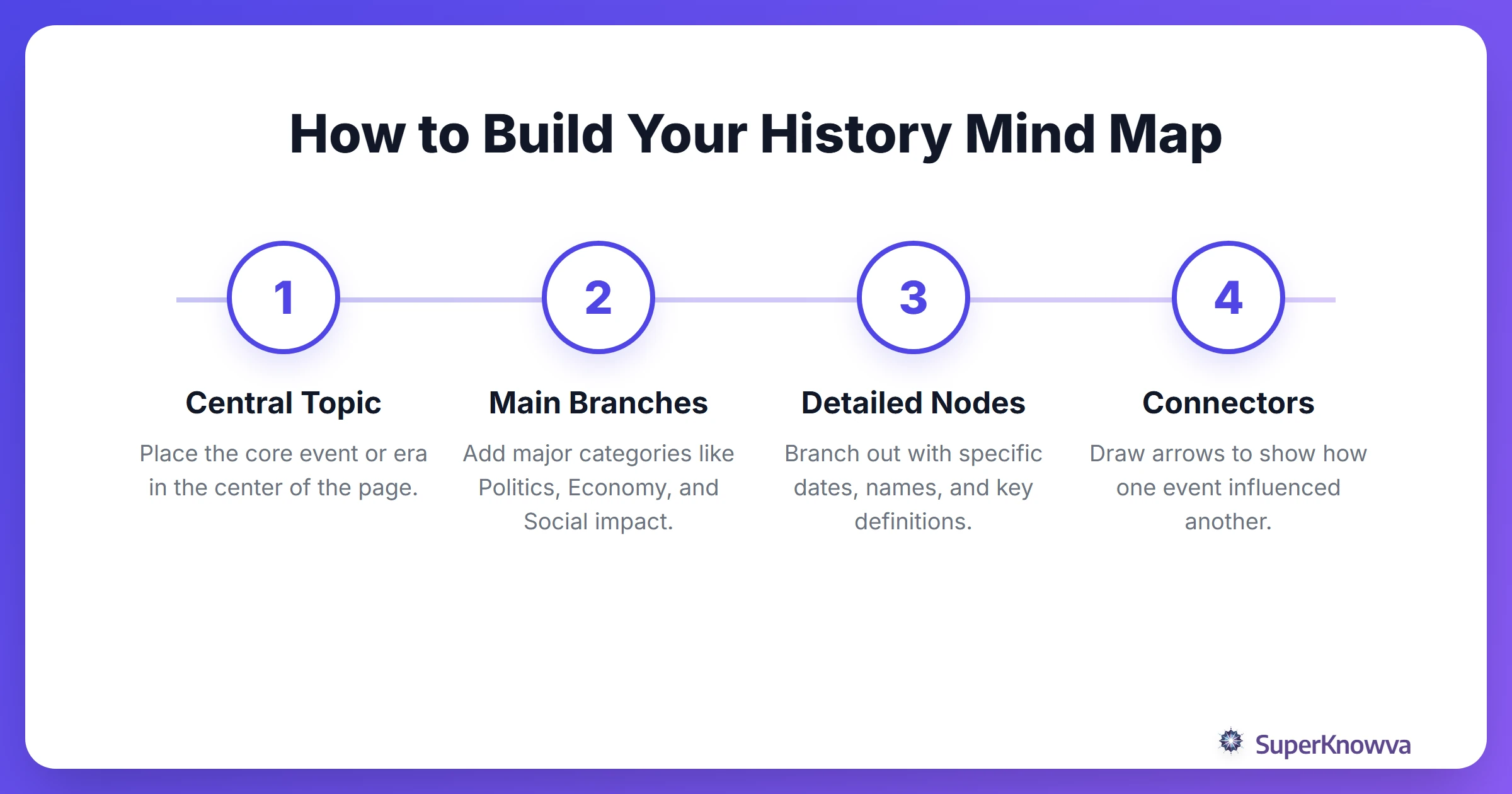
- Step 1: Identify your bullseye. What’s the main prompt? If you’re studying the French Revolution, that goes dead center.
- Step 2: Brainstorm the 'Big Picture'. What were the immediate triggers? What was the Reign of Terror? What was the final legacy?
- Step 3: Connect the dots. Use arrows to show relationships. Link "Enlightenment Ideas" to "The Declaration of the Rights of Man." These arrows represent the "why" behind the "what."
- Step 4: Cut the clutter. A good mind map isn't a transcript. It should be a concentrated map of high-yield facts. If it’s too crowded, you won’t remember it.
Visualizing Social Science Theories and Frameworks
History is event-driven, but social sciences like Sociology and Psychology focus on theories. Mind mapping is effective here, too. You can use maps to visualize competing frameworks, such as Conflict Theory vs. Functionalism.
By linking specific theorists (like Marx or Durkheim) to their core arguments, you create a mental "filing cabinet." This approach is a key part of Building a Second Brain, where you curate knowledge so it’s ready to use, not just stored away. When you can see competing perspectives side-by-side on a map, those "compare and contrast" essay questions become much less intimidating.
Advanced Techniques: Timelines and Cause-Effect Chains
Want to level up? Try merging a timeline with your mind map. Create a central "time-spine" and branch out thematically from specific dates. It gives you the best of both worlds: chronological order and thematic depth.
Use this to visualize "The Domino Effect" and how one event, like the assassination of Archduke Franz Ferdinand, cascaded into a global war. Whether you prefer hand-drawing or digital tools, these maps provide a structure for an essay. You can check out history mind map examples online to see how others balance timelines with branching.

Visual structures lead to much higher retention. Research into the science of mind mapping suggests that since 90% of info sent to the brain is visual, these maps help you review up to 40% faster. To boost your efficiency even more, try Interleaving Practice by switching between different mind maps in one study session.
Integrating Mind Maps with Active Recall
A mind map is a useful tool, but it becomes more effective when you add active recall history techniques. Don't just stare at your map. Test yourself with it.
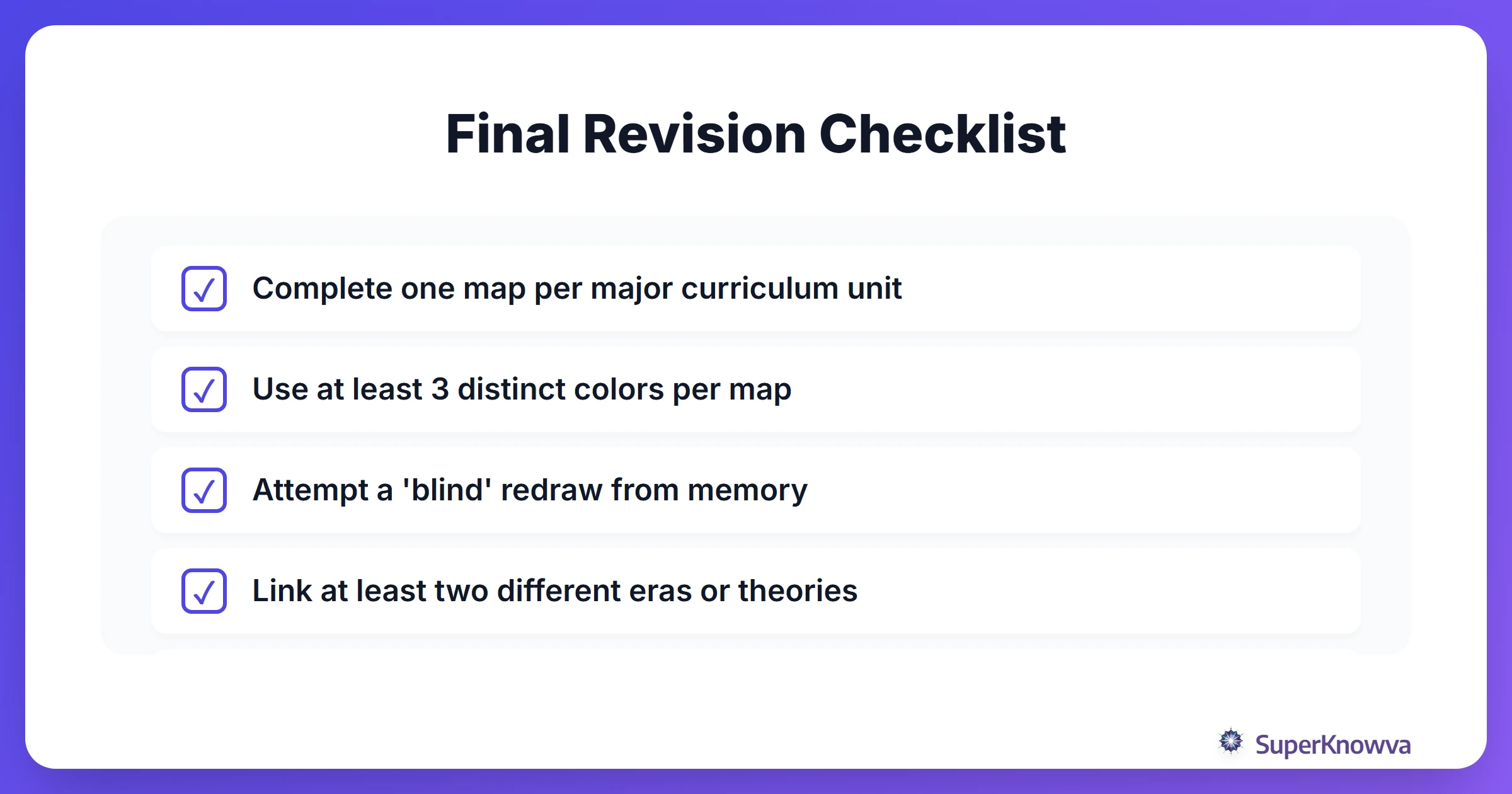
Try The Blurting Method. Look at your central topic, then try to recreate your entire mind map on a blank sheet of paper from memory. When you’re done, compare it to the original. The spots where your branches are thin or missing? Those are your "knowledge gaps." Now you know exactly what to study, saving you hours of pointless highlighting.
By combining visual maps with active testing, you aren't just preparing to pass; you are preparing to master the material. Grab your pens (or your tablet) and start connecting the dots.