It’s July. The sun is out, the AC is humming, and everyone you know seems to be posting photos from a beach or a hiking trail. Meanwhile, you’re staring at a textbook or a laptop screen, trying to make headway on summer courses or early exam prep. It’s brutal. Staying productive when the rest of the world is on vacation is an uphill battle, but when your phone is sitting right next to you? It’s practically impossible.
If you reflexively reach for your phone every time a paragraph gets difficult, you aren't lacking "willpower"; you're fighting a rigged game. Focus on reducing digital distractions.
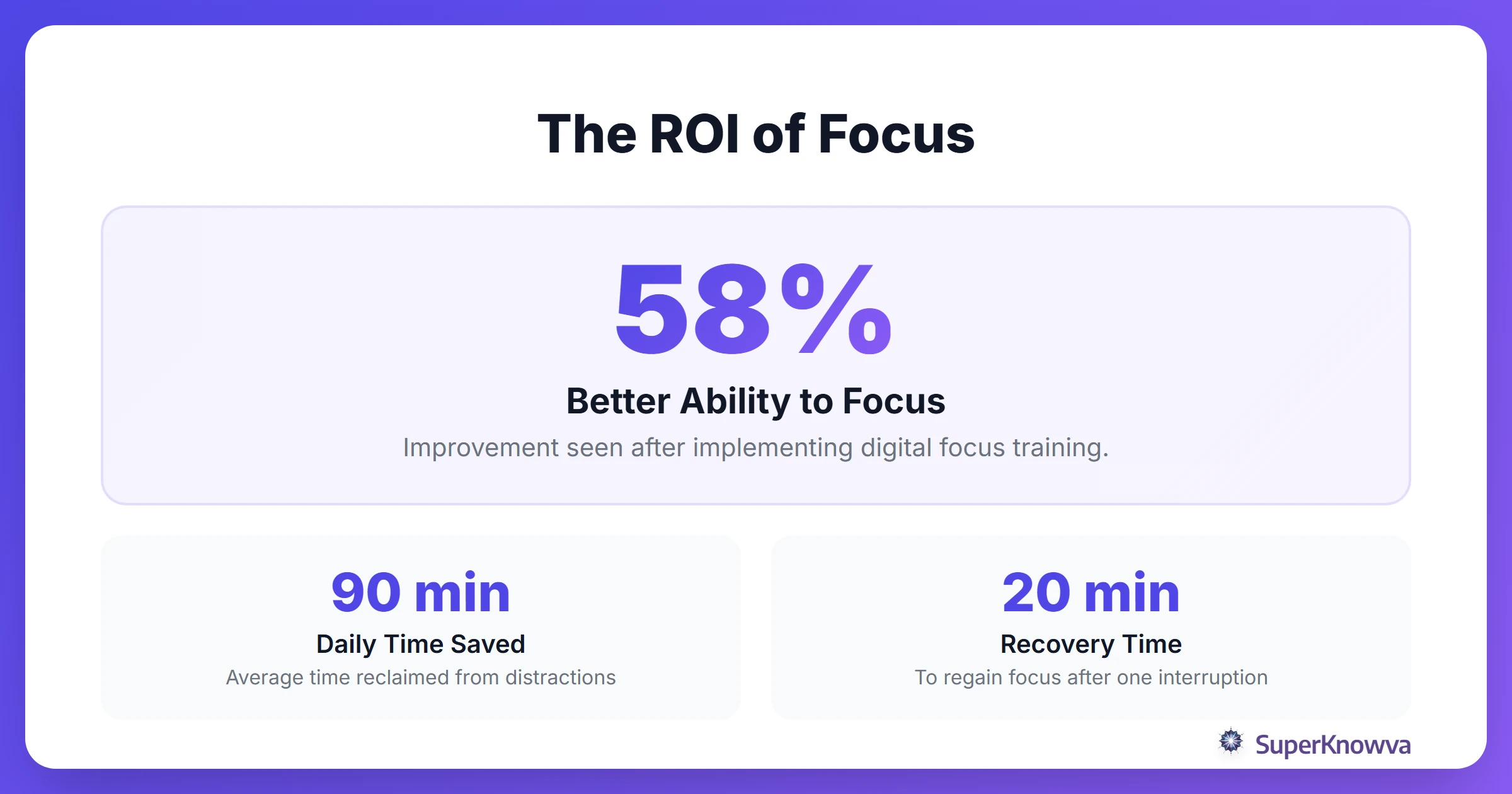
In this guide, we’ll look at how to reclaim your focus, boost your summer study productivity, and claw back over 90 minutes of wasted time every single day. Adopting a philosophy of digital minimalism for students is the first step toward getting your brain back.
The Hidden Cost of the "Quick Check"
We’ve all been there. You’re in the middle of a complex math problem or a dense reading, and you decide to take a "quick check" of your notifications. You tell yourself it’ll only take thirty seconds. But the reality is much more damaging to your focus than those thirty seconds suggest.
Neuroscientists call this the context switching cost. Every time you shift your attention from a high-concentration task to a low-value digital distraction, your brain has to expend massive amounts of energy to "re-load" where you left off. Based on over 10 years of peer-reviewed ReDD Focus research at the University of Oxford, we know that using curated tools makes it significantly easier to redesign your digital life and stop these energy drains before they start.
Research shows that "just five minutes" on social media usually results in a 20-minute lag before you return to a state of deep focus. Essentially, your "quick check" is stealing your entire afternoon.
Perform a Digital Audit of Your Study Space
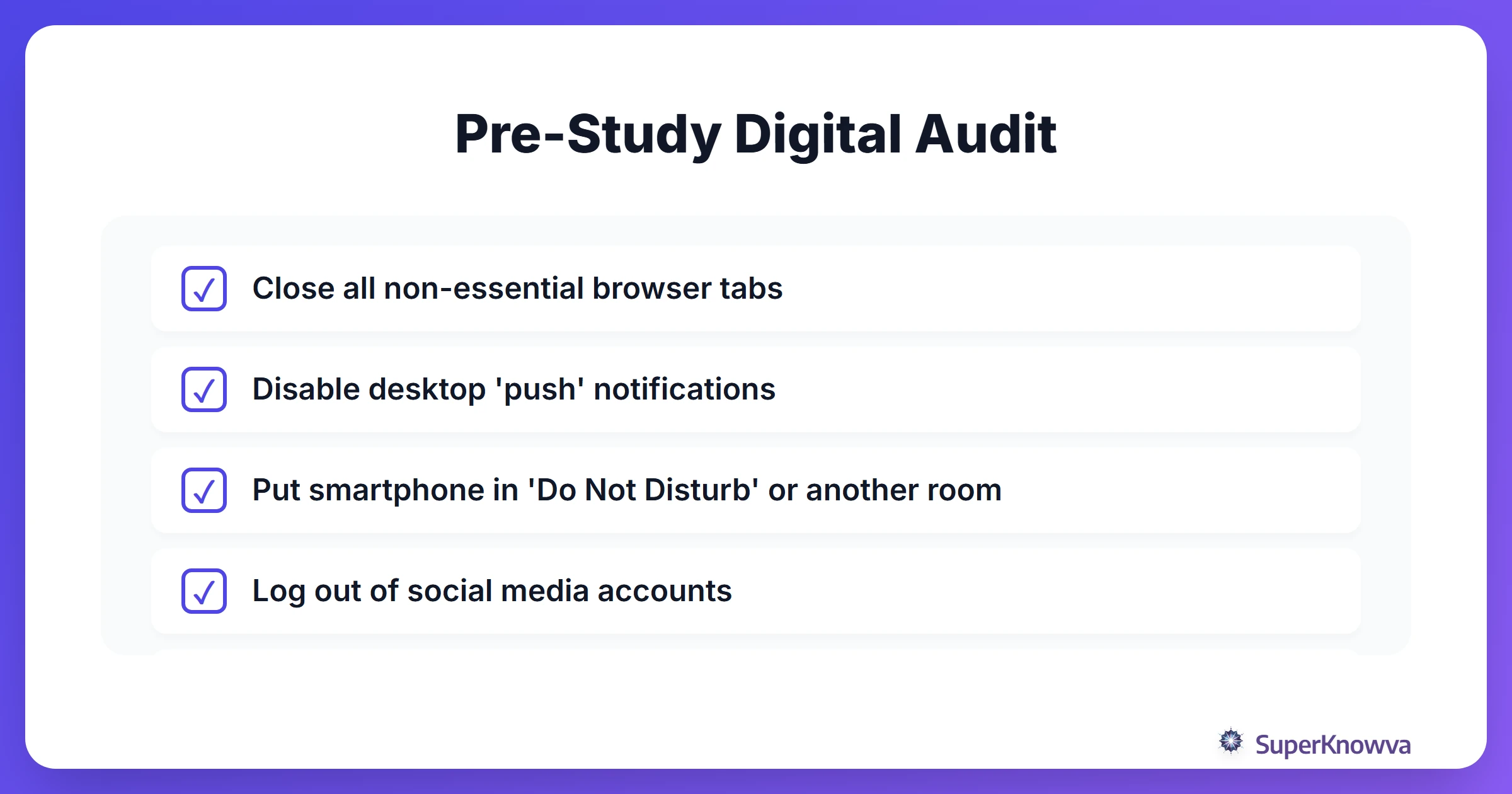
Before you even open a textbook, you need to plug the "digital leaks" in your environment. These are the small, often unnoticed interruptions that yank you out of the zone. Common culprits? Desktop "push" notifications, a cluttered taskbar, and those 15 unrelated browser tabs you’ve had open since last night.
To fix this, perform a quick digital audit. Categorize your apps and tabs into three buckets:
- Essential: Tools you need for the current task (e.g., your SuperKnowva dashboard).
- Utility: Tools that support the work but aren't the main focus (e.g., a calculator or a dictionary).
- Distraction: Everything else (Social media, news, YouTube, Discord).
Organizing your digital life is much easier when you are Building a Second Brain to manage your resources efficiently.
Leveraging Tactical Blocking Tools
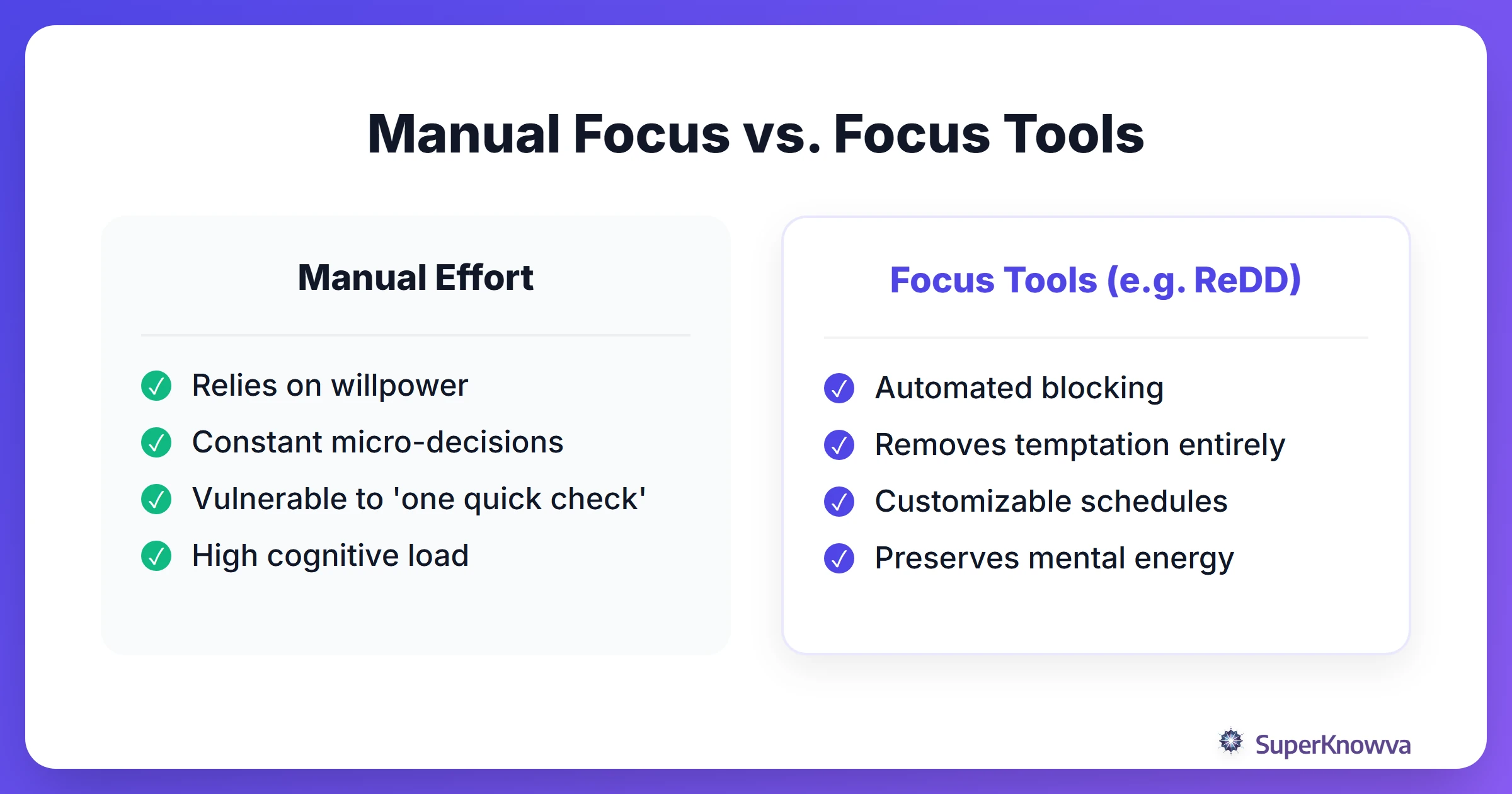
Willpower is a finite resource. If you rely solely on "grit" to stay off TikTok, you will eventually fail, especially during a July heatwave when your mental energy is low. This is where focus tools for students are essential.
Instead of fighting the urge to browse, use tactical blockers to make the decision for you. Open-source tools like ReDD Focus or various browser extensions can scrub distracting feeds, Shorts, and Reels during your designated study hours. By setting "hard blocks" on high-distraction sites, you preserve your mental energy for actual learning.
The Reddit Strategy: Swapping Content for Flow
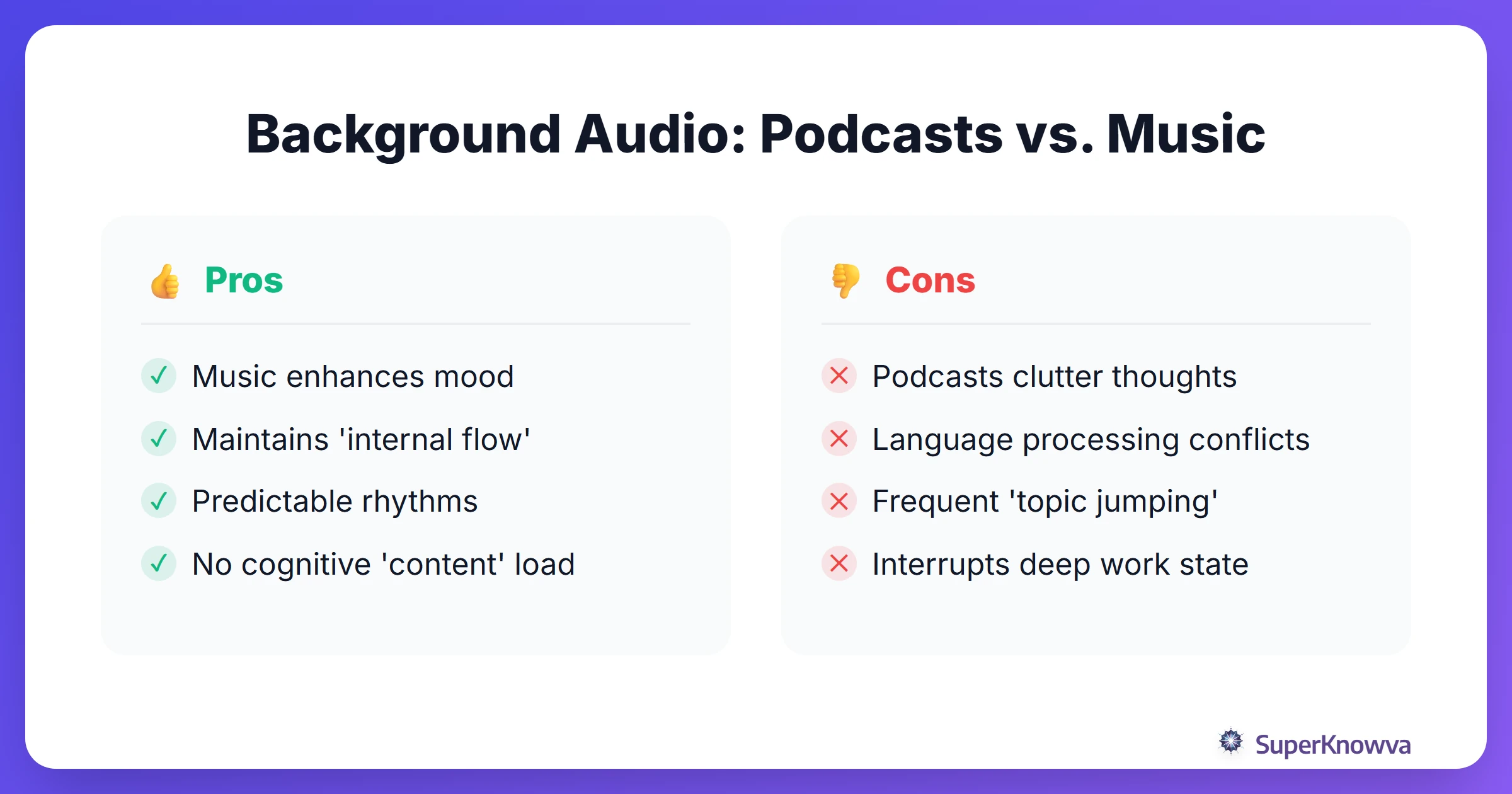
A common strategy discussed among high-performance students on platforms like Reddit is the shift from "content-heavy" background noise to "flow-inducing" audio.
Many students listen to podcasts or the news while studying, but this is a mistake for complex problem-solving. Podcasts require language processing, which competes with the same part of your brain you use to read or write. This "content" interrupts the inner monologue you need for deep work. Instead, try instrumental or lo-fi playlists. They provide a rhythmic backdrop that supports your mood without cluttering your mind.
Building a Deep Work Ritual for Summer
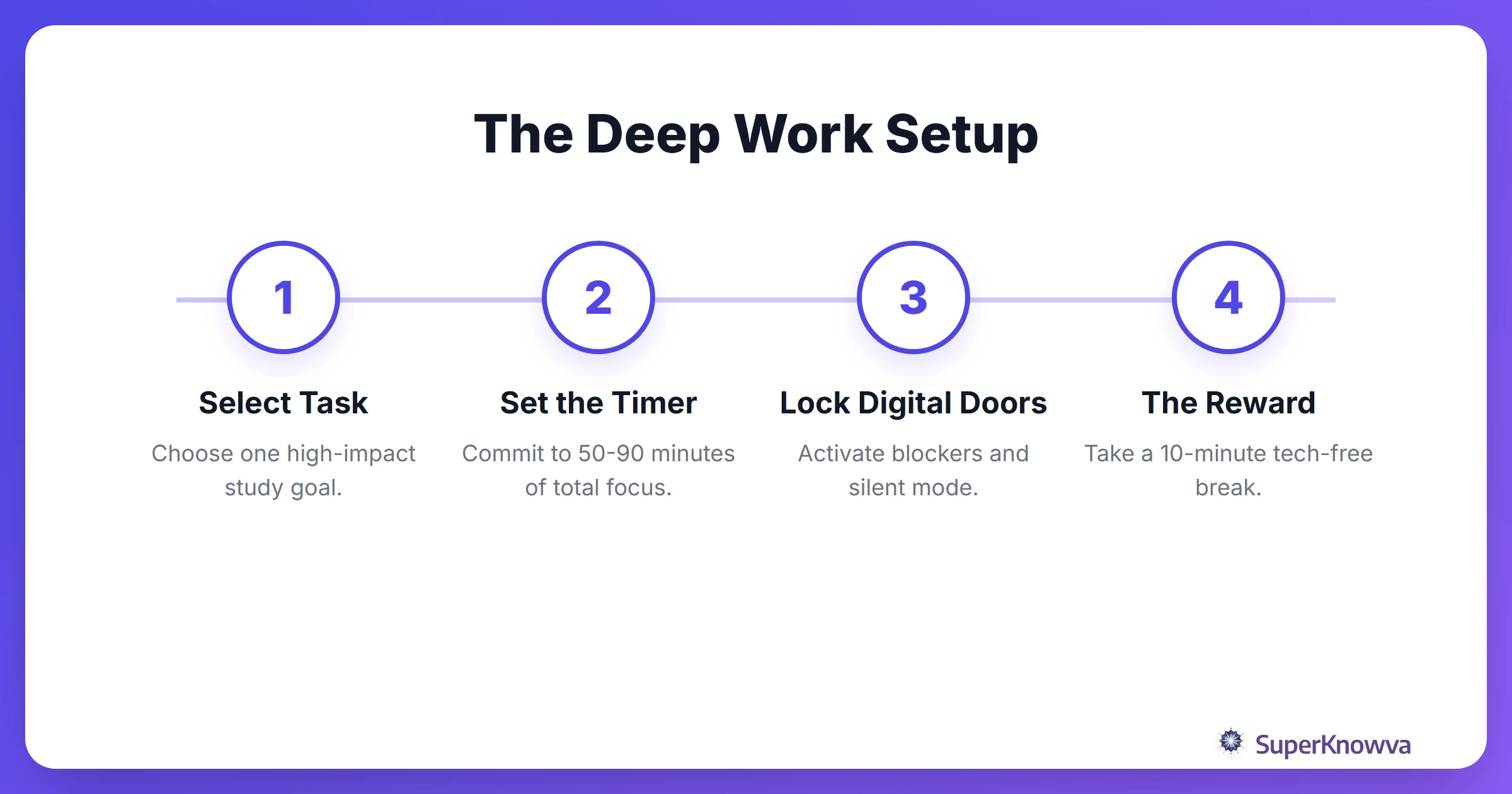
To master difficult concepts, you need to implement Deep Work for Students. This starts with a ritual: a specific set of actions that signals your brain to focus.
Define clear boundaries for "Online" vs. "Offline" study blocks. For example, if you are reading a physical textbook, your laptop should be closed and your phone should be in another room entirely. This eliminates the "mere presence" effect: the proven theory that even the sight of a smartphone reduces your cognitive capacity.
When deciding how to structure your distraction-free blocks, consider checking out Pomodoro vs. Flowtime to see which fits your rhythm better. You can also use gamified tools like the Forest app to provide visual feedback on your progress and keep you away from your phone.
Mindful Tech: Values Over Notifications
Reducing digital distractions is a mindset shift. It’s about moving from "reactive" mode, where you jump every time your phone pings, to "proactive" mode, where you dictate your own schedule.
During the summer, FOMO (Fear Of Missing Out) is at an all-time high. You might feel like you’re missing the party of the century every time you put your phone away. However, experts suggest that we have to stop valuing constant updates if we want to improve our concentration.
Instead of reacting to every notification, set specific "window times" (like 12:00 PM and 6:00 PM) to check all your messages and social feeds. This lets you stay connected without sacrificing your goals.
By implementing these deep work study strategies, you will study faster and better. Focus on your work without distractions and give your brain the space it needs to succeed.