
Ever feel like your brain starts to melt around hour six of a study session? We’ve all been there. You’re prepping for the MCAT, finals, or a massive certification, and you've spent the last eight hours staring at a screen until the words start to blur. It’s exhausting, it’s frustrating, and honestly, it’s a recipe for total burnout.
But what if you didn’t have to "power through" the exhaustion? By mastering the pomodoro technique for studying, you can stop treating your study day like a grueling mountain climb and start treating it like a series of manageable, high-intensity sprints.
This guide covers how to adapt this classic time-management tool for the long haul and how AI tools like SuperKnowva help you maintain focus throughout the day.
What is the Pomodoro Technique? The Tomato That Changed Everything
Back in the late 80s, a university student named Francesco Cirillo was struggling to stay focused. He grabbed a kitchen timer shaped like a tomato (pomodoro in Italian), set it for a few minutes, and committed to working until it rang. It worked.
The philosophy is simple: stop fighting against the clock and start working with it. Instead of facing a scary 8-hour block of "Study Time," you break your day into small, digestible intervals.
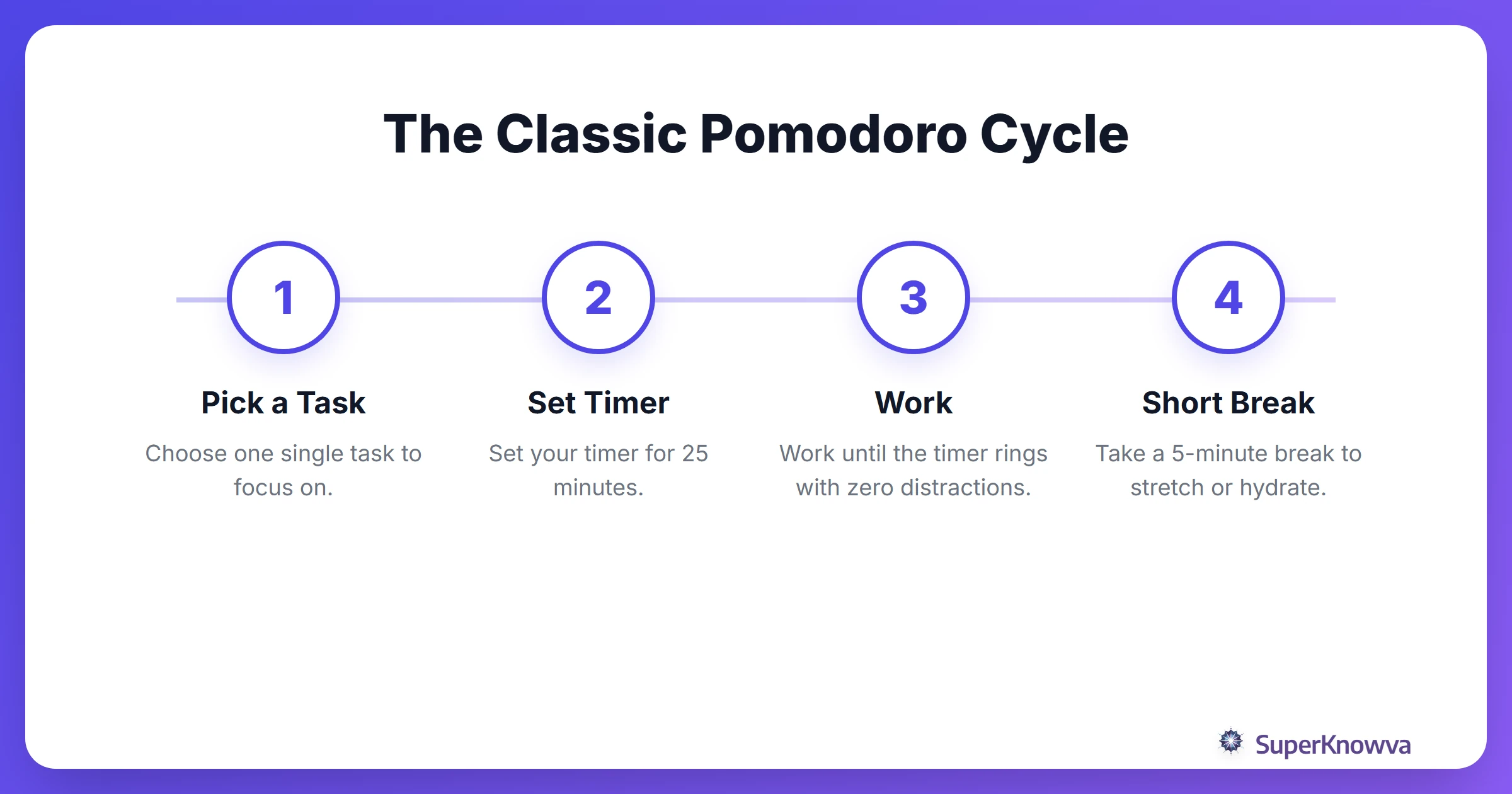
The classic structure looks like this:
- 25 minutes of deep, distraction-free work.
- 5 minutes of total rest.
- A longer break (15–30 minutes) once you’ve finished four cycles.
That ticking timer creates a gentle sense of urgency that keeps you on task, while the frequent breaks prevent that heavy "mental fog" from settling in.
The Science of Focus: Why 25 Minutes is the Sweet Spot
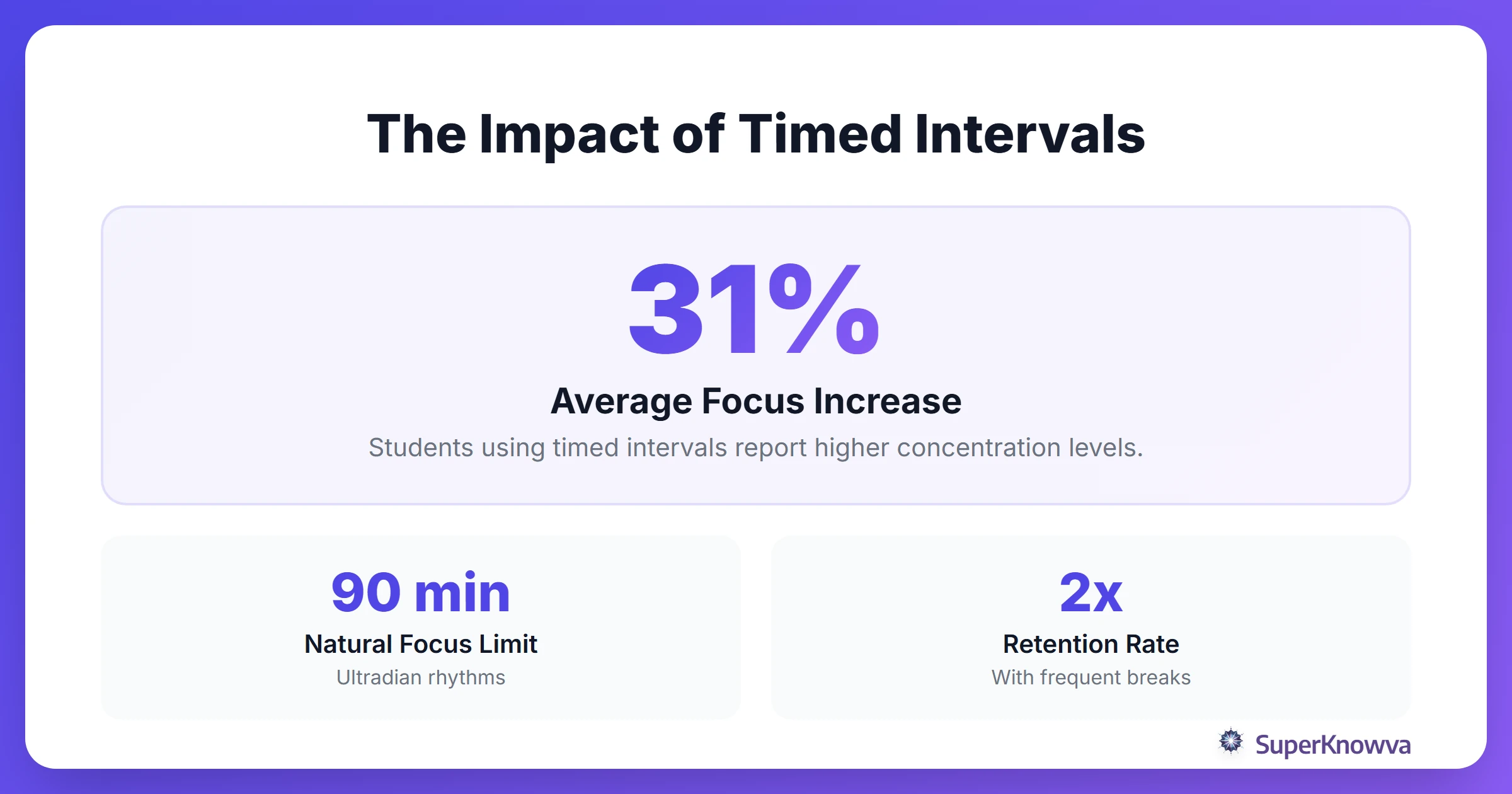
Is the pomodoro technique for studying actually backed by science, or is it just a trend? Your brain has a "battery" for focus, specifically in the prefrontal cortex.
When you try to focus on one thing for hours without a break, you hit "cognitive boredom." Your brain starts to tune out the information, a drop-off known as vigilance decrement.
Think of a short break as a "reset" button. It gives your subconscious a moment to breathe and consolidate what you just learned. Plus, let’s be real: it’s much easier to start a difficult chapter when you know a break is only 25 minutes away. It’s a simple, effective way of Overcoming Procrastination.
Adapting Pomodoro for 8-Hour Marathon Days
The standard 25/5 split is great for knocking out an essay, but for a full 8-hour marathon, it can feel a little... choppy. If you’re tackling complex physics or deep medical concepts, you need time to get into a "flow state."
For long days, many students use the "Long Pomodoro": a 50/10 split. You get 50 minutes of focused work and a 10-minute break to stretch and recover.
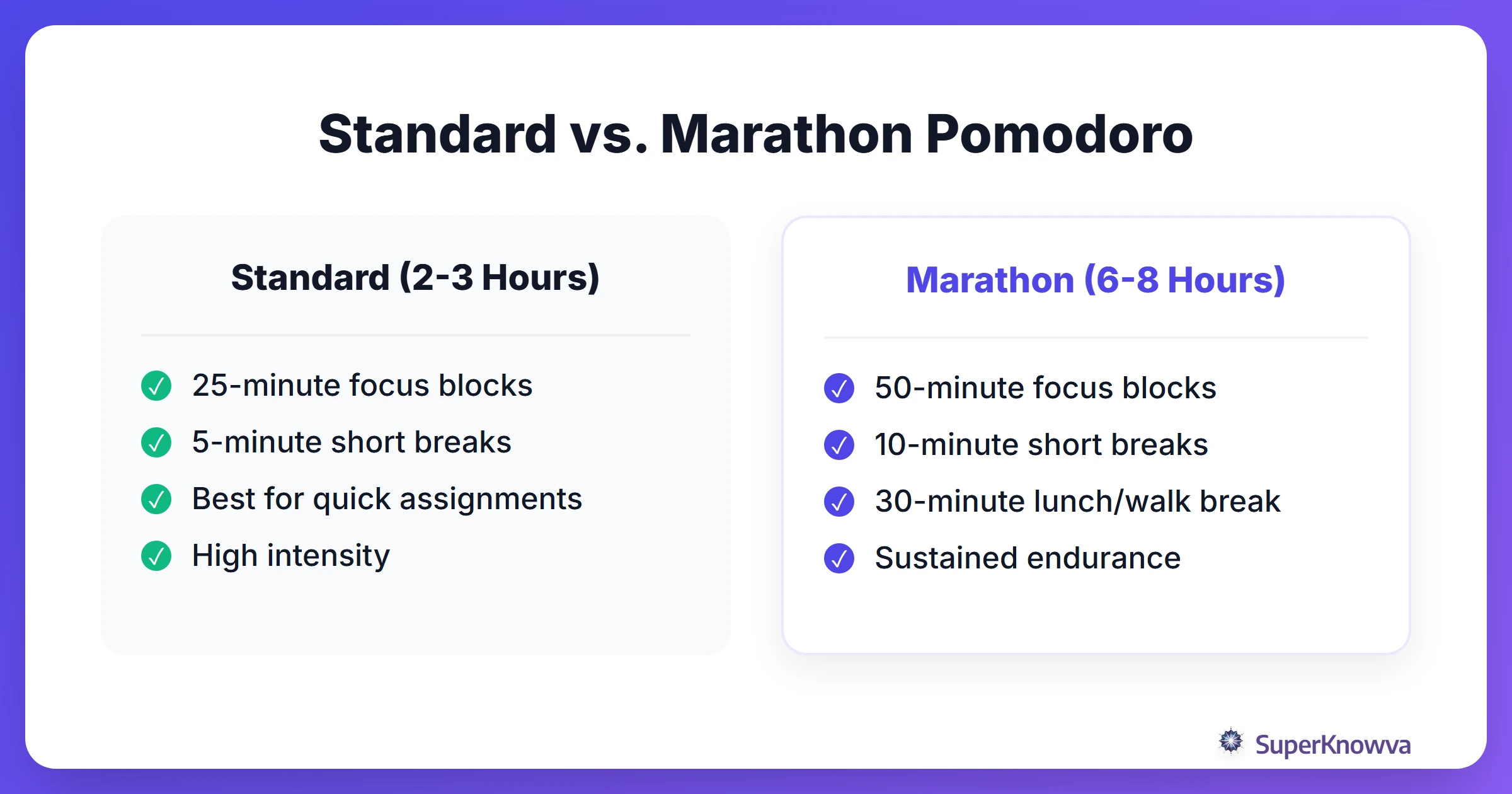
Here is how to map out a productive 8-hour day:
- Block 1 (2 Hours): Two 50/10 cycles. Tackle your hardest, most "brain-draining" topic first.
- The Big Reset: Take 30 minutes. Get away from your desk.
- Block 2 (2 Hours): Two 50/10 cycles.
- Lunch: 60 minutes. Eat, hydrate, and put the phone away.
- Block 3 (2 Hours): Two 50/10 cycles.
- Block 4 (2 Hours): Two 50/10 cycles. Use this final stretch for active recall and self-testing.
Need more tips on staying in the zone? Check out our guide on Deep Work for Students.
What to Do During Breaks: The "Junk Rest" Trap
The biggest mistake you can make? Spending your 10-minute break scrolling through TikTok. We call this "junk rest." It doesn't actually recharge your brain; it just fills it with more digital noise and blue light.
To survive an 8-hour day, you need active recovery.
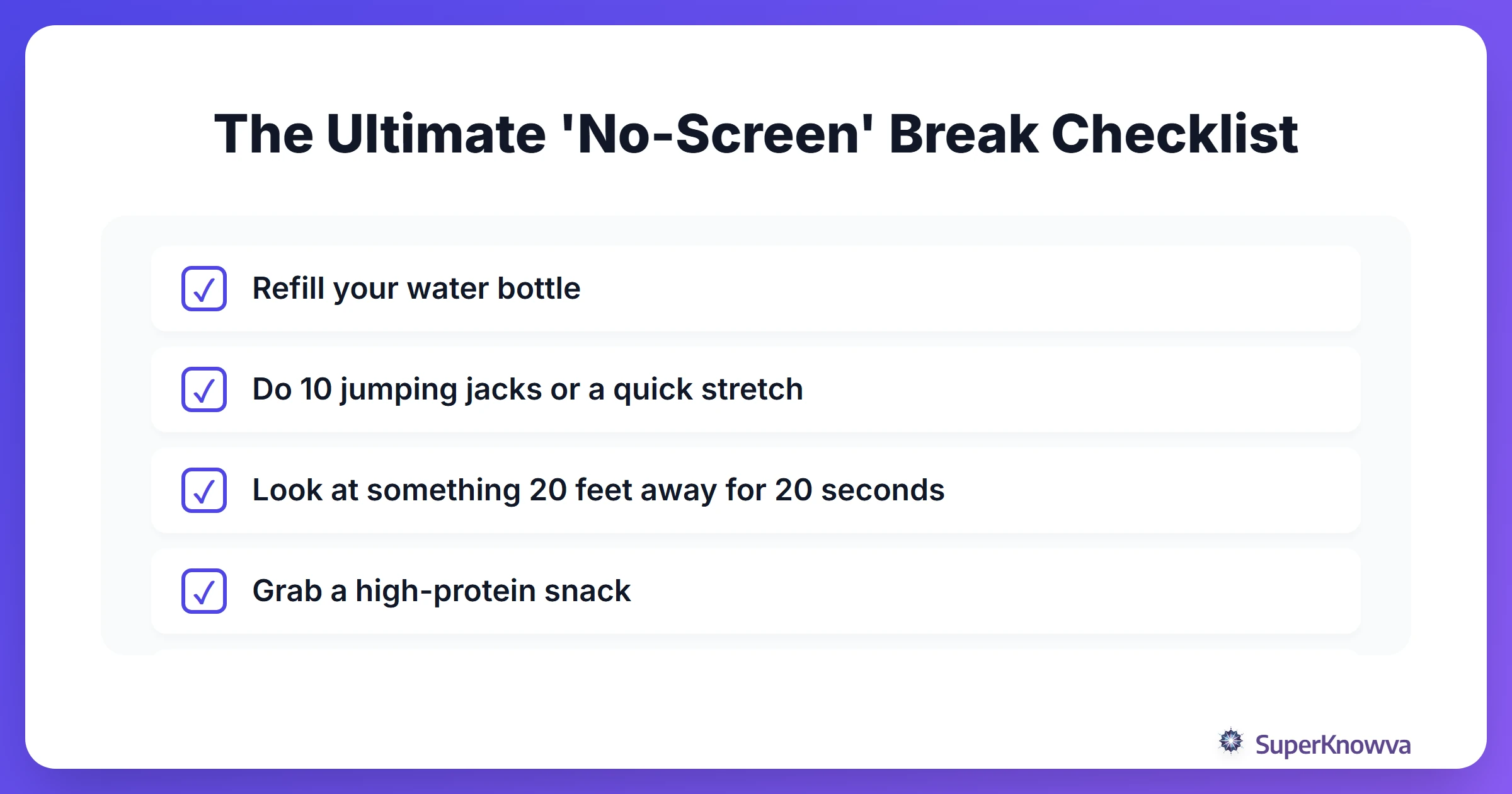
- The 20-20-20 Rule: Every 20 minutes (or during every break), look at something 20 feet away for 20 seconds. Your eyes will thank you.
- Get Moving: Blood flow is brain power. Do some air squats, stretch your neck, or just pace around the room.
- Hydrate: Brain fog is often just hidden dehydration. Drink water every time the timer goes off.
Practicing Digital Minimalism during these windows is the secret to making it to hour eight without feeling like a zombie.
AI-Enhanced Pomodoro: Predicting the Wall
We’re entering an era where you don't have to guess when you're getting tired. AI is changing time management for students by making it personalized.
When your quiz scores on SuperKnowva start to dip or your response time slows down, AI can suggest a "Dynamic Interval." This tells you to take a break now because you’re hitting a wall, rather than waiting for a timer to tell you.
At SuperKnowva, we help you make those 50-minute work blocks count. Instead of just passively reading, our platform generates personalized quizzes from your notes, ensuring you're using high-impact active recall during your Pomodoro sessions.
Wondering how this compares to other styles? Read our breakdown of Pomodoro vs. Flowtime.
Common Pitfalls: Don't Let the Timer Rule You
No system is perfect. To make this work, you have to be flexible:
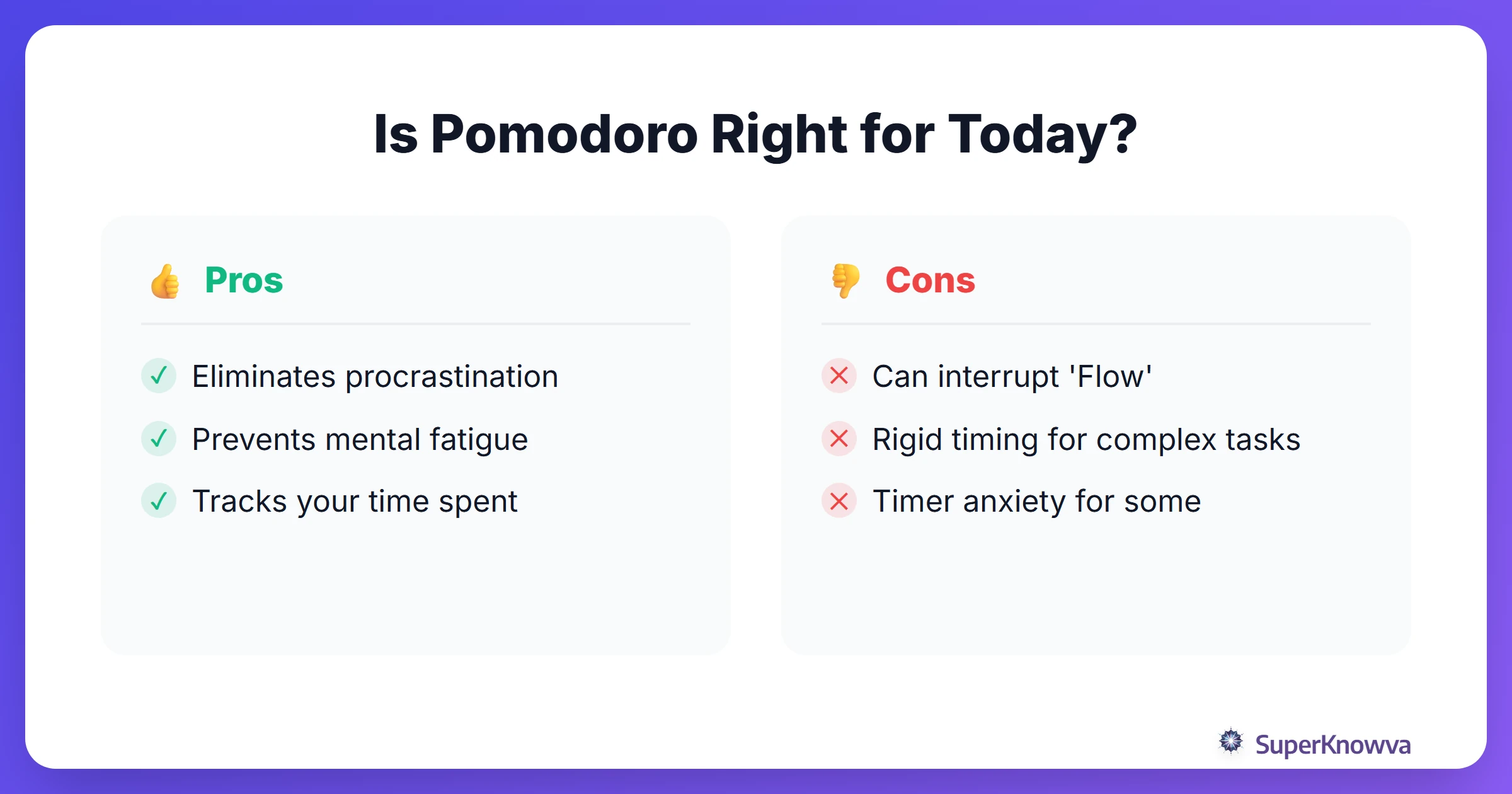
- Respect the Flow: If the timer rings but you’re finally "in the zone" and the work feels effortless, keep going! Just make sure you take a longer break later to pay back that "focus debt."
- Protect the Tomato: If someone interrupts you, the cycle is broken. Reset the timer.
- Don't Skip the Rest: You might feel like a hero for skipping a break to finish a chapter, but you’ll pay for it in hour seven when your brain shuts down completely.
Final Thoughts
Surviving a marathon study day isn't about having superhuman willpower; it’s about having a better strategy. By using the pomodoro technique for studying, you’re protecting your mental energy and making sure every hour at your desk actually moves the needle.
Ready to try your first session? Grab a tool like Pomofocus to keep time, and see what other students are saying about their schedules on Reddit.
Combine these focus strategies with SuperKnowva’s AI-powered tools, and you’ll find that 8-hour days aren't just doable; they’re where you do your best work.