Ever spent three hours "studying" only to realize you mostly just reorganized your desktop folders and stared at a single page of Organic Chem? This happens often. Most academic burnout doesn't happen because you aren't smart enough to handle the workload; it happens because your schedule has no skeleton.
Mastering time blocking for full-time students is the ultimate shift. It’s about moving from a state of constant, low-level anxiety to a clear, high-performance roadmap. In this guide, we’re moving past basic calendars to explore the advanced techniques that actually help you win your semester back.
The Core Philosophy: "When," Not "What"
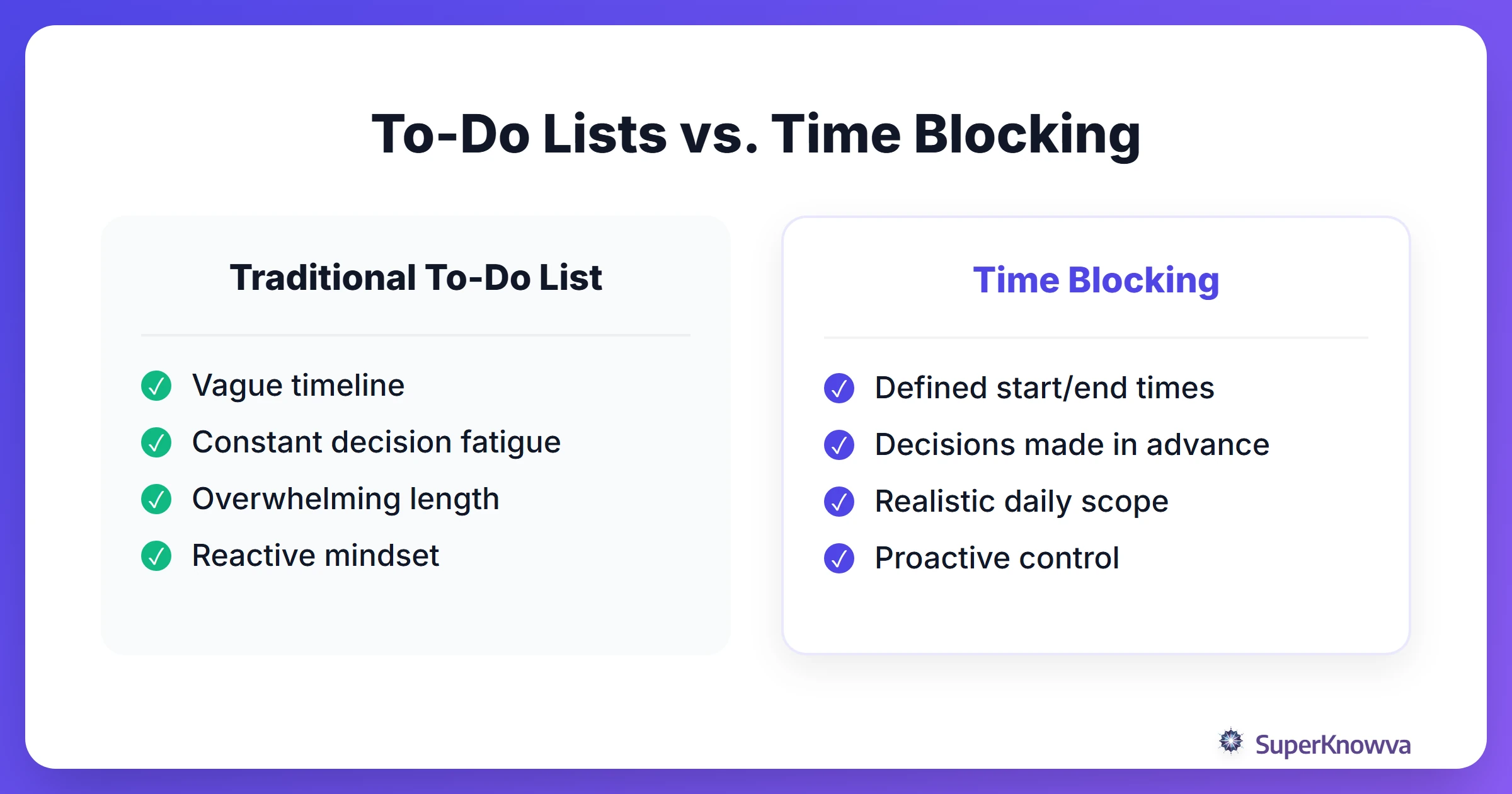
Most students live in a reactive state. You check your syllabus only when a deadline starts screaming at you, or you stare at a massive, overwhelming to-do list until you're too paralyzed to start. This "to-do list" mentality is the silent killer of academic productivity. Why? Because a list doesn't account for your most precious resource: time.
Time blocking turns your to-do list into a "when-to-do" list. By giving every task a dedicated home on your calendar, you create a "closed list." This provides immediate psychological relief. When you know "Organic Chemistry Chapter 4" is officially happening Tuesday at 2:00 PM, your brain can finally stop worrying about it on Monday night.
Standard schedules often fail because they treat every hour the same. Advanced time blocking is different. It acknowledges that the brainpower needed for a physics problem set is miles away from the energy needed to check your email.
The Three-Tier Categorization System
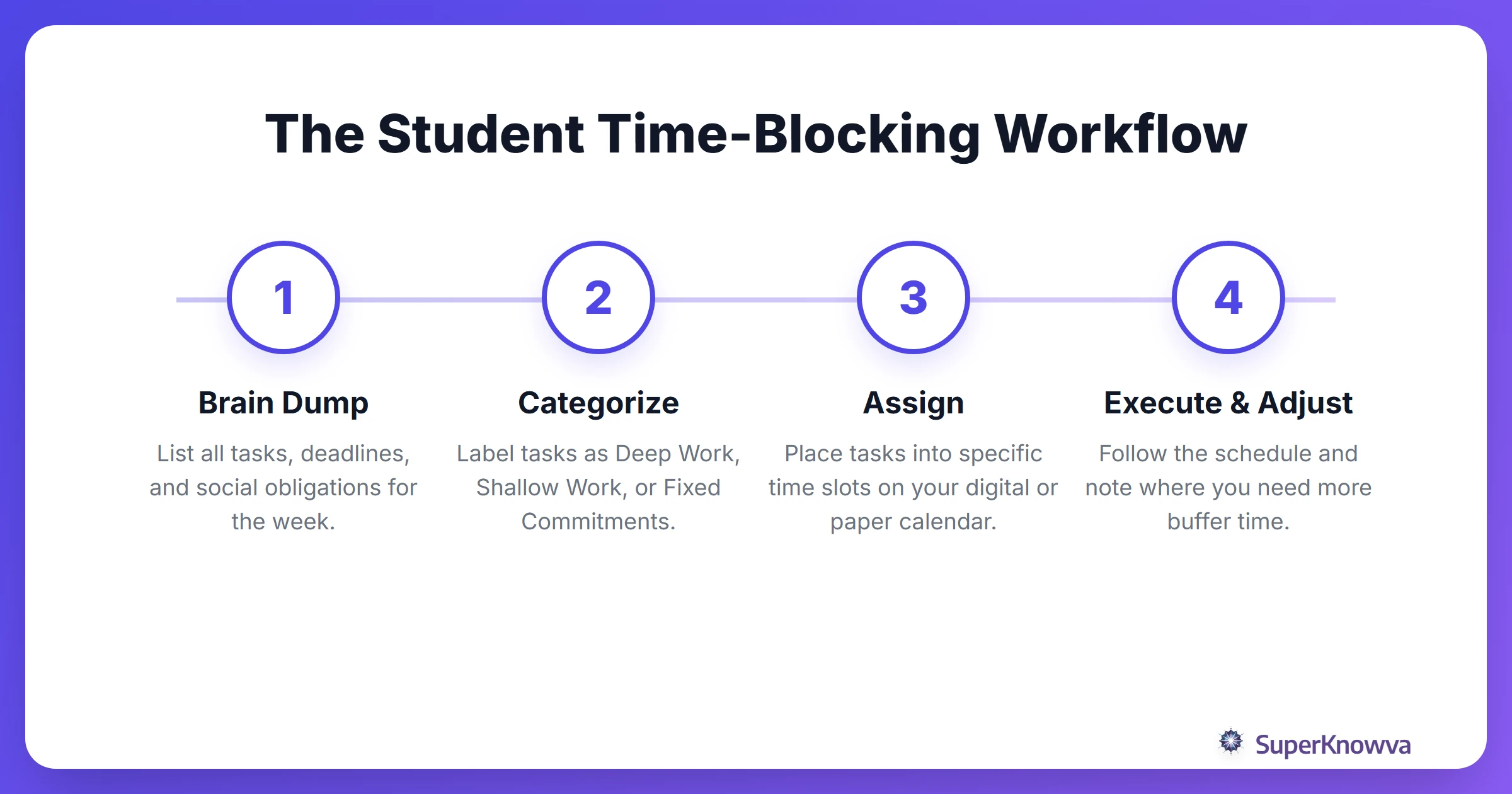
If you want to master student time management, you have to stop treating all tasks as equals. Use this three-tier system to audit your syllabus and map out your week:
- Fixed Blocks: These are your non-negotiables. Lectures, labs, seminars, and your job. These go in first. They are the skeleton of your week.
- Deep Work Blocks: These are for demanding tasks like essay drafting, complex problem sets, or memorizing anatomy. These require 90-120 minutes of total focus. For more on this, check out our guide on Deep Work for Students.
- Shallow Work Blocks: These are administrative tasks. Organizing digital folders, responding to club messages, or formatting a bibliography. These are perfect for 30-minute gaps between classes.
Why You Should Trade Pomodoro for Flowtime
The Pomodoro technique is famous, but for complex academic subjects, it can actually be a hindrance. Breaking every 25 minutes often snaps you out of a "flow state" just as you’re finally starting to understand a difficult concept.
Instead, try Flowtime. This method respects the "ramp-up" period required for difficult topics. You work as long as you are productive and only take a break when your focus naturally begins to dip.
When study schedule optimization is the goal, pay attention to your natural rhythm. Are you an early bird who should use Pomodoro vs. Flowtime during the quiet morning hours, or a night owl who works best after 8:00 PM? Once you find your peak energy window, protect it. Use a "pre-flight" ritual, such as clearing your desk or starting a specific lo-fi playlist, to signal that it is time to work.
The Visual Advantage: Color-Coding Your Vibe
A color coded calendar isn't just about making things look pretty for Instagram; it’s a tool to fight decision fatigue. When you glance at your week, you should instantly recognize the "vibe" of the day without having to read a single word.
Try this scheme:
- Red: Deadlines and Exams (High Urgency)
- Blue: Deep Work (High Focus)
- Yellow: Fixed Commitments (Lectures/Labs)
- Green: Rest and Socializing (Recovery)
Your calendar is a mirror. If you see a week covered in Blue and Red with zero Green, you’re sprinting toward a burnout wall. According to the Akiflow Guide to Student Time Blocking, visual clarity is the first step toward staying motivated for the long haul.
Beating the Planning Fallacy (and ADHD Hurdles)
We are often pathologically optimistic when we plan. This is the "planning fallacy," the tendency to underestimate how long a task will take. We think a lab report will take two hours; it actually takes four.
To fix this, use the 1.5x Rule: take your best guess for a task’s duration and multiply it by 1.5. These "buffer zones" prevent your entire day from collapsing if one session runs over. This is a lifesaver for students dealing with neurodiversity or ADHD, where "time blindness" can make traditional scheduling feel impossible.
And if you miss a block? Don't spiral. Procrastination happens. Instead of throwing the whole day away, just "re-block" your remaining hours. Learning overcoming procrastination is about resilience, not being a robot.
The Sunday Night Review: Your Secret Weapon
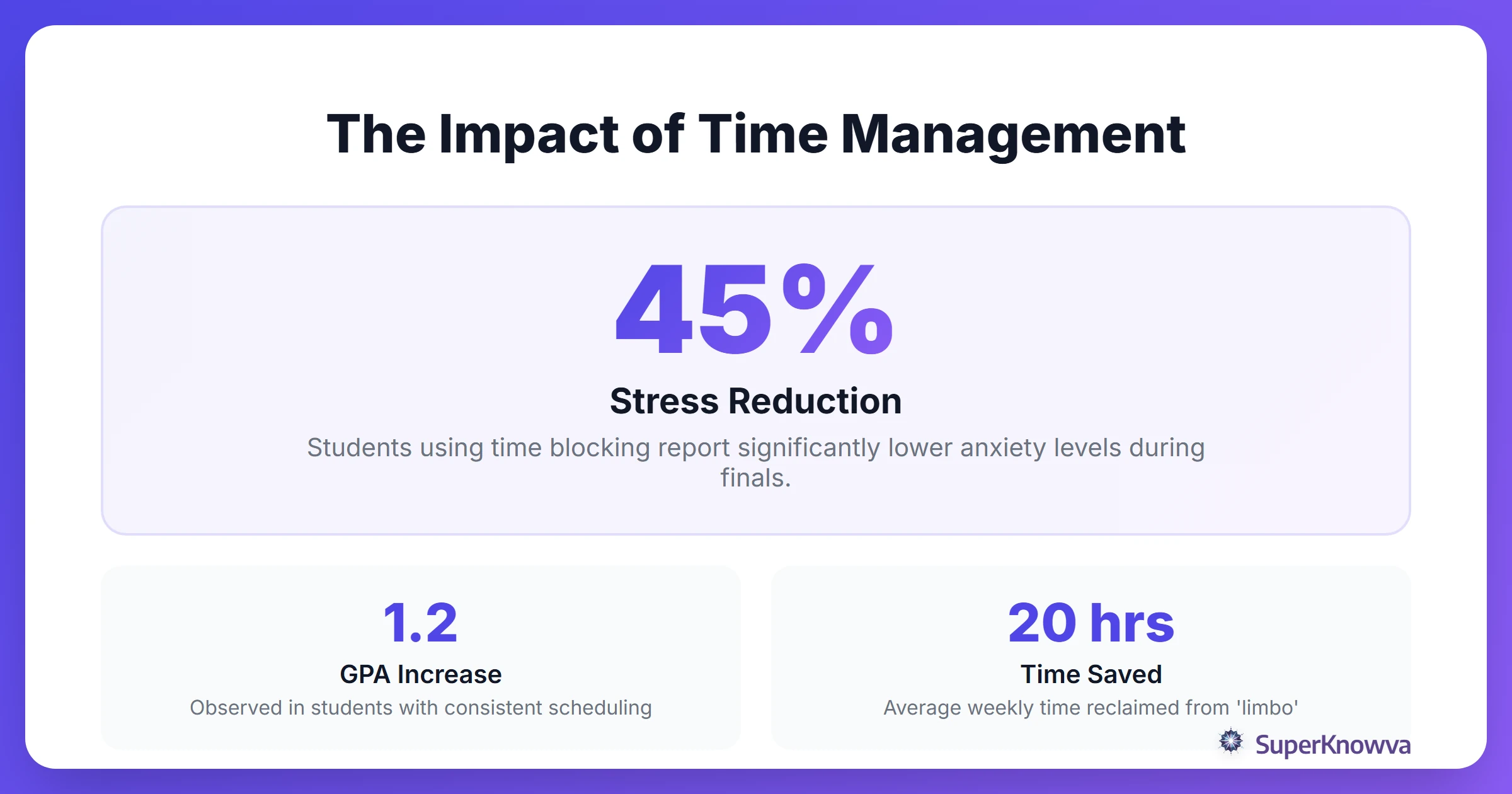
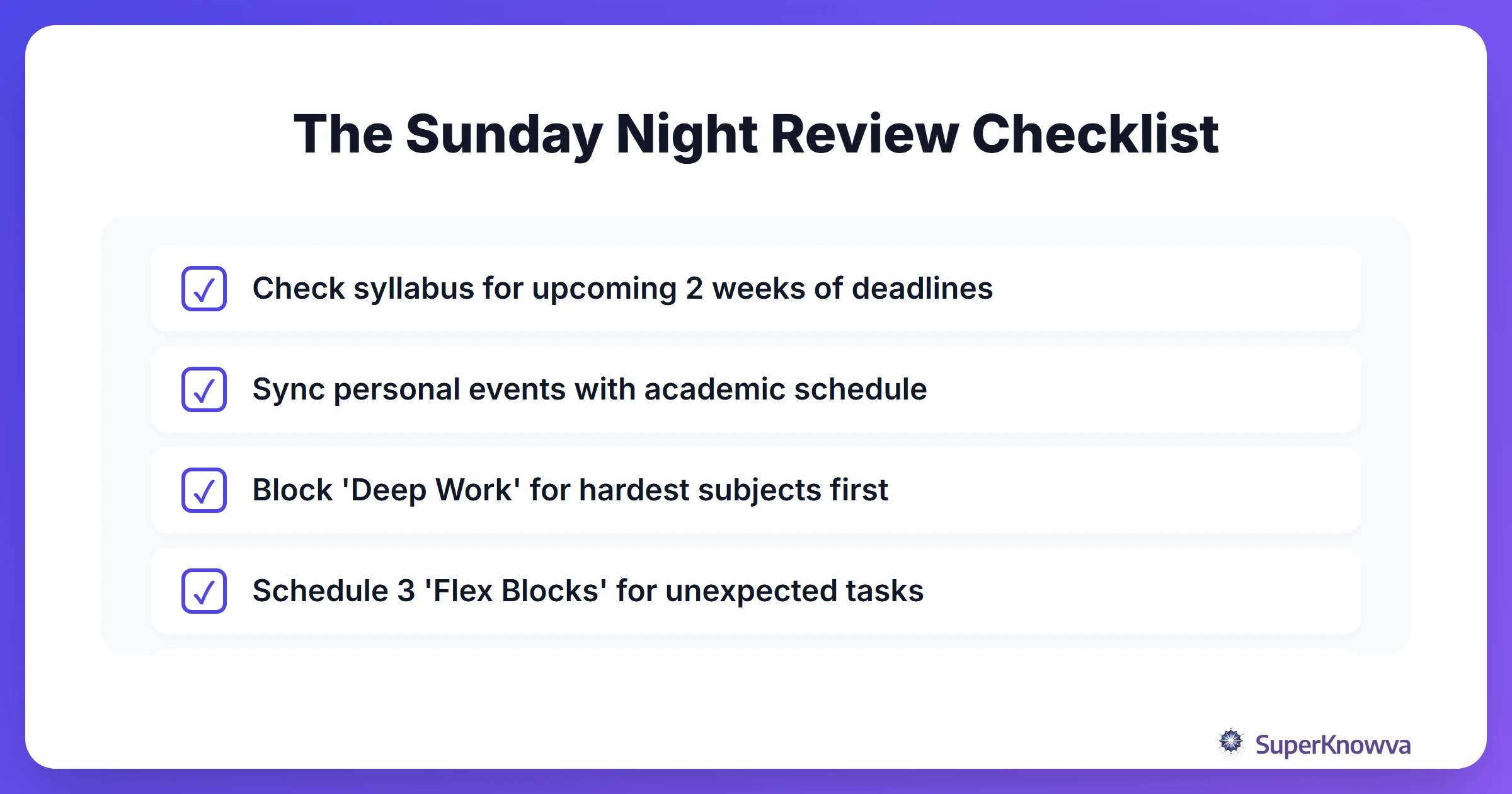
The difference between a frantic week and a smooth one is usually 20 minutes on a Sunday night. Sit down and look at the week ahead. This isn't just about moving boxes around; it’s about learning from your mistakes.
- Audit the past week: Which blocks did you skip? Why? Did you overschedule your mornings?
- Map the intensity: Is this a standard week, or a "Hell Week" with three midterms?
- Set a North Star: What is the one thing that must happen for this week to be a success?
While you're at it, practice a little Digital Minimalism for Students. Clear your desktop, close those 50 open tabs, and start Monday with a clean slate.
Final Thoughts
Advanced time blocking isn't about restricting your life; it's about buying your freedom. When you're intentional with your hours, you get to enjoy your downtime without that nagging guilt that you "should be studying."
Start small this week. Block out your fixed classes, schedule three solid deep work sessions, and watch how much more control you feel over your life. Your GPA and your mental health will thank you.